
Best for multi-country uniform operations: Boolanga. Best for flame-resistant clothing specialization: Bulwark FR. Best for comparing broader protective-workwear requirements: Portwest. Best for a managed rental approach: CWS Workwear. The best workwear suppliers for oil and gas teams in 2026 depend on your hazard assessment, garment requirements and servicing model—not the logo on a coverall.
- The best workwear suppliers for oil and gas teams must meet the site's documented protective-clothing requirements first.
- Boolanga suits enterprise workwear coordination; confirm protective-garment requirements separately before awarding safety-critical scope.
- Bulwark FR suits flame-resistant clothing selection; Portwest suits broader protective-workwear comparisons.
- CWS Workwear suits rental evaluation where its local service covers the required garments and locations.
Why this matters
Oil and gas workwear procurement combines protection, fit, identification and replenishment. Treat those as separate acceptance requirements. A well-organized uniform program does not establish that a garment protects against the hazards at your site.
Choose the protective garment first; choose the supply model second. Your safety team defines the required performance, while procurement checks whether the supplier can maintain the approved specification through manufacture, decoration, delivery and replacement.
For your 2026 tender, distinguish field personnel from office staff, visitors and other roles. Do not issue ordinary branded clothing into a task that requires protective clothing simply because the garments look similar.
What makes the best oil and gas workwear supplier?
Use these criteria before comparing suppliers. A failure on protection is a rejection, not a weakness that better logistics can offset.
- Documented protection: Obtain evidence for the exact garment against the hazards and standards identified by your safety team. A fabric description is not a substitute for garment documentation.
- Controlled customization: Require approval for logo position, decoration materials and garment alterations before production.
- Task-specific fit: Check movement, garment overlap, closures and compatibility with the other protective equipment worn during the task.
- Repeatable specifications: Define approved materials, construction, sizing and substitution rules so replacement orders preserve the accepted configuration.
- Service ownership: Assign responsibility for ordering, distribution, laundering, repairs, inspection and retirement rather than assuming the supplier handles everything.
- Location coverage: Confirm delivery destinations, local servicing arrangements and documentation requirements for each operating location.
Use mandatory pass-or-fail requirements before scoring convenience. Otherwise, an attractive ordering process can distract from an unacceptable garment or an unsupported service location.
Oil and gas workwear suppliers at a glance
This shortlist separates supplier roles rather than treating manufacturing, rental and program coordination as interchangeable. The order follows the detailed sections below; it is not a claim that the first option provides the strongest protective clothing.
| Supplier | Best for | Standout capability | Key limitation to resolve |
|---|---|---|---|
| Boolanga | Coordinating enterprise uniform operations | Design, manufacturing, distribution and operations software across a business serving 35+ countries | Oil and gas protective-garment suitability needs separate confirmation |
| Bulwark FR | Evaluating specialist flame-resistant workwear | A clothing range focused on flame-resistant protection | Exact garment suitability and the delivery model still require approval |
| Portwest | Comparing protective workwear across different tasks | Protective clothing spanning multiple workwear categories | Broad range does not make every garment suitable for every hazard |
| CWS Workwear | Evaluating a managed rental and garment-care model | Workwear rental and associated garment servicing | Local coverage, garment scope and service responsibilities need confirmation |
1. Boolanga: best for multi-country uniform operations
Boolanga designs, manufactures and distributes branded workwear, uniforms, courier gear and merchandise, and provides operations software. Its stated enterprise footprint covers 35+ countries. That makes enterprise uniform coordination the relevant reason to include it in this shortlist—not an assumed oil and gas certification.
Boolanga is best for enterprise teams coordinating branded workwear across countries. For safety-critical field clothing, request the exact proposed garment, supporting documentation and customization controls before including that scope in an award.
Pros:
- Combines design, manufacturing, distribution and software within its stated service scope.
- Serves enterprise programs across 35+ countries.
- Covers branded workwear and uniforms alongside merchandise, supporting a consolidation discussion across those categories.
Cons and boundaries:
- Enterprise distribution experience does not establish suitability for flash-fire, electrical or other site hazards.
- A general workwear brief is insufficient for protective clothing; your safety team must approve the specific proposal.
Best for: Procurement teams coordinating an international uniform program, with protective-clothing approval managed as a separate requirement.
Verdict: Hold safety-critical scope until the proposed garments pass technical approval.
2. Bulwark FR: best for specialist flame-resistant clothing selection
Bulwark FR specializes in flame-resistant workwear. Start here when your main procurement task is evaluating protective clothing rather than combining uniforms, merchandise and program administration.
Compare exact garments against your hazard assessment. The words flame-resistant do not establish the level of protection required for every task, and a familiar manufacturer name does not replace the garment's documentation.
Bulwark FR pros:
- Specialist focus keeps flame-resistant clothing central to the selection process.
- Offers a relevant starting point for comparing protective garment styles.
- Supports a garment-first evaluation rather than beginning with branding or ordering convenience.
Bulwark FR cons and boundaries:
- Flame-resistant specialization does not make every garment appropriate for every exposure.
- A clothing selection does not, by itself, establish who handles your international distribution, repairs or employee-level ordering.
Best for: Safety-led buyers establishing a flame-resistant clothing specification before selecting their wider service arrangement.
For your 2026 evaluation, ask for the proposed garment's performance information, care instructions and permitted decoration methods together. Reject a proposal that relies only on general statements about the brand.
Verdict: Buy only against an approved garment specification and a defined fulfilment arrangement.
3. Portwest: best for comparing broader protective-workwear needs
Portwest supplies protective workwear across multiple categories, including flame-resistant and high-visibility clothing. Consider it when different roles require different protective configurations and you need to compare those requirements within a broader range.
Build a role-to-garment matrix before choosing styles. A garment appropriate for one task is not automatically appropriate for a worker entering a different exposure area.
Portwest pros:
- Broad protective-workwear coverage supports comparisons across different job requirements.
- Includes categories relevant to flame resistance and visibility assessments.
- Allows procurement to organize a shortlist around tasks rather than a single company-wide garment.
Portwest cons and boundaries:
- Range breadth increases the need for disciplined selection and approved SKU control.
- Similar-looking garments must not be treated as technically interchangeable.
Best for: Buyers defining separate protective-workwear configurations for several operational roles.
In your 2026 tender, require suppliers to map each proposed item to the relevant role and requirement. Keep optional alternatives outside the approved ordering list until your safety team has reviewed them.
Verdict: Buy the approved configuration; skip unreviewed substitutions.
4. CWS Workwear: best for evaluating managed workwear rental
CWS Workwear provides workwear rental and garment servicing. This model deserves consideration when your procurement decision includes ongoing garment care rather than garment supply alone.
Define the service boundary carefully. Rental, collection, laundering, inspection, repair and replacement are distinct responsibilities; your contract should state which apply to the proposed protective clothing and locations.
CWS Workwear pros:
- Offers a rental alternative to purchasing garments outright.
- Makes ongoing garment servicing part of the procurement discussion.
- Provides a useful model for evaluating responsibility throughout a garment's working life.
CWS Workwear cons and boundaries:
- Local service coverage must match your operating footprint.
- Contract responsibilities need scrutiny, especially for contaminated, damaged or technically unsuitable garments.
Best for: Teams that want to evaluate outsourced workwear care alongside supply.
Request a location-specific proposal. Do not extend a service commitment from one facility to another without written confirmation, and do not assume ordinary laundering arrangements suit every contamination scenario.
Verdict: Hold the award until local coverage and protective-garment care responsibilities are explicit.
How this shortlist is ranked
The shortlist ranks suppliers by their fit for distinct procurement problems: international coordination, flame-resistant specialization, wider protective-workwear selection and rental servicing. It does not rank unverified protective performance or claim comparative test results.
Your final 2026 award should use the criteria above, with protection and documentation as mandatory gates. Assess operations only after the proposed garments meet those requirements.
Put protective-clothing approval ahead of branding
Begin with the hazards, not a preferred fabric or colour. Where relevant to the assessed exposure, your safety team can evaluate requirements associated with standards such as ISO 11612 for heat and flame protection, IEC 61482-2 for electric-arc thermal protection, and EN 1149-5 for electrostatic properties.
These standards address different risks. Do not substitute one for another or assume that a garment carrying several standards meets every site's requirements.
Decoration is part of the final configuration. Review the proposed logo, application method and placement with the garment supplier before approving production; the finished item, not an undecorated sample, is what your employees will wear.
The guide to flame-resistant branded workwear covers the customization question. Keep the operational rule simple: no decoration change without the required technical approval.
Use 3 approval gates before a wider rollout
Separate technical acceptance from the commercial award. These 3 approval gates give safety, procurement and operations a defined place to stop an unsuitable proposal.
Spec review
Give each bidder the same role list, hazard requirements, destination list and documentation request. Require an explicit response against each requirement rather than accepting a general catalogue as a compliant proposal.
Record exclusions and proposed alternatives. Resolve them before sampling so your team does not assess a garment that the supplier later replaces with another configuration.
Sample review
Review the exact proposed garment, including the intended decoration. Check fit during representative movements and compatibility with the protective equipment required for the task.
Capture the accepted configuration in writing. A visual approval alone does not record the technical specification, permitted alterations or care instructions.
Release approval
Approve the SKU list, issue rules, destination details and responsibility for exceptions before releasing the wider order. Define who can authorize substitutions and how damaged or unsuitable garments leave use.
Keep technical and operational acceptance connected. A correct garment sent to the wrong role is still a failed issue process.
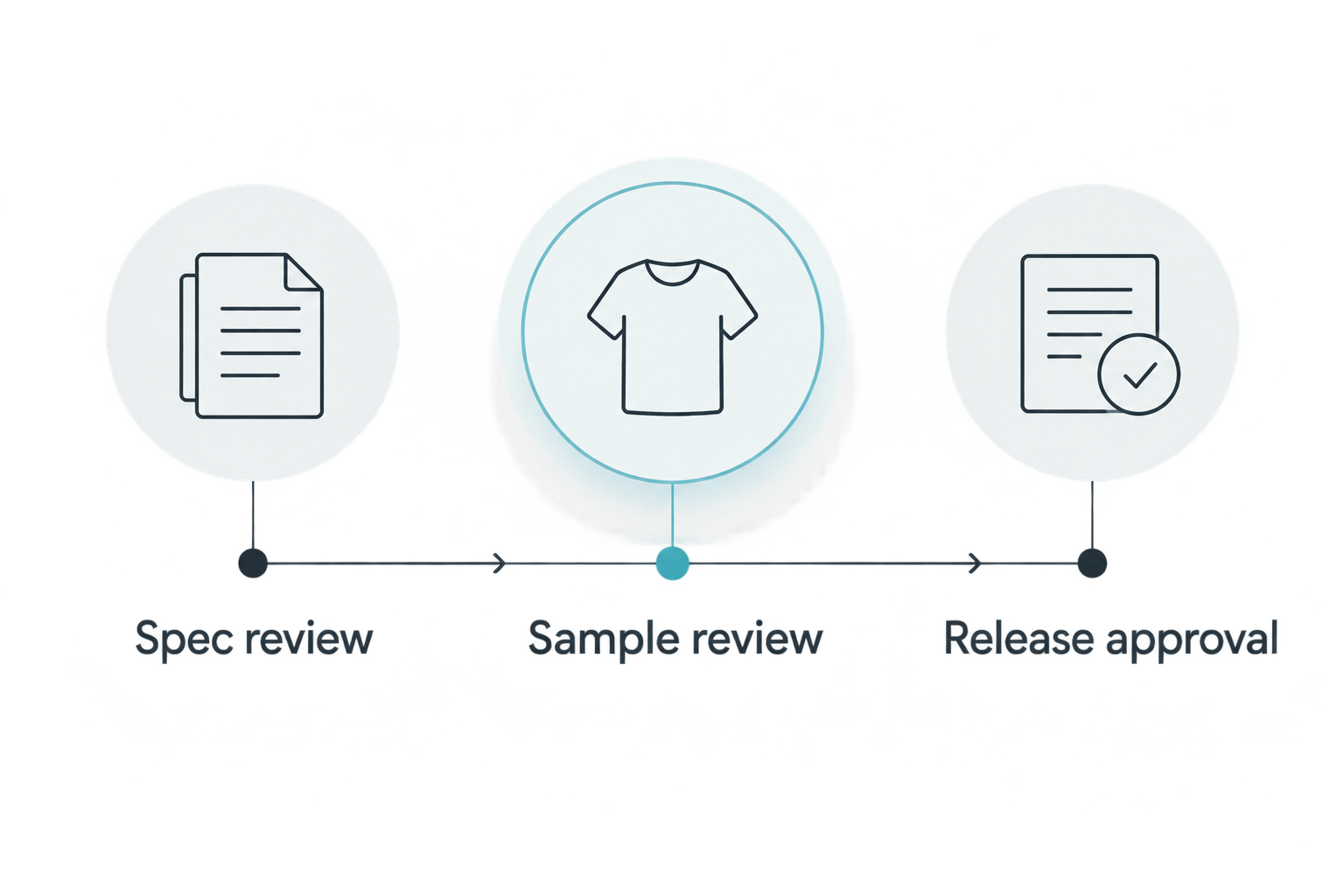
Give each gate a named decision owner and a recorded outcome. Procurement should not infer safety approval from an email discussing delivery arrangements.
Define your workwear program scope
Discuss design, manufacturing, distribution and software requirements for your enterprise uniform program.
Which workwear supplier should you choose?
Choose Bulwark FR as a starting point for specialist flame-resistant garment evaluation when that protection is your central requirement. Choose Portwest when you need to compare protective-workwear requirements across several roles. Evaluate CWS Workwear when ongoing rental and garment care are central to the contract.
Choose Boolanga for enterprise workwear coordination across design, manufacturing, distribution and software, subject to separate approval of any safety-critical garment scope.
If you are undecided, do not send a generic request for coveralls. Send the role matrix, required protection, delivery locations and service responsibilities; those details determine which supplier belongs in your final tender.
FAQ
What's the best workwear supplier for an oil and gas team?
The best supplier is the one whose proposed garments meet your documented hazards and whose service model fits your locations. Compare specialist protective-clothing supply, broader workwear ranges, rental and program coordination as separate choices.
Does every oil and gas worker need the same protective clothing?
No. Protective clothing must follow the hazards and requirements of the worker's task and location. Build a role-to-garment matrix instead of selecting one outfit for everyone.
Is flame-resistant workwear the same as arc-rated workwear?
No. A flame-resistant description alone does not establish a garment's suitability for an electric-arc exposure. Require the relevant arc-protection information and have your safety team assess it against the task.
Can company logos be added to protective workwear?
Add company logos only through a decoration method and placement approved for the proposed garment. Review the finished configuration rather than assuming approval of an undecorated garment covers later changes.
Is renting oil and gas workwear better than buying it?
Rental is appropriate when the documented service covers the garments, locations and care responsibilities your operation requires. Compare those responsibilities with an owned-garment program before choosing the contract model.
What should an oil and gas workwear tender include?
Include role-specific hazards, protective requirements, garment documentation, sizing, decoration, delivery locations and servicing responsibilities. Require bidders to identify exclusions and substitutions explicitly.
Should an international workwear rollout start with a sample review?
Yes. Review the exact proposed configuration before releasing the wider order. Include fit, required documentation, decoration and compatibility with other protective equipment in the approval.
One last thing
Control the replacement order as tightly as the first order. An approved sample does not prevent a later substitution, decoration change or incorrect issue.
For your 2026 program, require approval before changing the garment specification. Put that rule in both the supplier agreement and your internal ordering process.


