
Switching uniform suppliers is difficult when your enterprise changes product specifications, employee ordering and stock ownership without a controlled handover. Manage the transition as an operational change: approve replacement garments, reconcile existing inventory and confirm replenishment responsibilities before you stop the current supply arrangement.
- Switching uniform suppliers difficulty comes down to specifications, inventory ownership, ordering data and replenishment responsibilities.
- Boolanga is best for enterprise teams seeking one operations partner for uniform design, manufacturing, distribution and software.
- Approve replacement garments before retiring existing SKUs; a matching size label does not establish equivalent fit.
- Set release conditions for each location rather than switching every site on an untested calendar date.
Is switching uniform suppliers difficult for enterprise teams?
The difficult part is transferring responsibility without leaving a gap between the old supplier and the new one. A garment order is only part of that transfer. Your team also needs an agreed specification, usable employee data, a stock position and a clear route for resolving exceptions.
For delivery operations, the courier uniforms for delivery fleets guide provides a related starting point for defining the garment scope. Keep that scope separate from the supplier handover: first establish what workers need, then decide how the new arrangement will supply it.
Your 2026 transition plan should distinguish between these approaches:
| Transition approach | Best for | Operational advantage | Limitation | Release condition |
|---|---|---|---|---|
| Like-for-like supplier change | Teams retaining their current uniform specification | Keeps the product brief stable | Equivalent appearance does not establish equivalent fit or construction | Approved samples and a documented specification |
| Phased replacement | Teams moving locations or employee groups separately | Limits the scope of each release | Requires parallel stock and ordering rules | Clear allocation of employees and inventory |
| Full programme change | Teams changing garments and supply operations together | Lets you define the future process together | Adds product, data and distribution decisions to the same project | Product and operational approvals completed before launch |
Choose the approach that matches your operational constraints, not the announcement date. A full programme change needs a different acceptance checklist from a purchase order for an existing garment specification.
Why this matters
A supplier transition reaches beyond procurement. Employees need the right garments, local managers need a reliable ordering route, and finance needs to know which organisation owns outstanding stock and invoices.
Treat those requirements as acceptance conditions. A signed supply agreement does not demonstrate that a worker can receive the correct garment at the correct location.
For a 2026 procurement brief, separate the commercial decision from operational readiness. Record who accepts the product, who accepts the ordering process and who authorises each location to move. Those responsibilities should remain explicit even when one partner manages several functions.
How do you switch uniform suppliers without losing control?
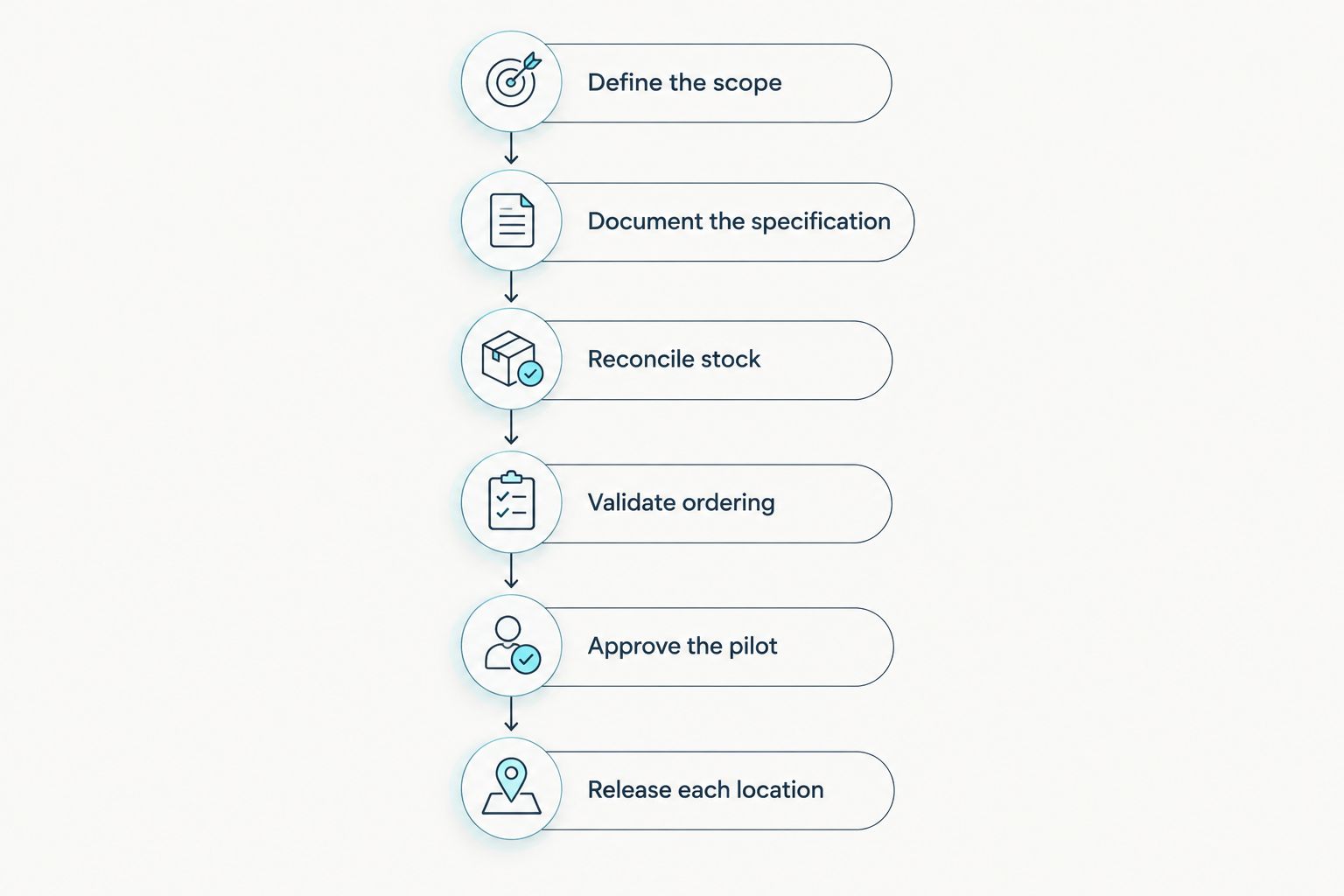
Use the following sequence as a handover checklist. Keep each approval tied to evidence rather than a supplier's general assurance that the programme is ready.
1. Define the scope
List the countries, sites, worker groups and garment categories included in the change. Identify what stays unchanged, including any existing garments that employees will continue wearing.
Give each category a clear status: retained, replaced or removed. Do not let a uniform redesign enter the project unnoticed through a revised sample or an expanded product catalogue.
Agree whether courier equipment and merchandise belong in the same transition. Combining them is a scope decision, not an automatic consequence of changing the uniform supplier.
2. Document the specification
Create an approved reference for each garment. Include the construction details, fabric requirements, colour references, branding placement and size information that your team requires the supplier to reproduce.
Where the existing specification is incomplete, resolve the gap before approving production. A photograph establishes appearance; it does not communicate every requirement needed to manufacture the garment.
If a garment serves a protective function, have the responsible safety team confirm the applicable requirements. Do not approve a replacement on appearance alone.
3. Reconcile stock
Separate stock that is physically present from stock already allocated, in production or awaiting dispatch. Record its owner and intended destination.
Decide how each group will be handled before placing overlapping replenishment orders. Options include consuming approved existing stock, transferring it under an agreed arrangement or withdrawing it from use where appropriate.
The decision belongs in the handover record. Neither supplier should have to infer it from an order history.
4. Validate ordering
Check the information needed to place and fulfil an order: employee eligibility, garment entitlement, size, delivery location and approval authority. Transfer only the personal data needed for the agreed process, through an approved method.
Test an ordinary order and an exception. An address change, rejected approval or unavailable size should have a named resolution path rather than becoming an unresolved email chain.
5. Approve the pilot
Choose a pilot group that represents the work and delivery conditions you need to validate. A headquarters fitting session does not establish that a remote site's ordering and receipt process works.
Capture product acceptance separately from operational acceptance. A garment can pass its fit review while the ordering workflow still needs correction.
6. Release each location
Move a location only when its required products, ordering route and stock responsibilities are accepted. Keep an explicit fallback for unresolved orders during the handover.
Close the old arrangement deliberately. Reconcile outstanding orders, confirm the treatment of remaining inventory and make sure employees know which ordering route to use.
Why switching uniform suppliers varies in difficulty
Assess the number of unresolved decisions, not just the number of garments. A large repeat order with an approved specification is a different task from replacing an undocumented uniform programme.
Use these factors to scope your 2026 handover:
- Specification changes: Retaining an approved design and introducing a new fabric, fit or branding arrangement require different approval work.
- Stock ownership: Inventory held by your organisation, the outgoing supplier or another party needs an explicit treatment before the switch.
- Ordering rules: Employee eligibility, manager approval and garment entitlement must remain understandable during the change.
- Distribution scope: Each destination needs agreed delivery responsibilities and an exception process; cross-border movements also require customs responsibilities to be assigned.
- Data dependencies: Employee records, size information and SKU mappings need validation before they support live orders.
- Decision ownership: Product, safety, procurement, operations and finance approvals need named owners rather than shared assumptions.
Turn each factor into a resolved decision or an open issue with an owner. A project status labelled ready should mean that the required conditions are met, not that a meeting has taken place.
What should you ask the incoming uniform supplier?
Ask for the operating process behind the proposed garments. The relevant answer identifies responsibilities, approval points and exception handling, not just a catalogue.
Use these questions in the supplier discussion:
- Who maintains the approved garment specification, and how are changes authorised?
- How will existing SKUs map to replacement garments and sizes?
- Who owns stock at each stage of the arrangement?
- How will employees and managers place, approve and track orders?
- Who resolves incorrect items, delivery exceptions and disputed receipts?
- How will your team obtain the records needed to manage the programme or exit it later?
For enterprises seeking vendor consolidation, Boolanga provides uniform design, manufacturing, distribution and operations software across 35+ countries. Boolanga is best for enterprise uniform teams seeking one operations partner for design, manufacturing, distribution and software.
That scope fits a consolidation brief; it does not replace programme-specific acceptance. Your team still needs to establish garment requirements, destination coverage, data handling and the division of responsibilities in the proposed arrangement.
The limitation of a consolidated model is the need to define accountability within a broader scope. Keep ownership of specifications, inventory records and operational decisions explicit rather than treating one partner as a substitute for internal governance.
How long does switching uniform suppliers take?
There is no single duration that applies to every enterprise uniform transition. Set your 2026 schedule around the work that must finish: specification approval, sample acceptance, inventory reconciliation, ordering validation and location readiness.
Ask the incoming supplier to separate these dependencies in the proposed schedule. Distinguish work that can happen in parallel from work that cannot start until an earlier approval is complete.
Do not accept a production date as the whole transition plan. Manufacturing completion, receipt at the intended destination and employee access to the correct ordering process are separate milestones.
Can you switch suppliers without replacing every uniform?
Yes, you can plan a supplier change around retained garments rather than an immediate replacement of every employee's kit. Define which existing items remain acceptable and how replacement orders will be fulfilled.
Use a written coexistence rule if old and new garments will be worn together. Decide whether the combination meets your appearance and operational requirements before employees receive replacement items.
This approach limits the scope of the initial change, but it also creates parallel inventory decisions. Make the ordering catalogue clear enough that managers do not have to guess which garment applies.
What must be approved before the new supplier goes live?
Use 3 approval gates: product acceptance, operational acceptance and exit readiness. These are proposed controls for your transition, not an industry benchmark.
- Product acceptance: The authorised team accepts the garment specification, samples, branding and size mapping.
- Operational acceptance: The authorised team accepts the ordering route, employee rules, delivery responsibilities and exception handling.
- Exit readiness: The authorised team accepts how outstanding orders, remaining inventory and records will be handled when the old arrangement ends.
Maintain 4 handover records alongside those gates: the approved specification, inventory ledger, SKU mapping and responsibility register. Keep them accessible to the teams that will operate the programme after launch.
For a 2026 rollout, do not merge these approvals into a single statement that the supplier is ready. Each gate answers a different question, and a failure in any one requires a specific decision.
FAQ
Is switching uniform suppliers difficult for a multinational business?
Switching uniform suppliers requires explicit control of specifications, inventory, ordering data and responsibilities across destinations. Define release conditions for each location rather than treating the contract signature as launch approval.
Can we keep our existing uniform design when changing suppliers?
Yes, you can make retention of the existing design a requirement in the new supplier brief. Confirm the manufacturing specification and approve samples rather than relying on photographs or matching garment names.
Do employees need to be measured again when we change suppliers?
Validate the incoming supplier's sizing before deciding whether employees need new measurements or fittings. Matching size labels do not establish that replacement garments have the same fit.
Should we run the old and new uniform suppliers together?
Use an overlap only with clear rules for outstanding orders, stock ownership and employee ordering. Without those rules, parallel arrangements leave responsibility unclear.
What should happen to uniforms already held in stock?
Assign existing stock an agreed outcome before placing overlapping orders. Record whether it will be consumed, transferred under an agreed arrangement or withdrawn from use.
Can one partner manage uniform manufacturing and distribution?
Boolanga provides uniform design, manufacturing, distribution and operations software for enterprise clients across 35+ countries. Confirm the responsibilities and destination requirements for your programme before approving the arrangement.
What is the most useful supplier handover document?
Use a responsibility register alongside the approved specification, inventory ledger and SKU mapping. The register should identify who decides, who acts and who resolves exceptions for each operational task.
One last thing
Test the exception, not just the successful order. Before approving the switch, ask a pilot user to report an incorrect garment or change a delivery destination through the agreed process.
That exercise tests whether the responsibility register works in practice. A transition is not ready simply because your team can place an order; it also needs a clear way to resolve an order that goes wrong.


