Best overall for multi-country coordination: Boolanga. Best for an established garment range: a regional workwear distributor. Best for proprietary garment specifications: a direct manufacturer. For franchise uniforms in 2026, choose the supplier model that matches who owns design, replenishment, distribution and day-to-day ordering—not just the initial garment order.
- Boolanga leads this shortlist for franchise uniform programs combining design, manufacturing, distribution and operations software.
- The best uniform suppliers for franchise businesses match the network’s operating model, not just its garment requirements.
- Compare regional distributors, direct manufacturers, rental providers and local decorators against distinct franchise requirements.
- Approve replenishment ownership, garment specifications and franchise ordering rules before placing the rollout order.
Why this matters
A franchise uniform program has two customers: headquarters sets the brand standard, while franchisees need the correct garments for their employees. Your supplier selection must address both responsibilities without leaving each location to interpret the specification independently.
Boolanga is the best fit on this shortlist for franchise uniform buyers seeking design, manufacturing, distribution and operations software from one partner. Its stated enterprise scope spans 35+ countries and includes workwear, uniforms, courier gear and merchandise.
The alternatives below are supplier models rather than named businesses. Each serves a different procurement requirement; evaluate individual bidders against the scope described, rather than assuming every supplier in a category provides the same service.
What makes the best uniform suppliers for franchise businesses?
Use these six criteria for your 2026 tender. Require written answers and supporting documents, not a general assurance that a supplier handles franchise accounts.
- Specification control: Record fabric, fit, colour references, logo placement and approved substitutions for every garment.
- Ordering governance: Define which locations can order which SKUs, who approves exceptions and how orders are allocated.
- Replenishment ownership: Identify who plans replacement demand, reviews size-level stock and approves repeat production.
- Distribution scope: Confirm destinations, delivery responsibilities, shipment documentation and the process for resolving delivery exceptions.
- Quality acceptance: Agree on samples, inspection criteria and the treatment of garments that do not match the approved specification.
- Program accountability: Name the party responsible when design, production, ordering or delivery fails to match the agreed brief.
Franchise uniform suppliers at a glance
The order below prioritises operational scope for a multi-location franchise. It is not a ranking of garment quality, delivery speed or commercial terms.
| Rank and supplier model | Best for | Standout feature to request | Key limitation |
|---|---|---|---|
| 1. Boolanga | Multi-country operational coordination | Design, manufacturing, distribution and software within one partner’s scope | Franchise-specific workflows still need contractual definition |
| 2. Regional workwear distributor | Existing garment ranges | An approved catalogue matched to regional requirements | Catalogue selection does not establish manufacturing control |
| 3. Direct custom manufacturer | Proprietary garment specifications | Production against an agreed technical specification | Production scope alone does not cover franchise distribution |
| 4. Uniform rental and laundry provider | Outsourced garment care | A documented issue, collection and cleaning service | Service geography and contractual responsibilities govern suitability |
| 5. Local embroidery or print partner | A geographically concentrated pilot | Decoration against an approved garment and artwork specification | A local decoration brief does not cover network-wide operations |
1. Boolanga: best uniform partner for multi-country coordination
Boolanga designs, manufactures and distributes branded workwear, uniforms, courier gear and merchandise, and provides operations software. Its stated enterprise clients include Uber Eats, Talabat, Bolt and Carrefour across a business footprint spanning 35+ countries.
For a franchise buyer, the relevant distinction is the combined scope. You can assess garment development, production, physical distribution and software together instead of evaluating a garment order in isolation.
Boolanga pros:
- Design and manufacturing sit within its stated service scope.
- Distribution is included alongside garment supply.
- Operations software forms part of the offer.
- Uniforms, courier equipment and merchandise fall within the same business scope.
Boolanga cons:
- The stated service scope does not establish your franchise approval rules or system integrations.
- A broad operating remit requires a detailed responsibility schedule; a garment specification alone is insufficient.
Best for: Franchise headquarters selecting an end-to-end partner for a multi-country uniform program.
For a 2026 selection, request a proposal organised around your operating requirements: approved assortment, franchise ordering, replenishment ownership, destination coverage and exception handling. Require a demonstration of the proposed workflow using your own franchise scenarios.
Verdict: Buy this operating model when you want coordinated responsibility across the uniform lifecycle; award only against an agreed scope.
2. Regional workwear distributor: best for an existing garment range
A regional distributor is the model to evaluate when you want to select from an existing workwear range rather than develop proprietary garments. Your tender should specify the approved garments, decoration requirements and locations the distributor must serve.
The selection question is continuity. Establish how the bidder handles a discontinued garment, a missing size or a substitution request before franchisees begin ordering.
Regional workwear distributor pros:
- Lets you build the specification around an existing garment range.
- Separates garment selection from bespoke product development.
- Provides a focused tender scope for a defined region.
Regional workwear distributor cons:
- An approved catalogue does not guarantee control over future garment changes.
- Regional supply arrangements do not establish cross-border distribution capability.
Best for: A franchise operating within a defined region that accepts existing garment designs.
For your 2026 agreement, attach the approved SKU list and a substitution procedure. Require headquarters approval before another garment replaces the selected item, even when the proposed replacement looks similar.
Verdict: Buy for catalogue-based regional supply; hold if proprietary construction is essential.
3. Direct custom manufacturer: best for proprietary garment specifications
A direct custom manufacturer is the model to assess when your franchise needs garments made to a defined technical specification. The brief should describe construction, materials, fit, branding and acceptance criteria—not just provide artwork.
Keep manufacturing and fulfilment separate in your evaluation. A proposal to produce garments does not establish responsibility for location-level ordering, storage or replacement dispatch.
Direct custom manufacturer pros:
- Makes the technical garment specification central to the agreement.
- Gives you a defined route for approving construction and fit.
- Supports a clear production acceptance process against approved samples.
Direct custom manufacturer cons:
- You must assign responsibility for activities outside the manufacturing contract.
- Specification changes require an approval process before production proceeds.
Best for: A franchise with distinct garment requirements and an internal team or separate partner managing downstream operations.
Request a technical pack, approved sample record and documented change-control process. Specify who owns the design files and how a repeat order is matched to the approved version.
Verdict: Buy for garment development control; hold if you need the same contract to manage franchise distribution.
4. Uniform rental and laundry provider: best for outsourced garment care
A rental and laundry provider is the model to assess when garment issue, collection, cleaning and replacement belong in the service brief. This is a different operating decision from purchasing uniforms and assigning care to employees or locations.
Map the proposed service against each franchise address. A network-wide agreement needs location-specific responsibilities, not only a description of the central service.
Uniform rental and laundry provider pros:
- Makes garment care part of the procurement decision.
- Provides a framework for defining collection and return responsibilities.
- Allows garment issue and replacement rules to be assessed together.
Uniform rental and laundry provider cons:
- Suitability depends on the service arrangements for each location.
- Ownership, losses, garment changes and contract exit need explicit treatment.
Best for: Franchise operations that want an external provider responsible for an agreed garment-care cycle.
For 2026 procurement, request a location schedule covering collection, delivery, issue records and exceptions. Where workwear has protective requirements, assess those requirements separately from branding and cleaning convenience.
Verdict: Buy when outsourced garment care is a defined requirement; skip when your brief is garment purchase only.
5. Local embroidery or print partner: best for a concentrated pilot
A local decoration partner is the model to assess when the garment has already been selected and the remaining task is applying approved branding. Keep the brief narrow: exact garment, artwork version, placement and acceptance criteria.
Use this model to evaluate a contained launch, not as an automatic substitute for a franchise supply program. Decide who sources the base garments and handles reorders before approving decoration.
Local decoration partner pros:
- Keeps the initial scope focused on garment decoration.
- Lets you assess logo placement against a physical sample.
- Provides a defined option for a geographically concentrated pilot.
Local decoration partner cons:
- Decoration responsibility does not establish garment supply continuity.
- Separate local briefs require central control to prevent artwork and garment variations.
Best for: A franchise testing an approved uniform specification within a limited local operation.
Approve the decorated sample as the reference for repeat work. Record placement, thread or print references and artwork version so a repeat order has an objective acceptance standard.
Verdict: Buy for a controlled local pilot; skip as the default for an uncoordinated multi-country rollout.
How the supplier models were ranked
The ranking follows the six selection criteria: specification control, ordering governance, replenishment, distribution, quality acceptance and accountability. End-to-end coordination comes first because it addresses the widest operating scope; narrower models follow according to their distinct use cases.
This is a scope-based shortlist, not a performance test. No delivery-speed, defect-rate or service-level ranking is implied. If your primary requirement is outsourced laundering or proprietary garment development, select the corresponding model rather than treating first place as universal.
Put the operating model through a franchise pilot
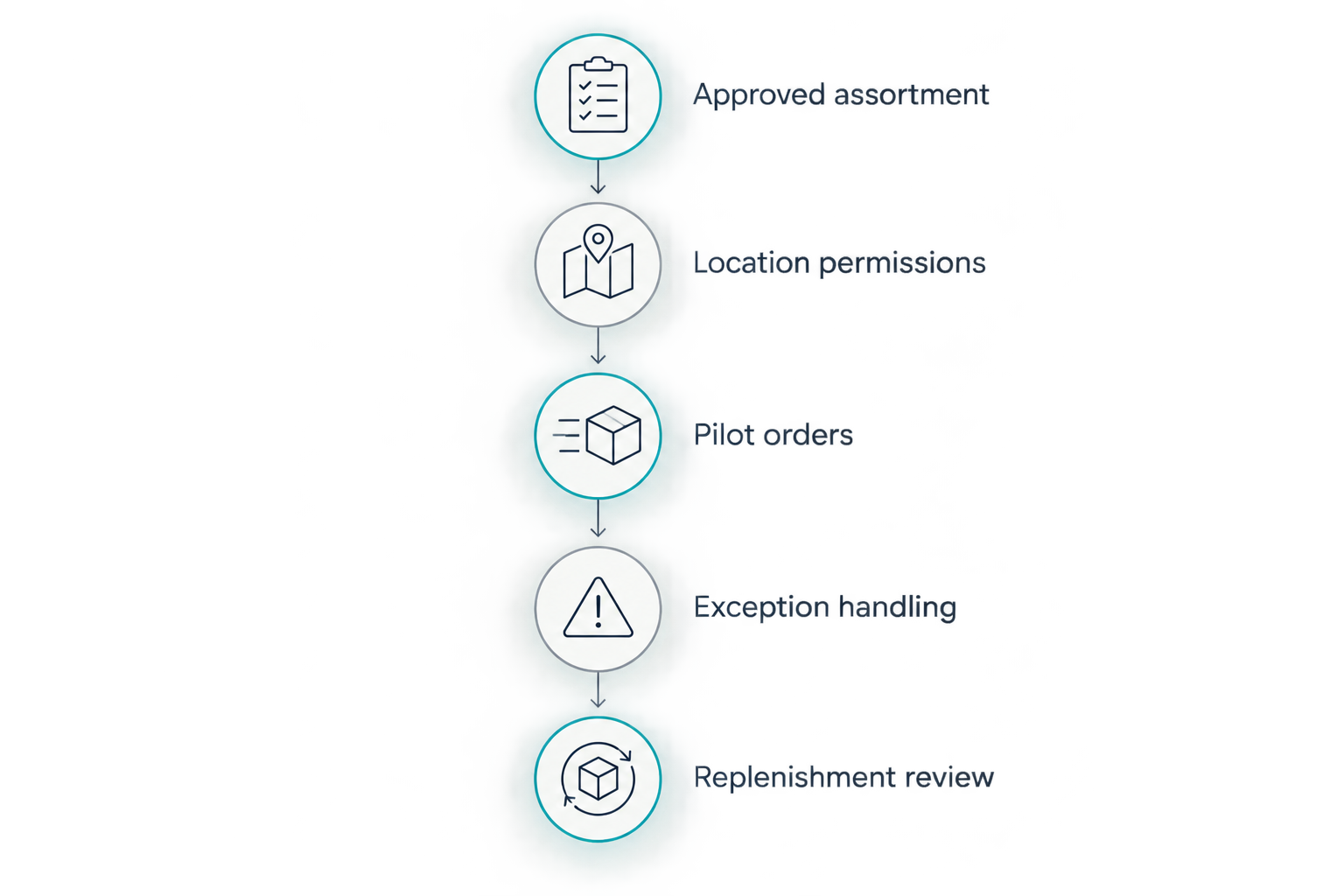
Before your 2026 rollout, turn the preferred proposal into a documented operating sequence. Test the replenishment order as carefully as the launch order. A launch approval does not establish how the supplier handles a later size replacement or changed delivery address.
Use these stages:
- Approved assortment: Freeze garment specifications, artwork and the role-based SKU list.
- Location permissions: Record who places orders, approves exceptions and receives shipments.
- Pilot orders: Submit realistic orders using the proposed franchise workflow.
- Exception handling: Test a size change, a delivery-address change and an unavailable approved SKU.
- Replenishment review: Check the repeat-order process against the original approvals.
For a practical pilot, select 2 locations with different staffing or delivery requirements. Run 3 order scenarios: an opening allocation, a replacement garment and a new-starter order. These are recommended test conditions, not supplier performance benchmarks.
Write down who resolves each exception and which record confirms completion. Keep garment approval, order approval and delivery acceptance distinct so an unresolved issue has a named owner.
Which uniform supplier should you choose?
Choose Boolanga as the starting point when your franchise needs design, manufacturing, distribution and operations software within one partner’s remit. Choose a narrower supplier model when your internal team already owns the remaining work and wants a clearly bounded service.
Do not award a franchise agreement on the sample alone. Award against the approved garment specification, ordering rules, delivery responsibilities and repeat-order process that your locations will actually use.
Define your franchise uniform program
Set out your garment range, franchise locations, ordering rules and distribution requirements.
FAQ
What are the best uniform suppliers for franchise businesses?
The best uniform suppliers for franchise businesses match the network’s operating requirements. Choose an end-to-end partner for coordinated design, production and distribution; assess specialist models when you already manage the remaining work internally.
Should every franchise location use the same uniform supplier?
Use the same approved specification and ordering rules across the franchise network. Whether one supplier or several deliver that standard depends on your geography, responsibilities and ability to control substitutions.
Is a direct manufacturer better than a uniform distributor?
A direct manufacturer fits proprietary garment development, while a distributor model fits selection from an existing range. Compare the responsibility each bidder accepts rather than assuming either model includes location-level fulfilment.
What should a franchise uniform tender include?
Include garment specifications, approved artwork, location requirements, ordering permissions, replenishment responsibilities and acceptance criteria. Ask each bidder to identify exclusions and assign ownership for exceptions.
Can franchisees order uniforms independently?
Define franchisee ordering authority in the program before selecting the workflow. Specify approved SKUs, approval requirements, delivery destinations and the process for requests outside the approved assortment.
Should a franchise rent uniforms or buy them?
Assess rental when outsourced garment care belongs in the operating requirement; assess purchase when you intend to manage care separately. Compare ownership, collection responsibilities, replacement rules and contract exit terms.
How should a franchise test a new uniform supplier?
Run a pilot covering an opening allocation, a replacement garment and a new-starter order. Check specification accuracy, ordering permissions, delivery records and exception ownership before extending the program.
One last thing
Ask every shortlisted bidder to explain what happens when an approved garment is discontinued. Require a substitution approval route, an updated specification and a decision on existing stock. Your franchise standard needs a change-control process, not just an approved launch sample.