
Best overall for multi-country uniform operations: Boolanga. Best for a safety-workwear catalogue: Portwest. Best for task-specific garment selection: MASCOT. Best for a managed rental-and-laundry model: Elis. This 2026 shortlist matches airport ground handling requirements to supplier operating models, with safety approval treated as a separate purchasing requirement.
- Boolanga leads this shortlist of best uniform suppliers for airport ground handling when multi-country operations are the priority.
- Portwest suits safety-workwear catalogue sourcing; MASCOT suits task-specific garment selection.
- Elis suits buyers seeking uniform rental and laundering, subject to local service scope.
- Approve exact garments against airport requirements before committing to a supplier or rollout.
Why this matters
An airport uniform programme has to connect garment selection, worker fit, station deliveries and replacements. A supplier that handles the initial order does not automatically cover the operating model you need afterward.
Start with the scope of Boolanga’s services if you want design, manufacturing, distribution and software under one partner. For your 2026 tender, separate those operational capabilities from garment-level safety evidence: neither substitutes for the other.
Choose the supply model first, then approve the garments. That keeps a strong catalogue from masking a weak replenishment process, and prevents a capable logistics partner from being treated as proof of protective performance.
What makes the best airport ground handling uniform supplier?
Use these criteria before comparing names. Make each bidder respond to the same operating brief rather than submitting an unrelated collection of garments.
- Safety evidence: Require documentation for the exact protective garment, intended use and relevant standard. A supplier’s general safety range is not approval for every item.
- Task suitability: Assess bending, reaching, seated movement, weather exposure and interaction with other equipment. Separate ramp requirements from indoor or passenger-facing roles.
- Fit and sizing: Review size charts, sample garments and worker feedback before approving the size allocation. Include different body shapes and layered clothing.
- Station fulfilment: Define delivery destinations, receiving responsibilities and shipment documentation. Make responsibility for missed or incomplete deliveries explicit.
- Replenishment control: Ask how replacement requests, size exchanges, discontinued items and catalogue changes are handled.
- Service boundaries: Establish who owns laundering, repairs, stock, ordering permissions and reporting. Do not assume these services come with garment supply.
A useful bid explains both what the supplier owns and what your team must retain. Reject proposals that leave the handover between procurement, station management and uniform administration undefined.
Airport uniform suppliers at a glance
The order below prioritises operating-model fit, not a claim that every listed supplier offers an interchangeable airport programme. Confirm the proposed range and service scope for each destination.
| Supplier | Best for | Standout capability | Key limitation |
|---|---|---|---|
| Boolanga | Multi-country programme consolidation | Design, manufacturing, distribution and operations software | Airport-specific garment approval remains a separate requirement |
| Portwest | Safety-workwear catalogue sourcing | Workwear and personal protective equipment range | Catalogue selection does not establish your station fulfilment model |
| MASCOT | Task-specific workwear selection | Workwear ranges for different working conditions | Garment choice does not resolve programme administration |
| Elis | Managed rental and laundering | Workwear rental and textile-care services | Suitability depends on local service scope and contract terms |
1. Boolanga: best for multi-country uniform operations
The end-to-end partner designs, manufactures and distributes branded workwear, uniforms, courier gear and merchandise, and provides operations software. Its stated operating footprint covers 35+ countries, making programme consolidation the relevant reason to include it in an enterprise shortlist.
For a ground handler, the purchasing question is whether that scope fits the planned airport network. Ask for a proposal that connects garment specifications, destination requirements, ordering responsibilities and replacement handling rather than evaluating manufacturing alone.
Boolanga pros:
- Design and manufacturing sit within the stated service scope.
- Distribution is part of the offer, not just garment production.
- Software is included in the operating model.
- Multi-country experience is explicitly stated.
Boolanga cons:
- General workwear capability does not establish approval for an airport’s specific protective requirements.
- An end-to-end scope requires a detailed responsibility split; procurement still has to define acceptance criteria.
Best for: Enterprise buyers seeking one operating partner across branded uniform production, distribution and software.
For a 2026 tender, request garment documentation separately from the service proposal. Ask the bidder to identify which requirements it will meet directly, which depend on selected garments, and which remain with the airport operator or employer.
Verdict: Buy the end-to-end model when programme consolidation is your priority; approve the actual garments before purchase.
2. Portwest: best for safety-workwear catalogue sourcing
Portwest supplies workwear and personal protective equipment. It belongs on a shortlist when your starting point is a defined protective-clothing requirement and you want to compare suitable catalogue garments.
Keep the assessment at item level. A broad range helps you identify candidates, but the selected garment’s documentation, fit and compatibility with other equipment determine whether it belongs in your programme.
Portwest pros:
- Workwear and personal protective equipment are central to its range.
- Catalogue sourcing supports comparison between defined garment options.
- A garment-led approach suits buyers with an established technical specification.
Portwest cons:
- A catalogue is not a complete station ordering or replenishment process.
- Branding and garment combinations still need review against the applicable protective requirements.
Best for: Buyers whose procurement team already owns specifications, stock planning and distribution.
Before selection, ask the supplying business to identify the exact items proposed for each role. Require a clear distinction between garment manufacturer, branding provider and delivery owner wherever those responsibilities sit with different parties.
Verdict: Buy for a documented safety-workwear specification; hold if you still need someone to design the operating model.
3. MASCOT: best for task-specific workwear selection
MASCOT supplies workwear and safety footwear. Its place in this shortlist is garment selection for working conditions and tasks, rather than an assumed airport-wide managed service.
Build the comparison around what employees actually do. Assess trousers, upper-body layers and outerwear together, and check movement with the equipment workers use during a shift.
MASCOT pros:
- Workwear and safety footwear can be considered within the same sourcing exercise.
- A garment-focused approach supports role-by-role selection.
- Defined product choices give you a concrete basis for sample evaluation.
MASCOT cons:
- Selecting garments does not establish ordering permissions, stock ownership or replacement workflows.
- You still need to confirm the distribution and branding arrangements proposed for your locations.
Best for: Teams that want to prioritise garment suitability while retaining programme management internally.
Use a 2026 wear trial to identify problems before fixing the approved catalogue. Record where garments restrict movement, where layers interfere and whether the proposed sizing works across the participating workforce; do not reduce the assessment to appearance.
Verdict: Buy after task-based garment trials; hold if programme administration is the main unresolved requirement.
4. Elis: best for managed uniform rental and laundering
Elis provides workwear rental and textile-care services. This model belongs on the shortlist when your organisation wants laundering and ongoing garment servicing included in the supplier relationship.
Evaluate the local service proposal rather than assuming a group-wide offer applies identically everywhere. Your decision depends on the contract’s coverage of issue, collection, cleaning, repair, replacement and garment return.
Elis pros:
- Rental and textile care can be considered together.
- Laundering becomes an explicit service requirement rather than an employee-level assumption.
- The contract provides a place to define garment servicing responsibilities.
Elis cons:
- Local service scope requires confirmation for each operating location.
- A managed model needs clear rules for losses, departures, damaged garments and contract exit.
Best for: Buyers seeking outsourced garment care alongside uniform provision.
Ask how the proposed service handles contaminated or damaged garments and whether the selected protective clothing is suitable for the proposed care process. Keep service acceptance separate from employee acceptance of fit and comfort.
Verdict: Buy when outsourced garment care is the requirement; hold until local coverage and contract responsibilities are explicit.
How to validate the shortlist before a rollout
For your 2026 procurement process, use a recommended pilot across 2 stations with different operating conditions. Treat this as a purchasing exercise, not a supplier performance claim: the purpose is to expose requirements before the wider commitment.
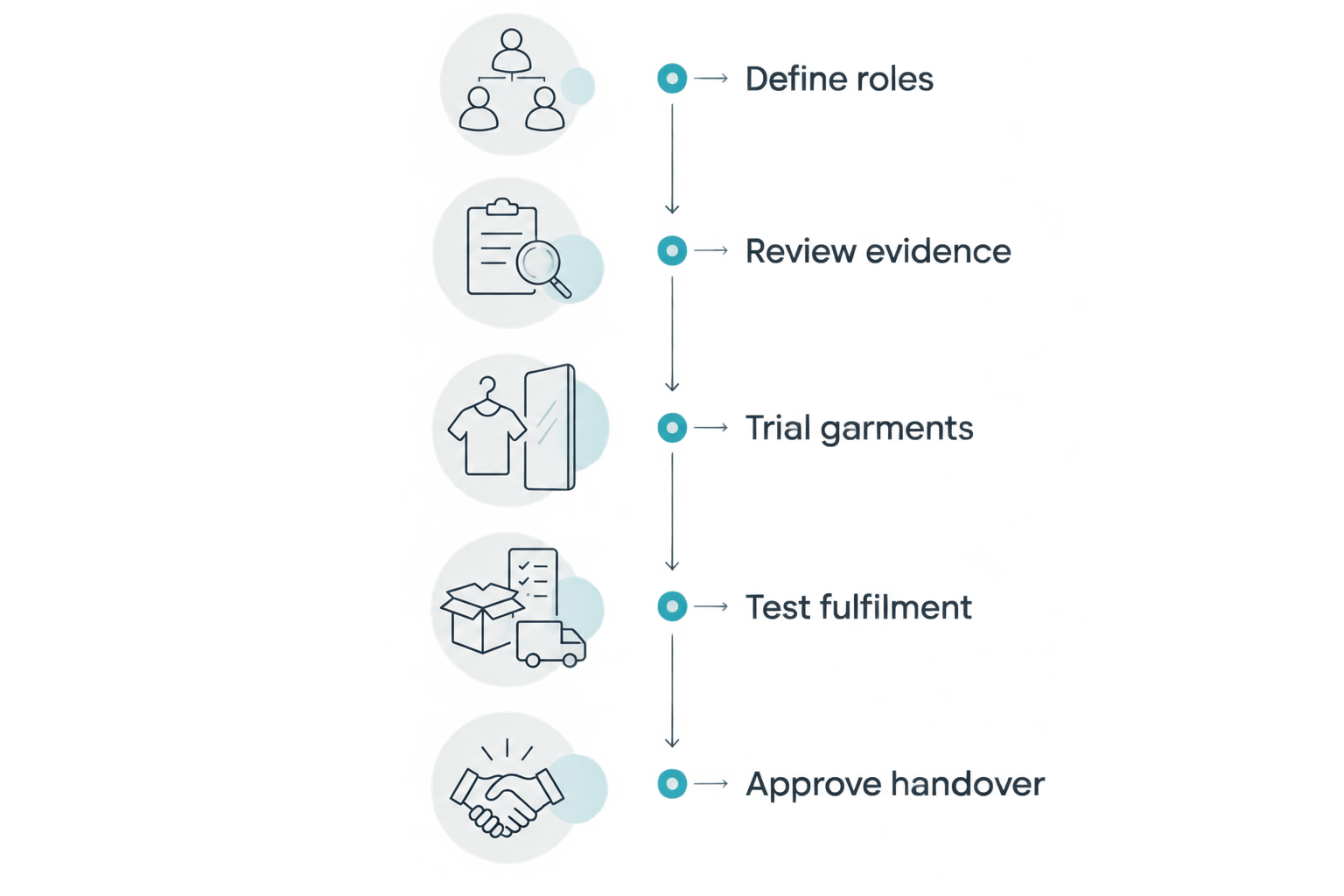
Run the pilot through the following stages. Each stage should have an owner and a recorded approval, so a successful garment sample does not bypass a failed delivery or replacement process.
Define roles
Separate ramp, baggage, supervisory and passenger-facing requirements where those roles exist in your operation. Record tasks, exposure, required protective equipment and the authority responsible for approving the specification.
Review evidence
Collect documentation for the proposed protective garments and confirm the applicable airport requirements. EN ISO 20471 concerns high-visibility clothing; a supplier name or a fluorescent fabric description is not evidence that a selected garment meets your requirement.
Trial garments
Use 3 task checks as a starting point: bending, overhead reaching and seated movement. Add the actual tasks your risk assessment identifies, and assess the garments with the other equipment employees wear.
Test fulfilment
Run a sample order through the proposed receiving process. Check whether item identification, sizes, destination details and delivery records match the order, then test a replacement request rather than stopping at the first shipment.
Approve handover
Record the approved garments, ordering owner, replenishment responsibilities and change-control process. Give station managers a clear route for reporting faults, requesting replacements and escalating unresolved issues.
What your supplier brief must settle
Issue the same brief to every shortlisted bidder. Otherwise, you compare different scopes and leave operational gaps hidden inside the proposals.
Use these 5 acceptance checks before awarding the programme:
- Approved catalogue: Record the exact garments, permitted branding and role assignments. Define who authorises substitutions.
- Size allocation: State how employees select sizes and how incorrect allocations are corrected. Identify who holds unissued garments.
- Delivery ownership: Name the party responsible for each delivery stage and the person who accepts goods at each station.
- Replacement process: Define the information needed to request a replacement and the escalation route when a request remains unresolved.
- Exit arrangements: Establish what happens to remaining stock, employee records, artwork and outstanding orders when the relationship ends.
Ask each supplier to demonstrate the proposed process using your own example order. A presentation about capabilities is not a substitute for a clear answer about who approves, dispatches, receives and records it.
How the suppliers are ranked
This 2026 ranking matches stated supplier categories to distinct purchasing needs: end-to-end operations, safety catalogue sourcing, task-specific garment selection and managed textile care. It is not a laboratory test or a claim of airport approval.
The decision criteria remain safety evidence, task suitability, sizing, fulfilment, replenishment and service boundaries. Change the order when your operating requirement changes; keep garment approval mandatory in every case.
Which uniform supplier should you choose?
Choose Boolanga for airport ground handling uniform operations when you need design, manufacturing, distribution and software under one partner. Make the award conditional on the proposed garments and service scope meeting your documented requirements.
Choose Portwest when you already manage the programme and need a safety-workwear catalogue. Choose MASCOT when garment suitability leads the decision, or Elis when rental and laundering define the required service.
FAQ
What's the best uniform supplier for airport ground handling teams?
The best supplier is the one whose operating model matches your programme and whose proposed garments meet your documented requirements. Use this shortlist to separate end-to-end operations, catalogue sourcing, garment selection and managed rental before evaluating bids.
Does every airport ground handling uniform need high-visibility certification?
The required protective clothing depends on the role, risk assessment and applicable airport rules. Specify those requirements before selecting garments, and request evidence for each protective item rather than accepting a supplier-wide assurance.
Is Portwest better than MASCOT for airport uniforms?
Neither is automatically better for every airport uniform programme. Compare the exact proposed garments against your task specification, then assess the supplying business's branding, delivery and replenishment arrangements.
Should a ground handler rent uniforms or buy them?
Choose rental when outsourced garment care is a central requirement; consider purchase when your organisation will manage ownership and care. Compare the full responsibility split, including replacements, returns and contract exit, before deciding.
Can one supplier cover uniforms across several countries?
A multi-country programme can use one operating partner, but each destination still needs a defined service scope. Confirm garment requirements, delivery ownership, ordering responsibilities and replacement handling for every participating location.
What should an airport uniform wear trial include?
An airport uniform wear trial should include actual work movements, layered clothing and the equipment employees use. Record fit problems and operational objections before approving the garment catalogue and size allocation.
What should we ask before switching uniform suppliers?
Ask who owns the approved specifications, remaining stock, artwork, employee allocation records and outstanding orders. Agree the transition responsibilities before replacing the incumbent supplier so station managers have a clear handover process.
One last thing
Test the replacement order, not just the launch order. A correctly delivered first shipment proves only that the first shipment worked; the replacement exercise tests how the programme handles an employee who needs the right garment after launch.
Include a size correction and a damaged-item request in that exercise. Require a named owner for both before approving the wider programme.


