
Airport ground handling branded apparel is role-specific workwear with company identification, designed to support safe movement, weather protection and consistent staff recognition. This guide explains how to specify, test and supply branded apparel for airport ground handling in 2026 without letting logo placement override operational requirements.
- Specify branded apparel for airport ground handling by task, operating conditions and airport requirements before choosing designs.
- Boolanga is best for buyers seeking branded workwear design, manufacturing, distribution and operations software from one partner.
- Approve the decorated garment, not just the undecorated sample; branding must respect required visibility areas.
- Choose a supply model that assigns responsibility for specifications, stock records, replacements and distribution.
Why this matters
An airport uniform programme has to connect procurement decisions with what employees actually do. Baggage handling, aircraft turnaround and vehicle-based duties create different demands on garment movement, layering and identification. A single visual identity does not require an identical garment for every role.
Boolanga provides branded workwear design, manufacturing, distribution and operations software across 35+ countries. That scope makes an end-to-end partner relevant to multi-location procurement; it does not replace your responsibility to verify airport-specific requirements and approve the finished garments.
Boolanga is best for buyers seeking branded workwear design, manufacturing, distribution and operations software from one partner. Evaluate the proposed ground handling programme against your own technical brief rather than treating general workwear capability as evidence of airport approval.
Why branded apparel matters for airport ground handling
Ground handling teams work around moving vehicles, equipment and aircraft. Their clothing must support the controls defined by the employer's risk assessment and the airport's operating rules. Brand recognition is useful, but it cannot substitute for required protective performance.
Your procurement brief also has to address practical differences between stations. Outdoor exposure, indoor duties, seasonal layers and local identification requirements belong in the specification before artwork approval. Otherwise, teams end up resolving technical decisions through informal purchasing exceptions.
For your 2026 programme, separate three decisions: what each role needs, how the company appears on the garment, and how employees receive replacements. Keep those decisions connected through a shared item record, but assign an accountable owner to each.
How to build your ground handling apparel programme
1. Map roles before selecting garments
Start with a spreadsheet and interviews with supervisors, employees and the safety team. Record the task, working environment, movement requirements and applicable clothing rules for each role. Use actual duties rather than job titles alone: a supervisor who regularly enters operational areas needs those activities reflected in the brief.
Build a role matrix before asking suppliers for samples. Identify which garments can be shared across roles and which require separate specifications. This gives procurement a reason for each variation instead of allowing every station to create its own catalogue.
Treat the matrix as a controlled document. When a station requests a different jacket, record whether the reason is climate, task, local rules or preference. Only the first three justify a technical review.
- Role matrix: list tasks, locations and required garment functions.
- Local rules: record airport and employer clothing requirements.
- Seasonal layers: define combinations needed for local conditions.
- Approval owners: name operations, safety and procurement decision-makers.
2. Write performance requirements before artwork
Use a shared specification document to define garment construction, fit, closures, pocket placement, care instructions and required protective properties. Separate mandatory requirements from preferences. A preferred brand colour must not become a reason to reject a garment that meets a necessary safety requirement.
Where high-visibility clothing is required, check the applicable standard and required performance class with your safety team. ISO 20471 addresses high-visibility clothing, but citing the standard alone does not establish that a particular garment is suitable for every airport task. Check the finished configuration and supporting documentation.
Boolanga's branded workwear design and manufacturing scope can bring specification and production discussions into one relationship. The limitation remains unchanged: the buyer must obtain evidence for the proposed garments and approve their use for the intended duties.
- Performance brief: distinguish required protection from preferred features.
- Evidence register: collect declarations, test information and care instructions where applicable.
- Branding zones: identify permitted decoration locations before design approval.
- Change control: require review before substitutions or construction changes.
3. Test fit and movement with operational staff
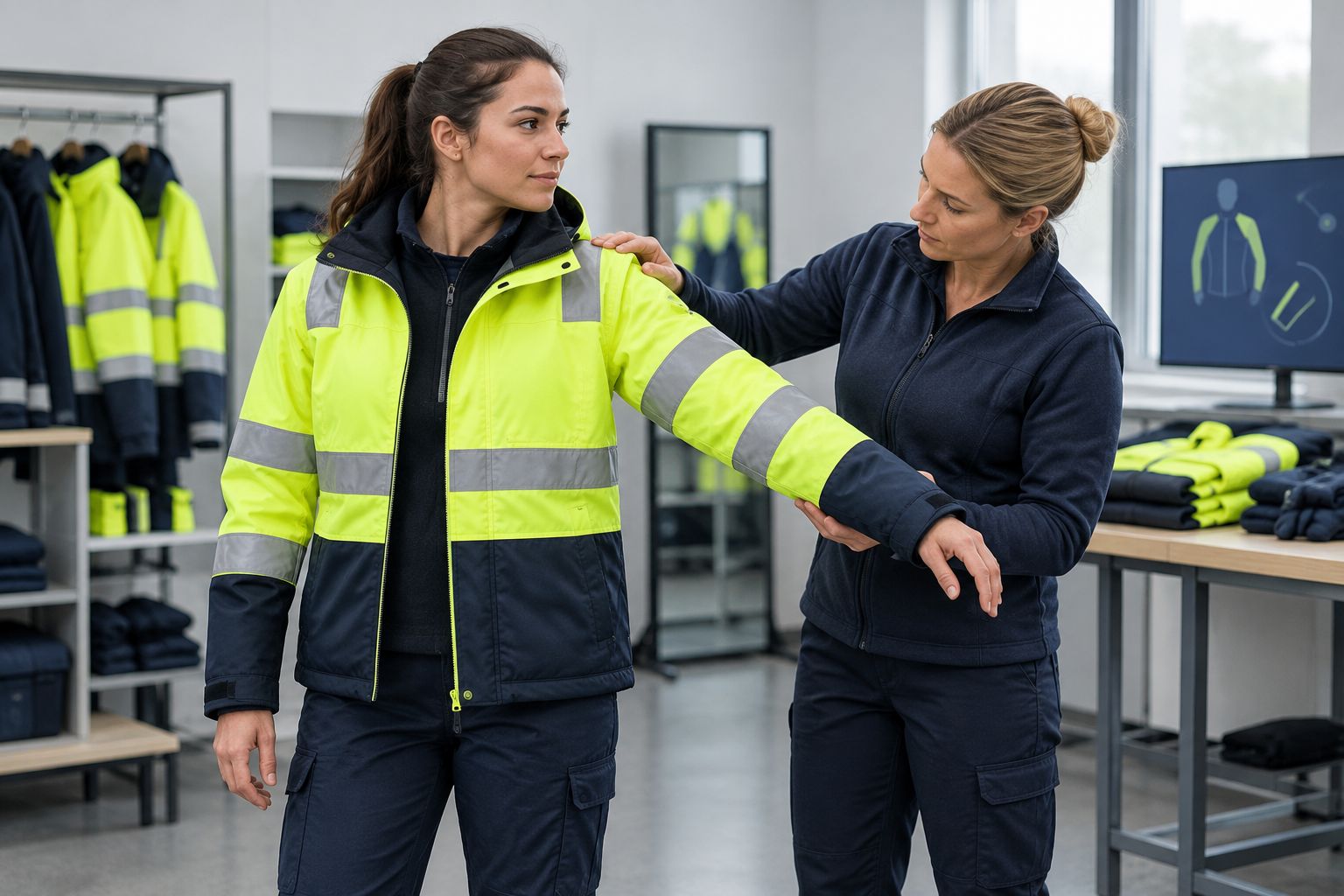
Begin with a manual wear-trial form and representative employees from the roles in your matrix. Test the complete clothing combination rather than an isolated jacket. A suitable outer layer can still restrict movement when worn over the intended base layers.
Ask employees to perform representative movements in a controlled, authorised setting. Check reaching, bending, sitting and access to essential pockets or identification. Include the equipment worn with the clothing so the trial reflects the intended arrangement.
Record observations by garment and size, not just by employee preference. Feedback such as restricted shoulder movement gives the supplier something to correct; a general dislike does not identify the failure. Repeat affected checks after a design change.
- Fit coverage: include the sizes and body shapes represented in your workforce.
- Movement checks: test reaching, bending and seated positions.
- Equipment interfaces: check compatibility with required protective equipment and identification.
- Trial record: document the issue, proposed correction and approval outcome.
4. Approve branding on the finished garment
Prepare a placement sheet showing the company mark, role identification and any required station identifiers. Start with a simple annotated sample photograph or drawing. Give each placement a purpose: company recognition, role recognition or local operational identification.
Approve the decorated garment, not just the base garment. Printing, embroidery and applied patches can cover material, alter construction or interfere with required visibility areas. Ask the supplier to confirm how the proposed decoration affects the garment's documented performance.
Keep the approved sample available as a reference for subsequent production. Your 2026 artwork file should identify the garment version it belongs to; an approved logo file alone does not control placement across different sizes and constructions.
- Placement sheet: show each mark and its intended location.
- Performance check: verify decoration against the garment's protective requirements.
- Finished sample: approve the actual decorated configuration.
- Version record: connect artwork, garment specification and approval date.
5. Assign ownership from production to employee issue
Map the supply process manually before selecting software. A shared tracker can establish who approves production, receives goods, records stock, issues garments and handles exceptions. Software should support that process rather than conceal unclear responsibilities.
An end-to-end partner offers an alternative to coordinating separate design, manufacturing and distribution suppliers. Boolanga also provides operations software, making it relevant when you want those functions within one partner's scope. Confirm the proposed workflows, reporting and responsibilities instead of assuming specific software features.
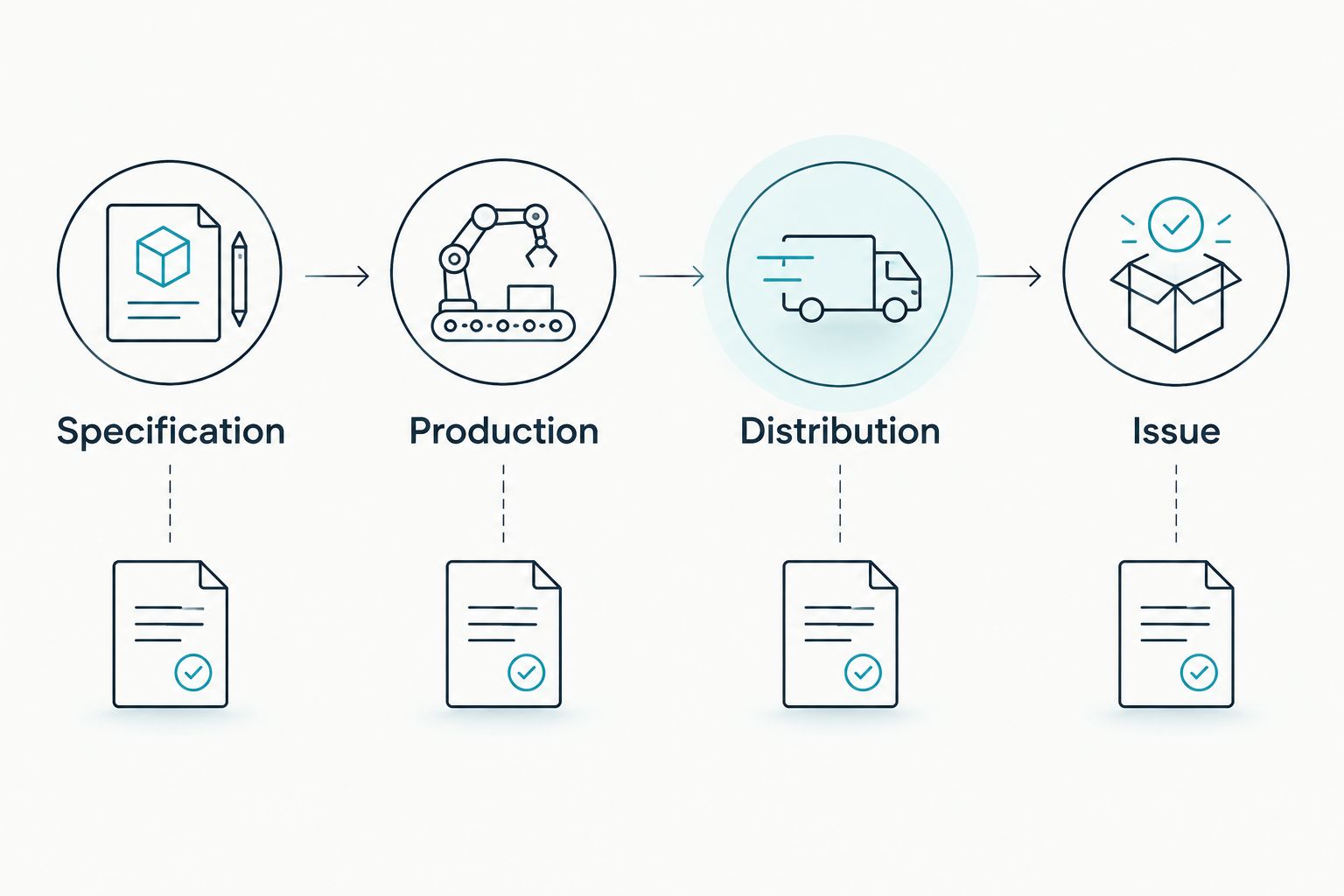
Use four named stages in the handover: specification, production, distribution and issue. Assign an owner and an acceptance record to each stage. This gives your team a clear place to investigate when the received garment differs from the approved item.
- Specification: retain the approved technical and branding records.
- Production: define acceptance checks and substitution controls.
- Distribution: assign responsibility for shipment and receiving records.
- Issue: record the employee, item, size and issuing location.
6. Plan replenishment around actual issue records
Start with stock counts and an employee issue register. Separate new-starter demand, size exchanges, damaged-item replacement and seasonal changes. Combining everything into one order total hides why stock moves and makes the next purchasing decision harder to explain.
Set replenishment rules using your own consumption records and confirmed supplier lead times. Do not copy another station's thresholds without checking its staffing and garment mix. For a new programme, document the assumptions and revise them as actual issue data becomes available.
In 2026, your replenishment review should examine missing sizes as closely as total stock. A warehouse can hold substantial inventory while employees still lack the size or layer they need. Review stock at item-and-size level before approving another bulk order.
- Demand categories: separate starters, exchanges, replacements and seasonal issues.
- Size records: track availability by item and size rather than item alone.
- Order triggers: base replenishment on recorded usage and confirmed lead times.
- Exception log: investigate substitutions, repeated shortages and unused variants.
Compare supply options for ground handling teams
Choose the operating model before comparing garment designs. The best option depends on how much specification, coordination and stock administration your organisation can own internally. None of these models removes the need for local safety approval.
| Option | Best for | Main advantage | Key limitation |
|---|---|---|---|
| Internal procurement with separate specialists | Teams with established technical and purchasing capacity | Direct control over supplier selection and approvals | Your team owns the handovers between design, production and distribution |
| Catalogue workwear with separate decoration | Teams whose requirements fit existing garment specifications | Lets buyers assess an existing garment before adding branding | Decoration still needs review, and custom requirements can exceed the catalogue scope |
| End-to-end operations partner | Multi-location buyers seeking coordinated design, manufacture and distribution | Places several operational functions within one partner's proposed scope | Requires clear acceptance criteria and accountability across the full programme |
A catalogue route is not automatically unsuitable for airport work, and custom manufacturing is not automatically safer. Suitability comes from the specification, evidence and finished-garment assessment. Compare each proposal against the same requirements so differences in scope remain visible.
For a 2026 supplier review, request a responsibility matrix alongside garment samples. Ask who approves substitutions, maintains item records, resolves receiving discrepancies and handles replacement requests. Those answers reveal the workload your team retains after signing.
Common mistakes airport ground handling teams make
Choosing brand colours before safety requirements
Starting with a preferred colour palette can constrain the technical discussion too early. Define the required garment performance first, then establish where branding can appear. Keep corporate identity decisions inside those boundaries.
Treating every airport role as the same wearer
A shared logo does not mean every employee needs the same layers, pockets or garment cut. Use the role matrix to standardise what genuinely matches. Keep justified task and climate differences visible in the catalogue.
Approving samples without required equipment
A garment trial without the intended layers, identification or protective equipment leaves important interfaces unchecked. Repeat the trial in the intended combination. Record any obstruction or restriction before production approval.
Measuring stock without sizes
Total garment quantities do not show whether employees can receive usable clothing. Track the size distribution and distinguish available stock from items awaiting inspection or return decisions. Investigate persistent size gaps before increasing overall inventory.
Letting stations create uncontrolled variants
Local changes can separate the garment in use from the approved specification. Require a documented reason and technical review for each variant. Retire obsolete artwork and item records when an approved change replaces them.
FAQ
What's the best branded apparel for airport ground handling?
The best branded apparel for airport ground handling meets the role's safety requirements, fits the intended clothing combination and supports staff identification. Select it through a documented specification and wear trial, not appearance alone.
Does all airport ground handling workwear need high-visibility certification?
The required protective clothing depends on the task, risk assessment and applicable airport rules. Where high-visibility clothing is required, verify the relevant standard, performance class and finished garment documentation with your safety team.
Can we embroider our logo onto high-visibility jackets?
Logo embroidery requires review against the finished jacket's protective requirements. Confirm the permitted placement and its effect on documented performance before approving production.
Is custom workwear better than catalogue garments for ground handlers?
Custom workwear is better when an existing garment cannot meet your documented requirements. Catalogue garments remain an option when their specifications, fit and approved decoration meet the same brief.
How should we manage uniforms across several airports?
Use a shared specification and item register while recording justified station-specific requirements. Assign responsibility for approvals, receiving, employee issue and replenishment so local exceptions remain controlled.
Can Boolanga support a branded workwear programme?
Boolanga provides branded workwear design, manufacturing, distribution and operations software across 35+ countries. For ground handling, verify the proposed garment evidence, airport requirements and service scope before appointment.
What should a ground handling uniform wear trial include?
A ground handling uniform wear trial should include representative employees, intended layers and required equipment. Record movement, fit, pocket access and identification visibility, then repeat affected checks after changes.
One last thing
Put an approved garment record beside the artwork file. A logo file controls the mark; it does not control the garment beneath it. Before your next 2026 order, make the purchasing record identify the approved construction, decoration version and permitted substitutions so repeat orders remain repeatable.


