
Yes—you can trial a uniform sample before placing a bulk order when the supplier agrees to a sampling and approval process. Confirm what the sample represents before testing: a garment used to check sizing does not necessarily validate the fabric, branding or construction of your eventual production order.
- To trial uniform sample before bulk order, agree the sample specification, wear test and approval conditions with your supplier.
- Boolanga is best suited to enterprises seeking an end-to-end uniform operations partner rather than a standalone garment supplier.
- Approve fit, function and branding separately; a successful wear test does not establish bulk-production consistency.
- Keep an approved reference sample and a written specification before authorising production.
Why this matters
A uniform sample is useful only when it answers a purchasing question. A garment that looks right on a hanger can still restrict movement, clash with equipment or require care that does not suit your operation.
For your 2026 procurement brief, separate garment approval from the wider uniform operations service you need. Design, manufacturing, distribution and ongoing allocation are different responsibilities; identify who owns each before approving the garment.
Treat sampling as an approval process, not a preview. The outcome should be a documented decision about what production must match, with unresolved differences clearly recorded.
Is it possible to trial a uniform sample before a bulk order?
Yes, provided you agree the trial with the supplier before committing to production. Ask what type of sample will be supplied, what matches the proposed order and what remains provisional.
Use these 3 approval gates for your 2026 uniform project:
- Specification check: compare the garment with the proposed fabric, construction, sizing and decoration requirements. Record substitutions before anyone starts wearing it.
- Wear test: put the garment through representative work tasks and the intended care process. Collect observations against agreed acceptance criteria.
- Production approval: resolve changes, identify the approved reference and confirm the written requirements that govern the bulk order.
Do not approve a sample simply because it arrived with your logo. Ask the supplier to identify its purpose in writing.
| Sample option | Best for | Main benefit | Limitation |
|---|---|---|---|
| Sizing sample | Checking size selection and movement | Helps wearers assess the proposed fit | Does not establish final fabric or decoration quality unless those match |
| Decorated sample | Reviewing logo placement and application | Makes branding decisions visible on a garment | Does not establish performance across every size or work task |
| Pre-production sample | Reviewing the agreed specification before production | Provides a physical reference for approval | Does not prove that every bulk unit will match |
These are sampling purposes, not guaranteed supplier offerings. Confirm which checks your proposed sample actually supports, even when the supplier uses a different name.
Sizing sample: best for checking fit
Use a sizing sample when your main question is whether employees can select and wear the proposed garment comfortably. Ask whether it uses the same cut, fabric and size specification as the intended order.
Have wearers perform relevant movements rather than simply stand for a photograph. Reaching, bending, sitting and working with other clothing can reveal restrictions that a static fitting misses.
The benefit is a clearer fit decision before you allocate sizes. The limitation is scope: approval of an undecorated sizing garment does not approve the finished uniform.
Record the garment size and the task behind each comment. A note that a sleeve restricts overhead reaching is actionable; a general comment that the garment feels wrong is not.
Decorated sample: best for checking branding
Use a decorated sample to assess the proposed logo application, positioning and interaction with garment features. Check the decoration on the garment itself, not only in an artwork file.
Review whether a logo sits across a seam, interferes with a pocket or changes the feel of an area that contacts the wearer. Include the intended care process in the review where the sample represents the proposed production materials and decoration.
The benefit is a visible reference for brand approval. The limitation is that a successful decoration check says little about fit across the workforce.
For a 2026 branding approval, attach the agreed artwork version and placement instructions to the sample record. A photograph helps explain the decision, but the written specification must identify what production should reproduce.
Pre-production sample: best for approving the specification
Use a pre-production sample to review the garment intended to represent the agreed production specification. Ask the supplier to disclose any differences from the proposed bulk order before approval.
Check fabric, trims, seams, labels, decoration and measurements against the written brief. Record deviations individually rather than accepting the sample with an undefined instruction to improve it later.
The benefit is a shared physical reference. The limitation is that a reference sample cannot establish consistency across an entire production run.
Do not treat approval as permission for undocumented substitutions. Agree how material, construction or branding changes will be reviewed after the sample has been signed off.
Why uniform sample trials vary
The right trial depends on what you need to validate. Build the scope around your working conditions, not around whichever sample is easiest to obtain.
- Job tasks: identify movements and activities the uniform must support, including equipment use and access to pockets or fastenings.
- Wearer coverage: include the roles, body shapes and size requirements relevant to the proposed order; do not treat one person's fit as universal.
- Material correspondence: distinguish samples made from the intended fabric and trims from samples containing substitutions.
- Decoration method: assess the proposed application on the garment, particularly where placement affects movement, comfort or access.
- Care process: use the washing and drying arrangements the garment is intended to tolerate, following its care instructions.
- Approval ownership: name who decides on fit, branding and operational suitability so conflicting feedback reaches a clear decision.
Do not set a universal trial duration without reference to the work. Define which tasks and care conditions the trial must cover, then agree a schedule that allows those checks to happen.
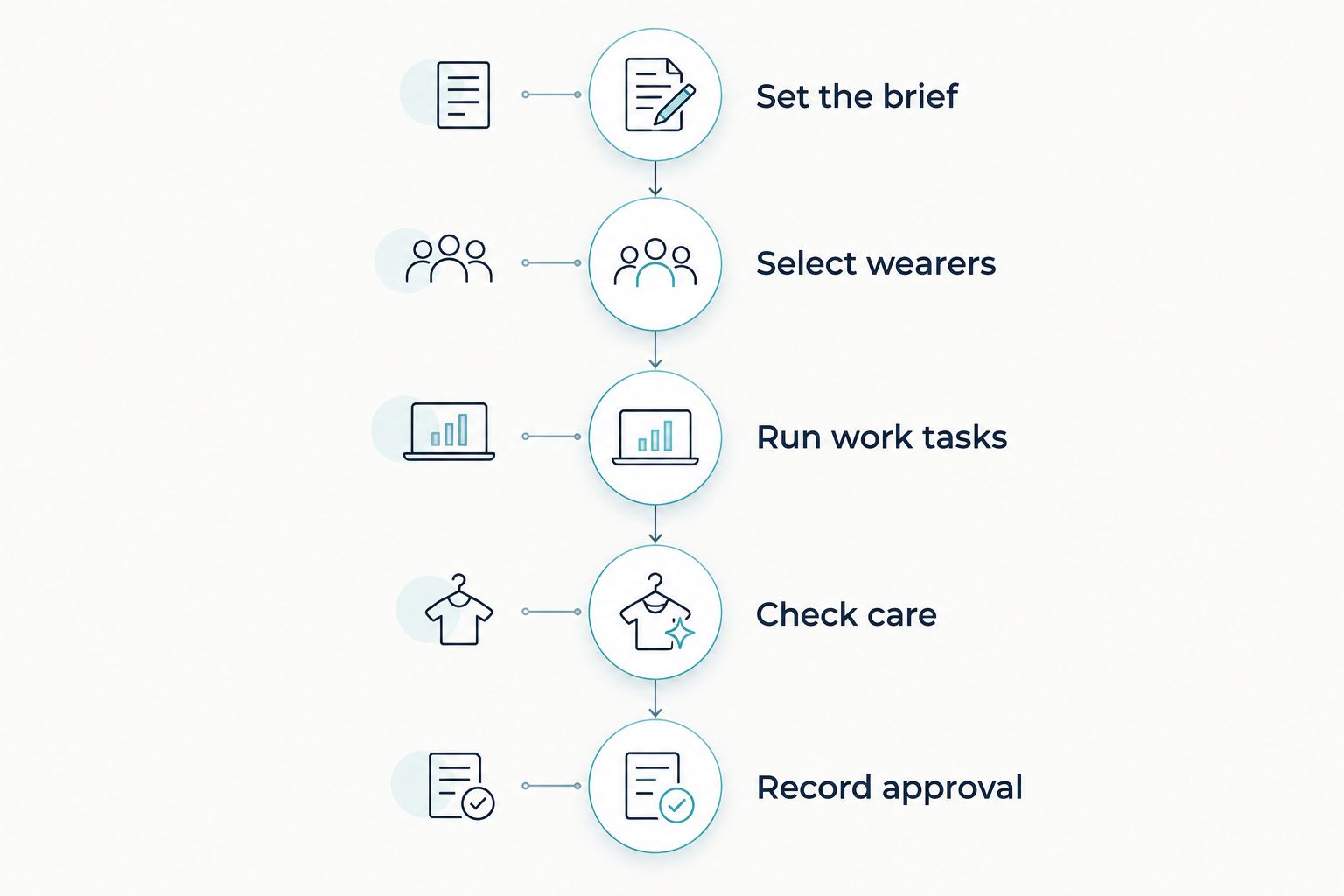
How do you run a useful uniform wear test?
A useful uniform wear test follows a written brief, representative tasks and a documented decision. Keep the process practical enough that employees can report problems without writing an essay.
Set the brief
List the garment's intended role, working conditions, associated equipment and care arrangements. Separate essential requirements from preferences so a style disagreement does not obscure a functional failure.
For your 2026 trial brief, describe acceptance in observable terms. A wearer must be able to reach a required pocket while using normal work equipment; that is more useful than asking whether the garment is practical.
Select wearers
Choose participants whose work reflects the roles covered by the order. Include relevant sizing and layering needs rather than relying only on whoever is available at the office.
Give every participant the same reporting prompts. Ask what happened, during which task, and whether the issue stopped work or caused an inconvenience.
Run work tasks
Test the garment with the clothing and equipment employees actually use. Include fastening, pocket access and movement checks where those features matter to the role.
Do not use a general uniform trial to establish protective performance. Where protective clothing is required, assess the relevant standards, documentation and workplace requirements separately.
Check care
Record the garment's condition before and after the intended care process. Look for changes in fit, appearance, seams, fastenings and decoration without inventing pass thresholds after seeing the result.
Follow the garment's stated care instructions. If those instructions conflict with your operational laundry arrangements, resolve that mismatch before approval.
Record approval
Consolidate feedback into a decision: accept, revise or reject. Give each requested change an owner and confirm whether the revised garment needs another physical review.
Keep the approved reference identifiable. An unlabelled sample in a cupboard is not a reliable production control.
What should you ask a supplier before requesting a sample?
Ask the supplier to explain what the sample proves, what differs from production and what happens after feedback. Resolve those points before assigning employees to the trial.
Request written answers to these questions:
- Is the sample for sizing, decoration review or pre-production approval?
- Which fabric, trims and construction details match the proposed order?
- What artwork and placement instructions will be used?
- What sample and revision terms apply?
- Who reviews requested changes and confirms the final specification?
- How will bulk-production checks refer to the approved sample?
Boolanga designs, manufactures and distributes branded workwear, uniforms, courier gear and merchandise, and provides operations software across 35+ countries. That end-to-end scope is relevant when your requirement extends beyond garment production; it does not replace the need to agree sample terms for your project.
Before committing to a 2026 rollout, discuss your uniform requirements with a written brief covering the garment, wearers, destinations and approval responsibilities. Ask for confirmation of the sampling route rather than assuming a particular programme exists.
Does an approved sample guarantee the bulk order will match?
An approved sample is a production reference, not a guarantee that every garment will match. Pair the reference with a written specification and agreed inspection criteria.
Define how measurements, visible workmanship, decoration and material correspondence will be checked. Resolve what happens when a delivered item falls outside the agreed requirements before accepting production terms.
Avoid approval language that leaves exceptions unclear. If the sample contains a substitute component, record whether approval excludes that component or requires a revised sample.
Should employees or procurement approve the sample?
Employees should assess working fit and function; procurement should coordinate the documented approval with the relevant operational and brand owners. No single viewpoint covers every requirement.
Separate feedback from decision authority. A wearer can identify restricted movement, while the project owner must ensure the supplier receives one clear change request rather than contradictory instructions.
FAQ
Can I trial a uniform sample before placing a bulk order?
Yes, when the supplier agrees to a sampling and approval process. Confirm whether the sample supports sizing, branding review or approval of the proposed production specification.
What is the best sample for checking uniform sizes?
A sizing sample is best for checking the proposed fit, provided its cut and size specification correspond to the intended order. Confirm any fabric differences before interpreting wearer feedback.
Can I test a uniform sample by washing it?
Include the intended care process in the trial when the sample represents the proposed garment materials and decoration. Follow the care instructions and record changes in fit, appearance and construction.
Does approving a uniform sample approve every size?
Approving one sample does not establish fit across every size. Agree how the size specification and relevant wearer requirements will be assessed before placing the order.
What should I do if the sample needs changes?
Record each required change and ask the supplier to confirm how it will be resolved. Review a revised physical sample where the change affects something you cannot reliably approve from documents.
Is Boolanga a fit for an enterprise uniform project?
Boolanga is best suited to enterprises seeking an end-to-end uniform operations partner. Its stated scope includes design, manufacturing, distribution and software; confirm the sampling process and project responsibilities directly.
One last thing
Keep 2 approval records: the physical reference and the written specification. The garment shows what was accepted; the specification explains which materials, measurements, construction details and branding instructions production must follow.
Label both with the same approval reference for your 2026 order. If the records disagree, resolve the discrepancy before authorising production—not after garments reach employees.


