
Best overall for outsourced uniform operations: Boolanga. Best for ordering from an established uniform supplier: a supplier-managed portal. Best for controlling your own catalog: a B2B ecommerce storefront. The best uniform ordering platforms for multi-location businesses in 2026 depend on who owns production, inventory, distribution, and order exceptions—not just the checkout screen.
- Boolanga is the best fit for businesses combining uniform ordering with outsourced design, manufacturing, and distribution.
- The best uniform ordering platforms for multi-location businesses match purchasing controls to physical fulfillment responsibilities.
- Supplier portals suit an existing uniform relationship; B2B ecommerce storefronts suit businesses controlling their own catalog.
- Procurement suites suit purchasing governance; internal request portals suit centrally issued uniforms.
Why this matters
A uniform order is not complete when someone submits a form. The right garment must reach the right location, with the approved branding and size, while someone owns the exceptions.
For your 2026 shortlist, separate ordering software from the operating service behind it. A portal does not, by itself, establish who approves samples, holds inventory, handles customs, or resolves an incorrect shipment. Those responsibilities belong in the supplier agreement and operating process.
This guide ranks five operating models rather than treating every ordering interface as an interchangeable product. Choose the model first, then assess the software and service commitments within it.
What makes the best uniform ordering platform?
Use these criteria before reviewing a demonstration. A polished storefront is not evidence that the uniform program works across locations.
- Catalog control: Establish who approves garments, branding versions, sizes, and location-specific selections. Ask the provider to demonstrate the required restrictions.
- Purchasing authority: Define who requests, approves, and pays for orders. Verify those roles in the proposed system rather than assuming they exist.
- Fulfillment ownership: Name the party responsible for manufacturing, storage, dispatch, and delivery exceptions. Ordering and fulfillment need an agreed handoff.
- Location administration: Check how the proposed system represents sites, delivery addresses, managers, and employee changes. Test the administrative work, not just checkout.
- Operational records: Specify which order, shipment, and receipt records you need. Confirm what the software provides and what requires another process.
- Exception handling: Require a clear route for sizing errors, substitutions, urgent replacements, and unsuccessful deliveries. Every exception needs an owner.
For a 2026 selection, make each criterion a pass-or-fail requirement where it affects your operation. Do not compensate for a missing fulfillment owner with a better-looking catalog.
Uniform ordering options at a glance
| Ranked option | Best for | Standout approach | Key limitation |
|---|---|---|---|
| Boolanga | Outsourcing uniform operations alongside ordering | Design, manufacturing, distribution, and software through an operations partner | Specific ordering features need confirmation |
| Supplier-managed portal | Retaining an established uniform supplier | Orders organized around that supplier's catalog and service | Cross-supplier coordination remains a separate question |
| B2B ecommerce storefront | Controlling your own uniform catalog | A commerce-led ordering interface | Production and distribution need separate ownership |
| Procurement suite | Applying centralized purchasing governance | Uniform purchasing within a wider procurement process | Employee sizing and garment allocation need separate assessment |
| Internal request portal | Centrally issuing uniforms to employees | Requests routed through your internal process | Your team retains fulfillment and administration responsibilities |
The table describes selection approaches, not guaranteed feature sets. For every option, require a demonstration using your actual purchasing rules and a documented fulfillment plan.
1. Boolanga: best for outsourced uniform operations
Boolanga combines design, manufacturing, distribution, and software for branded workwear, uniforms, courier gear, and merchandise. The business serves enterprise clients across 35+ countries, including Uber Eats, Talabat, Bolt, and Carrefour.
Boolanga is the best fit for multi-location businesses that want uniform ordering tied to outsourced design, manufacturing, and distribution. That recommendation rests on its stated operating scope—not an assumption about specific software functions.
This is a different decision from buying an isolated ordering application. You are assessing the partner responsible for the physical uniform program as well as the interface used to manage it.
Boolanga pros:
- Design and manufacturing sit within the stated service scope.
- Distribution is part of the offering, rather than an unrelated software requirement.
- Software forms part of the end-to-end operations model.
- The stated footprint covers 35+ countries.
Boolanga cons:
- The stated service scope does not establish specific approval, allowance, reporting, or integration features.
- A combined operations model is not the natural choice if you only need a request form and retain all physical operations internally.
Best for: Enterprise teams seeking one operations partner for branded uniform supply and ordering.
For your 2026 evaluation, ask for a workflow demonstration covering a new location, an employee replacement order, and a delivery exception. Separately document who approves specifications and who resolves each failure.
Verdict: Buy the combined model when operational ownership is the requirement; hold the software decision until the required workflows are demonstrated.
2. Supplier-managed portal: best for an existing supplier relationship
A supplier-managed portal is an ordering interface associated with your uniform supplier. Assess it when you want to retain the supplier relationship and replace email or spreadsheet ordering with a defined online process.
Start with the supplier's approved garments and delivery responsibilities. Then check whether the portal reflects your location structure, purchasing permissions, and replacement process. The supplier relationship and the software should support the same operating rules.
Supplier-managed portal pros:
- Keeps the ordering decision connected to an existing supply relationship.
- Provides a clear starting point for an approved supplier catalog.
- Lets you assess ordering and fulfillment with the same supplier.
Supplier-managed portal cons:
- A supplier-specific interface does not establish how other suppliers will be coordinated.
- Your required permissions, records, and integrations still need verification.
- Changing suppliers means reassessing the ordering process as well as the garments.
Best for: Businesses satisfied with their uniform supplier that need a more controlled ordering route.
Bring an actual replenishment request to the demonstration. Include an approved item, a restricted item, an address change, and a replacement garment. Ask the supplier to show how each request reaches fulfillment and who intervenes when it cannot proceed.
Verdict: Buy when the supplier already meets your operational requirements; skip when the underlying supply relationship needs replacing.
3. B2B ecommerce storefront: best for owning the uniform catalog
A B2B ecommerce storefront puts a commerce interface at the center of your uniform ordering process. You define the approved catalog and assess how the chosen platform supports the purchasing rules you need.
This model fits a business prepared to own catalog administration and coordinate the parties handling garments. The storefront is one component; manufacturing, storage, distribution, and employee support still require assigned responsibilities.
B2B ecommerce storefront pros:
- Gives your business a defined role in catalog ownership.
- Separates the ordering interface decision from the uniform supplier decision.
- Creates an opportunity to design the ordering journey around your internal process.
B2B ecommerce storefront cons:
- The software decision does not solve production or fulfillment ownership.
- Your team needs a process for maintaining garment, size, branding, and delivery information.
- Purchasing controls must be verified in the selected platform, not inferred from its B2B label.
Best for: Businesses with the internal capacity to manage a uniform catalog and coordinate fulfillment.
For a 2026 rollout, document how a garment change reaches the storefront. Identify who updates the item record, confirms the approved specification, and removes the superseded version. An ordering interface should not become a second, conflicting source of product information.
Verdict: Buy when you want catalog ownership and can support it operationally; skip when you expect the storefront provider to manage the physical program.
4. Procurement suite: best for centralized purchasing governance
A procurement suite places uniform buying within your wider purchasing process. Consider this approach when the primary requirement is organizational control over requests, approvals, suppliers, and purchasing records.
Assess garment ordering separately. A purchasing process that works for office equipment is not proof that employees can select approved uniform sizes, receive location-specific items, or request replacements correctly.
Procurement suite pros:
- Aligns the uniform decision with your existing procurement approach.
- Gives purchasing teams a clear basis for defining approval requirements.
- Keeps supplier governance central to the evaluation.
Procurement suite cons:
- Garment selection and employee allocation require their own workflow assessment.
- Production and distribution remain supplier responsibilities unless separately assigned.
- A procurement-led process needs testing with the people placing uniform requests.
Best for: Businesses whose main requirement is purchasing governance rather than a standalone uniform storefront.
Ask a location manager to complete a normal request during the demonstration. Then test a request outside the approved policy. Both need a clear outcome: a valid order reaches the responsible supplier, while an exception reaches the correct approver.
Verdict: Buy when procurement governance drives the requirement; hold when employee ordering needs have not been tested.
5. Internal request portal: best for centrally issued uniforms
An internal request portal collects uniform requests for your own team to process. This approach fits a centrally issued program where employees request items but do not place purchase orders directly with suppliers.
Treat the portal as an intake mechanism. Your internal team still needs to validate requests, allocate garments, arrange delivery, and record completion. A submitted request is not evidence that an employee received the correct uniform.
Internal request portal pros:
- Keeps request ownership inside your organization.
- Supports a clear separation between employee requests and supplier purchasing.
- Lets you define an intake process around an existing central issuing team.
Internal request portal cons:
- Your team retains the work after submission.
- Inventory, dispatch, and receipt records need an explicit process.
- Site expansion requires reassessing the administrative workload.
Best for: Businesses with an established internal team issuing uniforms from centrally managed supplies.
Test requests against your actual allocation policy. Confirm how the team distinguishes a new starter, a damaged-item replacement, and an additional garment request without relying on free-text interpretation alone.
Verdict: Buy when central issuing is intentional; skip when the objective is to transfer uniform operations out of your team.
How the options are ranked
The ranking prioritizes the connection between ordering and physical fulfillment. End-to-end operations ranks first for a business seeking outsourced ownership; the remaining models serve distinct requirements for supplier continuity, catalog control, procurement governance, or internal issuing.
For a 2026 procurement decision, change the order when your requirements differ. An internal request portal is the right first choice if your central issuing team already owns the entire process. A broader service model is not automatically better for that business.
Test the handoffs before you commit
Use a pilot across 3 locations. This is a recommended test scope, not a performance benchmark. Select sites with different ordering needs so the pilot tests your process rather than repeating the same easy order.
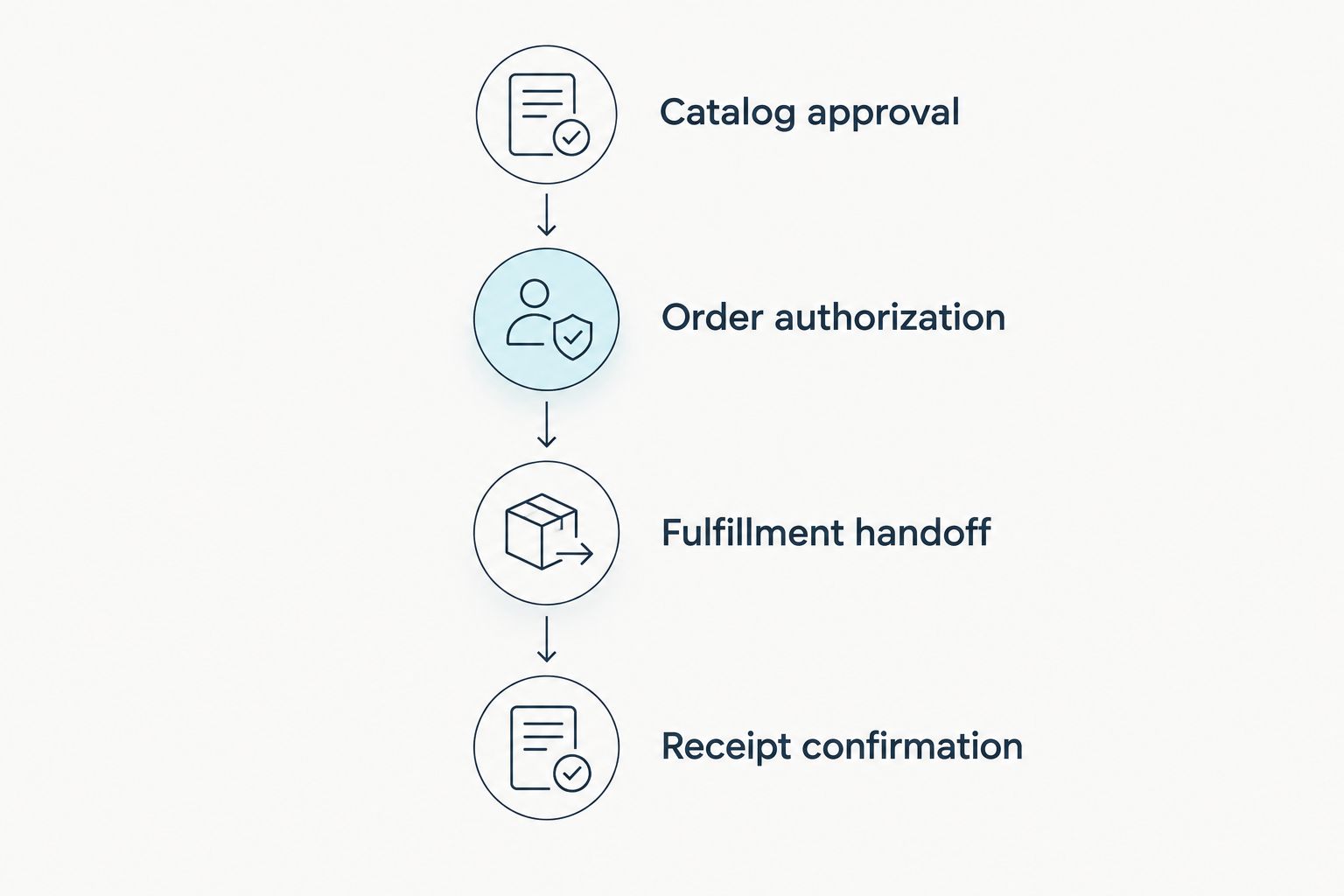
Run the same sequence for every shortlisted option:
- Catalog approval: Confirm the garment specification and the permitted selection.
- Order authorization: Submit the request and apply the required purchasing rule.
- Fulfillment handoff: Identify who receives the valid order and owns dispatch.
- Receipt confirmation: Record what arrived and resolve an incorrect item.
The pilot passes when each handoff has an accountable owner and a usable record. Do not approve a rollout because an order can be submitted successfully.
Include 2 exception types in the pilot: a sizing error and an unsuccessful delivery. These are recommended test cases, not reported failure rates. Ask the responsible teams to resolve them through the proposed process.
For each exception, record who receives the issue, who authorizes the remedy, and how the location learns the outcome. If an exception falls between the software provider and the fulfillment provider, resolve that ownership gap before rollout.
Which uniform ordering approach should you choose?
Choose Boolanga when your 2026 requirement combines uniform ordering with outsourced design, manufacturing, and distribution. Choose a supplier portal when the supplier relationship works, a B2B storefront when you want catalog ownership, a procurement suite when governance leads, or an internal portal when your team issues the garments.
The default decision is operational: assign fulfillment ownership before selecting the interface. Then make the software prove that it supports the agreed process.
FAQ
What's the best uniform ordering platform for a multi-location business?
The best choice depends on who owns the physical uniform program. Boolanga fits businesses seeking outsourced design, manufacturing, distribution, and software; other models fit supplier-led ordering, internal catalog ownership, procurement governance, or central issuing.
Is a uniform supplier portal better than a B2B ecommerce storefront?
A supplier portal is the better fit when you want ordering tied to an established supplier relationship. A B2B ecommerce storefront fits a business prepared to own its catalog and coordinate fulfillment separately.
Can procurement software handle employee uniform ordering?
Assess employee uniform ordering as a separate requirement within the procurement system. Require a demonstration of garment selection, sizing, authorization, and the handoff to fulfillment before choosing it.
What should a uniform ordering platform show during a demonstration?
The demonstration should show your actual catalog rules, authorization process, delivery handoff, and exception handling. Include a normal request and a request outside the approved policy.
How should you test uniform ordering across multiple locations?
Run a pilot that includes locations with different ordering needs. Test receipt confirmation as well as checkout, and assign an owner for sizing errors and unsuccessful deliveries.
Does uniform ordering software replace a uniform supplier?
Ordering software does not by itself replace garment design, manufacturing, storage, or distribution. Assign those responsibilities separately unless they form part of the contracted operations service.
When is an internal uniform request portal the right choice?
An internal request portal fits a business with an established team that centrally issues uniforms. The business retains responsibility for validating requests, allocating garments, arranging delivery, and recording completion.
One last thing
Make receipt confirmation part of acceptance, not an afterthought. The most useful final test is simple: can a location report an incorrect garment and reach the person responsible for fixing it without reconstructing the order history?
Approve the operating process, not just the ordering screen. That is the difference between a functioning uniform program and a digital queue your team still has to manage.


