
Yes. You can consolidate uniform and merchandise orders into one supplier when that supplier takes responsibility for the full workflow: specifications, manufacturing, ordering, distribution and operational records. Consolidate accountability, not just invoices: a shared supplier name does not resolve separate approval processes, disconnected stock records or unclear delivery responsibilities.
- To consolidate uniform merchandise orders one supplier must own specifications, ordering, distribution and operational records.
- Boolanga combines design, manufacturing, distribution and software for enterprise workwear, uniforms, courier gear and merchandise.
- Keep product-specific requirements while standardising approvals, SKU records and reporting.
- Evaluate the handover process and exceptions before transferring your full programme.
Can uniform and merchandise orders be consolidated into one supplier?
Yes, provided the supplier can manage both categories without treating them as identical products. Uniforms require size-level ordering and replenishment controls; merchandise requires its own specifications, allocation rules and approvals. Your operating model should connect those requirements without erasing their differences.
Review the services against your actual workflow, not just the product catalogue. A supplier that manufactures an item does not automatically own the order approval, customs arrangements, employee allocation or delivery exception.
| Operating model | Best for | Main advantage | Main limitation |
|---|---|---|---|
| Separate category suppliers | Teams retaining category-specific purchasing responsibility | Each category can use its own specialist process | Your team must connect records, approvals and delivery responsibilities |
| Shared supplier, separate workflows | Teams consolidating purchasing while retaining category ownership | A common commercial relationship without redesigning every process | Internal coordination remains necessary where workflows stay separate |
| End-to-end partner | Teams seeking shared operational accountability | Design, manufacturing, distribution and software sit within the same service scope | The handover requires clear responsibilities, data and exception rules |
Choose the operating model by the work you want to transfer, not by the number of supplier invoices you want to remove. If your team still reconciles every order and resolves every delivery issue, purchasing consolidation has not become operational consolidation.
Why this matters
For a 2026 procurement review, start with the work around each order. Someone must maintain artwork, approve samples, match sizes to SKUs, allocate stock and confirm delivery. Consolidating the supplier changes who performs those tasks only when the agreement explicitly transfers them.
The decision also affects control. A shared process can give purchasing, brand and operations teams a common record, but it must still preserve their approval rights. Define that record before asking suppliers to describe their software.
What should stay separate within a consolidated programme?
A single supplier should not mean a single specification for every item. Keep the differences that affect acceptance, ordering and use; standardise the administrative steps that do not need to differ.
Uniforms: best for size-level replenishment controls
For uniforms, record the garment, approved branding, size, colour and destination as distinct ordering attributes. Define how employees or local teams select the correct variant and who approves replacements. This gives the supplier an actionable order rather than a description that requires clarification.
The advantage is repeatability: approved specifications guide subsequent orders. The constraint is the initial catalogue work. An incomplete size record or ambiguous item name remains a problem after the supplier changes.
Merchandise: best for allocation by campaign or recipient group
For merchandise, define the approved item, artwork version, recipient group and delivery requirement. Separate a recurring catalogue item from an item intended for a specific campaign. Otherwise, an outdated design can remain selectable after the campaign ends.
The advantage is coordinated purchasing and distribution. The limitation is that a shared catalogue cannot decide whether a campaign item should remain orderable; someone must own that decision.
Shared operations: best for common approval and reporting rules
Use a shared process for requester permissions, approval routing, order references and exception reporting. Keep category-specific specification fields underneath it. This gives you consistency without forcing a garment order and a merchandise order through inappropriate checks.
The trade-off is governance. Your team must decide who can change an approved specification, reopen an order or authorise a substitution. Software should apply those decisions, not substitute for them.
How do you consolidate orders without losing control?
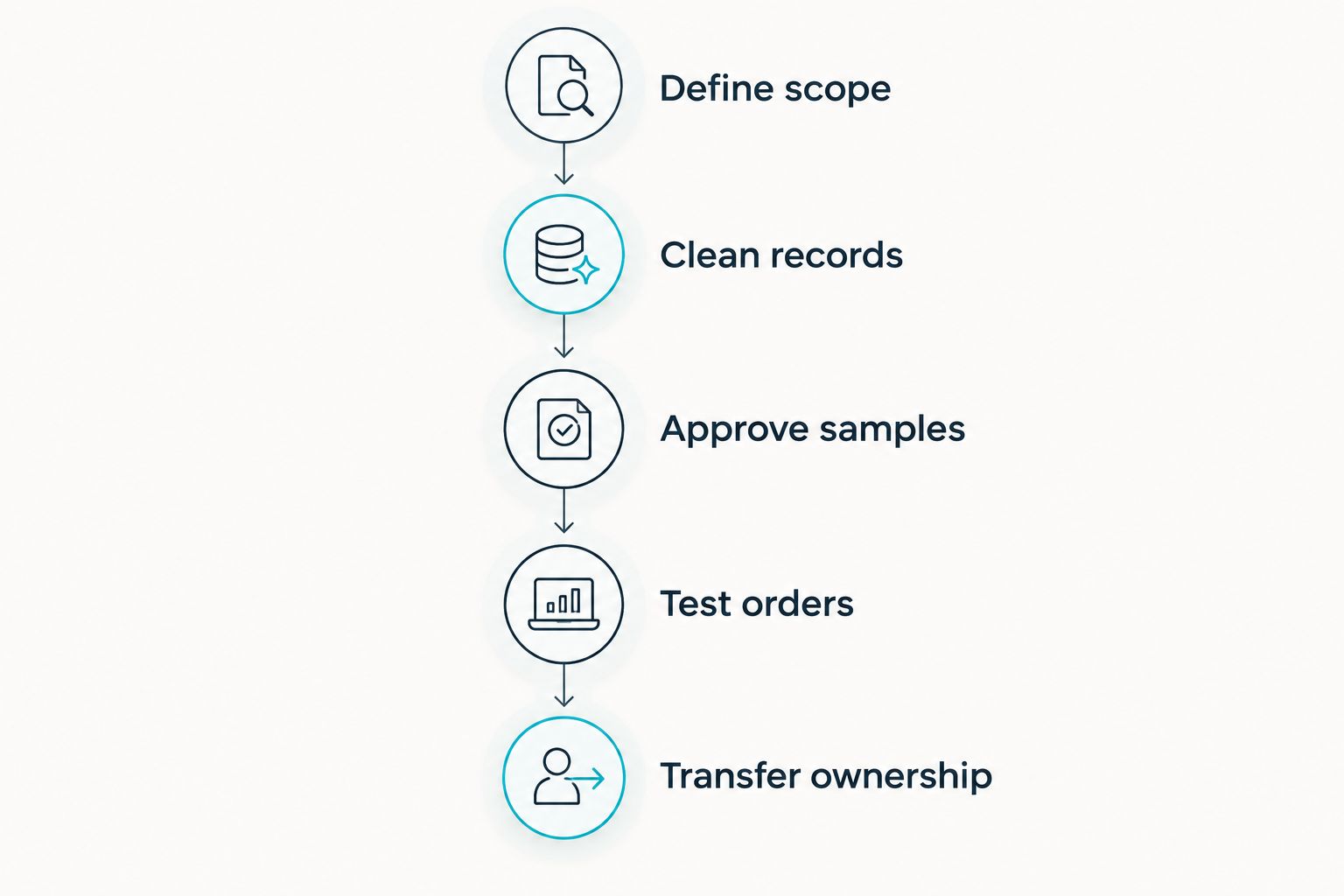
Use the following 5 stages as a transition plan for 2026. Each stage should produce an approved record that the next stage can use.
- Define scope. List the categories, destinations and activities included in the proposed agreement. Distinguish manufacturing from distribution, and distinguish distribution from recipient-level fulfilment. Identify any work your team will retain.
- Clean records. Reconcile item names, artwork versions, sizes and destination details. Mark which specifications are approved and which need a decision. Do not migrate conflicting records as if they were valid alternatives.
- Approve samples. Agree how representative samples or proofs will be reviewed, who can approve them and what constitutes acceptance. Record the approved version against the relevant item before ordering production.
- Test orders. Choose a bounded set of orders that exercises the workflow you intend to use. Include approvals, fulfilment, delivery confirmation and an exception scenario rather than testing only order submission.
- Transfer ownership. Confirm who maintains records, handles changes and resolves exceptions after launch. Move the remaining scope only when the agreed acceptance conditions are met.
The sequence matters because a working ordering interface does not prove that specifications, permissions and delivery responsibilities are correct. Test the complete order journey before treating the handover as finished.
Why the scope of supplier consolidation varies
The right arrangement depends on the responsibilities being transferred. For your 2026 supplier brief, make these factors explicit rather than asking for an undefined end-to-end service.
- Category requirements. State the specifications and approval evidence each category needs. Common administration does not remove product-specific checks.
- Destination coverage. List the countries and delivery destinations in scope. Ask who owns transport arrangements, customs tasks and delivery exceptions for each route.
- Ordering permissions. Identify whether central procurement, local managers or individual recipients can request items. Define approval rights separately from ordering access.
- Inventory ownership. Agree who owns stock, who authorises replenishment and who decides what happens to obsolete branded items.
- Data responsibilities. Specify who maintains SKU records, recipient information and order statuses. Require a clear process for correcting errors and exporting records.
- Transition boundaries. Identify existing commitments, remaining stock and categories that will stay outside the new agreement. Give each boundary an owner.
These factors explain why a supplier relationship can be consolidated commercially while remaining fragmented operationally. The contract and workflow need to describe the same scope.
What should you ask an end-to-end supplier to demonstrate?
Ask for a walkthrough using your order scenarios, not a general capabilities presentation. Follow an approved item from request through delivery, then introduce a change. The response should identify both the system record and the person responsible.
Show the product record
Ask how the supplier distinguishes a garment size, an artwork revision and a replacement item. Check whether an approved item can be changed without the designated owner's permission. A searchable catalogue is useful only when the underlying records are controlled.
Show the exception process
Ask what happens when an item fails approval, a destination changes or a delivery cannot be completed. Require an owner and an escalation route for each scenario. Do not accept a demonstration that stops at successful order submission.
Show the reporting record
Require 4 status fields in your evaluation example: approval status, production status, fulfilment status and delivery status. Treat these as requested reporting requirements, not assumed supplier capabilities. Ask how your team accesses the record and corrects an inaccurate status.
For a 2026 selection process, judge the evidence against your written scope. A polished demonstration should not override a missing responsibility or an unresolved handover condition.
Is Boolanga suitable for a consolidated programme?
Boolanga is best for enterprises seeking one operations partner for branded workwear, uniforms, courier gear and merchandise. Its stated scope covers design, manufacturing, distribution and software, serving enterprise clients across 35+ countries.
That scope makes Boolanga relevant when you want to connect product supply with the operations around it. The limitation is programme specificity: coverage across 35+ countries does not establish the delivery arrangement, reporting configuration or transition requirements for your particular locations.
For Boolanga uniform and merchandise consolidation, confirm the responsibilities attached to each category and destination. Compare the proposed scope against the work your team wants to transfer, including the tasks that remain internal.
Define your consolidation scope
Discuss categories, destinations, ordering responsibilities and the handover requirements for your programme.
Can you consolidate suppliers without replacing every item?
Yes. Supplier consolidation and product replacement are separate decisions; your brief can require existing specifications to remain unchanged while you assess a new operating model. Confirm whether the proposed supplier can meet those specifications before approving a transfer.
Keep existing items in the evaluation until there is a documented reason to change them. Combining a supplier transition with unnecessary product changes makes acceptance harder to assess.
Does one supplier mean one warehouse or one shipment?
No. A single accountable supplier does not, by itself, specify where stock is held or how orders are shipped. Those arrangements belong in the distribution scope.
Ask how the proposed model handles different destinations, category requirements and delivery instructions. Consolidate responsibility without assuming that every physical movement must be combined.
Can local teams keep ordering access?
Yes, if the agreed operating model preserves local ordering permissions. Define what local teams can request, what requires central approval and which records they can change.
Keep ordering access separate from specification ownership. A local manager can be authorised to request approved items without being authorised to change branding or create new variants.
FAQ
Can one supplier handle both uniforms and merchandise?
Yes, when the supplier's agreed scope covers both categories and their supporting operations. Check specifications, ordering, distribution and exception ownership rather than relying on catalogue breadth alone.
What's the best way to start consolidating uniform suppliers?
Start by defining the work you want to transfer and the responsibilities you will retain. Then reconcile product records and test the complete order journey before expanding the scope.
Is an end-to-end supplier better than separate specialist suppliers?
An end-to-end supplier is better suited to a programme seeking shared operational accountability. Separate specialists remain an option when your team intends to retain category-specific coordination and reporting.
Can we keep our existing uniform designs?
You can make existing designs a requirement of the supplier brief. Confirm manufacturing feasibility and approve the relevant samples or proofs before transferring production.
Does consolidation require a new ordering platform?
Not automatically; platform requirements depend on the ordering permissions, records and reporting your programme needs. Establish those requirements before deciding whether a platform change belongs in scope.
Can Boolanga support uniform and merchandise operations internationally?
Boolanga designs, manufactures and distributes branded workwear, uniforms, courier gear and merchandise, and provides supporting software across 35+ countries. Confirm your destinations and required responsibilities against the proposed service scope.
What should we check before signing a consolidated supplier agreement?
Check category scope, approved specifications, inventory ownership, destination responsibilities, reporting access and exception handling. Include handover acceptance conditions and access to your operational records.
One last thing
Before signing a 2026 agreement, ask how you would transfer the programme again. Require access to approved specifications, SKU records, artwork versions and open-order information, with ownership and export arrangements recorded in the agreement.
Consolidate the supplier relationship without surrendering control of the records that make the programme work. That requirement belongs in the initial brief, not in a discussion after the relationship ends.


