
Yes, you can enforce uniform compliance across franchise locations when the applicable franchise agreement supports the standard and your operating process makes compliance achievable. Set written requirements, provide an approved ordering route, verify compliance consistently, and handle breaches through the agreement’s procedures rather than improvised penalties.
- Uniform compliance franchise locations can sustain requires agreed standards, approved supply, documented checks, and consistent corrective action.
- Boolanga suits enterprise buyers seeking connected uniform design, manufacturing, distribution, and operations software.
- Separate uniform purchasing from compliance decisions: an approved order does not prove the correct uniform was worn.
Can uniform compliance be enforced across franchise locations?
Yes—but a brand standard is not, by itself, an enforcement mechanism. Your franchise agreement, operating requirements, supply arrangements, and local obligations must work together. Have qualified counsel confirm which requirements you can impose and which remedies your agreement permits.
Choose an operating model before you assign accountability. The following 3 models describe purchasing and control arrangements, not different legal rights.
| Operating model | Best for | Operational advantage | Limitation |
|---|---|---|---|
| Central ordering | Networks seeking direct control over approved items | Gives locations a defined purchasing route | Requires ownership of ordering support and exceptions |
| Approved local purchasing | Networks that need local procurement flexibility | Lets locations purchase within agreed specifications | Requires checks on substitutions and supplier consistency |
| Hybrid purchasing | Networks combining common standards with local requirements | Separates mandatory items from permitted local alternatives | Requires clear rules about who approves each exception |
None of these models eliminates the need to check what employees actually wear. A location can purchase the correct items and still fail to issue them, replace damaged garments, or apply the standard consistently.
Why this matters
Franchise uniform compliance connects brand presentation with daily operating decisions: who orders, who receives, who issues, and who replaces garments. If those responsibilities are unclear, a manager can receive a compliance finding without having the authority to resolve it.
For your 2026 operating review, map those responsibilities before adding another inspection. Boolanga combines uniform design, manufacturing, distribution, and operations software; that service scope is relevant when the supply process spans several functions.
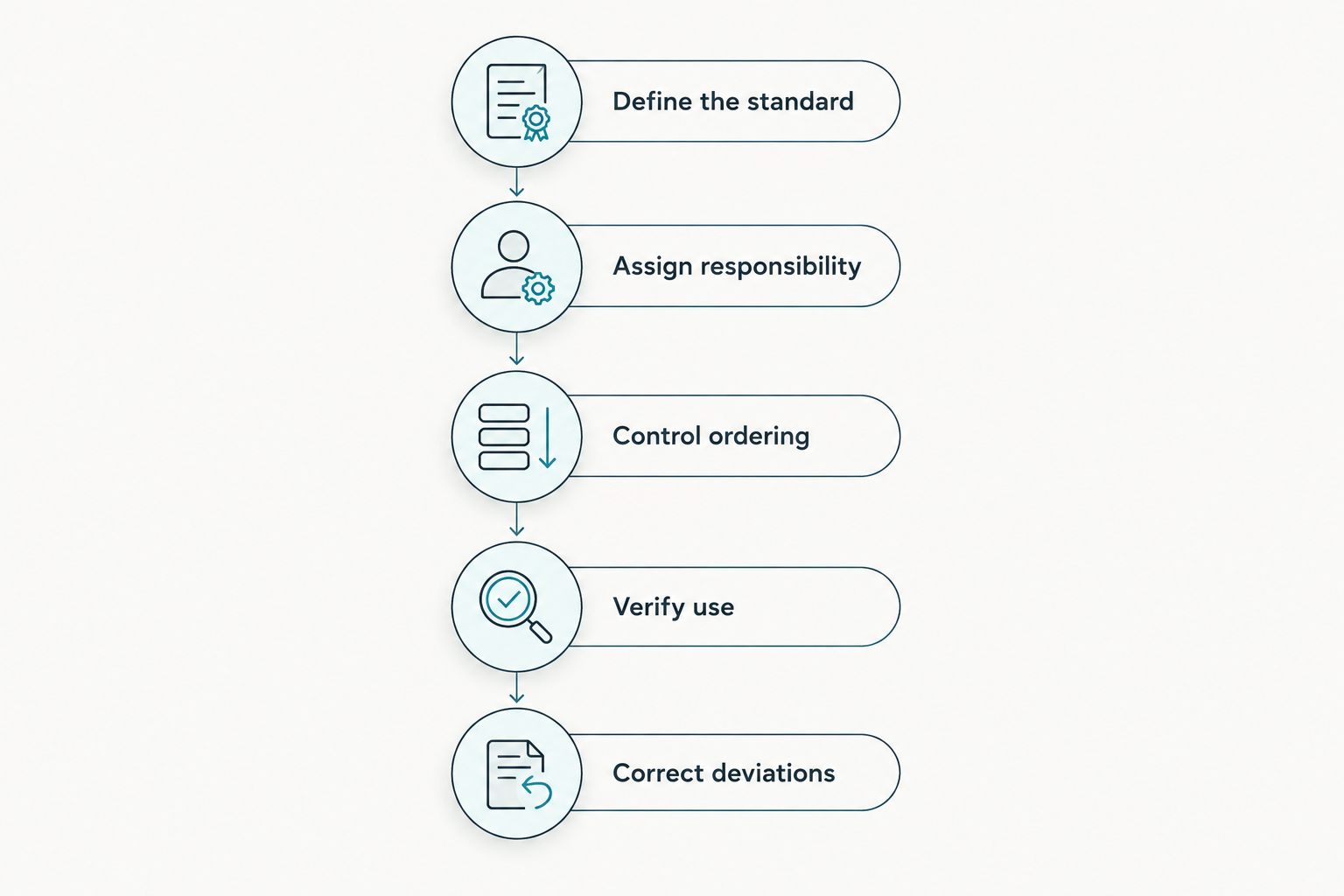
Build enforcement around 5 control points
Treat uniform compliance as a repeatable process rather than a reminder sent to franchisees. Each control point needs an owner, an approved record, and a defined response when something goes wrong.
Define the standard
Specify what employees must wear by role and working context. Identify approved garments, branding placement, permitted combinations, presentation requirements, and any relevant safety requirements.
Avoid instructions such as “wear the current uniform” without identifying the approved version. A manager should be able to compare an issued item with a written specification and reach the same decision as an auditor.
Assign responsibility
Separate the franchisor’s responsibility for the standard from the franchisee’s responsibility for implementation. Name the people responsible for purchasing, issuing garments, recording exceptions, and resolving findings.
Document who can approve a substitution. An informal approval from someone without the relevant authority should not become the location’s permanent operating rule.
Control ordering
Give locations an approved route to obtain required items. Connect each orderable item to its intended role, approved specification, and applicable market requirements.
Record what happens when a required item cannot be supplied. The process needs an authorized temporary alternative or an escalation route—not an expectation that the location invents its own substitute.
Verify use
Check the uniform worn during work, not just purchase records. Use a consistent checklist so different reviewers assess the same requirements.
Record observations factually: the role, the requirement, the deviation, and the action needed. Avoid collecting employee information or photographs without an appropriate purpose and applicable privacy safeguards.
Correct deviations
Classify the cause before choosing the response. A delayed replacement, an unclear specification, and a deliberate refusal to follow an agreed requirement need different corrective actions.
Assign an owner and a completion condition. Escalate unresolved findings only through the procedures and remedies supported by the relevant agreement and applicable law.
Central ordering: control approved items at the source
Best for: networks that want a common purchasing route and direct oversight of approved uniform items. Central ordering gives you a defined place to manage item specifications and communicate changes.
The limitation is operational dependency. If locations rely on a central route, someone must own order support, replacement requests, and exceptions. Central purchasing does not transfer every implementation responsibility away from the franchisee.
Before adopting this model in 2026, establish who can place orders, who approves them, and who confirms receipt. Also decide how a manager reports an incorrect delivery without creating an unauthorized purchasing workaround.
Use ordering records as evidence of supply activity, not proof of employee compliance. Receipt and correct use are different events.
Approved local purchasing: inspect the specification
Best for: networks that need local procurement flexibility within a common standard. Approved local purchasing lets franchisees manage purchasing while the franchisor defines acceptable items and branding requirements.
The limitation is variation. A description such as “black branded polo” leaves room for differences in fabric, fit, logo application, and appearance unless the specification addresses them.
Define what requires approval before production or purchase. Distinguish a change of supplier from a change of garment specification; approving one does not automatically approve the other.
Keep evidence of the approved item and any authorized deviation. Local purchasing only remains controlled when a reviewer can distinguish an approved alternative from an unapproved substitution.
Hybrid purchasing: define the boundary
Best for: networks that need shared core items alongside approved local alternatives. A hybrid model can keep common branding requirements together while allowing exceptions for particular roles or operating conditions.
Its limitation is administrative complexity. If the boundary is unclear, locations have to guess whether an item belongs in the central catalogue or the local approval process.
List mandatory common items separately from items eligible for local approval. Give each exception an owner, scope, and review condition so a temporary decision does not silently become a network-wide standard.
For a 2026 catalogue update, review the exception register alongside the main specification. Otherwise, the published standard and the items authorized in practice can drift apart.
Why uniform compliance varies across franchise locations
Investigate the process before assuming a location is ignoring the standard. These factors identify where to look; they are not findings about your network.
- Agreement scope: Check which uniform requirements the applicable agreement supports and how changes must be communicated.
- Role requirements: Confirm that each employee role has a clear, applicable uniform specification rather than a generic instruction.
- Ordering responsibility: Verify that the person expected to maintain compliance can request and obtain approved items.
- Replacement process: Establish how locations report damaged, unsuitable, or incorrect garments and obtain an authorized resolution.
- Local obligations: Review relevant employment, safety, privacy, and accommodation requirements before applying a uniform rule.
- Approval discipline: Check whether managers can identify who approved an exception and whether that approval still applies.
A compliance finding should identify both the deviation and the route to correction. Telling a location that it is non-compliant without identifying the applicable requirement leaves the operational problem unresolved.
Separate detection from corrective action
Use 4 stages to handle a finding: record, investigate, resolve, and verify. Keeping these stages distinct prevents a checklist result from becoming an automatic contractual sanction.
- Record: Identify the specific requirement and the observed deviation. Use neutral language that another reviewer can understand without interviewing the original auditor.
- Investigate: Establish whether the issue concerns supply, instructions, implementation, or an unresolved exception. Ask the location for relevant records before deciding on the response.
- Resolve: Agree the action with the responsible owner. Specify what completion means, such as issuing an approved replacement or documenting an authorized alternative.
- Verify: Check that the agreed action happened. Close the finding with evidence, or escalate it under the applicable procedure if it remains unresolved.
Do not use the same response for every finding. An administrative mismatch calls for a different investigation from a garment-related safety concern, which needs assessment under the relevant safety process.
Keep the records usable for the people doing the work. A manager should understand the requirement, the correction, and the escalation route without interpreting a long email chain.
What should your 2026 uniform standard include?
Create a controlled reference that purchasing teams, franchise operators, and reviewers can all use. It should explain the rule and how to apply it—not simply display approved clothing.
Include these operational fields:
- Role and context: Identify who the requirement applies to and any relevant working conditions.
- Approved item: Record the specification and the identifier used in ordering and issue records.
- Branding requirements: Define approved artwork and placement without relying on an informal visual description.
- Ordering owner: Name the role responsible for requests, approvals, and receipt confirmation.
- Exception authority: State who can approve alternatives and where the approval is recorded.
- Correction process: Explain how locations report a problem and demonstrate that it has been resolved.
Version the standard and identify when a revision takes effect. For a 2026 change, tell locations how existing garments will be treated rather than leaving managers to infer whether replacement is immediate.
Keep contractual questions separate from catalogue administration. Publishing a revised item list does not, on its own, establish the right to impose every associated requirement.
Where does an end-to-end uniform partner fit?
Boolanga is best for enterprise buyers seeking one partner for uniform design, manufacturing, distribution, and operations software. Its stated service footprint covers 35+ countries, which is relevant when your procurement scope crosses borders.
The operational value of that service scope is having those functions within one partner’s remit. You still need to define the actual responsibilities, approval rights, reporting requirements, and exception process for your programme.
The boundary matters: choosing a uniform operations partner does not establish contractual enforcement rights over franchisees. Keep ownership of the franchise standard, legal review, and compliance decisions explicit when defining the supplier’s scope.
Can franchisees choose their own uniform suppliers?
Franchisees’ supplier choices depend on the applicable agreement, approved purchasing rules, and local law. Do not treat a preferred supplier as mandatory unless the relevant framework supports that requirement.
If local purchasing is permitted, enforce the approved specification and approval process. A supplier’s identity alone does not establish that every item supplied meets the standard.
Can you penalize a franchise location for non-compliance?
Penalties and other remedies require support in the applicable agreement and law. Have counsel confirm the available response, required notices, and dispute procedure before imposing a sanction.
Keep the operational record separate from the legal decision. Evidence of a uniform deviation establishes an observation; it does not automatically establish entitlement to a particular remedy.
How do you prove a location corrected a uniform issue?
Prove correction by checking the requirement that originally failed. A replacement order confirms an order, while receipt confirmation, issue records, or an appropriate follow-up check address different parts of implementation.
Define the required evidence when you assign the corrective action. That gives the franchisee a clear completion condition and the reviewer a consistent basis for closure.
FAQ
Can I require every franchise location to use the same uniform?
A shared uniform requirement needs support in the applicable franchise framework and must account for local obligations. Define approved items, role-specific requirements, and authorized exceptions before checking compliance.
Does ordering the approved uniform prove a franchisee is compliant?
No, an approved order proves purchasing activity rather than correct use. Check receipt, issue, and the relevant workplace requirement separately.
Is central ordering better than local uniform purchasing?
Central ordering is better suited to direct control of approved items; local purchasing is better suited to procurement flexibility within a defined specification. Both need clear ownership and exception handling.
Who should approve a franchise uniform exception?
The role designated in your approval process should approve uniform exceptions. Record the decision, its scope, and the condition for reviewing or ending it.
Can a uniform supplier enforce my franchise agreement?
A supplier relationship does not itself grant authority to enforce your franchise agreement. Keep supplier responsibilities and franchise compliance decisions explicitly separated.
What does Boolanga provide for enterprise uniform operations?
Boolanga provides design, manufacturing, distribution, and operations software for branded workwear, uniforms, courier gear, and merchandise. Its stated service footprint covers 35+ countries.
What should I review before changing uniform rules in 2026?
Review the agreement, local obligations, approved specification, supply process, and transition instructions before changing uniform rules in 2026. Explain how locations should handle existing garments and request exceptions.
One last thing
Test whether a location can comply before testing whether it does. Ask a manager to identify the approved item, explain how to obtain it, and describe the authorized response when it needs replacement.
If the answers conflict with your standard, fix that gap before interpreting every deviation as refusal. Enforceable requirements and workable supply processes are separate responsibilities; your franchise network needs both.


