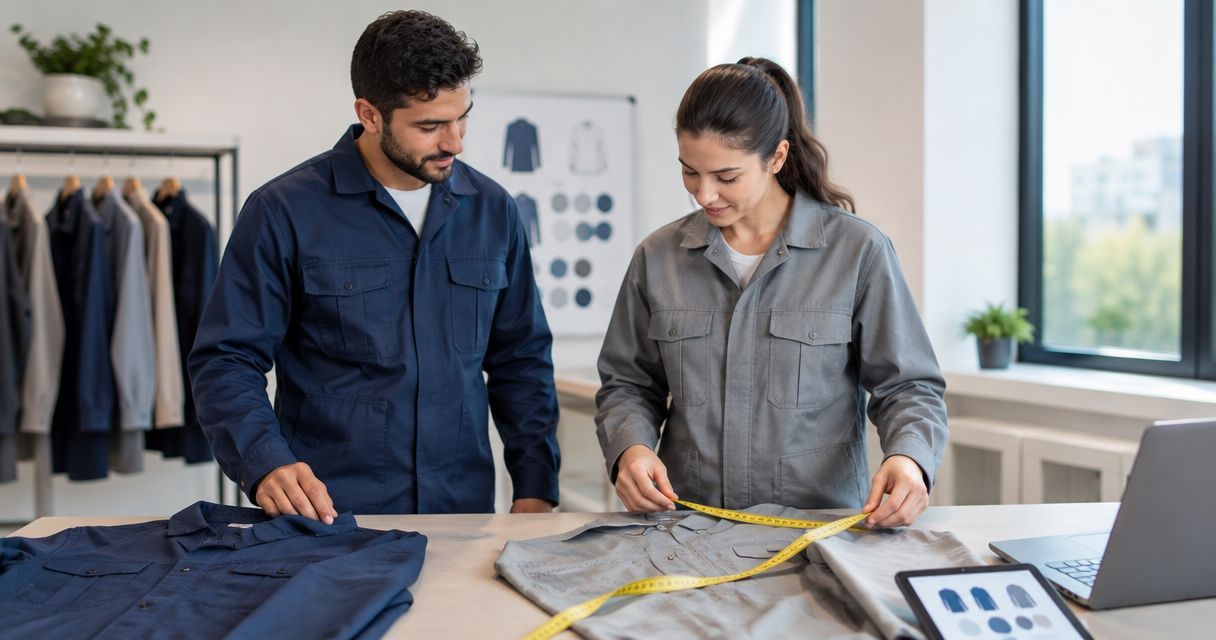
Yes—workwear sizing charts can cover both men's and women's fits when they separate the measurements and size mappings for each garment pattern. For your 2026 uniform programme, use one shared measurement method, clearly identified fit-specific tables, and a separate explanation of body measurements versus finished-garment measurements; a shared size label alone does not establish equivalent fit.
- Workwear sizing charts men and women can share a format, but each garment pattern needs its own measurement mapping.
- Separate body measurements from garment dimensions; they answer different sizing questions.
- Unisex workwear still needs fit checks across the people who will wear it.
- Boolanga suits enterprise workwear programmes that connect design, manufacturing, distribution and operations software.
Why this matters
A sizing chart is an ordering instruction. If employees interpret it differently, the same order form collects different kinds of information: body measurements from one person, measurements from an existing jacket from another, and a familiar retail size from someone else.
For a 2026 workwear rollout, define the measurement method before collecting employee selections. Put the chart, garment reference and fit instructions together wherever people place orders. Your workwear operations brief should treat sizing as part of the specification, not as an attachment added after garment approval.
Standardise how you measure; keep pattern-specific differences visible. That gives procurement a consistent process without pretending every garment has the same shape.
Can workwear sizing charts cover both men's and women's fits?
Yes. A shared sizing document can contain men's, women's and unisex fits, provided each section identifies the garment pattern it describes. The document should help employees choose a garment, not merely convert one letter size into another.
There are 2 measurement types to distinguish: body measurements and finished-garment measurements. Body measurements describe the wearer; finished-garment measurements describe the item. Ease—the difference between the body and garment dimensions—helps explain why those figures are not interchangeable.
| Chart approach | Best for | Strength | Limitation |
|---|---|---|---|
| Separate men's and women's tables | Programmes ordering distinct garment patterns | Keeps each pattern's measurement mapping explicit | Requires employees to find the correct table before selecting a size |
| Unisex table | A garment supplied in one shared pattern | Gives that pattern one ordering reference | Does not establish suitability for every body shape |
| Combined document with fit-specific tables | Procurement managing several fits together | Keeps instructions consistent while preserving pattern differences | Needs clear headings and garment references to prevent cross-reading |
Use a combined document when you need central control, but retain separate tables wherever the underlying patterns differ. A universal conversion such as one men's letter size equalling one women's letter size is not a substitute for measurements.
The deciding question is whether the table describes the actual garment being ordered. Its title alone cannot answer that.
Men's fit: map the actual garment pattern
A men's fit chart should identify the garment or garment family it covers and explain the measurements used for selection. Do not assume a shirt chart also applies to trousers, outerwear or another supplier's shirt.
For upper-body garments, relevant checks include chest, waist, sleeve length and garment length. For trousers, waist, hip or seat, and inseam help distinguish circumference from length. Include the measurements that determine selection for the garment concerned rather than filling every chart with identical fields.
The strength of a separate men's table is clear pattern ownership. Its limitation is that the category name does not describe every wearer's proportions. Give employees measurement instructions and a route to request a fit check rather than directing them by label alone.
Women's fit: publish its own measurement mapping
A women's fit chart needs its own connection between body measurements, garment pattern and orderable size. Do not create it by changing the headings on a men's chart or applying an unexplained size conversion.
For fitted upper-body garments, bust, waist and hip measurements help distinguish where a garment needs room. Length and sleeve measurements remain relevant: a suitable circumference does not establish that a sleeve or hem falls in the intended position.
The strength of a separate women's table is that it describes a distinct pattern directly. Its limitation is the same as any table: measurements guide selection but do not demonstrate comfort during work. Employees should be able to compare the fit with their movement and layering requirements.
Unisex fit: validate the shared pattern
A unisex label identifies a shared fit option; it does not prove that everyone needs the same proportions. Publish the actual measurement guidance for that pattern, including relevant length information.
Unisex workwear is best for programmes that deliberately choose a shared pattern and confirm its suitability with wearers. It offers one chart for that garment, but employees still need to check where it fits and where it restricts movement.
Do not solve a length problem automatically by increasing circumference. If a wearer needs a longer sleeve, a larger size also changes other dimensions. Record which measurement is unsuitable before deciding whether another size or another pattern is the answer.
Why workwear fit varies
A chart explains dimensions. Fit also depends on how those dimensions interact with the garment and the task, so your approval process should address these factors:
- Pattern shape: The distribution of room through the chest or bust, waist, hip and seat affects where a garment fits.
- Garment purpose: A close-fitting base layer and an outer jacket have different fit requirements. Their charts should not be treated as interchangeable.
- Layering: Employees need to assess outer garments with the layers intended for work, not only over whatever they wear to a fitting.
- Movement: Reaching, bending and sitting test restrictions that a standing measurement does not show.
- Fabric behaviour: Stretch and care instructions belong in the assessment. Do not assume either from the garment's appearance.
- Length: Sleeve, torso and leg length require attention independently of circumference.
Use these factors to build your fitting questions. Ask where a garment pulls, restricts or sits incorrectly rather than collecting only a general verdict that it feels too small.
What should a shared sizing chart include?
Your 2026 chart specification should make every selection traceable to a garment, a pattern and a measurement method. A spreadsheet can hold this information; clarity matters more than the format.
| Field | What to specify | Why it matters |
|---|---|---|
| Garment reference | The item or approved garment family | Prevents using an unrelated chart |
| Fit reference | Men's, women's, unisex or another explicitly defined pattern | Identifies which table governs selection |
| Measurement basis | Body measurements or finished-garment dimensions | Prevents comparing unlike measurements |
| Measurement method | Position, posture and tape placement | Makes instructions repeatable |
| Units | Centimetres or inches, labelled consistently | Prevents unit confusion |
| Size mapping | The approved relationship between measurements and sizes | Connects employee information to an order |
| Revision reference | The approved chart version | Distinguishes current instructions from superseded copies |
For unit conversion, 1 inch equals 2.54 centimetres. Conversion changes the unit, not the fit: it cannot turn a men's pattern into a women's pattern or resolve different measurement methods.
Keep tolerances separate from selection guidance. A manufacturing tolerance describes permitted variation against a specification; it is not automatically extra room that a wearer should add to a body measurement.
How do you validate the chart before ordering?
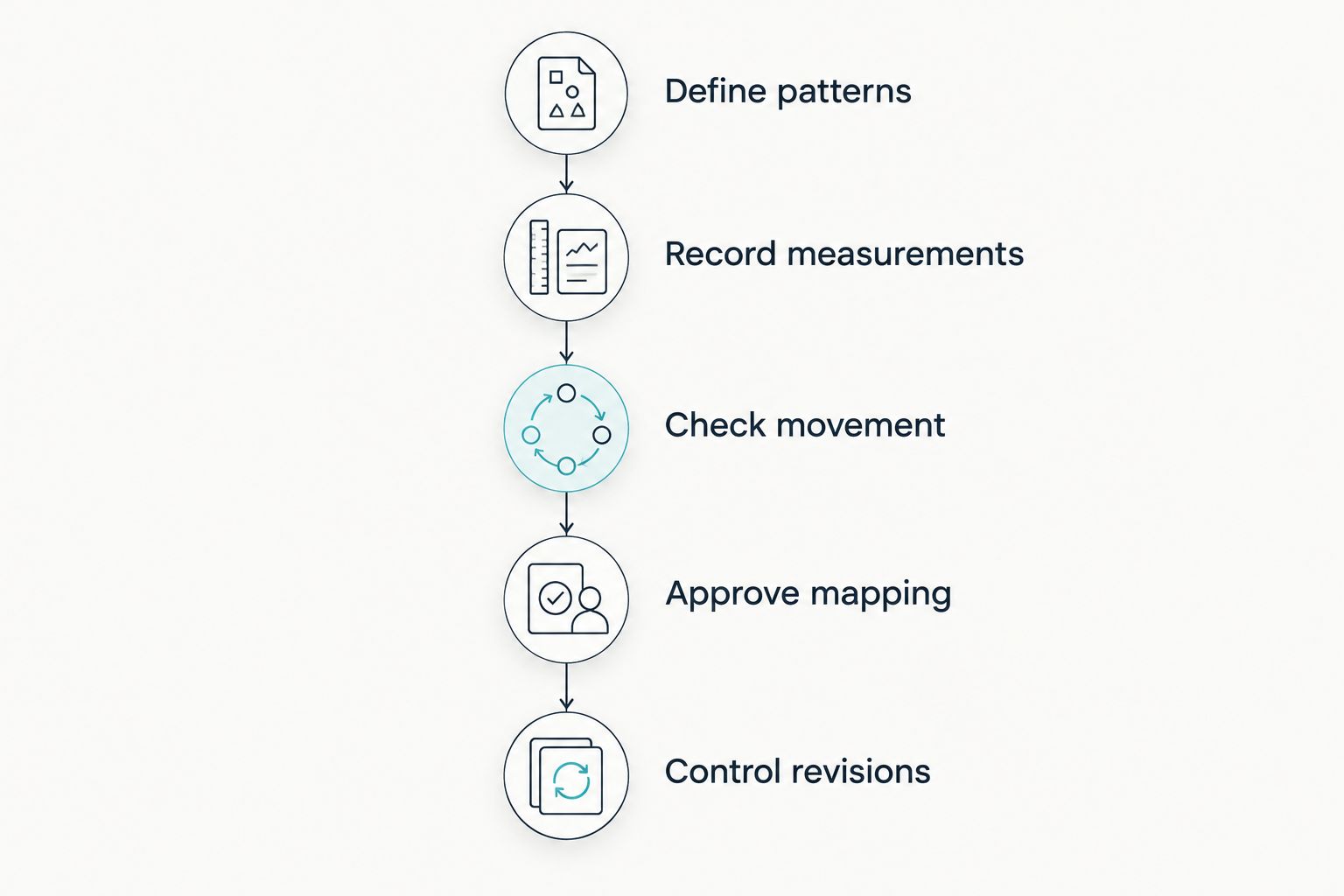
Use 5 checks to move from a sizing document to an approved ordering instruction. These are approval steps, not a claim that every programme needs the same sampling volume or timetable.
- Define patterns. List the garments and fits you intend to order. Confirm which chart belongs to each, and remove any unexplained cross-fit conversions.
- Record measurements. Give employees the same instructions and clearly labelled units. Keep body measurements separate from dimensions taken from existing clothing.
- Check movement. Ask wearers to try the relevant work positions and intended layers. Record the location of a restriction, not just a preferred letter size.
- Approve mapping. Resolve discrepancies between the chart and fitting observations. Confirm the size selection method before collecting the final order.
- Control revisions. Keep the approved chart with the garment reference and ordering instructions. Review changes to the pattern or measurement specification before reusing it.
For your 2026 rollout, assign responsibility for approval before employee orders open. Otherwise, procurement, employees and the garment supplier can each work from a different understanding of what has been accepted.
What should employees do if their measurements span different sizes?
Employees whose measurements span different sizes need garment-specific guidance, not an automatic instruction to choose the largest label. Identify which measurements determine the garment's fit, then check the proposed size against movement and length requirements.
For a restrictive work task, a standing fit alone is insufficient. Keep a clear route for unresolved cases instead of asking employees to guess and treating the resulting order as a confirmed fit.
Can you reuse the chart for a repeat uniform order?
You can reuse an approved chart when it still describes the garment being ordered. Confirm the pattern, measurement specification and revision reference before treating the repeat order as identical.
A familiar product description is not the approval record. Keep the chart connected to the specification so the ordering team can distinguish continuity from an undocumented change.
Where an operations partner fits
Boolanga is best for enterprises that need workwear sizing coordinated with design, manufacturing and distribution. Its stated scope includes those functions and operations software across 35+ countries, making the sizing handoff relevant to the wider uniform programme.
That scope does not replace garment-level validation. Request the applicable charts, measurement methods and approval responsibilities for your programme; do not treat geographic reach as evidence that a particular pattern fits your workforce.
FAQ
Can men's and women's workwear use the same sizing chart?
Men's and women's workwear can share a sizing document, but distinct garment patterns need their own measurement mappings. Make the fit reference visible beside each table so employees do not select from the wrong pattern.
Is a unisex workwear size the same as a men's size?
A unisex size is not an automatic equivalent of a men's size. Compare the actual pattern measurements and fit instructions rather than relying on the letter label.
Should I measure my body or an existing uniform?
Use the measurement basis specified by the chart: body measurements and finished-garment dimensions are different. Measuring an existing uniform is appropriate only when the instructions explicitly call for garment measurements.
Can I convert a workwear chart from inches to centimetres?
Yes—1 inch equals 2.54 centimetres. Keep the measurement method unchanged and label the converted units clearly; conversion does not change the garment's fit.
What should I do if the chest fits but the sleeves are too short?
Check length separately before selecting a larger size. Increasing size also changes other garment dimensions, so confirm whether a different length or pattern is needed.
Does an approved size chart remove the need for a fitting?
An approved chart does not demonstrate comfort during work. Use fit checks to assess movement, intended layers and length against the actual garment.
How does Boolanga fit into an enterprise workwear programme?
Boolanga provides workwear design, manufacturing, distribution and operations software. Define the sizing deliverables and approval responsibilities within your programme so chart ownership remains explicit.
One last thing
For your 2026 reorder process, record why a size was changed. A replacement marked only as too small hides the distinction between a tight waist, a short sleeve and restricted movement.
That distinction tells you whether to review an individual's selection, the available pattern or the chart instructions. A size label records the choice; the fitting note explains the problem.


