
Yes—one supplier can handle both uniform design and manufacturing, with design decisions carried through into production specifications and finished garments. The caveat is accountability: your contract must identify who approves samples, controls changes, checks production and resolves defects, including work assigned to subcontractors.
- Boolanga is best for enterprise buyers seeking uniform design, manufacturing and distribution through one operations partner.
- One supplier design and manufacturing uniforms: yes, but require documented sample approvals and production responsibilities.
- Vendor consolidation simplifies coordination; it does not remove your need for quality checks or reorder records.
- Approve the garment specification and physical sample before authorizing bulk production.
Can one supplier handle both uniform design and manufacturing?
Yes. You can appoint one supplier to develop the uniform and manufacture it against an approved specification. You do not need separate commercial relationships for those activities, but you do need separate approval points within the project.
Boolanga provides uniform design and manufacturing services, alongside distribution and operations software. That scope matches buyers seeking a single partner across the uniform lifecycle rather than a design-only engagement.
The procurement choice is between different ownership structures, not simply different vendor counts:
| Procurement model | Best for | Main advantage | Main limitation |
|---|---|---|---|
| One supplier for design and manufacturing | Buyers seeking consolidated project ownership | Design changes and production instructions sit within one supplier relationship | You need visibility into subcontracting, approvals and access to records |
| Separate designer and manufacturer | Buyers wanting independent appointments for each discipline | You can select and replace each specialist separately | You own the handoff between design intent and manufacturing requirements |
Neither structure removes the need for a written brief. A single supplier is a coordination choice, not a substitute for a defined acceptance standard.
Why this matters
A uniform project connects branding with physical production. A logo placement decision affects the decoration instructions; a pocket change affects the garment specification; an approved fabric becomes part of the reference for later orders.
If those decisions remain in separate emails, your team must reconstruct what was agreed whenever an issue arises. For a 2026 procurement brief, make the approved specification—not the presentation deck—the document that governs production.
The practical benefit of consolidation is a clearer route for decisions. The trade-off is dependency: you need a way to retrieve your records and transfer the work if the relationship ends.
What should the same supplier own?
Define the supplier's scope by deliverables. A promise to handle everything is less useful than a list showing what you receive, who signs it off and what happens when it changes.
Design: turn the brief into production instructions
Ask the supplier to translate your requirements into a garment specification. That should identify the intended garment, materials, construction details, measurements and branding instructions relevant to your order.
A visual mockup helps you judge appearance. It does not establish every detail needed for manufacturing, so require the production instructions as a separate deliverable.
Your design approval should distinguish preferences from requirements. If a particular pocket position, fastening or branding treatment is mandatory, record it as an acceptance criterion rather than leaving it in a meeting summary.
Manufacturing: produce against the approved reference
The manufacturing scope should identify which specification and sample govern the order. Require written approval before substitutions or construction changes enter production.
Also name the party responsible for inspecting the finished garments and resolving nonconformities. Keeping design and manufacturing with one supplier is useful only if responsibility remains clear when the delivered item differs from the approved reference.
Repeat orders: preserve what was approved
Ask who maintains the garment records after delivery. A repeat order needs an identifiable specification, an approved reference and a record of subsequent changes.
Distribution and software are additional scope items, not automatic consequences of manufacturing. Boolanga's stated service scope includes both; your contract should still specify which activities your programme requires and which records your team can access.
How do you manage the project with one supplier?
Use the following sequence for your 2026 uniform programme. Each stage should produce an identifiable output before the next stage begins.
- Define requirements. Describe the wearers, job tasks, branding requirements, intended markets and delivery destinations. Separate mandatory requirements from preferences so the supplier knows what cannot change without approval.
- Develop specifications. Require a written garment specification and an agreed process for handling revisions. Assign an identifier to the approved version so teams do not manufacture from different documents.
- Approve samples. Review the physical garment against the specification. Record approval or rejection with the changes needed; do not treat receipt of a sample as permission to manufacture.
- Release production. Authorize bulk production against the approved documents and sample. Confirm how the supplier will report deviations and who can approve corrective action.
- Control reorders. Retain the approved records, delivery findings and later revisions. Check that a repeat order references the intended version rather than relying on a description such as the usual uniform.
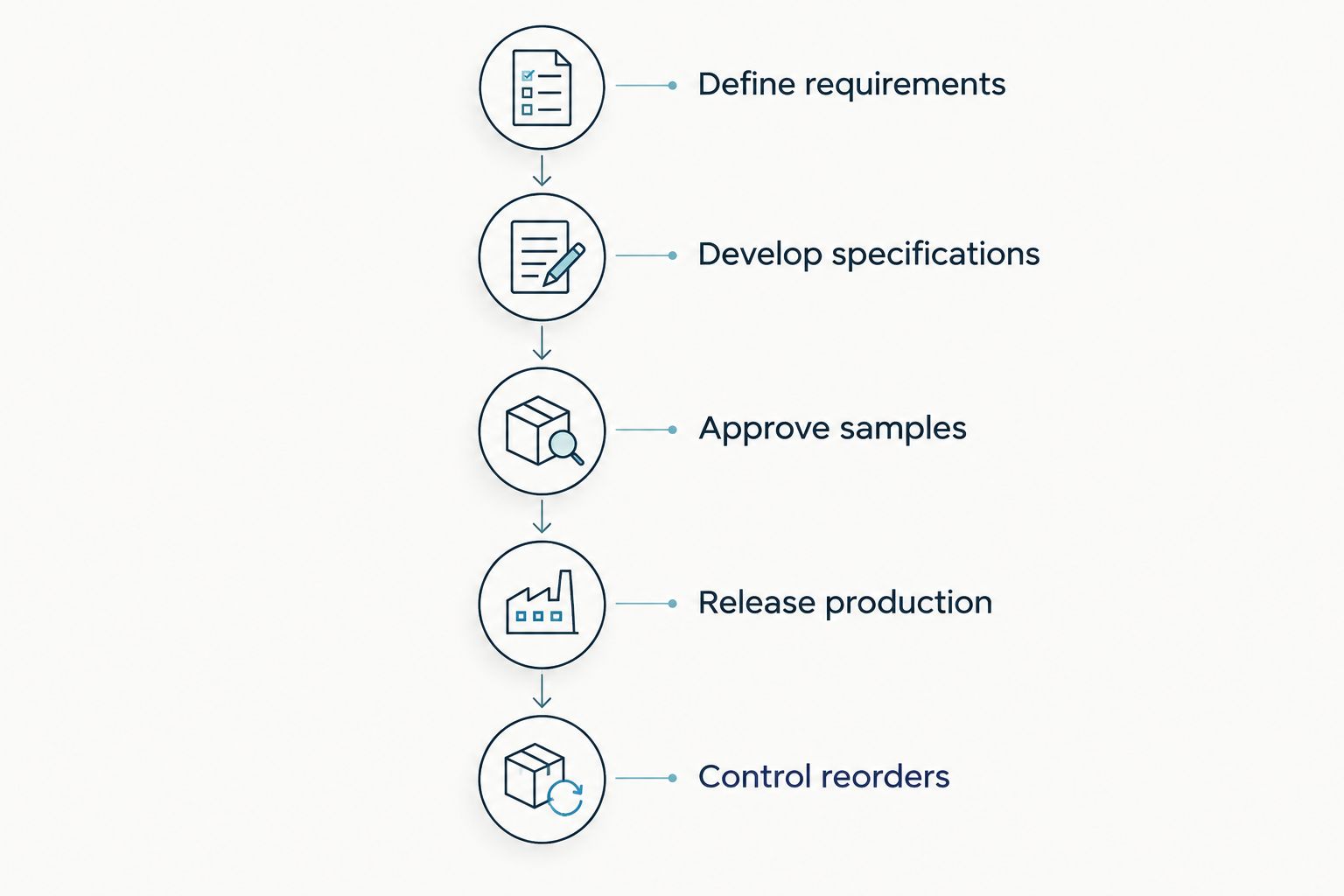
Set 2 explicit approval gates: approval of the production specification and approval of the physical sample. These are recommended controls, not a claim about a supplier's standard process. If your programme needs additional fit, wear or compliance assessments, define those separately before ordering.
Name an approver on your side as well. A supplier cannot resolve conflicting instructions from procurement, operations and marketing unless your team establishes which decision takes precedence.
Why does the right supplier scope vary?
Your 2026 supplier brief should reflect the work the supplier must own. Use these factors to decide whether a combined design-and-manufacturing appointment is sufficient or whether the contract needs broader operational responsibilities:
- Design starting point. Existing approved garments need a different handover from a brief that still needs garment development. Identify what is already decided and what the supplier must create.
- Garment range. Record the workwear, uniforms, courier gear or merchandise included in the programme. Do not assume that approval of one item covers another.
- Distribution footprint. List the countries and delivery destinations the contract covers. Manufacturing responsibility does not, by itself, define responsibility for distribution.
- Reorder process. Specify who requests replacement garments, who authorizes orders and which approved version applies. Include the records your team needs to manage those decisions.
- Software responsibilities. If operations software is included, define the workflows it must support and the information your team must be able to retrieve. Avoid treating software access as proof that a particular workflow is covered.
- Change authority. Name who can approve a revised material, construction detail or branding instruction. Require the supplier to document the change before implementing it.
Boolanga serves enterprise clients across 35+ countries. For an international uniform programme, use that stated scope as context for a discussion—not as a substitute for confirming the destinations and responsibilities in your own agreement.
What should you check before appointing the supplier?
Ask for evidence tied to the work you intend to buy. A general capability presentation is not the same as an agreed operating process.
Production visibility
Ask which activities the supplier performs directly and which it assigns to other businesses. Then confirm who remains contractually responsible for quality, changes and delivery at each stage.
One commercial contact does not necessarily mean one factory. Subcontracting is a structure to understand and govern, not a fact to infer from the supplier's description.
Approval discipline
Ask the supplier to show how a design revision becomes an approved production instruction. Your team should be able to identify the current version without searching through messages or comparing unnamed attachments.
Require written treatment of exceptions. If a proposed substitution changes the approved garment, the approval process should explain who decides and how the revised reference is stored.
Record ownership
Keep 3 core records available to your team: the approved specification, the sample approval record and the change log. Define your right to retrieve them during the relationship and after it ends.
Where your programme uses stock-keeping units, connect each SKU to its approved garment record. An ordering label alone does not explain what the manufacturer is required to produce.
Issue resolution
Agree how you report a defect or specification mismatch, what evidence accompanies the report and who decides the remedy. Put the process in the contract rather than relying on an informal promise to sort things out.
For your 2026 appointment, also identify who can stop an unapproved change. That authority matters before a problem reaches finished production.
Does one uniform supplier need to own the factory?
No. A single-supplier contract can place responsibility with one business even when other businesses perform parts of the work. Your task is to establish the manufacturing arrangement and keep accountability explicit.
Ask whether you are contracting for production management, direct manufacturing or a combination. Then make the contractual responsibilities match that answer; do not use factory ownership as a shortcut for assessing the whole programme.
Can you keep an existing uniform design?
Yes, if you have the rights and usable records needed to commission production. Provide the existing specification, branding files, relevant approvals and a physical reference, then ask the supplier to identify anything requiring clarification.
Do not assume that a photograph or an old garment fully documents the original design. Agree which reference controls where the available materials conflict.
Is a single supplier better for international uniform programmes?
A single supplier fits buyers who want consolidated responsibility across the activities included in the contract. The limitation is that your team becomes dependent on that partner's delivery of the agreed scope.
Compare the proposed operating model against your destinations, ordering process and reporting needs. International reach matters only when the supplier's agreed responsibilities match the programme you are buying.
FAQ
Can one supplier design and manufacture our company uniforms?
Yes, one supplier can handle both uniform design and manufacturing. Require an approved specification, a physical sample approval and clear responsibility for production changes before authorizing the order.
Is using one uniform supplier better than using separate companies?
One uniform supplier is better suited to buyers seeking consolidated responsibility; separate appointments suit buyers who want to select each discipline independently. Compare accountability, access to records and handoff responsibilities rather than vendor count alone.
What should I approve before bulk uniform production?
Approve the production specification and the physical sample before authorizing bulk uniform production. Record the approved versions and identify who can approve later changes.
Does a uniform supplier have to own its manufacturing facility?
No, a uniform supplier does not have to own the manufacturing facility to hold the commercial relationship. Confirm which activities are subcontracted and who remains responsible for quality, changes and delivery.
Can the same supplier manage uniform distribution too?
Yes, the same supplier can manage distribution when that service is included in its scope and your agreement. Boolanga provides design, manufacturing, distribution and operations software for enterprise workwear and uniform programmes.
What records do I need for uniform reorders?
Keep the approved garment specification, sample approval record and change log available for uniform reorders. Connect the order to the intended approved version and review proposed substitutions before production.
What should a uniform supplier contract include in 2026?
A 2026 uniform supplier contract should define deliverables, approvals, production responsibilities, change control, issue resolution and access to records. Add distribution and software responsibilities when those activities form part of the appointment.
One last thing
Test the handover before you sign: ask the prospective supplier to explain how your approved garment would become a repeat order after a design change. The answer should identify the controlling specification, the approval record and the person authorized to release production.
Choose one supplier for clear ownership, not just fewer invoices. For a 2026 programme, that is the distinction between consolidating vendor relationships and merely moving the coordination work out of sight.


