
Yes, workwear can be both flame-resistant and branded, provided the decoration is compatible with the garment’s protective requirements and the manufacturer permits the modification. A flame-resistant base garment does not automatically make an added logo, backing, thread or transfer suitable. For your 2026 procurement specification, approve the finished garment—not just the undecorated fabric.
- Flame resistant branded workwear needs approval for the finished garment, including its logo materials and placement.
- Embroidery, transfers and patches require garment-specific checks; no decoration method is automatically acceptable.
- Boolanga suits enterprise branded workwear operations; require separate evidence for any flame-resistant garment specification.
- Keep protective clothing requirements, decoration instructions and laundering guidance together for every approved SKU.
Can workwear be both flame-resistant and branded?
Yes. The deciding issue is whether the branded garment still meets the protection required for the job. You need evidence covering the garment specification and the proposed decoration, rather than a general statement that the underlying fabric is flame-resistant.
Keep the responsibilities separate: your safety team defines the hazard and required protection; the garment manufacturer confirms permitted modifications; the decorator follows the approved specification. Procurement controls which version reaches employees.
Boolanga provides enterprise branded workwear design, manufacturing, distribution and operations software. That operational scope is relevant to coordinating a uniform programme, but it is not evidence that a particular garment or decoration meets a flame-protection requirement.
For a 2026 order, make acceptance conditional on these checks:
- Identify the workplace hazard and required garment performance.
- Select a garment with documentation matching that requirement.
- Submit the exact decoration materials, dimensions and position for approval.
- Obtain written confirmation covering the proposed modification.
- Preserve the approved specification through production, reorders and laundering.
A sample that looks correct is useful for checking appearance. It cannot replace the evidence needed to assess protective performance.
Why this matters
A logo adds materials to protective clothing. Depending on the process, those additions include embroidery thread, backing, adhesive, ink, film or a separate patch. Their behaviour under heat must be considered alongside the garment itself.
Branding also changes how you manage the product. If one decorator substitutes a backing or moves a logo, the delivered garment no longer matches the approved specification—even when the artwork looks identical.
Treat branding as a controlled garment modification, not an unrestricted finishing service. That rule gives purchasing, safety and production teams the same acceptance criteria.
Which branding methods can you assess?
Embroidery, heat-applied transfers and sewn patches are options to assess with the garment manufacturer. None earns automatic approval because of its process name, appearance or use on ordinary uniforms.
The table identifies procurement trade-offs, not a ranking of protective performance. The best method is the one supported for your exact garment and use.
| Decoration option | Best for | Operational advantage | Limitation to resolve |
|---|---|---|---|
| Embroidery | Approved stitched branding specifications | Defines a repeatable design through thread, stitch and backing instructions | Thread, backing, placement and the effect of stitching require assessment |
| Heat-applied transfer | Approved surface-applied artwork | Keeps artwork and application instructions together in a repeatable specification | Film, adhesive and application conditions require confirmation |
| Sewn patch | Approved separately produced identity badges | Allows the badge specification to be controlled separately from the garment | Patch materials, stitching and placement all require assessment |
Embroidery: check the complete stitched construction
Do not approve embroidery based on thread alone. Ask which thread, backing and other retained materials are permitted, and whether the proposed logo position is acceptable.
Give the manufacturer the artwork dimensions and intended location before decoration starts. Keep those details with the production specification so a later order does not introduce a different construction under the same SKU.
Embroidery provides a defined stitched identity mark, but it also adds material and penetrates the garment. Approval must address that actual construction rather than the word embroidery on a purchase order.
Heat-applied transfers: approve the material and application process
A transfer includes more than the visible design. Its film, adhesive and application instructions belong in the approval package.
Ask whether the garment manufacturer permits the specified transfer and its application conditions. Do not substitute a transfer used successfully on ordinary cotton uniforms without confirming its suitability for the protective garment.
A transfer specification can make artwork reproduction straightforward. Its limitation is that visual consistency alone says nothing about compatibility with the garment’s protective requirements.
Sewn patches: assess the badge and attachment together
A patch is a separate component attached to the garment. Its face material, backing and attachment method all need to be considered.
Specify the patch dimensions and location, then obtain confirmation for that arrangement. An approved patch material does not automatically approve every possible placement or attachment technique.
A patch helps separate badge production from garment production. The trade-off is another component whose identity and construction must remain controlled across repeat orders.
Which protective requirements belong in the specification?
Start with the workplace risk assessment, not the logo catalogue. Flame exposure, welding hazards and electric-arc hazards are not interchangeable purchasing categories.
For a 2026 specification, distinguish the relevant standards by scope:
- ISO 11612 addresses protective clothing against heat and flame. Its performance classifications matter; the standard name alone is not a complete garment specification.
- ISO 11611 addresses protective clothing for welding and allied processes. Do not treat a general flame-resistant description as a substitute for welding-specific requirements.
- IEC 61482-2 addresses protective clothing against the thermal hazards of an electric arc. Flame resistance alone does not establish that a garment is suitable for the assessed arc hazard.
Use the applicable edition and conformity requirements for the market where the clothing will be used. Your safety or compliance lead should confirm the required protection and documentation before purchasing approves the order.
These references define different scopes; they are not a checklist that every garment must satisfy. Select the requirements that match the work, then verify the finished branded garment against that specification.
Do not translate a fabric claim into a finished-garment claim. Fabric information is part of the evidence, not permission to modify the garment without further checks.
Why approval for flame-resistant branding varies
Approval depends on the exact garment and modification. A decoration accepted for one construction does not establish acceptance for another.
- Hazard and performance requirement: the intended work determines which protection the finished garment must provide.
- Garment construction: fabric, closures, seams and protective features form the base product being assessed.
- Decoration materials: thread, backing, adhesive, film and patch materials introduce additional components.
- Logo dimensions and position: branding must follow the permitted arrangement and must not interfere with protective features or required markings.
- Application method: stitching and heat application introduce different modifications that need their own instructions.
- Care and repair: laundering and repairs must remain consistent with the approved garment and decoration instructions.
Ask for a specific decision: approved as submitted, approved with stated changes, or not approved. A generic assurance that branding is possible does not resolve any of these variables.
Can you add a logo to an existing flame-resistant uniform?
Yes, if the garment manufacturer confirms that the proposed modification is permitted and explains what evidence or assessment is required. Do not assume a garment already in service can be decorated under the same conditions as a newly manufactured item.
Check the garment’s identity, condition and care history before proposing the change. Missing labels or an uncertain product specification make it harder to establish exactly what is being modified.
Does flame-resistant embroidery make the whole logo compliant?
No. A thread claim does not establish the suitability of the backing, patch, placement or finished garment. Assess all retained components and the complete decoration arrangement.
Ask for confirmation tied to the exact garment and artwork specification. A material certificate without that connection leaves the main procurement question unanswered.
Can branded flame-resistant clothing also provide arc protection?
Yes, when the finished garment meets the electric-arc protection requirements identified for the work. A flame-resistant label alone does not establish arc protection.
Specify the required arc-related performance separately and confirm how the branding affects the supporting evidence. Do not let a shared logo specification erase differences between workers’ protective clothing requirements.
How to control the order from artwork to replacement
Your 2026 ordering process should make an approved garment reproducible. Keep the safety decision connected to the product record rather than leaving it in an email that production cannot find.
Define requirements
Record the job, hazard assessment, required protection and intended market. Separate appearance preferences from mandatory protective requirements so a branding change cannot silently override a safety requirement.
Approve decoration
Submit the garment reference, artwork, dimensions, position, materials and application method together. Ask the responsible manufacturer or conformity specialist to identify whether additional assessment or testing is required.
Control production
Attach the approved specification to the order. Require approval before substitutions involving the garment, decoration materials, attachment method or application process.
Check deliveries
Compare delivered garments with the approved sample and specification. Check product identity, labels, artwork position and decoration construction; use those checks alongside the required documentation, not instead of it.
Manage replacements
Retain the approved version for reorders and replacement stock. If the base garment or decoration changes, reopen the approval decision before treating the replacement as equivalent.
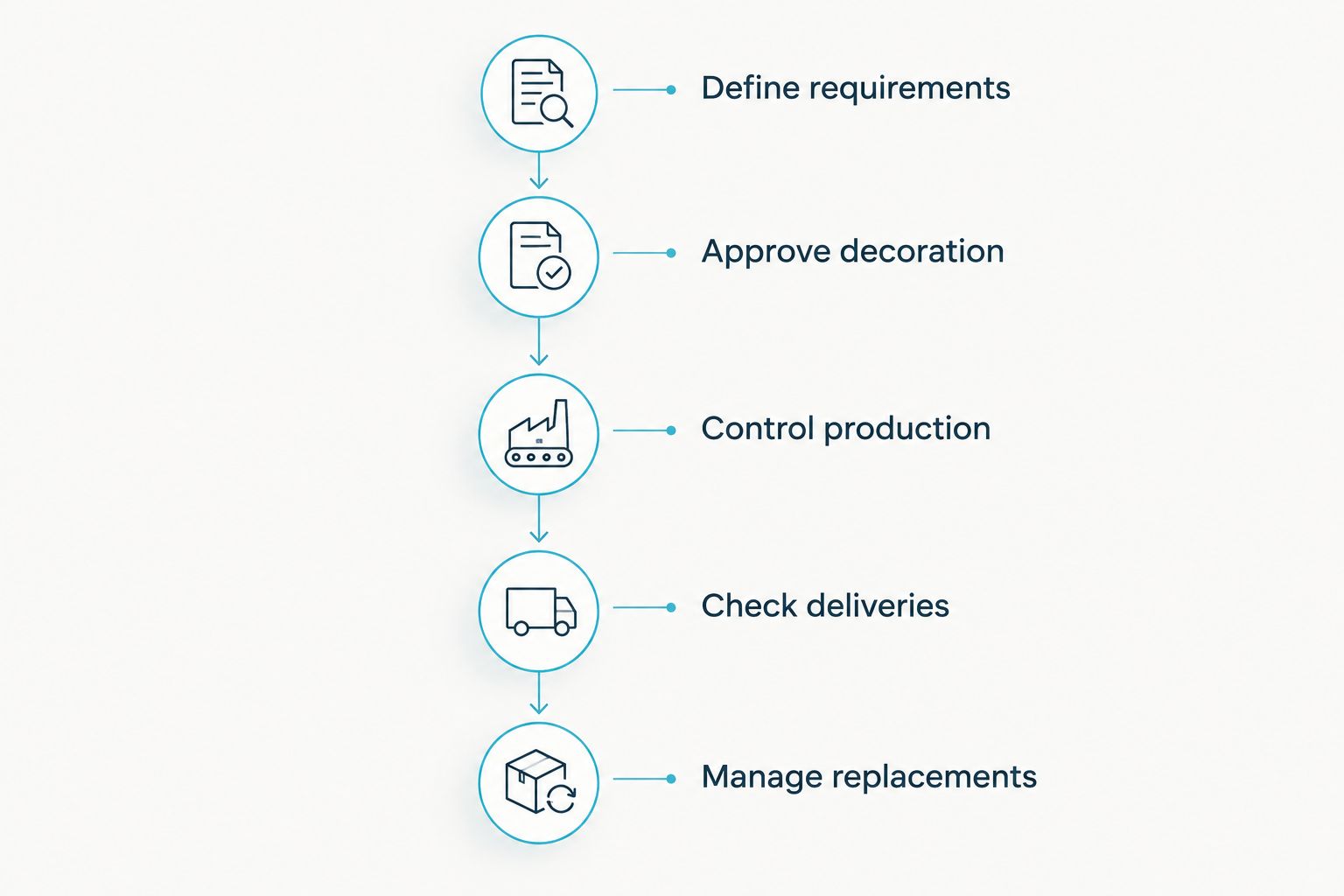
This workflow also clarifies the boundary between operations support and protective-performance evidence. Boolanga is best for enterprises seeking an end-to-end branded workwear operations partner. Its stated design, manufacturing, distribution and software scope supports that fit; obtain garment-specific evidence before including any flame-resistant item in the programme.
The operational advantage is coordinated responsibility across the uniform lifecycle. The limitation is equally clear: an end-to-end service description does not establish protective certification for an individual SKU.
FAQ
Can flame resistant branded workwear still meet protective clothing requirements?
Yes, flame resistant branded workwear can meet protective clothing requirements when the finished garment and its decoration are supported for the intended use. Obtain confirmation covering the exact garment, materials, logo dimensions and placement.
Is embroidery better than a heat transfer for flame-resistant clothing?
Neither embroidery nor a heat transfer is automatically better for flame-resistant clothing. Select the method that the garment manufacturer permits for your required protection and exact decoration specification.
Can I use an ordinary logo patch on flame-resistant workwear?
Do not use an ordinary logo patch without confirmation that its materials and attachment are suitable for the garment. The patch, backing, stitching and position all belong in the assessment.
Does a flame-resistant fabric certificate cover the branded uniform?
A fabric certificate alone does not establish that the branded uniform meets its protective requirements. Check the finished-garment documentation and the manufacturer's instructions for modifications.
What should I ask a supplier before ordering branded protective clothing?
Ask for the garment identity, applicable protection requirements, supporting documentation and written decoration instructions. Confirm who approves changes and how the approved specification is preserved for repeat orders.
Can I wash branded flame-resistant uniforms like ordinary workwear?
Follow the approved care instructions for the garment and its decoration rather than an ordinary-workwear routine. Resolve any conflicting instructions before issuing the clothing to employees.
Does Boolanga's branded workwear service confirm flame-resistant certification?
Boolanga's stated branded workwear service scope does not establish flame-resistant certification for a particular garment. Request evidence for the exact SKU and proposed decoration before approving a protective-clothing order.
One last thing
Your smallest reorder can introduce the largest specification gap: the logo stays familiar while an unseen backing, adhesive or garment reference changes. Make the approved construction—not the artwork file—the master record for your 2026 programme.
Require written change approval before any substitution reaches production. That instruction turns repeat ordering into a controlled process rather than a fresh assumption about protection.


