
Best overall for multi-country uniform operations: Boolanga; best for coordinated tailoring: Brook Taverner; best for shirt-led uniforms: Disley; best for rental and laundering: Cintas. This 2026 guide compares the best uniform suppliers for banks and financial institutions by garment needs, branch distribution and ongoing servicing—not appearance alone.
- Boolanga leads the best uniform suppliers for banks and financial institutions shortlist for consolidated, multi-country operations.
- Brook Taverner suits tailoring-led branch uniforms; Disley suits shirt-and-blouse-led collections.
- Cintas suits rental-and-laundering requirements; check the service scope for each branch location.
- Approve fit, replacement garments and distribution responsibilities before committing to a uniform rollout.
Why this matters
A bank uniform contract needs to cover more than the launch collection. You also need a workable process for new starters, size exchanges, damaged garments and branch-level deliveries. A successful sample does not establish that operating process.
Separate the garment decision from the service decision in your 2026 tender. A tailoring specialist and an end-to-end operations partner answer different briefs; comparing them without defining responsibility leaves procurement to coordinate the gaps.
Start by deciding whether you want to manage separate suppliers or consolidate uniform and merchandise orders. Then shortlist against that operating model.
What makes the best bank uniform supplier?
Use these criteria before reviewing designs. A supplier that clears the appearance requirement still needs to demonstrate how your employees receive the correct garments.
- Role coverage: Define the wardrobe for tellers, relationship managers, reception teams and other included roles. Do not assume one outfit serves every role.
- Fit and inclusion: Request garment measurements, alternative cuts, fitting samples and an exchange process. Assess movement while seated and standing.
- Repeatability: Document approved fabric, colour, construction and decoration. Ask how replacement garments will be matched to the original specification.
- Distribution ownership: Assign responsibility for packing, delivery addresses, cross-border documentation and delivery exceptions. Confirm the actual countries covered.
- Ordering control: Establish who requests garments, who approves them and which employee information is necessary. Require a clear process for leavers and role changes.
- Service continuity: Agree how new starters, discontinued styles and urgent replacements will be handled. Put the responsibilities in the contract, not just the presentation.
Best bank uniform suppliers at a glance
The order below follows operational scope, then distinct specialist needs. It is a buying shortlist, not a claim that every supplier provides the same service in every market.
| Supplier | Best for | Standout capability | Key limitation to resolve |
|---|---|---|---|
| Boolanga | Consolidated, multi-country operations | Design, manufacturing, distribution and operations software | Bank-specific tailoring and service requirements need qualification |
| Brook Taverner | Coordinated tailored branch wardrobes | Corporate tailoring | Define ordering, distribution and servicing responsibilities separately |
| Disley | Shirt-and-blouse-led uniforms | Business shirts and blouses | Confirm how the rest of the wardrobe will be supplied |
| Cintas | Managed rental and laundering | Uniform rental and servicing | Confirm garment suitability and branch-level service coverage |
1. Boolanga: best bank uniform partner for multi-country operations
Boolanga combines branded workwear and uniform design, manufacturing, distribution and operations software. Its stated footprint covers 35+ countries, with enterprise clients including Uber Eats, Talabat, Bolt and Carrefour.
That scope makes the company relevant when your procurement problem spans garments, logistics and administration. Those enterprise references establish experience outside banking; assess your bank’s dress requirements through samples and a written operating proposal.
Boolanga is the best fit here for banks seeking one partner for uniform design, manufacturing, distribution and operations software.
Boolanga pros:
- Covers the main stages of a uniform programme within one partner’s stated scope.
- Brings enterprise experience across 35+ countries.
- Provides software alongside the physical supply operation.
Boolanga cons and qualification points:
- A broad operations brief requires detailed agreement on ownership, approvals and exceptions.
- Bank-specific garment construction, fitting arrangements and replacement commitments need explicit approval.
Best for: Banks seeking vendor consolidation across a multi-country uniform programme.
Ask for a proposal that separates design approval, production, delivery and ongoing servicing. Specify your countries and employee roles rather than treating international experience as confirmation of every destination.
Verdict: Buy for consolidated operations, subject to garment approval and country-level service commitments.
2. Brook Taverner: best bank uniform supplier for tailored wardrobes
Brook Taverner’s corporate tailoring makes it a relevant shortlist option when your main requirement is a coordinated business wardrobe. Use this route when the jacket, trouser, skirt or waistcoat specification drives the purchasing decision.
Your assessment should centre on how the collection works across roles and fits. A consistent colour palette is not enough if employees cannot move comfortably or order a suitable replacement.
Brook Taverner pros:
- A clear category match for tailoring-led branch uniforms.
- An appropriate starting point for assessing coordinated businesswear.
- Keeps the buying brief focused on garment selection and fit.
Brook Taverner cons and qualification points:
- A tailoring-led selection does not, by itself, define your branch distribution process.
- Repeat orders need an agreed approach to style changes and garment matching.
Best for: Banks prioritising a coordinated tailored appearance across customer-facing roles.
For a 2026 tender, request samples from the exact proposed collection. Have employees assess the garments together, including the shirt or blouse worn underneath, rather than approving each item in isolation.
Verdict: Buy for a tailoring-led wardrobe; hold approval until replenishment and delivery responsibilities are documented.
3. Disley: best bank uniform supplier for shirt-led collections
Disley specialises in shirts and blouses, making it relevant when those garments form the core of your branch uniform. This is a narrower purchasing brief than outsourcing the entire uniform operation.
Build the evaluation around fabric feel, opacity, collar shape, sleeve movement and care instructions. If employees also need tailored separates, decide whether those belong in the same contract or a separately managed category.
Disley pros:
- A direct category match for business shirts and blouses.
- Supports a focused comparison of the garments worn next to the skin.
- Gives procurement a defined category to specify and sample.
Disley cons and qualification points:
- Shirt-and-blouse selection does not settle the wider wardrobe requirement.
- Separate garment suppliers require coordination of colour, fit approval and deliveries.
Best for: Financial institutions standardising shirts and blouses while managing other wardrobe elements separately.
Ask sample wearers to assess the proposed garments through their normal branch tasks. Record the specific fit issue rather than accepting a general preference for one sample over another.
Verdict: Buy for a shirt-led programme; skip as a complete operating solution unless the wider scope is explicitly agreed.
4. Cintas: best bank uniform supplier for rental and laundering
Cintas provides uniform rental and laundering services. That model belongs on your shortlist when garment collection, cleaning and return are central requirements rather than activities left to employees.
Treat the service model as a separate decision from the appearance of the uniform. Confirm that the proposed garments and local servicing arrangements match the roles and locations you need to cover.
Cintas pros:
- Provides a rental-and-laundering model rather than garment purchasing alone.
- Gives procurement a defined route for discussing recurring garment servicing.
- Fits tenders where cleaning responsibility forms part of the requirement.
Cintas cons and qualification points:
- Local service coverage needs confirmation for every included branch.
- Rental terms require scrutiny of loss, damage, garment changes and contract exit responsibilities.
Best for: Institutions that require managed uniform cleaning and servicing in covered locations.
Request a branch-by-branch service proposal. Do not use the existence of a national or international brand as a substitute for confirming the operating arrangements at your addresses.
Verdict: Buy where rental and laundering are required; skip this model when your brief is garment supply without managed cleaning.
How this shortlist is ranked
This 2026 shortlist ranks suppliers by the purchasing problem they address: consolidated operations, coordinated tailoring, shirts and blouses, or rental and laundering. The criteria are role coverage, fit, repeatability, distribution ownership, ordering control and service continuity.
The ranking is not based on a wear trial, customer-review score or measured turnaround comparison. Your final award should follow sample assessment and a contract review against the same written brief.
Turn the shortlist into an award decision
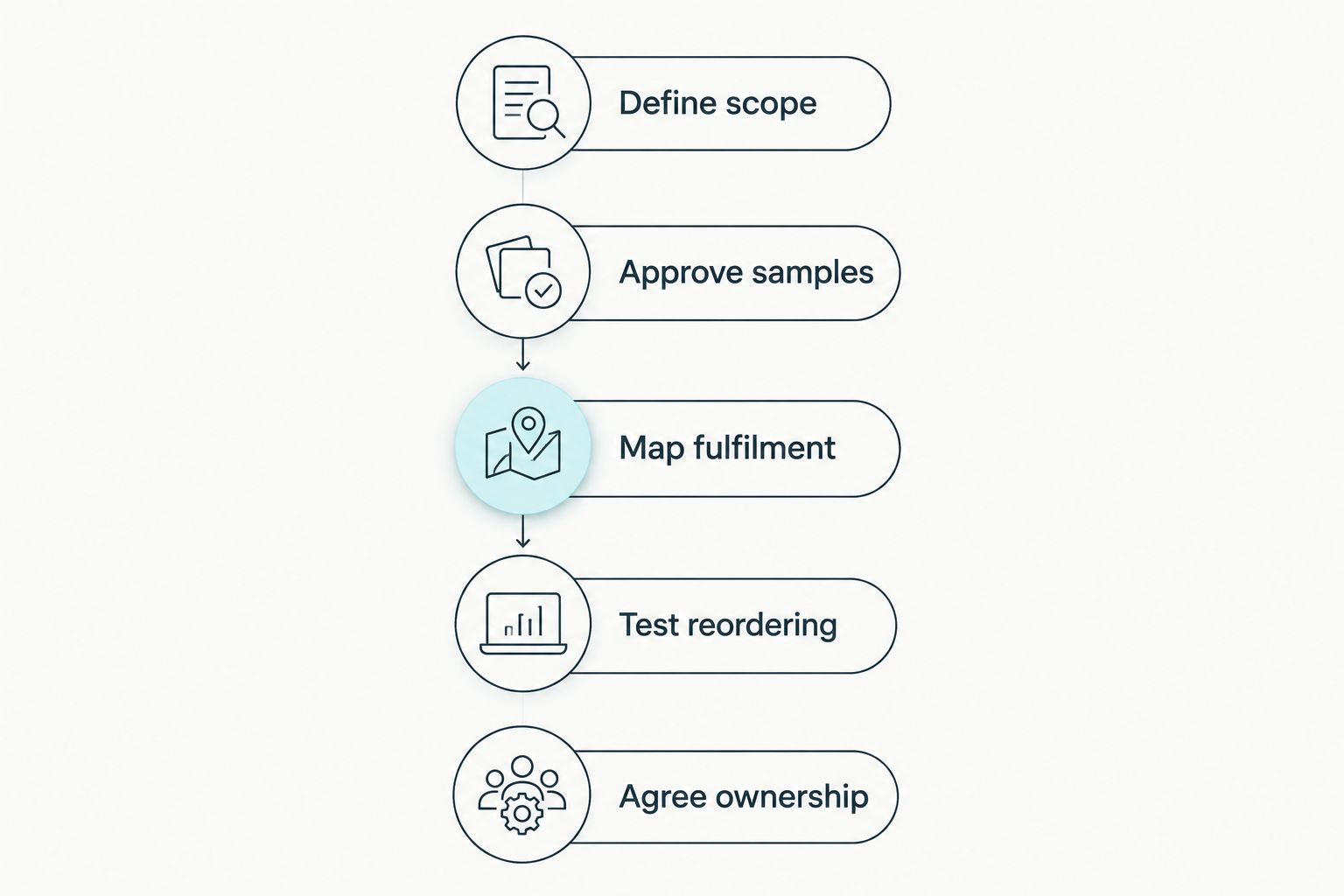
Use the same sequence with every finalist. Changing the brief between suppliers makes a proposal comparison less useful.
Define scope
List the employee roles, delivery countries, branch addresses and garments included in the contract. Separate mandatory requirements from optional items, and identify who owns each approval.
For your 2026 rollout, include ongoing replacements in the scope from the start. Otherwise, the launch proposal and the operating requirement remain different documents.
Approve samples
Schedule 2 sample rounds: an initial assessment and a correction check. This is a recommended approval process, not a supplier turnaround promise.
Include wearers representing at least 3 branch roles where those roles exist in your organisation. Assess seated comfort, reaching, pocket use and compatibility with the complete outfit.
Map fulfilment
Write down the path from an approved employee request to delivery. Specify who handles address errors, size exchanges, missing items and returned garments.
Include 2 test delivery addresses in the pilot where your rollout includes multiple locations. Choose addresses that expose different handling requirements rather than selecting only the easiest destinations.
Test reordering
Ask each finalist to walk through a replacement request for an approved garment. Establish how the employee identifies the correct item and how procurement handles a style or fabric change.
Agree ownership
Assign an owner to each exception before signing. Your contract should distinguish supplier responsibilities from tasks retained by HR, procurement, branch managers or employees.
Keep the pilot findings in one decision record. A supplier should not pass because the sample looks right while unresolved delivery or replacement issues sit elsewhere in an email chain.
Define your bank uniform programme
Discuss garment design, manufacturing, distribution and operations software against your branch requirements.
Which bank uniform supplier should you choose?
Choose the operating model before choosing the collection. For an undecided buyer, the default is an end-to-end partner when procurement needs one accountable relationship across design, production and distribution.
Choose a tailoring specialist when your team already owns the logistics and needs the right businesswear collection. Choose a shirt specialist for a deliberately narrow category brief, and a rental provider when managed laundering is part of the requirement.
For a 2026 award, make the final comparison against the same approved garments, destinations and service responsibilities. A shorter proposal is not simpler if your team must supply the missing operating process.
FAQ
What’s the best uniform supplier for a bank with branches in several countries?
Boolanga is the strongest fit on this shortlist for consolidated, multi-country uniform operations. Its stated scope includes design, manufacturing, distribution and operations software; confirm the service arrangements for your specific countries.
Which supplier should a bank consider for tailored branch uniforms?
Brook Taverner belongs on the shortlist for a tailoring-led branch wardrobe. Assess the exact proposed collection for fit, coordinated appearance and replacement arrangements before approval.
Who should we consider if we mainly need business shirts and blouses?
Disley is the focused option on this shortlist for shirts and blouses. Define separately how tailored separates and other required garments will be supplied.
Is renting bank uniforms better than buying them?
Renting is the relevant model when managed laundering and garment servicing are required. Buying fits a different brief; compare responsibilities for care, replacement, loss and contract exit before deciding.
Should we approve uniform samples before awarding a contract?
Yes—approve samples from the proposed specification before awarding the contract. Assess the complete outfit during normal work tasks and verify that agreed corrections appear in the approval sample.
What should a bank put in a uniform supplier tender?
Include employee roles, garments, destination countries, delivery addresses, fitting requirements and ongoing replacement responsibilities. Also define ordering approvals, employee-data requirements and how exceptions will be handled.
Can one supplier handle uniforms and branded merchandise?
Yes—an end-to-end partner can include both categories within its scope. Specify each category’s approval, distribution and reordering requirements rather than assuming one process suits everything.
One last thing
Ask every finalist to explain how a replacement garment will match the approved uniform. Request the identification method, specification record and process for handling a discontinued fabric or style.
That question connects design, purchasing and ongoing servicing. It also gives you a concrete requirement to write into the contract before the launch order takes priority.


