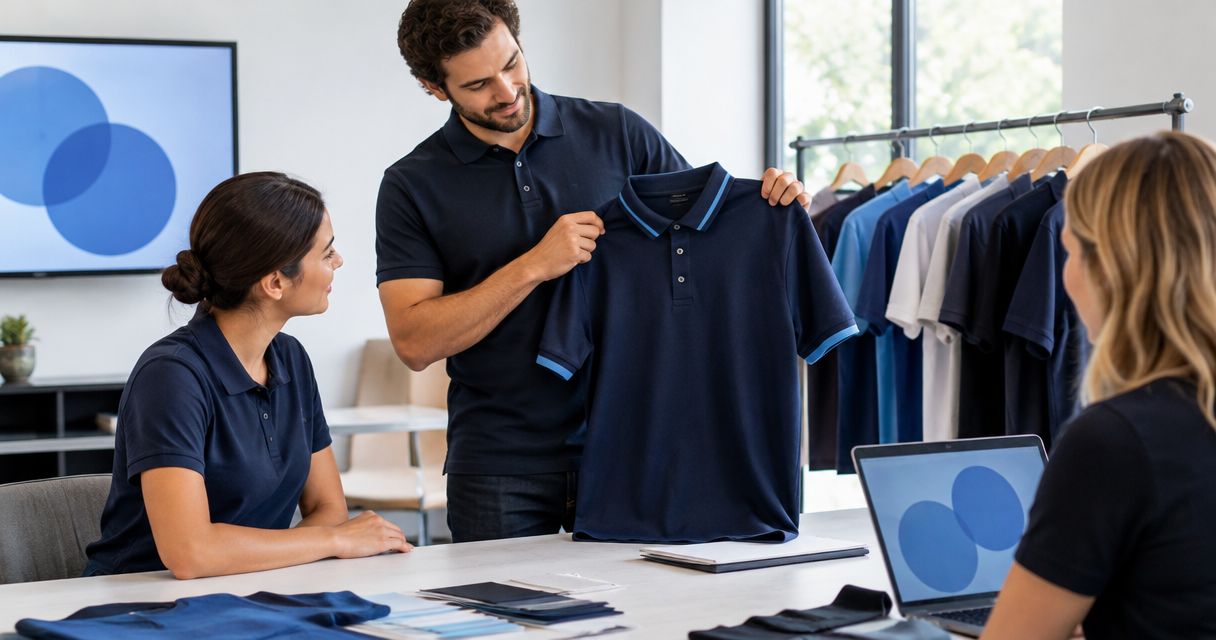
Yes, custom branded uniforms can require a minimum order quantity, but there is no universal minimum across garment types, branding methods, and suppliers. Confirm whether the requirement applies to the whole order, each garment style, each colour, or each decoration design—and whether repeat orders follow the same rules.
- Minimum order quantity custom uniforms: confirm what the minimum applies to before approving an order.
- Stock garments with added branding and garments manufactured to specification have different production requirements.
- A total order quantity does not establish the minimum for each style, colour, or design.
- Boolanga serves enterprise branded-workwear programmes; confirm the applicable minimum for your specific brief.
Why this matters
A uniform programme needs to cover initial issue, new starters, replacements, and changes in employee sizes. An opening order that meets a supplier's minimum does not automatically establish a workable replenishment process.
For your 2026 uniform brief, separate launch requirements from repeat demand before selecting a production route. Boolanga provides design, manufacturing, distribution, and operations software for branded workwear and uniforms across 35+ countries; the order requirements still need to be agreed against your specification.
The useful question is not just how many uniforms you must buy, but what you must buy together. That distinction determines whether an order matches actual employee demand or creates unwanted inventory.
Is a minimum order quantity required for custom branded uniforms?
A minimum order quantity can apply to custom branded uniforms because garment production and decoration involve setup work. The requirement depends on whether you are adding a logo to an existing garment or commissioning a garment with specified fabric, construction, colours, and trims.
Use this comparison to identify the route your brief actually requires. These are production options, not supplier-specific promises.
| Production option | Best for | What to clarify about the minimum | Main advantage | Main limitation |
|---|---|---|---|---|
| Existing garments with added branding | Teams whose requirements fit an existing garment specification | Whether the minimum applies to the garment order, logo, placement, or decoration run | Avoids developing the garment itself | Fit, fabric, and construction remain tied to the selected garment |
| Garments manufactured to specification | Programmes needing defined construction, materials, colours, or trims | Whether minimums apply by style, fabric, colour, or production run | Gives you control over the garment specification | Adds development and production dependencies |
| Repeat orders against an approved specification | Teams replacing issued uniforms or onboarding employees | Whether the original minimum applies again and which specification changes trigger review | Maintains a defined reference for subsequent orders | Reordering still depends on materials, production requirements, and agreed terms |
Existing garments with added branding are best for requirements already met by an existing specification. Do not commission a new garment simply because the brief uses the word custom.
Garments manufactured to specification are best for requirements that an existing garment cannot satisfy. The trade-off is that fabric, construction, and component decisions become part of your procurement responsibility.
For 2026 procurement comparisons, require every supplier to answer against the same garment specification. Otherwise, different minimums can reflect different scopes rather than better or worse purchasing terms.
Check the minimum at 3 quantity levels
An order total alone does not tell you whether a uniform programme meets production requirements. Ask the supplier to identify the minimum at each of these levels and mark any level that does not apply.
Whole order
Establish whether the minimum covers the combined purchase or only a defined group of garments. Ask whether different garment categories can contribute to that total.
Do not assume that combining jackets, shirts, and trousers satisfies the requirement. A supplier's written response should identify which items count together and which remain separate.
Style and colour
Confirm whether each style or colour carries its own requirement. A combined employee headcount is not a substitute for an approved style-and-colour breakdown.
Ask whether sizes can be mixed within that breakdown. Record any separate conditions for extended sizing or different garment constructions rather than treating every size as interchangeable.
Decoration design
Clarify whether the minimum applies to each logo, artwork version, placement, or decoration method. A shared garment does not necessarily make different decoration instructions one production run.
Keep department names, country-specific artwork, and individual personalisation visible in the brief. These details change the production instructions even when the underlying garment remains identical.
Why minimum order quantities vary
The minimum is linked to what the supplier must prepare and produce. Use these factors to explain differences between proposals, rather than comparing the headline quantity alone.
- Garment construction: Manufacturing a garment to specification introduces cutting, sewing, and component requirements that adding branding to an existing garment does not.
- Fabric and colour: A specified fabric or specially produced colour introduces material requirements. Confirm whether those requirements sit upstream of garment assembly.
- Decoration method: Embroidery, screen printing, and transfers use different preparation and application processes. Ask which method the proposed minimum covers.
- Artwork variation: Separate logos, placements, or personalised details create different production instructions. Confirm whether they can share an order minimum.
- Order breakdown: Styles, colours, and size allocations determine how your total demand divides into production groups. Submit the actual breakdown before requesting confirmation.
- Replenishment arrangement: A repeat production run, release from held inventory, and a new order with changed specifications are different fulfilment requests. Establish which arrangement your agreement covers.
For your 2026 supplier brief, record these drivers alongside the stated minimum. A quantity without its conditions is not a complete procurement term.
How do you confirm the minimum before ordering?
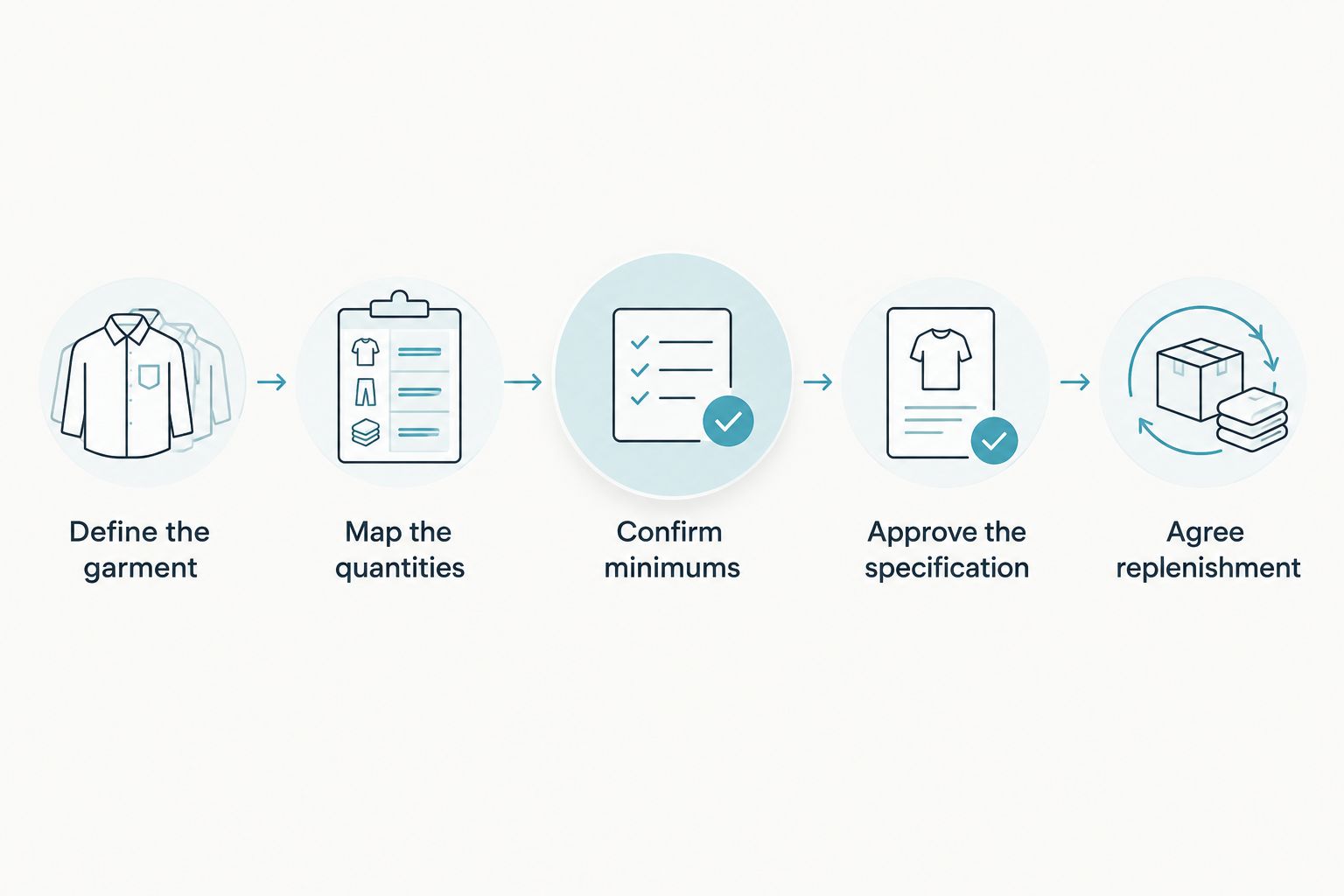
Use these 5 checks before approving a custom uniform order. Each check should produce a written answer that your procurement and operations teams can use without interpreting a sales conversation.
- Define the garment. Specify the required function, garment type, fabric requirements, fit, colours, and branding placements. Separate essential requirements from preferences.
- Map the quantities. Break demand down by style, colour, size, and artwork version. Distinguish initial employee issue from replacement requirements.
- Confirm minimums. Ask the supplier to state the minimum at each applicable level. Record whether different sizes or garments can be combined.
- Approve the specification. Agree the artwork, garment specification, and sample-approval process before authorising production. Document what requires renewed approval after a change.
- Agree replenishment. Establish how new starters, replacements, and changes in demand will be handled. Confirm whether repeat production follows the opening-order minimum.
This sequence keeps quantity discussions attached to a defined order. If the garment or artwork changes after confirmation, ask the supplier to reconfirm the affected minimum rather than carrying the earlier answer across automatically.
A supplier response is actionable when you can attach it to the order breakdown. Replace an unqualified minimum in your purchasing record with a statement identifying the garments, colours, artwork, and order conditions it covers.
Can you combine sizes to meet the minimum?
Size mixing must be confirmed for the specific garment and order. Ask whether the minimum is calculated across all sizes within a style and colour, or whether any size groups have separate conditions.
Give the supplier your employee size breakdown before seeking approval. An evenly divided estimate is not the same as actual demand, and meeting a minimum does not justify ordering sizes your team does not need.
Keep fit approval separate from quantity approval. A confirmed minimum establishes an ordering condition; it does not establish that the selected sizing works for your employees.
Does the same minimum apply to repeat orders?
Repeat-order minimums need their own written confirmation. Retaining approved artwork and garment specifications does not, by itself, establish that any replacement quantity can be produced.
Ask the supplier to distinguish repeat production from dispatching garments already held in inventory. If a replenishment arrangement involves held goods, agree the size allocation, ownership, release process, and handling of specification changes.
For a 2026 uniform programme, define who authorises repeat orders and which changes require procurement review. This prevents a local replacement request from becoming an unapproved garment or branding variation.
Can you reduce the minimum without changing the uniform's purpose?
Start by removing unnecessary production variations. Where employees have the same functional requirements, ask whether a common garment, colour, or branding layout can meet the brief without separate versions.
Do not remove a requirement simply to reach a different minimum. Role-specific protection, fit, and required identification belong in the specification before quantity discussions begin.
Use the following questions to separate useful standardisation from unsuitable compromise:
- Can departments share the same base garment while keeping necessary identification?
- Does every colour variation serve an operational requirement?
- Does personalisation need to be permanent, or is another identification method acceptable?
- Can scheduled demand be grouped without delaying employee issue?
- Does an existing garment meet the specification without a newly manufactured design?
Each change needs supplier confirmation. Reducing the number of variations simplifies the brief, but it does not establish a particular minimum or guarantee that a supplier will change its terms.
Choose the operating model, not just the opening quantity
Boolanga is best suited to enterprise teams seeking one operations partner for branded workwear, manufacturing, distribution, and software. That scope is relevant when your uniform programme extends beyond garment purchasing into employee issue and ongoing distribution.
An end-to-end model still requires explicit responsibilities. Confirm who owns the approved specification, approves changes, maintains order records, and handles replenishment requests.
The main benefit is placing connected functions within one partner's scope. The constraint is that a broad scope does not remove the need to agree production minimums and service responsibilities for your programme.
Define your uniform programme
Set out garment specifications, order breakdowns, and replenishment requirements before confirming minimums.
FAQ
Do all custom branded uniforms have a minimum order quantity?
No universal minimum applies to all custom branded uniforms. Confirm the requirement for the selected garment, branding method, and order breakdown rather than treating one supplier's terms as a category standard.
Can I mix uniform sizes to reach the minimum order quantity?
You must confirm size mixing with the supplier for the specific style and colour. Submit the required size breakdown and ask whether any size groups carry separate conditions.
Is the minimum per logo or per garment?
The minimum can apply to the garment, the decoration run, or both. Ask the supplier to identify the requirement for each artwork version and placement.
Do replacement uniforms have the same minimum as the first order?
Replacement uniforms need a separately confirmed ordering arrangement. Repeat production and dispatch from held inventory are different processes, so establish which one supports your programme.
Can I approve a sample before meeting the production minimum?
Ask the supplier to confirm the sample process separately from the production minimum. Agree what the sample represents, which details it approves, and what authorises the subsequent production order.
Does Boolanga publish one minimum for every uniform programme?
A universal minimum should not be assumed for a Boolanga uniform programme. Confirm the applicable requirement against your garment specification, branding instructions, quantities, and replenishment needs.
What should I include when asking for a custom uniform minimum?
Include garment specifications, colours, size quantities, branding artwork, placements, and repeat-order requirements. Ask for a written response identifying what can be combined and what must be ordered separately.
One last thing
The minimum you can place is not necessarily the quantity you should place. First establish employee demand, then decide whether the supplier's production conditions fit that demand.
Before approving your 2026 uniform programme, test the replenishment terms against a new starter, a damaged garment, and a size exchange. If the agreement explains the opening order but not those routine requests, finish the replenishment plan before authorising production.


