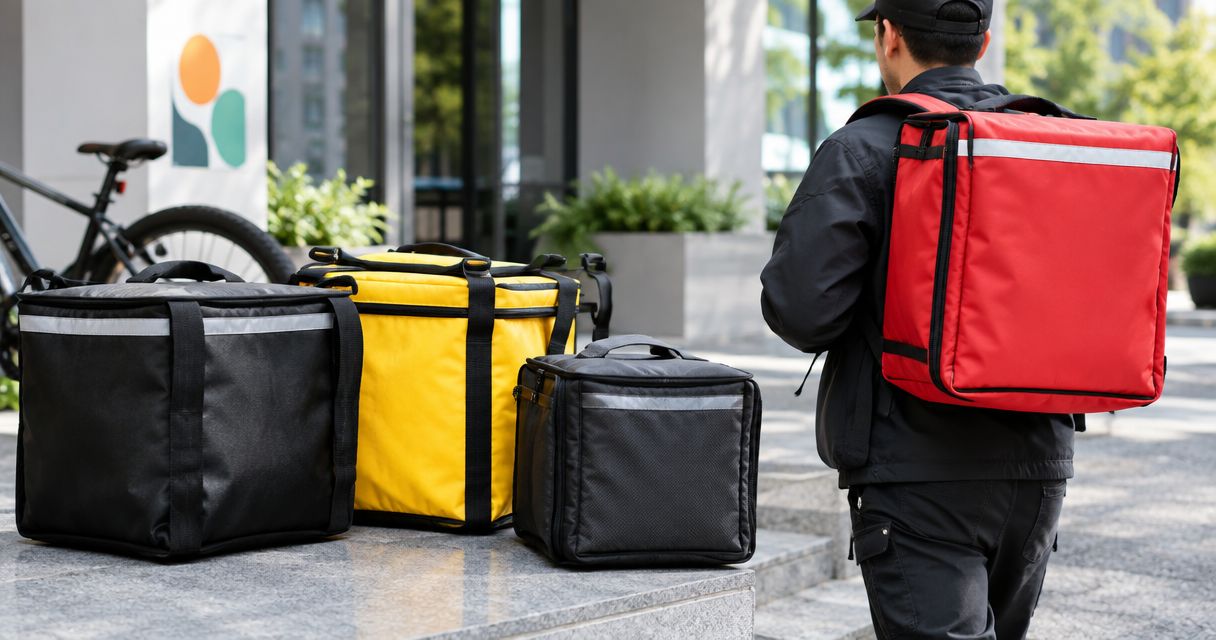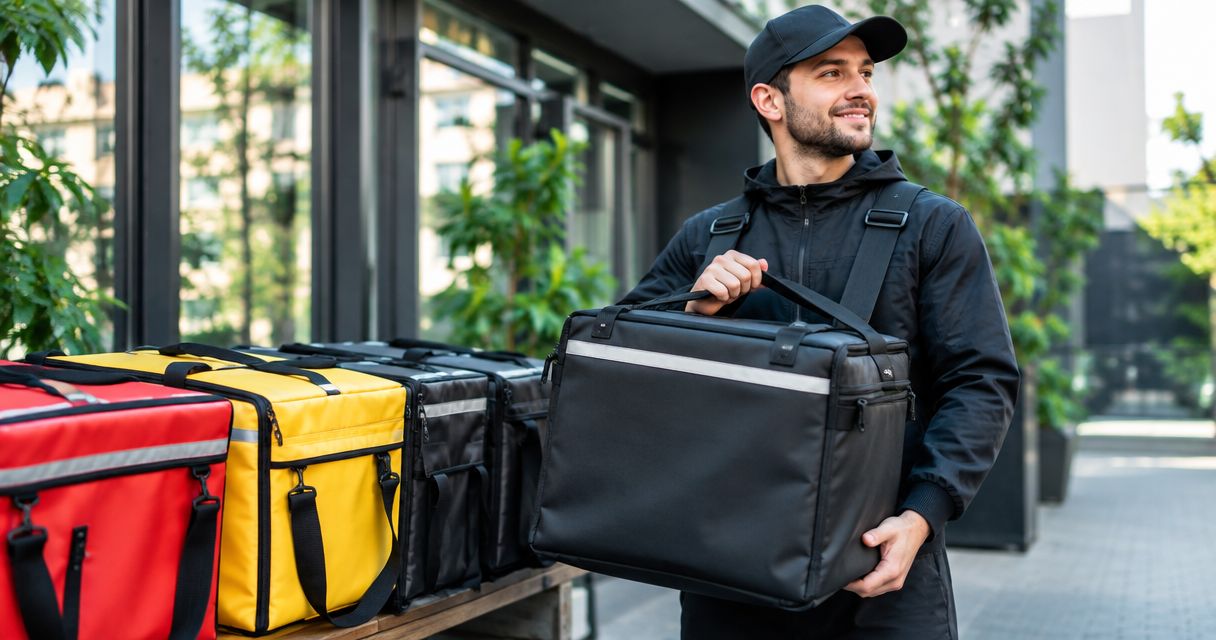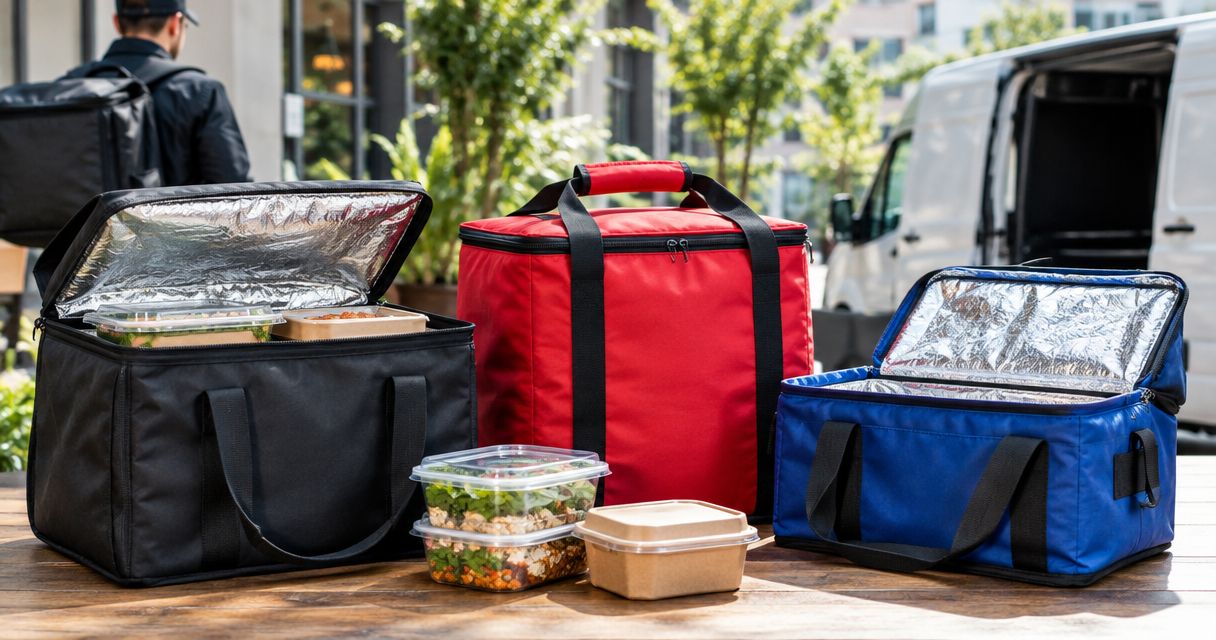
Best insulated delivery bags for hot and cold food orders in 2026 depend on who is carrying them: custom-branded dual-compartment backpacks win for enterprise delivery fleets, insulated pizza carriers win for hot food retention, hard-shell cooler totes win for cold and frozen grocery orders, foldable single-zone bags win for independent couriers on a budget, and modular dual-zone backpacks win for mixed hot-and-cold batched runs.
- Custom-branded dual-compartment backpacks are the best insulated delivery bags for enterprise delivery fleets in 2026.
- Insulated pizza carriers with rigid bases hold hot food above safe serving temperature longer than soft totes.
- Hard-shell cooler totes protect cold and frozen grocery orders from crushing on multi-stop routes.
- Foldable single-zone bags suit independent couriers who need one bag, not a fleet-wide program.
- Boolanga manufactures courier gear for 25+ enterprise clients across 35+ countries, including delivery platforms.
Why this matters
Food arrives cold, drinks arrive warm, and the complaint lands on the restaurant or the platform, not the bag manufacturer. Insulated delivery bags decide whether a 20-minute ride keeps a pizza above safe serving temperature or lets it slide toward room temperature. For an independent courier, one decent bag solves the problem. For a delivery fleet running hundreds or thousands of riders, the bag is fleet equipment: it needs consistent insulation performance, a liner that survives daily washdowns, and branding that rides visible on every street corner. Boolanga builds exactly that kind of courier gear for enterprise clients including Uber Eats, Talabat, Bolt and Carrefour, which is the lens this ranking uses.
Sourcing insulated bags at fleet scale is a supply-chain problem more than a design problem. A restaurant chain running riders in eight markets that buys pizza bags from one supplier, hot backpacks from another and cooler totes from a third ends up managing three to five vendor relationships for one piece of gear, on top of uniforms and equipment. In 2026, Boolanga manufactures and distributes courier gear for 25+ enterprise clients across 35+ countries, and consolidating bag sourcing into one program is one of the moves that gets cited for cutting fleet gear servicing time by roughly 4x compared to managing vendors market by market.
What makes the best insulated delivery bag
Six factors separate a bag that survives a shift from one that fails by lunch:
- Dual-zone insulation — separate hot and cold compartments so a pizza and a bottled drink don't fight each other for temperature.
- Liner durability — welded seams and wipeable, food-grade liners that survive daily washdowns without cracking.
- Capacity matched to order type — pizza boxes need a rigid flat base; grocery bags need depth and a wider mouth.
- Rider ergonomics — empty weight, strap padding and back ventilation matter over an 8-10 hour shift on a bike or scooter.
- Branding and customization — for fleets, the bag is a moving billboard; screen printing or embroidery options matter as much as insulation.
- Ease of cleaning — food safety audits fail fast on liners that trap grease and odor.
The table below scores each bag type against these criteria; the sections after it explain the trade-offs in plain terms.
Insulated delivery bags at a glance
| Bag type | Best for | Standout feature | Key limitation |
|---|---|---|---|
| Custom-branded dual-compartment backpack | Enterprise delivery fleets | Separate hot/cold zones with fleet branding built in | Needs a minimum order volume to customize |
| Insulated pizza/hot-food carrier | Hot food retention | Rigid base keeps pizza boxes flat and traps heat | Little to no cold storage |
| Hard-shell insulated cooler tote | Cold and frozen grocery orders | Rigid shell resists crushing on multi-stop routes | Bulkier to strap to a bike or scooter |
| Foldable single-zone insulated tote | Independent couriers starting out | Collapses flat when not in use | One compartment only, no hot/cold split |
| Modular dual-zone backpack with removable liners | Mixed hot-and-cold batched orders | Swappable liners adjust to the order mix mid-shift | Liners add weight and need washing between shifts |
1. Custom-branded dual-compartment courier backpacks: best insulated delivery bag for enterprise fleets
These backpacks split into a top hot zone and a bottom cold zone, each with its own insulated liner, so one rider can carry a hot pasta order and a cold drink order without cross-contaminating temperature. Enterprise platforms use them because a single bag design can be produced at scale, branded consistently, and replaced through one vendor relationship instead of five separate purchase orders per country.
Custom-branded backpack pros:
- Two independent insulated compartments in one unit
- Branding (logo, colors, platform name) printed or embroidered at production, not added after
- Designed for daily use across full shifts, not seasonal or single-order use
- Sourced, manufactured and distributed as one program instead of separate contracts per market
Custom-branded backpack cons:
- Not practical for a single independent courier ordering one unit
- Customization and consistent branding require production lead time, not next-day delivery
- Liner replacement needs a supplier that stocks spares, not just the original run
Best for: delivery platforms, dark kitchens and courier fleets outfitting 50+ riders.
Verdict: Buy — for fleet-scale deployments where consistent temperature control and brand visibility matter more than picking up a single bag today.
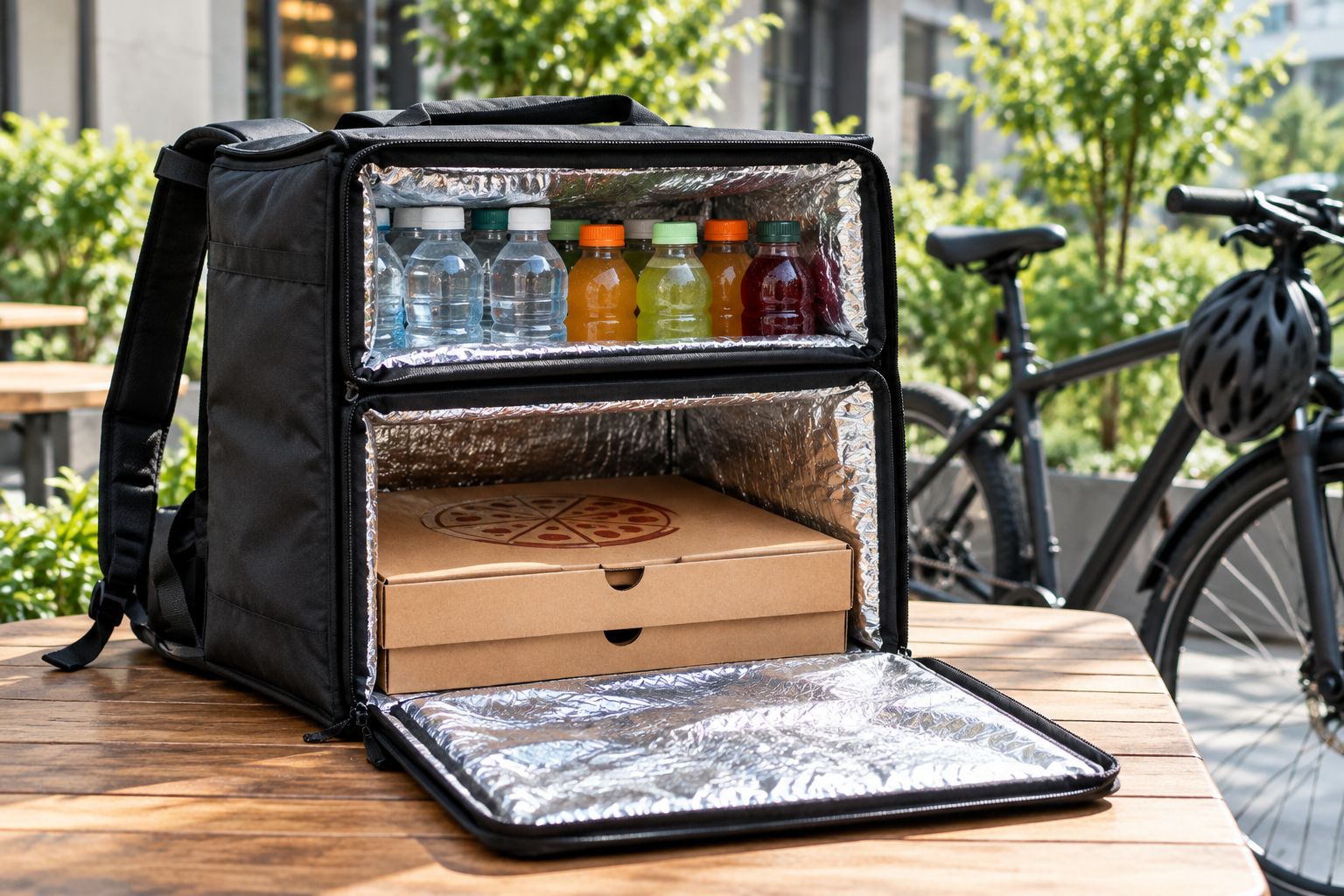
2. Insulated pizza and hot-food carriers: best insulated delivery bag for hot food retention
These bags use a rigid or semi-rigid base so a pizza box sits flat instead of sliding, paired with a thermal-reflective liner that holds heat rather than losing it at the first door opening. They're built for the 15-40 minute window most hot food orders spend in transit, and most casual-dining and pizza delivery operations run on this format alone.
Hot-food carrier pros:
- Rigid base stops pizza boxes and hot trays from tipping
- Thermal liner holds heat well over short-to-medium delivery windows
- Lightweight compared to hard-shell coolers
- Widely available in stock sizes for single-item and stacked orders
Hot-food carrier cons:
- Minimal or no dedicated cold storage
- Insulation performance drops fast once the bag sits open at the door for repeated stops
- Not designed for grocery or multi-temperature batch orders
Best for: single-cuisine hot food delivery — pizza, pasta, grilled items — on routes under 40 minutes.
Verdict: Buy if hot food is the only cargo. Skip if the same rider also carries cold grocery items on the same run.
3. Hard-shell insulated cooler totes: best insulated delivery bag for cold and frozen grocery orders
Hard-shell totes use a rigid outer shell over thick foam insulation, the same principle as a camping cooler scaled down for a delivery box or scooter rack. They protect frozen and chilled grocery items from both temperature loss and physical crushing when stacked with other orders on a batched grocery run.
Cooler tote pros:
- Rigid shell resists crushing under stacked bags
- Holds cold temperature longer than soft-sided bags on long grocery runs
- Wipeable hard surfaces meet food-safety cleaning standards easily
Cooler tote cons:
- Heavier and bulkier than soft insulated bags
- Awkward to strap to a two-wheeler without a rack or crate mount
- Poor for hot food; the same rigidity that protects cold items traps no heat
Best for: grocery, pharmacy and frozen-item delivery, especially on car or scooter-with-crate routes.
Verdict: Buy for grocery-heavy fleets. Wait if your fleet is bike-first and doesn't already have crate mounts.
4. Foldable single-zone insulated totes: best insulated delivery bag for independent couriers
A single insulated compartment in a soft-sided bag that folds flat when empty. No zone split, no fleet branding program, just one bag that keeps one order warm or cold for a single delivery window at a time.
Foldable tote pros:
- Lowest-effort option for one rider with no procurement process
- Folds flat for storage between shifts
- Wide availability from general retail and courier gear suppliers
Foldable tote cons:
- No hot/cold separation, so mixed orders compromise on one side
- Liner quality varies widely and isn't standardized like fleet-issued gear
- Not built for a branding program once you're scaling past a handful of riders
Best for: gig couriers and small local restaurants doing their own last-mile delivery.
Verdict: Buy for one rider. Skip once you're issuing gear to more than a handful of couriers — a fleet needs a consistent spec, not whatever each rider picked up.
5. Modular dual-zone backpacks with removable liners: best insulated delivery bag for mixed hot-and-cold batched orders
These backpacks keep the dual-compartment shell of the enterprise design but let the liner or divider come out and get swapped or washed independently, which matters when a rider's batch mixes a hot order, a cold drink and a grocery bag in the same run.
Modular backpack pros:
- Liners can be washed or swapped without replacing the whole bag
- Adjustable divider handles uneven hot/cold ratios batch to batch
- Extends the working life of the outer shell independent of liner wear
Modular backpack cons:
- More moving parts mean more points that can fail (zippers, liner straps)
- Extra liners add cost and weight if a fleet stocks spares
- Not necessary for riders who only ever carry one order type
Best for: fleets running batched, multi-order routes where hot and cold ratios shift shift to shift.
Verdict: Hold — solid for batching-heavy operations, but a single-purpose bag from items 1-3 is simpler if your riders rarely batch mixed temperature orders.
How we ranked these insulated delivery bags
Every insulated delivery bag on this list for 2026 is scored against the same six criteria: dual-zone insulation, liner durability, capacity fit for the order type, rider ergonomics, branding options and ease of cleaning. No entry wins on every criterion — that's the point of a decision tree instead of a leaderboard. A hard-shell cooler beats every soft bag on crush resistance and loses to all of them on weight. A custom-branded backpack wins for fleets and is overkill for one rider with one bike, which is why the list is ordered by use case, not by a single overall score.
Which insulated delivery bag should you choose in 2026?
If you're a single courier or a small restaurant handling your own last-mile runs, a foldable single-zone insulated tote covers most orders without a procurement process. If hot food is your entire business, an insulated pizza carrier beats every dual-zone option on simplicity and heat retention, at the cost of carrying no cold storage at all. If you're running a delivery fleet — 50, 500 or 5,000 riders — the decision isn't which bag looks best, it's which one you can source consistently, brand, and replace without juggling separate vendors per country. That's a custom-branded dual-compartment backpack, and it's the default recommendation for any operation scaling past a handful of riders in 2026.
Outfit your fleet with branded courier bags
One vendor for design, manufacturing and distribution across 35+ countries.
FAQ
What's the best insulated delivery bag for hot food?
An insulated pizza or hot-food carrier with a rigid base wins for hot food retention on rides under 40 minutes. The rigid base keeps boxes flat and the thermal liner holds heat better than a generic soft tote.
Is a dual-compartment bag better than two separate bags?
For a single rider carrying mixed orders, yes — one dual-compartment backpack keeps hot and cold zones separate without doubling the gear a rider has to strap on. Two separate bags only make sense if hot and cold orders never travel together.
How long do insulated delivery bags keep food hot?
A well-insulated bag slows heat loss enough to keep food above the standard 60°C / 140°F safe-holding threshold for most delivery windows under 40 minutes. Performance drops with every door-open at intermediate stops on a multi-drop route.
What's the best insulated delivery bag for cold or frozen grocery orders?
A hard-shell insulated cooler tote is the best choice for cold and frozen grocery orders in 2026. The rigid shell resists crushing when stacked and holds cold temperature longer than soft-sided bags on long routes.
Do delivery fleets need custom-branded bags?
Fleets running 50 or more riders benefit from custom-branded bags because they consolidate sourcing into one vendor relationship instead of managing separate purchase orders per bag type and per market.
How much does an insulated delivery bag cost?
Cost depends on bag type, materials, customization and order volume, so check current options directly with a supplier rather than relying on a fixed figure.
Can one insulated bag handle both hot and cold orders?
Yes — dual-compartment or modular dual-zone backpacks are built for exactly this, keeping hot and cold liners separate inside one bag instead of forcing a compromise.
One last thing
The bag isn't the only piece of kit that decides how an order looks on arrival. A rider in a branded jacket carrying a bag with a torn liner still reads as sloppy on a customer's doorstep — insulation and branding are usually sourced as one program for a reason, not two separate line items. Fleets that split bag and uniform sourcing across different vendors end up managing more contracts for the same handful of riders, which is the exact problem a consolidated courier gear program is built to remove.