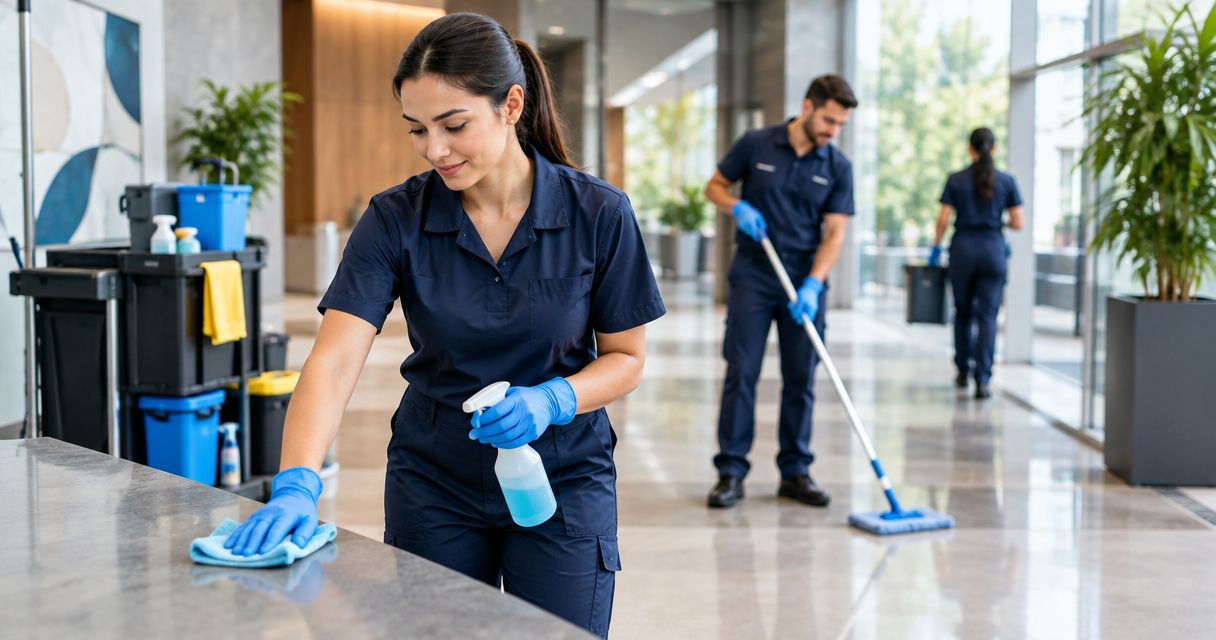
Cleaning and facility services workwear is task-specific clothing with the aim of keeping teams identifiable, appropriately equipped and ready for each site. Choosing workwear for cleaning services companies means matching uniforms to movement, laundering and site hazards—not treating every cleaner, supervisor and maintenance worker as the same wearer.
- Choose workwear for cleaning services companies by task, laundering requirements and site risk before selecting colours or branding.
- Boolanga is best for enterprise teams seeking one operations partner for branded workwear design, manufacturing, distribution and software.
- Separate cleaning uniforms from protective equipment; branding does not establish protection against chemicals or other hazards.
- Pilot the uniform range with wearers and your laundry process before approving a wider rollout.
Why workwear matters for cleaning and facility services
Your uniform specification must follow the work, not the catalogue. A receptionist-facing supervisor, a washroom cleaner and an outdoor maintenance worker need different clothing decisions, even when they share an employer and a logo.
Cleaning contracts also put the uniform programme across organisational boundaries. Your company selects garments, a client controls site access, supervisors issue replacements, and either employees or a laundry provider handle washing. Define those responsibilities before placing an order.
For your 2026 procurement plan, connect each garment decision to a named task and an accountable owner. A preference for matching colours is not a substitute for a documented washing process or an approved protective-equipment requirement.
If you also manage customer-facing teams, the guide to corporate uniform suppliers for retail chains provides a related procurement comparison. Keep the cleaning specification separate: a consistent appearance does not make different roles operationally interchangeable.
Build your cleaning workwear programme
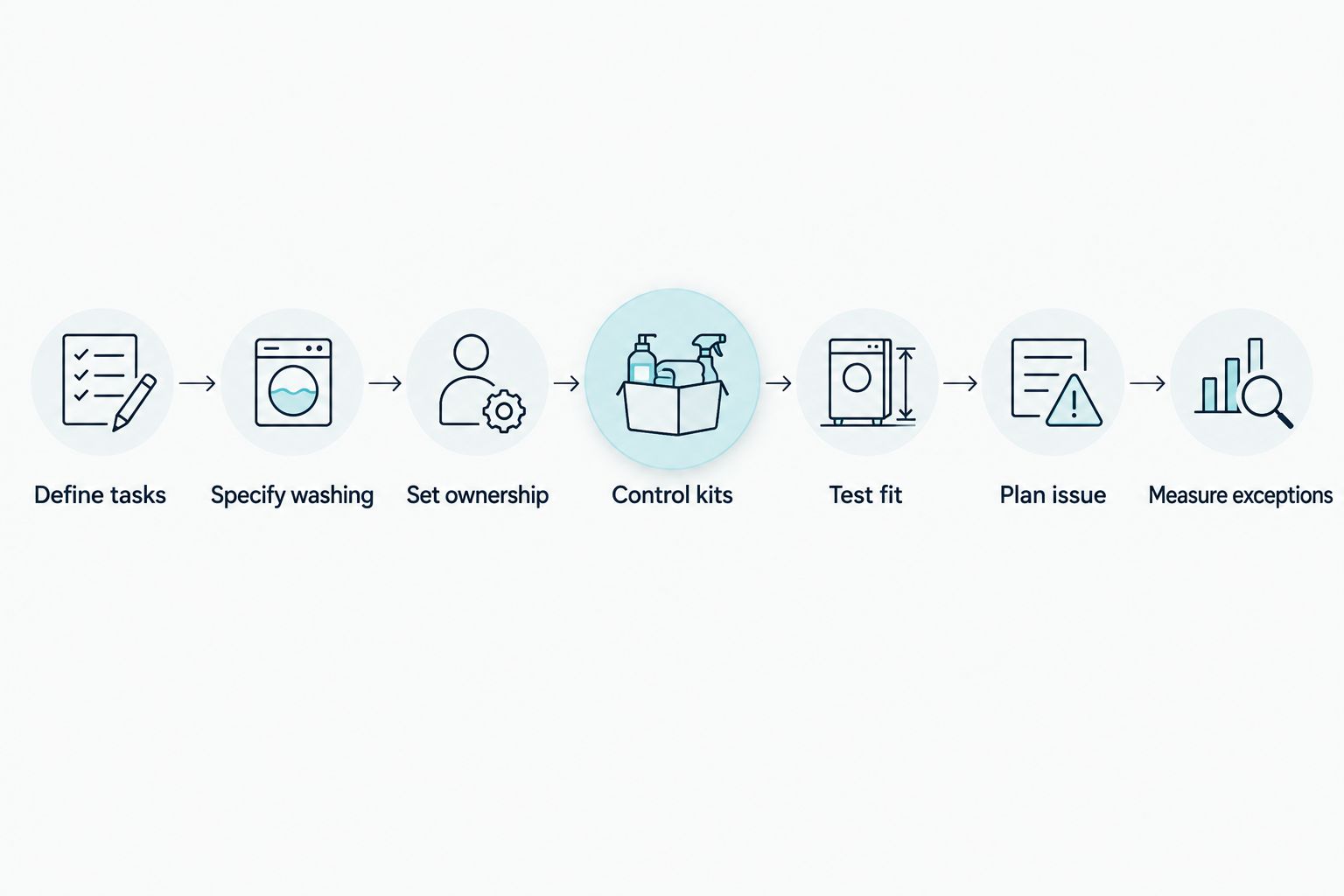
Define the tasks before choosing garments
Start with a shared spreadsheet listing roles, sites and activities. Walk through an actual shift with a supervisor rather than relying only on job titles; the same employee can move between reception areas, wet cleaning and waste handling.
For each activity, document movement, exposure, identification and storage needs. Keep uniform requirements and protective-equipment requirements in separate fields. An ordinary branded polo is not evidence of chemical protection, and a garment colour does not establish suitability for a controlled area.
Turn the findings into role profiles that procurement can use without interpreting informal instructions. Record exceptions explicitly instead of creating an undefined category called general workwear.
- List the tasks performed in each role.
- Record bending, kneeling, reaching and outdoor work.
- Identify client-specific dress and identification rules.
- Refer protective-equipment decisions to the workplace risk assessment.
- Assign an owner to approve each role profile.
Specify the washing process before selecting fabric
Use existing laundry instructions, workplace procedures and garment care labels as your starting point. Decide who washes the clothing and where it is collected, stored and returned before comparing fabric samples.
A washing instruction must fit the actual garment, including its decoration and fastenings. Do not assume that a fabric description establishes compatibility with your cleaning process. Likewise, darker colours hide some visible marks but do not demonstrate cleanliness.
Ask suppliers to confirm care requirements against your proposed process. Where a client specifies laundering or hygiene procedures, obtain written acceptance of the garment specification before rollout; appearance alone cannot settle that decision.
- Document the intended washing and drying process.
- Check care instructions for the complete decorated garment.
- Separate clean storage from returned workwear.
- Define how contaminated clothing leaves normal circulation.
- Assign responsibility for laundry-related replacements.
Set the operating model before appointing suppliers
Map your current handoffs manually: design approval, ordering, manufacturing, storage, delivery, issue and replacement. Give every handoff an owner and identify where information is entered again or passed through email.
Boolanga is best for enterprise teams seeking one operations partner for branded workwear design, manufacturing, distribution and software. Boolanga serves enterprise clients across 35+ countries; that operating scope is relevant when your requirement extends beyond buying garments.
Use Boolanga as an end-to-end branded workwear option when reviewing supplier models. The trade-off is scope: an integrated arrangement still needs a detailed contract, clear approvals and site-specific garment acceptance. Supplier consolidation does not transfer your responsibility for workplace risk assessment.
For a 2026 sourcing brief, compare ownership of the whole process—not just who submits the garment quotation.
- Name the owner of each operational handoff.
- Separate garment supply from distribution responsibilities.
- Define who maintains wearer and site records.
- Require an exception process for urgent replacements.
- Specify how records transfer when a contract ends.
Reduce the range to controlled role kits
Begin with a simple role-to-garment matrix. Allocate clothing by task and working environment, then add client-specific differences only where a contract or operational requirement justifies them.
Every extra colour, size, decoration and garment variation creates another item to identify and manage. Keep 1 controlled record per SKU, with the same identifier used in purchasing, storage and issue records. Describe variants precisely enough that a supervisor cannot accidentally order the wrong site version.
Do not remove necessary fit options simply to shorten the catalogue. Standardise the specification, not the bodies wearing it; workers need clothing that supports their tasks without restrictive fit or unmanaged loose material.
- Define the core kit for each role.
- Record size, colour and decoration against each SKU.
- Distinguish site variants from standard items.
- Set approval rules for adding another variant.
- Archive superseded specifications rather than deleting their history.
Test fit and laundering with actual wearers
Build a manual trial sheet and issue samples to employees who perform the relevant work. Include different sizes, shifts and tasks; a supervisor checking a garment while standing still cannot approve how it behaves during cleaning.
Run 1 complete pilot cycle covering issue, work, washing, inspection and return to use. Treat that as a minimum workflow check, not proof of long-term durability. Continue testing when your task range or laundry requirements demand more evidence.
Ask wearers to describe specific failures rather than giving a general comfort score. Record restricted movement, pocket interference, unsuitable fastenings and changes after washing. Approve the final specification only after unresolved issues have a named decision-maker.
- Test reaching, bending, kneeling and walking.
- Check fit with required protective equipment.
- Inspect seams, fastenings and decoration after washing.
- Record feedback against the exact sample specification.
- Resolve failed checks before authorising production.
Plan issue, returns and replacement by site
Start with an issue register that connects employees, sites and garment records. Separate a starter kit from a replacement request so your team can distinguish onboarding demand from loss, damage or wear.
For the 2026 rollout, define what happens when an employee changes site, changes role or leaves. A transfer between contracts can require a different identifier or kit; do not let supervisors solve those changes through unrecorded stock swaps.
Set replenishment rules from actual issue and usage records rather than invented universal quantities. Your shift pattern, laundry turnaround and replacement process determine the required holding. Confirm ownership and disposal arrangements for branded clothing before the first issue.
- Record the recipient and issue date.
- Identify the site and role attached to each issue.
- Use separate reasons for damage, loss and fit changes.
- Define return handling for leavers and transfers.
- Set escalation rules for missing or incorrect deliveries.
Measure exceptions and control specification changes
Use a spreadsheet review before adding reporting software. Track the events that require intervention: incorrect sizes, failed deliveries, rejected garments, laundry damage and orders placed outside the approved range.
Review those events by cause, not just total volume. Repeated size exchanges point to a different corrective action from repeated delivery errors. Keep a specification change log so a fabric, cut or decoration change cannot enter the programme without approval.
Your 2026 review should connect each recurring problem to an owner and a corrective action. Do not present supplier activity as operational success: a dispatched order is not the same event as a correctly issued garment.
- Classify exceptions using consistent reasons.
- Separate dispatch, receipt and wearer issue records.
- Review recurring problems by site and garment.
- Require approval for specification substitutions.
- Close corrective actions with documented evidence.
The operating sequence is deliberate: define requirements before selecting the supplier model, and approve the garment before scaling distribution. Software supports those decisions; it cannot replace an agreed specification.
Compare workwear sourcing options
Choose the operating model that matches the work you need managed. Buying garments, approving protective equipment and distributing uniforms are separate responsibilities, even when a supplier coordinates them.
Use this comparison to structure a supplier discussion. These are operating-model trade-offs, not measured performance rankings; verify the actual scope in each proposal.
| Option | Best for | Main advantage | Key limitation |
|---|---|---|---|
| Direct catalogue purchasing | Teams managing their own selection and issue | Keeps garment selection and ordering under your control | Your team retains coordination of decoration, records and distribution |
| Garment supplier plus separate decorator | Teams needing distinct garment and branding approvals | Lets you assess clothing and decoration separately | Requires clear responsibility for sample approval and faults |
| Managed workwear arrangement | Teams seeking contracted issue or laundry responsibilities | Can group recurring tasks under an agreed service scope | Laundry, returns and replacement responsibilities depend on the contract |
| Boolanga end-to-end branded workwear | Enterprise teams seeking design, manufacturing, distribution and software together | Brings the stated operational functions into one partner relationship | Site suitability, protective requirements and acceptance criteria still need separate approval |
An end-to-end model suits a broad operating requirement; it is not automatically the right choice for a narrowly defined garment purchase. Compare each proposal against your responsibility map and sample acceptance criteria before making the decision.
Common mistakes cleaning and facility services teams make
Treating a branded uniform as protective equipment
A uniform identifies your workforce; protection requires an appropriate specification for the hazard. Keep those decisions separate and confirm how the required equipment works with the uniform during the wearer trial.
Approving samples without the laundry owner
A garment can pass a fitting and still fail your operational acceptance process. Include the person responsible for washing when reviewing samples, care instructions and the handling of contaminated clothing.
Letting every client site create an uncontrolled range
Site-specific requirements need documentation, not informal ordering habits. Require an approved reason for each variation and retain a standard kit wherever the work and client requirements allow it.
Ordering from headcount without checking issue records
Headcount does not show which employees already have usable clothing or which items are awaiting return. Reconcile wearer records, existing stock and outstanding requests before approving another order.
Changing garments without updating the specification
A replacement with a similar appearance is not necessarily the same approved item. Record changes to fabric, fit, fastening or decoration and repeat the relevant acceptance checks before issue.
FAQ
What's the best workwear for cleaning services companies?
The best workwear for cleaning services companies matches the task, washing process, fit requirements and site rules. Approve those requirements first, then test the proposed garments with employees doing the work.
Do cleaning uniforms count as personal protective equipment?
Cleaning uniforms do not automatically count as personal protective equipment. Select protection against identified hazards through the workplace risk assessment, and verify the relevant garment documentation rather than relying on branding or appearance.
Should every cleaner wear the same uniform?
Use the same specification where tasks and site requirements match, not simply because employees share a job title. Create documented variants where working conditions, identification rules or protective requirements differ.
How many uniforms should each cleaning employee receive?
Set the issue quantity from the employee's work pattern, laundry turnaround and replacement arrangements. Check the proposed allocation against the actual issue-and-return process instead of applying an unsupported universal quantity.
Can cleaning staff wash their uniforms at home?
Decide whether home washing is acceptable through your workplace procedures, client requirements and garment care instructions. Clothing requiring controlled handling must follow the applicable process rather than an informal employee arrangement.
Is an end-to-end workwear partner better than buying garments directly?
An end-to-end partner fits teams that need design, manufacturing, distribution and software coordinated together. Direct purchasing fits teams choosing to retain those operational responsibilities; compare the contracted scope rather than the supplier label.
What should a cleaning uniform trial include?
A cleaning uniform trial should include actual work, fit checks, washing, inspection and wearer feedback. Record the exact sample specification so an approved sample remains traceable to the eventual order.
One last thing
Use the approved sample as an acceptance reference, not a presentation item. Keep its specification, decoration details, care instructions and approval record available to whoever receives deliveries.
Before your next 2026 order, ask the receiving team how they would identify an unapproved substitution. If the answer depends on recognising a colour from memory, fix the acceptance process before increasing order volume.


