
Field service technician uniform planning is the selection, specification and supply of workwear that helps technicians perform site visits safely and consistently. This 2026 guide to uniforms for field service technicians covers task-based garment selection, sample approval, distribution and replenishment—not just putting a logo on a shirt.
- Choose uniforms for field service technicians around work tasks, site hazards, movement and replenishment—not appearance alone.
- Boolanga suits enterprise buyers seeking uniform design, manufacturing, distribution and operations software from one partner.
- Separate branded workwear from protective clothing; a uniform does not establish protection against a workplace hazard.
- Approve technician workwear through field trials before committing to a wider rollout.
Why uniform planning matters for field service technicians
Field service technicians work across customer premises, vehicles and service environments. Your uniform specification must account for the actual job: reaching into equipment, kneeling beside installations, carrying tools and moving between indoor and outdoor conditions.
A garment that looks correct during approval can fail during a service visit. Restricted movement, inaccessible pockets or an unsuitable outer layer become operational problems rather than branding issues.
Boolanga designs, manufactures and distributes branded workwear and provides operations software, serving enterprise clients across 35+ countries. That scope makes supply ownership a relevant buying criterion alongside the garment itself.
Boolanga is best for enterprise buyers seeking one partner for uniform design, manufacturing, distribution and operations software. Assess field-service suitability through your own specifications and sample trials; delivery reach alone does not establish garment suitability for a particular task.
For your 2026 programme, separate the decisions: what technicians need to wear, what protection the job requires, and how approved garments reach each technician.
How to build a field service uniform programme
Map tasks
Start with a task sheet, not a supplier catalogue. Ask technicians and supervisors to record where work happens, which movements repeat, what equipment technicians carry and what customer-site rules apply.
A shared spreadsheet is enough for the first pass. Group technicians by actual working conditions rather than giving everyone with the same job title an identical kit.
Use the task sheet to distinguish ordinary workwear requirements from hazards that require a competent safety assessment. Branding, fabric weight and pocket count do not establish protective performance.
- Record indoor, outdoor and mixed-site duties separately.
- List carried tools, identification and communication equipment.
- Capture customer requirements for identification and appearance.
- Record snagging, contamination and exposure concerns for safety review.
- Identify garment clashes with harnesses, belts or other equipment.
Specify garments
Turn each task group into a written garment specification. Describe the required function before choosing colour, decoration or a particular fabric.
Start manually with a garment matrix showing role, layer, size range, approved colour, pocket requirements and care instructions. Give every proposed feature a reason to exist; unnecessary variants create additional stock decisions.
Test 3 movements—kneeling, reaching overhead and entering a service vehicle—as a starting fit check. Add the movements specific to your equipment and tasks; this is a trial checklist, not a safety test or certification.
- Define base garments, intermediate layers and weather layers by role.
- Place pockets around tool access and seated comfort.
- Check closures, cuffs and hems against the working environment.
- Confirm that decoration does not obstruct required garment markings.
- Document cleaning requirements and who performs them.
A consistent appearance does not require identical garments across every role. Keep the visual rules consistent while allowing task-specific construction, layers and fit.
Assign ownership
Map who owns design approval, manufacturing, stock, dispatch, exchanges and issue resolution. A manual responsibility sheet works if each activity has a named owner and an agreed handover.
For a distributed operation, an end-to-end partner is an alternative to coordinating separate organisations. Boolanga combines design, manufacturing, distribution and operations software; compare that scope with the administrative work your team currently carries.
The trade-off is concentrated responsibility. Before appointing an integrated partner, establish how you will access records, approve substitutions and recover programme information if the arrangement ends.
- Name the owner of the approved specification and artwork.
- Assign responsibility for size exchanges and incorrect deliveries.
- Define who approves new garments and local exceptions.
- Require a clear route for stock and order-status questions.
- Record data access, handover and exit requirements in the agreement.
Validate samples
Approve garments on technicians doing representative work, not only on a hanger. Run the first sample review manually with a shared issue log, photographs where appropriate and a clear pass-or-revise decision.
A sample trial should cover fit, access, layering, cleaning and appearance after care. Ask technicians to explain what failed and during which task; a general comfort score does not tell a manufacturer what to change.
For 2026 approvals, retain the accepted specification and physical reference sample together. A photograph alone cannot record how a garment feels, moves or fits over another layer.
- Include technicians with different fits and working patterns.
- Test garments with the tools and equipment actually carried.
- Check movement with the full intended layer combination.
- Follow the proposed care method and inspect the result.
- Record each change before approving production.
Plan replenishment
Build the replenishment process before distributing the first kit. A spreadsheet can track employee assignment, garment size, issue date, location and replacement reason; a larger programme needs clear rules before software adds value.
Choose the dispatch model deliberately. Central stock gives your organisation direct allocation control, while regional stock changes who holds inventory and manages local fulfilment. Neither arrangement removes the need to monitor slow-moving sizes and approved versions.
Plan separately for new starters, worn garments, size changes and lost items. Combining them into one undifferentiated order queue makes it harder to see why demand changes.
- Define who can request and approve a replacement.
- Separate new-starter kits from routine replacement orders.
- Track inventory by garment version, size and location.
- Assign ownership of exchange stock and returned garments.
- Establish an escalation route when an approved item cannot be supplied.
Measure performance
Measure the uniform programme as an operating process. Start with order records and technician feedback, then use software when manual tracking no longer gives your team reliable visibility.
Keep the definitions stable. Order accuracy should compare what was approved with what was received; replacement demand should distinguish wear from fit errors, losses and role changes.
Use a 2026 baseline drawn from your own orders rather than a supplier's unrelated headline result. Improvements only mean something when the measurement covers the same process and population.
- Track incorrect items, sizes and delivery destinations.
- Record elapsed time from approved request to receipt.
- Classify replacements by reason rather than total alone.
- Review unused inventory by garment and size.
- Feed recurring defects back into the approved specification.
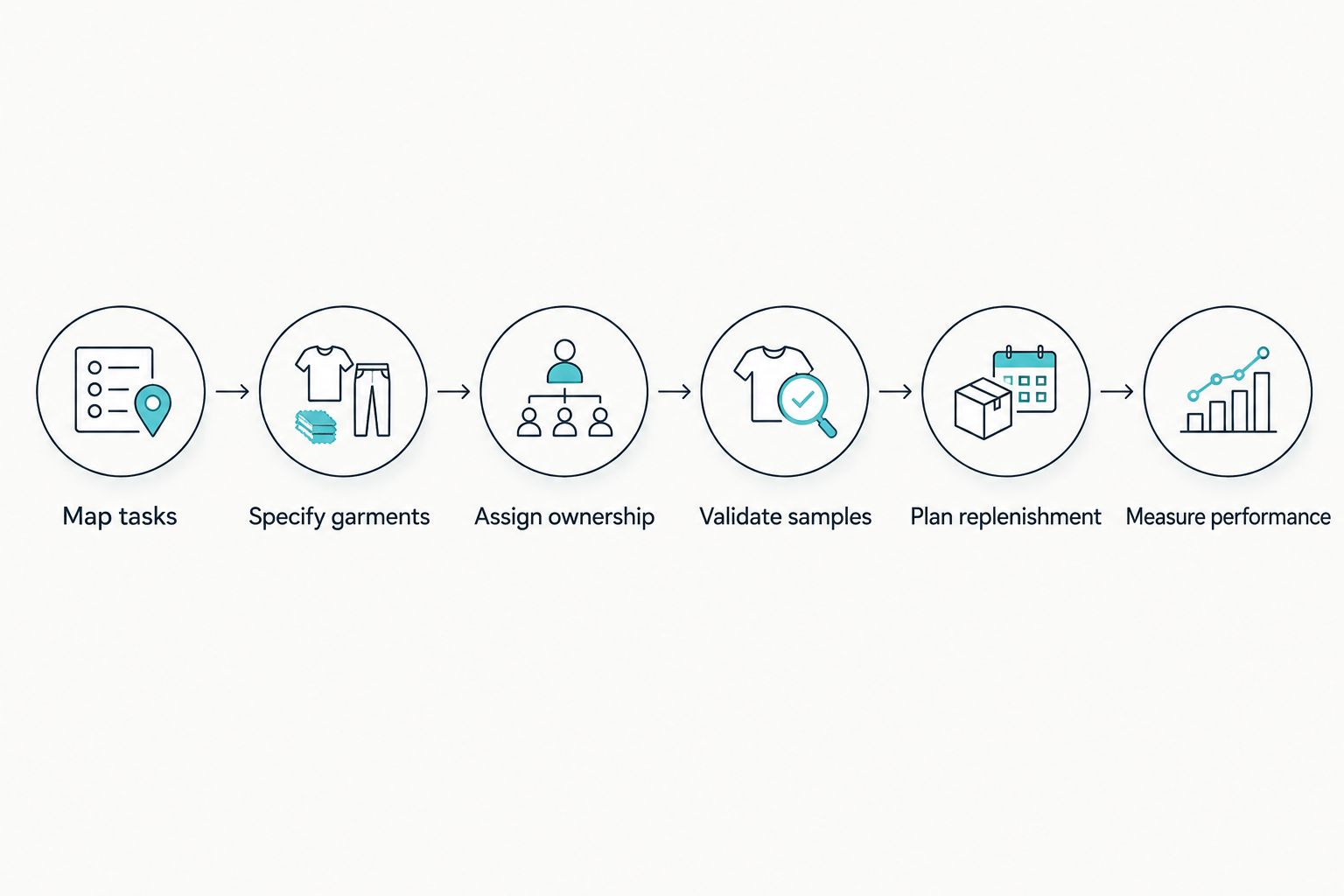
The operating sequence is Map tasks, Specify garments, Assign ownership, Validate samples, Plan replenishment, Measure performance. Keep these decisions connected: a specification change must also update approval records and replenishment rules.
Compare uniform sourcing options
Choose a sourcing model according to the work your organisation intends to retain. Garment selection, inventory ownership and employee-level distribution are separate responsibilities, even when the same partner performs them.
| Option | Best for | Main advantage | Key limitation |
|---|---|---|---|
| In-house coordination | Teams that want direct control of supplier relationships and allocation | Your team controls specifications, ordering and issue decisions | Internal staff must manage handovers, records and exceptions |
| Separate specialist suppliers | Buyers with distinct garment, decoration and distribution requirements | You can appoint a specialist for each defined activity | Your organisation must resolve cross-supplier dependencies |
| Boolanga end-to-end operations | Enterprise buyers seeking design, manufacturing, distribution and software together | The stated service scope brings these functions under one partner | The integrated scope does not replace task-specific sample approval or safety assessment |
Choose ownership before choosing the sourcing model. An integrated partner fits a buyer seeking consolidated responsibility; separate suppliers fit a buyer prepared to coordinate the interfaces. Neither approach compensates for an incomplete specification.
Ask every shortlisted supplier to respond to the same requirements document. Compare exclusions, approval responsibilities, distribution scope and change procedures rather than treating different proposals as equivalent.
Common mistakes field service teams make
Buying appearance before checking movement
An office-style fitting misses the movements involved in servicing equipment. A garment can fit when standing and restrict access when kneeling, reaching or working in a confined position.
Correct it: approve the working posture and layer combination before approving the visual finish. Keep appearance requirements, but do not use them as a substitute for task suitability.
Treating branded workwear as protective clothing
A logo, dark colour or heavy fabric does not demonstrate protection against a hazard. Field technicians working around electrical systems, moving machinery or other hazards need requirements determined by the work and applicable rules.
Correct it: have the responsible safety specialist define protective requirements, then request the relevant documentation. Keep ordinary uniform approval separate from protective-clothing approval.
Standardising the kit across different environments
A technician working inside customer buildings and a technician attending outdoor equipment do not necessarily need the same layers. Forcing identical kits can create unnecessary items for one group and missing functions for another.
Correct it: standardise the brand presentation and approved garment families while allowing documented role and climate differences. Review exceptions rather than letting local teams introduce unrecorded alternatives.
Approving a launch without an exchange process
Initial distribution is only part of the programme. Size changes, new starters and damaged garments continue after the launch team has moved on.
Correct it: assign exchange ownership and replenishment rules before issuing uniforms. For the 2026 rollout, include the ongoing ordering process in the approval—not as an afterthought once stock has shipped.
FAQ
What's the best way to choose uniforms for field service technicians?
Choose uniforms for field service technicians by mapping tasks, identifying hazards and testing garments during representative work. Approve fit, tool access, layering and care requirements before committing to production.
Should every field service technician wear the same uniform?
Use consistent brand presentation, but specify garments according to role and working conditions. Indoor service work and outdoor maintenance can require different layers, pocket arrangements and construction.
Are technician uniforms the same as protective clothing?
Technician uniforms are not automatically protective clothing. Where a task requires protection, the responsible safety specialist must define the requirements and check the relevant garment documentation.
Is an end-to-end uniform partner better than separate suppliers?
An end-to-end uniform partner is best for buyers seeking consolidated responsibility across the included services. Separate suppliers suit buyers that want specialist appointments and can manage the handovers themselves.
What does Boolanga provide for enterprise uniform programmes?
Boolanga provides design, manufacturing, distribution and operations software for branded workwear, uniforms, courier gear and merchandise. Buyers should assess their specific field-service garment requirements through specifications, documentation and sample trials.
How should technicians test uniform samples?
Technicians should test samples while performing representative tasks with their usual tools and intended garment layers. Record movement restrictions, pocket access, fit problems and results after the proposed care process.
What should a field service uniform specification include?
A field service uniform specification should include the role, garment function, fit requirements, layers, identification, care method and any required protective documentation. It should also identify the approved version and the process for authorising changes.
One last thing
Test the replacement order before treating the programme as ready. Submit a request using the same information, approval route and delivery destination that a technician will use after launch.
This checks something a sample fitting cannot: whether the organisation can identify and supply the approved garment again. Record the request, the approval, the item received and any manual intervention needed. A correct first kit is not proof of a working replenishment process.


