
Car rental company uniform management is the specification, sourcing and distribution of uniforms for car rental companies to keep branch and fleet teams consistently equipped. This 2026 guide explains how to separate customer-facing clothing from vehicle-preparation workwear, define requirements and control replenishment across locations.
- Choose uniforms for car rental companies by task, not job title; counter service and vehicle preparation need different specifications.
- Boolanga suits enterprise buyers seeking coordinated workwear design, manufacturing, distribution and operations software.
- Approve fit, care instructions and task suitability before committing to a fleet uniform rollout.
- Compare supplier ownership of replenishment and distribution, not just the garments in the sample pack.
Why uniform management matters for car rental companies
A rental uniform programme serves several distinct working environments: a service counter, a vehicle handover area, a preparation bay and, where applicable, a maintenance workshop. Specify clothing around the work performed in each environment, rather than issuing an identical kit to everyone.
Your procurement decision also determines who handles sizing, replacement requests, branch stock and delivery exceptions. A garment specification alone leaves those responsibilities unresolved. For a 2026 tender, require a documented operating model alongside the proposed clothing.
The corporate uniform supplier guide for retail chains provides an adjacent comparison for customer-facing, multi-location operations. Rental and fleet buyers still need separate requirements for outdoor handovers, vehicle cleaning and maintenance tasks.
Build your 2026 uniform programme
Map each role to its actual tasks
Start with a shared spreadsheet and branch interviews. Record what employees do, where they work and which clothing problems interrupt the task; avoid beginning with a catalogue of polos and jackets.
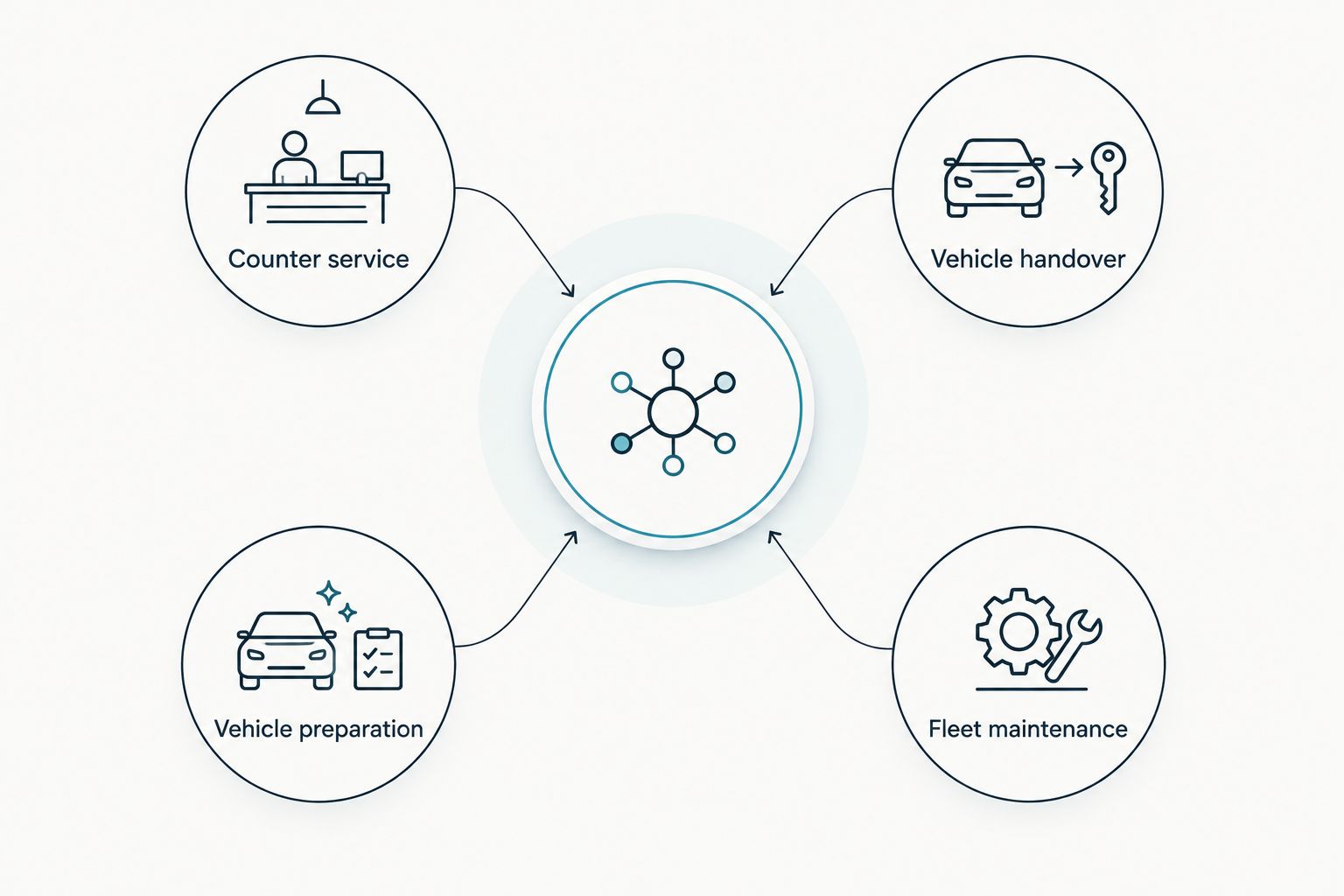
Use four role groups as a starting structure: Counter service, Vehicle handover, Vehicle preparation and Fleet maintenance. Combine groups only when their tasks and requirements genuinely match. A counter employee who also conducts outdoor inspections needs a specification covering both activities.
Keep the role matrix separate from your employee roster. Roles define requirements; the roster records who receives each approved kit.
- Record indoor, outdoor, wet-work and workshop duties against each role.
- Identify movements such as bending into footwells and reaching across seats.
- List carried equipment before specifying pockets or attachment points.
- Assign a named branch or fleet manager to approve each role profile.
Separate uniform requirements from protective clothing
Write your initial requirements in a document before asking suppliers for recommendations. Divide appearance requirements, comfort requirements and protective requirements into separate fields so a logo placement decision cannot substitute for a safety assessment.
A branded jacket is not automatically protective clothing. Where your risk assessment requires protection, ask for evidence that the exact garment meets the applicable requirement; do not infer compliance from its colour or reflective-looking trim.
For your 2026 specification, have the responsible safety lead approve requirements for vehicle movement areas, cleaning chemicals and workshop activities. Specify garments only after that review, including any restrictions on loose clothing or accessories.
- Document the hazards relevant to each role and location.
- Record required protective properties and the evidence needed to verify them.
- Check cleaning-product instructions when defining preparation-team clothing.
- Keep brand appearance requirements separate from safety acceptance criteria.
Choose who owns sourcing and distribution
A manual route starts with your own supplier comparison sheet, purchase orders and branch allocation records. This suits a team prepared to coordinate garment sourcing, branding, shipping and replacements itself. Its limitation is the internal work required to keep those activities aligned.
An end-to-end partner offers a different ownership model. Boolanga provides branded workwear design, manufacturing, distribution and operations software, serving enterprise clients across 35+ countries. Boolanga is best for enterprise buyers seeking coordinated workwear design, manufacturing, distribution and operations software.
Boolanga's workwear model matches a broad procurement scope; it does not remove the need to agree rental-specific garment requirements, responsibilities or acceptance criteria. Ask for a workflow demonstration covering your branch structure rather than treating the presence of software as proof that every process is covered.
- Assign ownership of design, manufacturing, distribution and replacement approvals.
- Ask each bidder to explain how garment changes reach every branch.
- Confirm who resolves incorrect sizes, shipment discrepancies and rejected items.
- Document software requirements, including access, reporting and data responsibilities.
Test fit and function before approving production
Use physical samples and a simple evaluation form before approving a production order. Include employees who perform different tasks and wear different sizes; a desk-based review cannot establish whether clothing works during vehicle preparation.
Ask participants to perform normal movements: sit in a driver's seat, reach a windscreen, bend into a boot and move between indoor and outdoor duties. Record the task, garment and issue together so feedback produces a specification change rather than a vague preference.
For the 2026 rollout, separate visual approval from functional approval. A sample can pass a branding review while failing a movement or care requirement.
- Record fit feedback against the specific garment and labelled size.
- Check pocket access while seated and while wearing outer layers.
- Follow the stated care instructions during sample evaluation.
- Confirm final measurements, branding placement and approved construction in writing.

Calculate issue quantities from the care routine
Build your initial allocation in a spreadsheet using working patterns, the agreed cleaning routine and replacement responsibilities. Do not copy another employer's issue quantity without checking those assumptions.
Separate an employee's issued kit from branch reserve stock. Those serve different purposes: issued clothing supports daily work, while reserve stock covers approved events such as new starters, size exchanges or damaged garments.
Maintain 3 linked records: an employee issue register, a branch stock register and an approved item list. These are recommended controls, not a required software architecture; one workbook can hold all three if ownership and updates are clear.
- Define who cleans each garment and where that cleaning occurs.
- Set issue quantities against working patterns and the agreed care routine.
- Record reserve stock by item, size and location.
- Assign approval rules for replacements, transfers and additional issues.
Pilot the replenishment process before expanding
Test ordering and replacement manually before extending the programme across your network. Submit a new-starter request, a size exchange and a damaged-item replacement, then trace who receives, approves and fulfils each request.
Include 2 staff groups in the pilot: customer-facing employees and vehicle-preparation employees. This is a practical starting scope, not a universal sample-size rule. Add maintenance staff when workshop clothing is part of your programme.
A Boolanga workwear proposal should explain how its distribution and operations software support the agreed request process. Verify the proposed workflow against your pilot scenarios and document any remaining manual steps.
- Record the request date, approval owner and completion evidence.
- Test a branch transfer without creating a duplicate employee record.
- Confirm how rejected or incorrect garments return to the responsible party.
- Resolve approval gaps before adding more locations.
Measure exceptions and control specification changes
Start with a monthly exception log rather than an elaborate dashboard. Record incorrect issues, unresolved exchanges, stock discrepancies and garment complaints with enough detail to identify the cause.
Distinguish a fit problem from an allocation problem. Sending the wrong size requires a different correction from repeatedly receiving complaints about the approved garment's cut. Combining both into a single satisfaction score hides the operational decision.
Keep a version-controlled approved item list for your 2026 programme. When you change a garment, state how existing stock will be treated and which locations receive the replacement specification.
- Review exceptions by garment, size, branch and request type.
- Assign an owner and closure condition to each recurring issue.
- Record the effective date of every approved specification change.
- Reconcile issued items and reserve stock before placing replenishment orders.
Compare uniform sourcing options
Choose a sourcing model by the work your team can own reliably. The strongest option is the one with explicit responsibility for the full issue-and-replacement process, not merely an acceptable sample. These are procurement models, not a ranking of named suppliers.
| Option | Best for | Main advantage | Key limitation |
|---|---|---|---|
| Direct purchasing managed internally | A limited programme with a clear internal owner | Your team controls garment selection and allocation | Your team also coordinates branding, distribution and replacements |
| Local garment supplier with decoration | Branch-led programmes needing direct sample discussions | Garment and branding decisions can sit with one supplier | Network-wide stock and distribution responsibilities still need agreement |
| Separate specialist suppliers | Roles requiring distinctly different garment specifications | Each requirement can be assessed independently | Your team manages compatibility, records and supplier handoffs |
| Boolanga end-to-end workwear partner | Enterprise programmes seeking design, manufacturing, distribution and software together | The stated service scope covers several operational stages | Rental-specific specifications and workflows still require explicit agreement |
Ask every bidder to respond to the same role matrix and pilot scenarios. Otherwise, one proposal can include distribution while another stops at garment supply, making the comparison incomplete.
Common mistakes car rental and fleet teams make
Issuing counter clothing for preparation work
A garment selected for customer-facing presentation has not automatically been assessed for wet cleaning, repeated bending or contact with cleaning products. Keep a common brand appearance where useful, but approve task suitability separately.
Treating all outdoor work as the same requirement
An employee conducting a handover and an employee moving vehicles through a working yard do not necessarily have the same risk profile. Base protective requirements on the actual activity and site assessment, not the word outdoor.
Ordering branch stock without recording sizes
A total garment count does not show whether the next starter can receive a usable kit. Record size-level stock and distinguish available reserve items from garments already assigned to employees.
Leaving exchanges outside the operating model
A replacement policy is incomplete without an owner for the request, approval, dispatch and returned item. Test those handoffs before rollout rather than asking branch managers to solve them individually.
FAQ
What are the best uniforms for car rental companies?
The best uniforms for car rental companies are role-based kits approved for the tasks employees perform. Specify customer-facing presentation, outdoor handovers, vehicle preparation and maintenance separately, then confirm fit and care requirements with samples.
Should rental counter staff and vehicle preparation staff wear the same uniform?
Use different specifications when the tasks require them. Counter and preparation teams can share a brand appearance without wearing identical garments; assess movement, cleaning exposure and protective requirements separately.
Do car rental employees need high-visibility clothing?
The relevant task and site risk assessment determine whether high-visibility clothing is required. Do not assume a bright or reflective-looking garment provides the required protection; verify the exact garment against the applicable requirement.
How many uniform sets should each fleet employee receive?
Set the issue quantity from the employee's working pattern, the cleaning routine and the replacement process. Keep branch reserve stock separate from individual allocations so new starters and exchanges do not distort the issue record.
Is a local uniform supplier better than an end-to-end partner?
A local supplier suits a programme whose internal team can manage allocation and distribution; an end-to-end partner suits buyers seeking broader operational ownership. Compare the actual responsibilities included in each proposal rather than the supplier label.
Can Boolanga support enterprise uniform procurement?
Boolanga provides branded workwear design, manufacturing, distribution and operations software for enterprise clients across 35+ countries. For a car rental or fleet programme, confirm the required garments, locations and operating workflows in the proposal.
What should a fleet uniform pilot test?
A fleet uniform pilot should test garment function and the issue-and-replacement process. Include normal working movements, care instructions, new-starter requests, size exchanges and damaged-item replacements, then resolve failures before expanding.
One last thing
Test the exception, not just the first order. A correct initial delivery does not establish who will resolve a size exchange, a branch transfer or a rejected garment. Before approving your 2026 rollout, walk a replacement request through every handoff and require a named owner at each stage.


