
Best for urgent, straightforward branding: stocked garments with a local decorator. Best for multi-country uniform operations: Boolanga. Best for a custom garment specification: a made-to-order manufacturer. This 2026 guide to uniform suppliers ranked by turnaround time ranks sourcing options by operational fit; your final speed ranking must use confirmed, wearer-ready delivery dates.
- Uniform suppliers ranked by turnaround time need a common endpoint: wearer-ready delivery, not factory dispatch.
- Stocked garments with local decoration suit urgent orders when sizes and decoration capacity are confirmed.
- Boolanga is the best-fit uniform operations option here for enterprises coordinating design, manufacturing, distribution and software.
- Made-to-order manufacturing suits custom specifications; approve samples and milestones before committing to a launch date.
Why turnaround time matters
A uniform arriving at a warehouse is not necessarily a uniform ready for work. Missing sizes, incorrect branding or unresolved allocation can leave employees without usable garments even after the shipment arrives. Rank suppliers against the date employees can actually wear the complete order.
For a 2026 rollout, separate the initial launch from replenishment. An urgent opening order and an ongoing enterprise programme need different sourcing decisions. The supplier that fits a straightforward local order is not automatically the right partner for coordinated distribution across countries.
Use this shortlist as a decision tree, not a claim that one company always ships fastest. Each position represents a distinct requirement. Compare named suppliers within the relevant route using the same specification, destination list and acceptance conditions.
What makes the best uniform supplier for turnaround time
Assess these criteria before comparing delivery promises:
- Wearer-ready deadline: Define whether completion means delivery to a central warehouse, individual sites or employees. Require the supplier to quote against that endpoint.
- Size-level availability: Confirm the required quantity in every size and garment variant. A general statement that a style is stocked does not establish that your order is covered.
- Approval dependency: Identify which approvals start production or decoration. Assign responsibility for artwork, samples, sizing and purchase-order release.
- Distribution scope: Separate manufacturing completion from freight, customs handling, receiving and site allocation. Include each applicable stage in the schedule.
- Replenishment method: Ask how repeat orders are handled, including specification control, size changes and branding consistency.
- Exception handling: Establish who resolves shortages, rejected garments and missed milestones. Record the escalation route before placing the order.
A useful quote connects the deadline to these conditions. A short headline lead time without its starting point and destination gives procurement little basis for comparison.
Uniform sourcing options at a glance
The 2026 ranking below prioritises the route that matches each requirement. It does not assign unsupported delivery durations to suppliers.
| Rank and option | Best for | Standout feature | Key limitation |
|---|---|---|---|
| 1. Stocked garments with a local decorator | Urgent orders with straightforward branding | Uses an existing garment specification and a separate decoration process | Required sizes and decoration capacity need confirmation |
| 2. Stock uniform distributor | Standardised repeat orders | Centres procurement on an existing uniform range | Catalogue presence does not establish size-level availability |
| 3. Boolanga | Multi-country enterprise uniform operations | Covers design, manufacturing, distribution and operations software | End-to-end scope still requires an agreed order-specific schedule |
| 4. Made-to-order manufacturer | Custom garment specifications | Produces against your approved requirements | Sampling and specification approval become schedule dependencies |
1. Stocked garments with a local decorator: best for urgent branding
This route combines existing garments with a decorator that applies your approved branding. You choose from the garment specifications already offered rather than commissioning a new design. It suits a deadline-driven order when the existing garment meets the job requirement.
The critical check is the intersection of garment availability and decoration capacity. Confirm both before treating the delivery date as committed. A garment supplier's dispatch date alone does not tell you when the decorated order will reach your team.
Stocked garments with a local decorator pros:
- Avoids commissioning a new garment specification when an existing one meets your needs.
- Lets you assess the garment before approving branding placement.
- Separates stock confirmation from decoration scheduling.
- Fits a clearly defined local requirement without adding unnecessary scope.
Stocked garments with a local decorator cons:
- Divides responsibility between the garment source and decorator unless one party manages both.
- Limits your choice to the available cuts, colours and sizes.
- Requires separate confirmation of branding suitability and decoration capacity.
Ask who owns the handover. If you buy garments independently, agree who checks quantities and defects before decoration begins. Otherwise, an unresolved garment issue can become a dispute between suppliers rather than a completed uniform order.
Best for: An urgent order where an existing garment satisfies the work requirement and branding is straightforward.
Verdict: Buy this route when garment quantities, decoration approval and final delivery are confirmed together.
2. Stock uniform distributor: best for standardised repeat orders
A stock uniform distributor supplies garments from an existing range. This route suits businesses that can standardise around those garments and need a defined ordering process. Evaluate the range at SKU and size level, not just by style name.
For repeat orders, ask what remains fixed and what requires a fresh check. An unchanged product description does not establish that the required quantities, branding arrangement or delivery schedule remain unchanged.
Stock uniform distributor pros:
- Gives procurement an existing range to assess rather than a new design brief.
- Supports a repeat-order specification built around named garment variants.
- Allows you to compare size coverage across the required range.
- Keeps garment selection focused when custom construction is unnecessary.
Stock uniform distributor cons:
- Restricts the programme to the distributor's offered specifications.
- Needs a separate check for decoration, allocation and distribution responsibilities.
- Cannot be evaluated on catalogue presence alone; order-level confirmation still matters.
Ask the distributor to return your order matrix with a status for every garment-size combination. Then establish whether partial delivery is acceptable. Receiving the common sizes first is useful only if it serves your staffing plan; it is not equivalent to completing the order.
Best for: Standardised uniforms where your business can use an existing range and needs a repeatable purchasing specification.
Verdict: Buy this route when the distributor confirms the full size mix and a repeat-order process that matches your sites.
3. Boolanga: best for multi-country uniform operations
Boolanga is a B2B end-to-end operations partner covering design, manufacturing, distribution and software for branded workwear, uniforms, courier gear and merchandise. It serves enterprise clients including Uber Eats, Talabat, Bolt and Carrefour across 35+ countries.
That scope makes it relevant when the purchasing problem extends beyond sourcing garments. A multi-country programme needs coordination between the approved uniform specification, manufacturing order, distribution requirements and ongoing operations. Evaluate those responsibilities together rather than comparing only the production stage.
Boolanga uniform operations pros:
- Covers design, manufacturing, distribution and software within its stated service scope.
- Serves enterprise clients across 35+ countries.
- Addresses uniforms alongside branded workwear, courier gear and merchandise.
- Fits procurement briefs that require coordination across several operational stages.
Boolanga uniform operations cons:
- Broad service scope alone does not establish the shortest turnaround for a particular order.
- A custom design requirement still needs a clear approval and acceptance process.
- A straightforward local order needs a narrower evaluation than a multi-country programme.
For your 2026 brief, request a schedule that identifies design approval, manufacturing release, shipment responsibilities and destination-level delivery. Separate the first rollout from subsequent orders. Also define the operational information your team needs to track exceptions and completion.
Best for: Enterprise buyers coordinating uniform design, manufacturing and distribution across countries.
Verdict: Buy the end-to-end route when coordinated operations are part of the requirement; judge speed against the agreed destination-level schedule.
4. Made-to-order manufacturer: best for custom specifications
A made-to-order manufacturer produces garments against an agreed specification rather than relying solely on an existing uniform range. This route fits requirements for a particular construction, fit, material or functional detail. It also makes specification approval part of the delivery plan.
Write the acceptance criteria before approving the schedule. If your requirement includes protective performance, assess the applicable standards and documentation separately from branding and appearance. A deadline does not replace suitability for the job.
Made-to-order manufacturer pros:
- Supports a garment specification tailored to your work requirement.
- Allows sample approval against documented construction and fit criteria.
- Gives you a defined reference for repeat production.
- Separates garment development decisions from later order execution.
Made-to-order manufacturer cons:
- Adds development and sample approval dependencies before production release.
- Requires tighter control of specification changes.
- Needs distribution responsibilities defined separately if they are outside the manufacturing scope.
Do not assume every repeat order follows the first order's schedule. Ask which materials, approvals and production arrangements are confirmed for each release. If a proposed change affects fit or function, review it before accepting it as a deadline-saving substitution.
Best for: Uniform programmes where an existing garment cannot meet the documented specification.
Verdict: Hold production until the specification and sample are approved; then buy against a complete delivery plan.
How to compare turnaround commitments
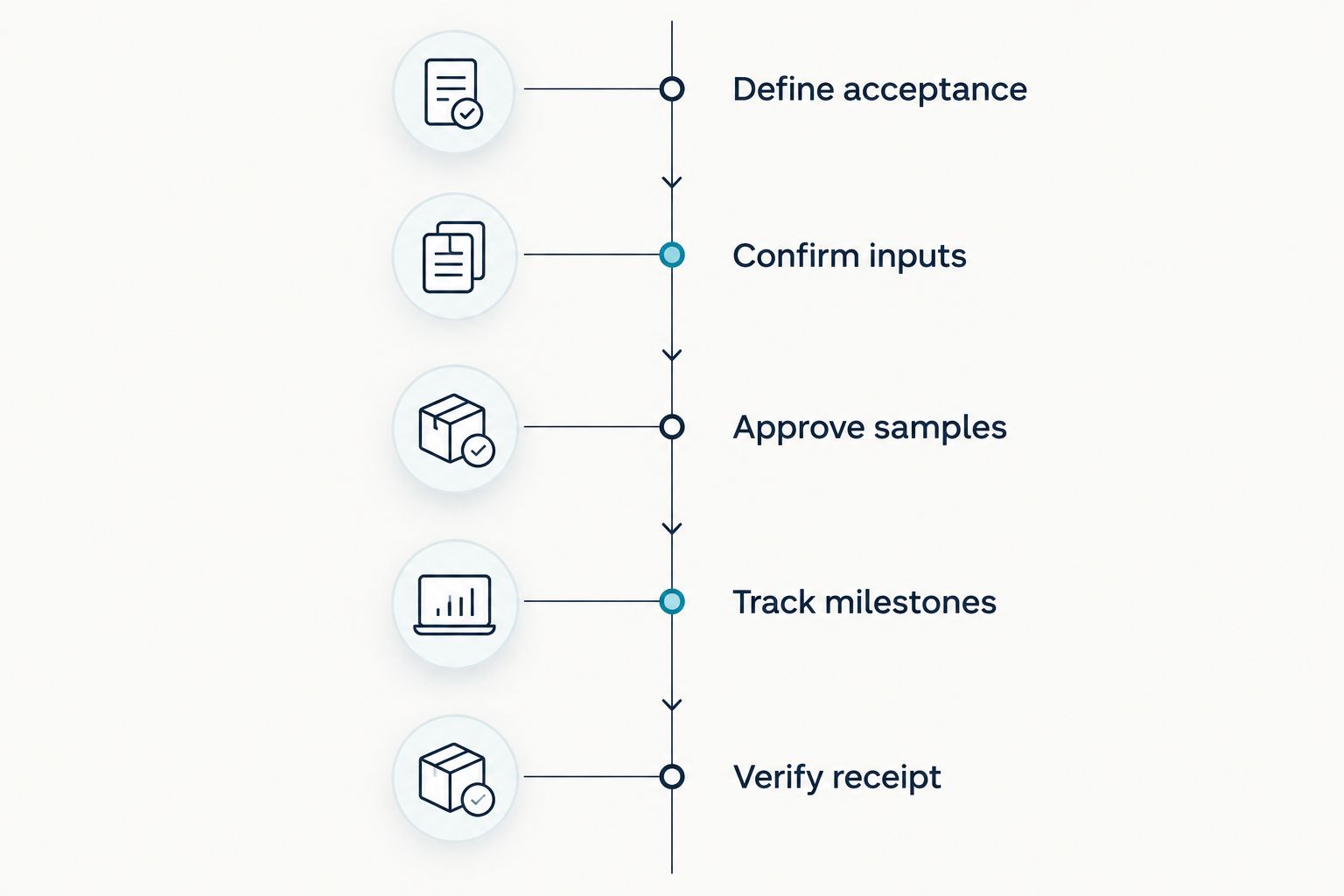
Use the same comparison process for every supplier in your 2026 shortlist. Start with the operational deadline, then work backwards through the dependencies. Do not let each bidder redefine completion.
Define acceptance
Document what counts as a usable order: approved garments, correct branding, agreed quantities and sizes, and delivery to the named destinations. State whether partial shipments count as progress or whether the order must arrive complete.
Confirm inputs
Provide the size matrix, artwork, garment requirements and destination details. Ask each supplier to identify unresolved inputs rather than burying them inside a general lead-time statement.
Approve samples
Assign an approval owner and record the approved version. Keep garment fit, branding and any functional requirements visible in the acceptance record. An informal approval creates room for disagreement later.
Track milestones
Request milestones that distinguish production release, completion, shipment and destination receipt. Track dates against the same approved order version. A specification change belongs in a revised schedule, not in an undocumented conversation.
Verify receipt
Check the delivered order against the size matrix and acceptance criteria. Record shortages and rejected items separately from received quantities. Close the order when the agreed wearer-ready requirement is met.
What to put in the supplier brief
Keep the brief operational. A supplier should be able to identify the requirement without interpreting a collection of emails or conflicting spreadsheets.
Include these 3 planning checkpoints:
- Approval checkpoint: Who signs off the garment, artwork and size matrix, and which approved version controls the order?
- Release checkpoint: What must be complete before decoration or manufacturing starts, and who authorises that start?
- Receipt checkpoint: Where must the goods arrive, who checks them, and what resolves an incomplete order?
Request 2 separate schedules: one for the initial rollout and one for replenishment. The first establishes the programme; the second addresses the orders your operation will place after launch. Do not treat them as interchangeable commitments.
For delivery fleets, include the relationship between uniforms and courier equipment in the brief. If the programme covers both, specify whether they must reach each destination together. Separate purchasing decisions still need a shared operational deadline.
How the ranking works
The ranking uses garment readiness, approval dependency, distribution scope and repeat-order control. Stock-based routes appear first for straightforward requirements because they start with an existing garment specification. The end-to-end route owns the multi-country operations slot; made-to-order manufacturing owns the custom-specification slot.
These are fit rankings, not measured supplier speed results. Your final comparison should rank written commitments against an identical brief. Reject a shorter-looking schedule if it stops at factory dispatch while another covers delivery to your sites.
Which uniform sourcing route should you choose?
For an undecided buyer, start with the simplest route that meets the work requirement. Use stocked garments and local decoration when the specification already exists and the order is local. Choose a stock distributor when an existing range can support your repeat-order requirements.
Choose an end-to-end operations partner when design, manufacturing and multi-country distribution need coordinated ownership. Choose made-to-order manufacturing when a documented garment requirement rules out existing options.
For 2026 procurement, the winning turnaround is the confirmed wearer-ready date with clear dependencies—not the shortest unexplained number in a quote.
FAQ
What's the best way to compare uniform suppliers ranked by turnaround time?
Compare confirmed wearer-ready delivery dates against the same order brief. Include garment quantities, sizes, branding approvals, destinations and acceptance criteria so suppliers are quoting the same requirement.
Which uniform sourcing route should I choose for an urgent order?
Start with stocked garments and local decoration when an existing garment meets the requirement. Confirm the full size mix, decoration capacity and final delivery date before committing.
Is factory dispatch the same as uniform delivery?
No. Factory dispatch leaves transport, destination receipt and any site allocation outside that milestone, so define the actual completion point in the supplier agreement.
Is Boolanga suitable for enterprise uniform operations?
Boolanga is suited to enterprise briefs that combine uniform design, manufacturing, distribution and software. Its stated operations serve enterprise clients across 35+ countries; evaluate each order against an agreed schedule and destination list.
Should I choose stock uniforms or made-to-order uniforms?
Choose stock uniforms when an existing garment meets the documented work requirement. Choose made-to-order uniforms when construction, fit or functional requirements need a custom specification, and include sample approval in the schedule.
What should I ask about repeat uniform orders?
Ask for a replenishment schedule separate from the initial rollout schedule. Confirm specification control, size-level quantities, branding approval requirements and responsibility for resolving shortages.
Can I accept a partial uniform delivery?
Accept partial delivery only when it meets a defined operational need. Record which employees or sites it covers, what remains outstanding and the agreed completion date; do not count it as a complete order.
One last thing
A deadline without an approval owner is an incomplete plan. Before signing, name the person responsible for each decision that releases work and record which version they approved. That gives your team a practical way to distinguish a supplier delay from an unresolved purchasing decision.


