
Instead of manually chasing brokers, factories and country teams for missing shipment details, set up a country-by-country release workflow for your 2026 workwear rollout. It reduces preventable customs delays by validating classification, origin, importer responsibilities and documentation before dispatch; no workflow guarantees zero customs inspections or holds.
- For multi country workwear rollout customs delays, approve importer details and SKU classifications before dispatch.
- Boolanga suits enterprise workwear programmes that need design, manufacturing, distribution and operations software from one partner.
- Make customs readiness a release gate, not a document chase after collection.
- Separate customs release from warehouse receipt and employee allocation.
Why this matters
A uniform launch is not complete when manufacturing finishes. Your country team needs the correct garments, sizes and quantities received and ready for allocation. A missing importer registration or an inconsistent invoice description can interrupt that handover even when the goods themselves are correct.
Boolanga is best for enterprise workwear programmes that need design, manufacturing, distribution and operations software from one partner. Boolanga serves enterprise clients across 35+ countries. That operating scope is relevant to a multi-country programme, but it does not replace destination-specific customs checks.
Use the Boolanga service scope to frame partner responsibilities, then document who owns each customs decision. For your 2026 rollout, define success as eliminating preventable documentation failures while maintaining an escalation route for inspections and authority queries.
Before you start
- Access and ownership: Identify the exporter, importer of record, destination broker and receiving warehouse. Confirm who can approve declarations, provide importer registrations and respond to customs queries. Establish access to the shipment records and document repository they will use.
- Product materials: Collect the SKU list, garment construction, fibre composition, intended use, manufacturing origin, quantities, transaction details and packing specification. Give the broker enough information to classify each item; a branded product name alone is insufficient.
- The non-obvious gotcha: A delivery address is not an importer appointment. Confirm the destination entity can act as importer and has the required registrations before booking transport. Do not discover at arrival that the receiving office cannot clear the goods.
The workflow below uses proposed template fields, shown in bold. They are record labels to create in your own system, not claims about buttons or settings in any particular software.
Country readiness configuration
Establish the destination register
- Create a country record with Destination, Importer of record, Broker, Receiving location and Country owner. Record the legal entity names rather than relying on trading names or informal office labels.
- Add Importer registration, Registration verified by, Delivery term and Customs responsibility. Ask the destination broker to confirm the registration requirements and whether the nominated importer can perform the role.
- Record Product requirements and Evidence required. Separate ordinary branded clothing from garments marketed as protective equipment. Have the responsible compliance specialist assess applicable requirements before production approval.
- Set Country readiness to a controlled status: pending review, approved or blocked. Require a named approver and a reason whenever a destination remains blocked.
Expected result: Every destination has an identified importer, broker and accountable owner. Unresolved registration or product-compliance questions remain visible before shipment planning starts.
Do not assume a delivery term settles every responsibility. Document who provides product information, who instructs the broker, who pays applicable charges and who answers authority queries. A contractual allocation of tasks does not remove statutory obligations.
Choose the fulfilment route
Use the destination register to choose between direct country shipments and distribution through a regional warehouse. These are workflow options, not universal recommendations.
| Route | Best for | Operational advantage | Constraint |
|---|---|---|---|
| Direct country shipment | Country launches with confirmed local receiving capacity | Avoids an intermediate warehouse handover | Each destination needs its own release preparation and receiving coordination |
| Regional warehouse distribution | Programmes allocating stock across several destination teams | Creates a central stock allocation point | Adds handling and requires checks on subsequent movements and customs status |
Choose the route only after confirming the importer and destination requirements. A regional warehouse does not automatically remove customs obligations. Movement within a customs territory and movement across its external border require different treatment; the broker must assess the actual route and status of the goods.
SKU and document configuration
Build the customs product record
- Create SKU, Plain-language description, Fibre composition, Construction, Intended use, Country of origin and Classification reference fields. Describe what the item is, not just its internal collection name.
- Send the product record and supporting specifications to the destination broker for classification review. The Harmonized System uses 6-digit international subheadings; destination tariff schedules extend that structure. Do not treat the international code as a complete import declaration code everywhere.
- Record the destination code under Approved tariff code, alongside Approved by, Approval date and Classification basis. For EU imports, distinguish the 8-digit Combined Nomenclature structure from the 10-digit TARIC structure used for import tariff measures.
- Add Declared value basis and Origin evidence. Have the broker confirm valuation treatment and any claim to preferential origin. The dispatch country is not automatically the manufacturing origin, and preferential treatment requires the applicable conditions and evidence.
Expected result: Each SKU has a traceable classification decision and the product information needed for destination documentation. Your 2026 product record becomes the controlled source for shipment preparation, rather than a collection of competing spreadsheets.
Do not assign a zero customs value simply because garments are samples, replacements or internal transfers. Those movements still require an appropriate valuation approach. Ask the broker what evidence supports the declaration for the transaction concerned.
Reconcile the shipment packet
Create a document packet for each shipment, then reconcile the commercial invoice, packing list and transport instructions against the approved order. Check legal entities, product descriptions, quantities, currency, weights, package counts and origin information wherever those details appear.
Use Document version and Shipment reference to connect the records. Keep superseded files out of the dispatch folder. A corrected invoice does not solve the problem if the broker receives the old attachment or the warehouse packs against an outdated order.
Give the broker a single route for queries. The country owner coordinates responses; the product specialist answers technical questions; the commercial owner confirms transaction details. This prevents different teams from supplying conflicting corrections to the same declaration.
Shipment release configuration
Create the dispatch gate
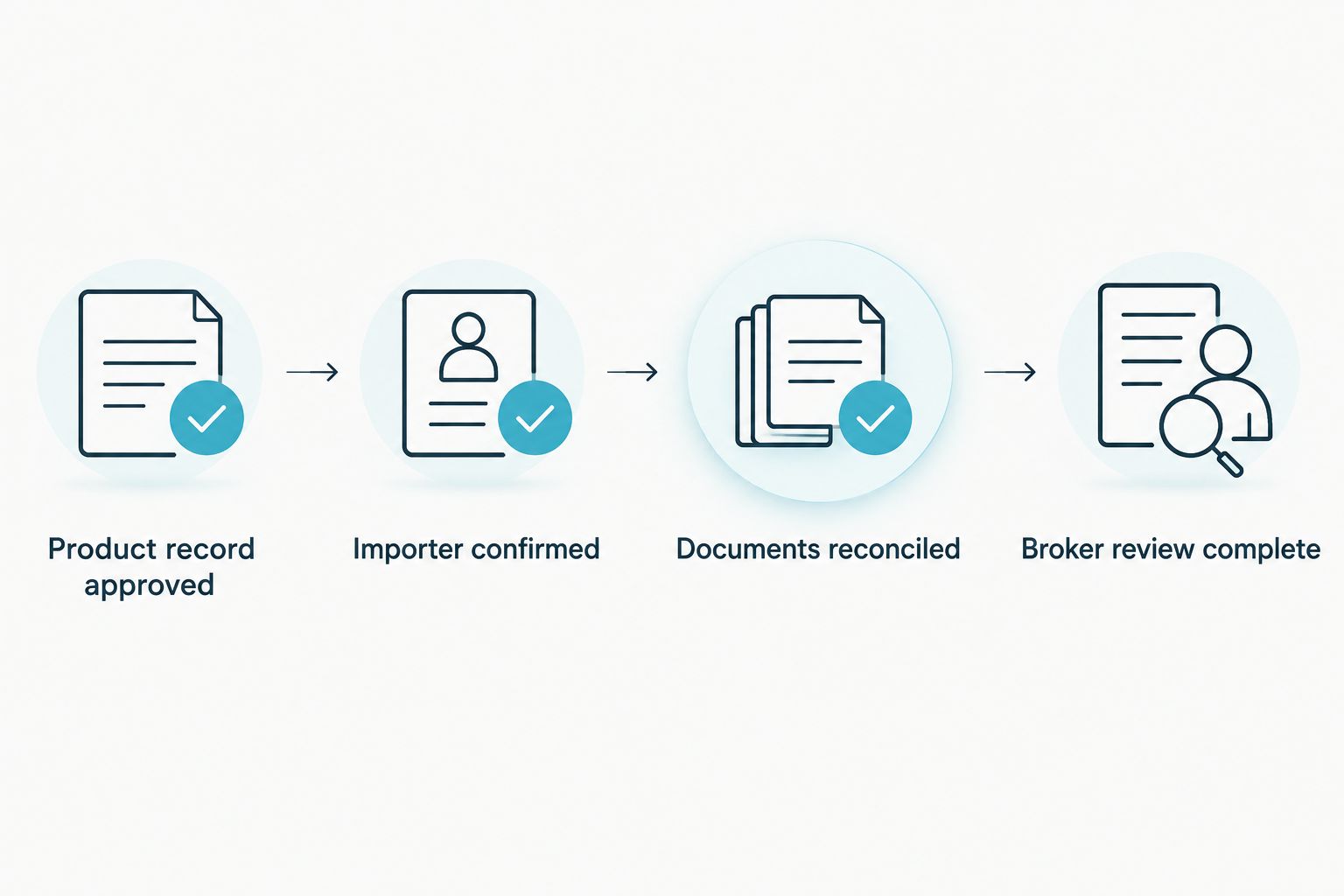
- Add Product record approved, Importer confirmed, Documents reconciled and Broker review complete to the shipment record. Require evidence for each status rather than an unexplained tick.
- Define Release owner and Release decision. Permit dispatch only after the nominated owner confirms that the readiness conditions are met. Record exceptions explicitly instead of hiding them in email threads.
- Add Booking reference, Transport document reference and Destination contact when available. Confirm that the carrier and broker have the same shipment identity and current document packet.
- Keep Dispatched, Customs released, Warehouse received and Allocated as separate milestones. Require the relevant party to confirm each event rather than treating collection as proof of destination readiness.
Expected result: Your release decision is visible, attributable and supported by current documents. Country teams can distinguish goods in transit from goods cleared and ready to issue.
For the 2026 launch calendar, work backwards from the required allocation date. Include production approval, dispatch readiness, transport, customs processing and receiving activities as separate planning stages. Obtain route-specific estimates from the parties responsible; do not substitute a generic global transit promise.
A broker's pre-dispatch review is not customs approval. Authorities retain the right to request information or inspect goods. The gate controls what your organisation releases, not what a customs authority decides.
Exception and receipt configuration
Assign the hold-response workflow
- Create Exception reason, Requested evidence, Action owner and Next action fields. Copy the broker's actual request into the record instead of reducing every issue to a generic customs delay status.
- Route classification questions to the product specialist, valuation questions to the commercial owner and importer-registration questions to the country owner. Keep the broker responsible for communicating declaration requirements.
- Maintain Decision history and Current document version. Send controlled corrections through the agreed channel, then request confirmation of the next procedural step.
- After release, record Receipt discrepancy and Allocation status. Reconcile received garments against the packing list before closing the rollout shipment.
Expected result: Every open exception has an owner and an actionable request. Customs release no longer masks shortages, damaged cartons or incorrect size allocations at the warehouse.
Review exceptions by cause, not just by country. A repeated description problem belongs in the product master; repeated importer questions belong in country readiness. Fix the source record before the next shipment copies the same defect.
Variant: trigger review whenever a SKU changes
A replenishment order needs a different trigger from an initial country launch. Reuse approved records only when the underlying facts remain valid; do not assume a familiar SKU makes every future shipment identical.
Configure a change review whenever Fibre composition, Construction, Manufacturing origin, Intended use or Importer of record changes. Return the affected record to pending review and identify which destinations need fresh broker confirmation.
Cosmetic changes and technical changes deserve different treatment. A logo update does not automatically change tariff classification, while a change in material or construction requires classification review. Have the responsible specialist decide whether the change affects the declaration or product requirements.
For your 2026 replenishment workflow, connect the approved revision to the purchase order, manufacturing specification and shipment packet. Keep previous approvals traceable without allowing obsolete specifications to populate new documents.
Best for repeat programmes: Change-triggered review preserves valid work while flagging changed facts. Its limitation is dependency on disciplined master data; an unrecorded supplier substitution bypasses the control entirely.
Troubleshooting
The broker cannot complete classification
Replace generic descriptions such as uniform or merchandise with the actual garment type, construction, fibre composition and intended use. Supply technical specifications or product images when requested. Keep the affected SKU blocked until the classification question is resolved.
The importer details fail validation
Check the legal entity, registration details and broker appointment against the destination requirements. Do not substitute the warehouse name unless that entity is actually authorised and responsible for importing. Correct the country register before revising the shipment documents.
Invoice and packing list quantities disagree
Reconcile the physical packing record with the commercial record. Issue controlled corrections and withdraw superseded versions. Do not ask the broker to choose between conflicting documents or amend quantities without confirmation from the packing team.
A cleared shipment is still unavailable for issue
Check receiving and allocation separately from customs release. Confirm warehouse receipt, investigate discrepancies and release only verified stock to the country team. Customs clearance does not prove that the receiving location has checked garment sizes or quantities.
Customs requests evidence after pre-dispatch review
Ask the broker for the exact request, then assign it to the owner of the relevant evidence. Preserve the request and response in the shipment record. Do not present pre-dispatch review as a guarantee against inspections or further questions.
Customize your workflow
Expand the control model beyond clearance to country allocation, replacement orders and programme reporting. Use the same approved SKU identity across design, manufacturing, distribution and issue records so that a document correction does not create a separate operational identity.
Boolanga combines branded workwear design, manufacturing, distribution and operations software. That scope supports a vendor-consolidation discussion, but your responsibility matrix must still identify the importer, broker and approval owners. A single partner relationship is not a substitute for explicit legal responsibilities.
For a courier programme, connect the customs record to the garment and allocation requirements covered in the courier uniforms for delivery fleets guide. Keep purchasing approval and shipment release distinct: buying the correct uniform does not establish customs readiness.
Define your workwear rollout scope
Discuss design, manufacturing, distribution and operations software for your country programme.
FAQ
Can a multi-country workwear rollout have zero customs delays?
No workflow can guarantee zero customs delays. Pre-dispatch checks reduce preventable documentation failures, but authorities can still inspect shipments or request evidence.
Who should own customs readiness for a uniform rollout?
A named release owner should coordinate customs readiness, with explicit responsibilities for the importer, broker, product specialist and country team. Each specialist approves the information within their responsibility.
Can I use the same tariff code in every country?
Do not assume the same complete import code applies everywhere. The Harmonized System provides 6-digit international subheadings, while destination tariff schedules add further detail and requirements.
Does a regional warehouse remove customs requirements?
A regional warehouse does not automatically remove customs requirements. The route, customs territory and status of the goods determine what procedures apply to subsequent movements.
What should trigger a customs review on a repeat order?
Changes to material, construction, manufacturing origin, intended use or importer details should trigger review. Reuse previous approvals only after confirming that the relevant facts remain valid.
Does Boolanga provide more than workwear manufacturing?
Boolanga provides design, manufacturing, distribution and operations software for branded workwear, uniforms, courier gear and merchandise. Define the customs responsibility split explicitly when setting the programme scope.
How should I handle workwear samples and replacement garments?
Give samples and replacements an appropriate customs valuation treatment rather than automatically declaring zero value. Ask the destination broker what supporting evidence the particular movement requires.
One last thing
Close the shipment only when the receiving team verifies it, not when customs releases it. Add a receipt reconciliation to your 2026 rollout checklist and carry unresolved discrepancies into the replenishment decision. Otherwise, a shipment marked complete can still leave the country team without the sizes needed for issue.


