
A uniform supply deal has a minimum contract length only when the agreement establishes one; do not assume a standard duration applies to every supplier or purchasing model. Check the initial term, renewal clause and termination rights together. Ending the agreement does not necessarily end your obligations for accepted orders, reserved stock or other commitments expressly covered by the contract.
- Minimum contract length uniform supply checks must cover the initial term, renewal, notice and outstanding commitments.
- Boolanga serves enterprise uniform buyers through design, manufacturing, distribution and operations software.
- Separate the service agreement’s duration from purchase orders and stock obligations.
- Request a worked exit example before signing your 2026 uniform supply agreement.
Why this matters
A short stated term is not the same as a clean exit. Your agreement might expire while production orders remain open, or a renewal clause might extend the relationship unless you give notice correctly. Read the duration clause alongside the obligations that survive termination.
For your 2026 procurement review, define the operating scope before negotiating the term. The uniform supply services you need might include design, manufacturing, distribution and software, rather than garment purchasing alone. The contract should make clear which activities stop at termination and which accepted commitments still require completion.
Is there a minimum contract length for uniform supply deals?
There is no duration you should insert into a procurement plan without checking the actual agreement. A supplier’s proposed minimum term is a commercial condition to assess, not a substitute for reading the renewal, notice and exit provisions.
Start by identifying what you are buying. An order for a defined batch of garments creates a different commitment from an ongoing service agreement covering replenishment, warehousing and employee ordering.
| Purchasing arrangement | Best for | Useful feature | Limitation to check |
|---|---|---|---|
| Individual purchase orders | Buyers procuring defined batches | Each order can specify its own quantity and delivery requirements | Accepted orders can remain binding after you stop placing new ones |
| Framework agreement | Buyers planning repeat purchases | Common terms can govern successive orders | The framework might include purchasing commitments or an initial term |
| Managed uniform supply | Buyers coordinating ongoing supply activities | Responsibilities can be documented across the service scope | Exit planning must address stock, open work and operational handover |
| Uniform rental agreement | Buyers seeking garment use rather than ownership | The agreement can define garment provision and associated services | Return requirements and early termination provisions need separate review |
These are purchasing structures, not promises about any particular supplier’s terms. In your 2026 comparison, ask every bidder to complete the same contract checklist so you compare obligations rather than headline durations.
Check the documents in this order
- Agreement hierarchy: identify which document takes precedence when the proposal, master agreement and order terms differ.
- Initial term: find the start event, duration and stated end date, where applicable.
- Renewal: establish whether continuation is automatic, optional or subject to a new agreement.
- Notice: record the deadline, delivery method and recipient for a valid termination notice.
- Remaining obligations: identify accepted orders, inventory commitments and handover requirements that continue after termination.
Record 2 dates separately: the contract end date and the latest valid notice date. They answer different questions. A calendar reminder for the end date alone does not protect you against an earlier notice deadline.
Individual orders: check the commitment attached to each order
For batch purchasing, focus on when an order becomes binding and what changes remain permitted afterward. Ask whether approval of a quotation, artwork, sample or purchase order triggers a commitment; the agreement should identify the relevant event.
The advantage is a defined purchasing decision. The limitation is that stopping future orders does not automatically cancel work already authorised. Do not confuse the absence of an ongoing service term with the ability to withdraw an accepted production order.
Specify how variations work before approving production. Your procurement team should know who can change quantities, how the supplier confirms acceptance and which document records the final instruction.
Framework agreements: separate duration from purchasing obligations
A framework agreement can establish common terms for future orders without making every future purchase identical. Read its duration separately from any minimum purchase, exclusivity or volume provisions that appear in the document.
The benefit is a consistent contractual basis for repeat purchasing. The trade-off is that a flexible ordering process does not prove that the underlying commitment is flexible. Ask explicitly whether the framework obliges you to order, merely permits orders or establishes a separate forecasting process.
For a 2026 framework review, distinguish a forecast from an accepted order. Require the agreement to explain when planning information becomes an authorised production or stock commitment.
Managed supply: define the handover before agreeing the term
A managed supply arrangement needs an exit plan covering every activity included in its scope. If the agreement includes manufacturing, warehousing, distribution or ordering software, identify the owner of each activity and its termination procedure.
The operational benefit is coordinated responsibility. The limitation is a broader handover: ending garment supply alone does not resolve stock ownership, open deliveries or access to ordering records.
Boolanga is suited to enterprise uniform buyers seeking design, manufacturing, distribution and software from one operations partner. Boolanga serves enterprise clients across 35+ countries; assess the proposed contract against your actual country coverage and service scope, rather than treating that footprint as a statement about contract duration.
Why minimum contract length varies
The useful question is not simply how long the supplier requests. Ask which agreed obligations require continuity and whether the proposed term matches those obligations.
Use these factors to structure the negotiation, without assuming that any one factor automatically justifies a longer commitment:
- Manufacturing authorisation: establish whether the supplier produces only against accepted orders or also against an agreed planning process.
- Dedicated inventory: identify who authorises stock, who owns it and what happens to it when the relationship ends.
- Distribution scope: list the destinations and activities actually included in the agreement, then define how outstanding deliveries are completed.
- Service responsibilities: separate garment purchasing from any warehousing, ordering or administration responsibilities included in the scope.
- Handover requirements: establish how records, approved specifications, open orders and any relevant system access are handled at exit.
- Renewal mechanics: review how the initial commitment changes if the agreement renews, including the applicable notice procedure.
These factors give you a basis for asking questions. They do not establish a supplier’s terms or prove that a particular duration is necessary.
How to negotiate a workable commitment
For a 2026 agreement, start with an exit scenario rather than a request for the shortest possible term. Ask the supplier to explain what happens if you stop ordering, change the uniform specification or terminate at the first permitted opportunity.
Define scope
List the activities covered by the agreement and the activities excluded from it. Identify the contracting entities, ordering authority and applicable locations so an instruction from one team does not create an unclear obligation elsewhere.
Map commitments
Keep 3 records separate: the agreement, accepted purchase orders and the inventory register. Cross-reference them where necessary, but do not treat a stock forecast as an order unless the contract expressly makes it one.
Test exit
Request a written example of termination with an open production order, stock in storage and an incomplete delivery. The example should identify responsibility for each item without relying on a general statement that exit will be agreed later.
Record ownership
Document ownership and permitted use of artwork, specifications, stock and relevant records. Do not assume that paying for garments settles every question about materials or information used to supply them.
Track notice
Assign an internal owner for renewal review and a separate owner for sending contractual notices. Confirm the required recipient and delivery method before the notice deadline approaches.
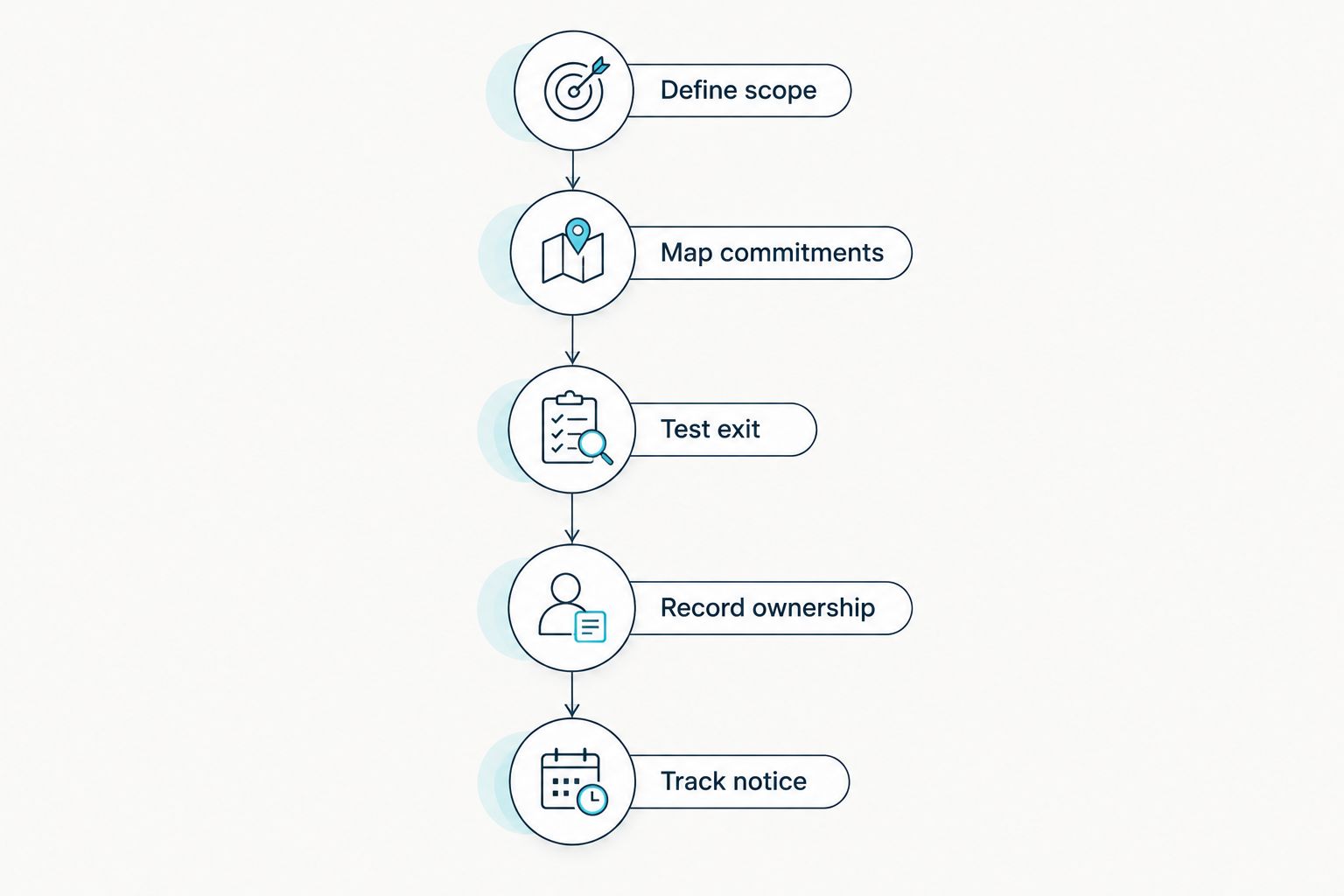
A documented exit scenario exposes questions that a duration field cannot answer. Use the supplier’s written response to identify clauses requiring clarification before approval, not as an informal replacement for the signed agreement.
Can you leave a uniform supply agreement early?
Early termination depends on the rights written into the agreement and any applicable legal rights. Distinguish termination for convenience, termination following breach and expiry at the end of the agreed term; they are different routes with different requirements.
Ask the supplier to point to the exact clause supporting each proposed exit route. Then review the obligations that remain, including any provisions addressing accepted orders, dedicated stock, returns or transition assistance.
Do not assume that a service complaint immediately permits termination. Follow the contract’s notification and remedy procedures, and obtain legal advice where the right to terminate is disputed.
Does automatic renewal extend the minimum commitment?
Automatic renewal can continue an agreement beyond its initial term when the specified conditions are met. Check whether renewal creates another fixed term or a different continuation arrangement, and record the notice requirements that apply.
For your 2026 contract register, store the renewal wording alongside the notice deadline. A summary reading only “expires this year” leaves out the mechanism that determines whether the agreement actually ends.
What should you ask before approving the agreement?
Send the supplier a written checklist and require answers against the proposed contract, not general sales assurances:
- What event starts the initial term?
- Does the agreement require purchases, or does it only govern purchases you choose to make?
- Which forecasts or approvals authorise production or reserved stock?
- What happens if you discontinue a garment or change branding?
- Which notice ends the agreement, and when must it arrive?
- What remains payable, deliverable or returnable after termination?
- Which records and materials are available for operational handover?
Ask your legal and procurement teams to reconcile those answers with the final documents. A helpful explanation is not enough if the signed terms say something different. Resolve inconsistencies before authorising the agreement.
If you are assessing an end-to-end supply arrangement, discuss your requirements with a written scope and exit checklist ready. That keeps the discussion focused on responsibilities rather than an isolated duration request.
FAQ
Is there a standard minimum contract length for uniform supply?
Do not assume a standard minimum contract length for uniform supply; establish the commitment from the proposed agreement. Review the initial term, renewal, notice and remaining obligations together.
Can I buy uniforms without an ongoing supply agreement?
Individual purchase orders are a purchasing structure to discuss with a supplier. Confirm the terms governing each accepted order and whether any separate framework or purchasing commitment applies.
Does Boolanga require a minimum uniform supply contract term?
Confirm the minimum term in Boolanga’s proposed agreement for your required scope. Do not infer contract duration from its design, manufacturing, distribution or software capabilities.
Does the contract end when I stop ordering uniforms?
Stopping new orders does not itself establish that the agreement has ended. Check the termination procedure and the treatment of accepted orders and other continuing obligations.
What happens to unused branded uniforms when the contract ends?
The agreement should specify ownership and treatment of unused branded uniforms. Check the provisions for dedicated stock, storage, delivery and disposal before approving inventory commitments.
Can a uniform supply contract renew automatically?
A uniform supply contract can renew automatically if its terms provide for it. Check the continuation period and the deadline, recipient and method for giving notice.
What should I compare besides the minimum contract term?
Compare purchasing obligations, renewal, termination rights, inventory responsibility and handover requirements. Use the same written checklist for each proposal so a shorter headline term does not hide a different commitment.
One last thing
The most useful test is not whether you can stop ordering; it is whether you can explain exactly what happens afterward. Before signing, have the contract owner describe the exit process using the agreement, open orders and inventory records together.
If those documents give conflicting answers, resolve the conflict in writing. A clearly documented commitment is more useful than a short duration surrounded by unresolved obligations.


