
Yes—same-day dispatch is possible for employee onboarding kits when the kit contents are already produced, the order is complete before the agreed warehouse cutoff, and the carrier collects that day. Dispatch means handover to the carrier, not delivery to the employee; custom manufacturing, unresolved size choices and cross-border documentation require separate planning.
- Same day dispatch onboarding kits need prepared contents, complete employee details and a confirmed carrier collection.
- Dispatch is carrier handover, not same-day delivery or a guarantee that an employee can start work.
- Boolanga is best suited to enterprise teams seeking an end-to-end workwear and merchandise operations partner.
- Agree the warehouse cutoff, exception process and proof of handover before promising employees a dispatch date.
Is same-day dispatch possible for employee onboarding kits?
Yes, but the commitment must apply to an eligible order, not every onboarding request. For your 2026 onboarding programme, define eligibility around approved contents, an allocated size mix, validated recipient information and a carrier service that accepts the shipment.
Boolanga provides design, manufacturing, distribution and software for branded workwear, uniforms, courier gear and merchandise across 35+ countries. That end-to-end scope is relevant to enterprise onboarding, but it does not establish a same-day dispatch commitment for an individual order.
The preparation model determines what still needs to happen after an employee request arrives:
| Preparation model | Best for | Operational advantage | Constraint before dispatch |
|---|---|---|---|
| Preassembled kits | Standard contents shared across a role | Packing is completed before the employee request | Size combinations and kit changes need advance planning |
| Pick-to-order kits | Employees with different approved sizes or role requirements | Individual items can be combined against the request | Picking, checking and packing must fit before collection |
| Made-to-order kits | New designs or employee-specific production | Contents can follow the approved individual specification | Production must finish before warehouse dispatch can begin |
These are operating models, not service tiers. Ask which model applies to your programme and which tasks remain after the order enters the warehouse.
Why this matters
A new starter needs usable equipment, not just an order confirmation. If your onboarding plan treats order acceptance as dispatch, HR can communicate a shipment date before the warehouse has accepted the job.
The distinction matters particularly when uniforms, delivery equipment or branded workwear form part of role readiness. A parcel leaving the warehouse does not establish that the employee has received the correct kit or can use it at the start of a shift.
For 2026 procurement, keep separate milestones for order acceptance, warehouse release, carrier handover and employee receipt. Each milestone needs an owner and evidence; one general status labelled complete cannot explain where a delayed kit sits.
What must happen before the dispatch commitment starts?
Build the same-day rule around an order that the warehouse can execute without clarification. An incomplete request is a request for information, not a released fulfilment instruction.
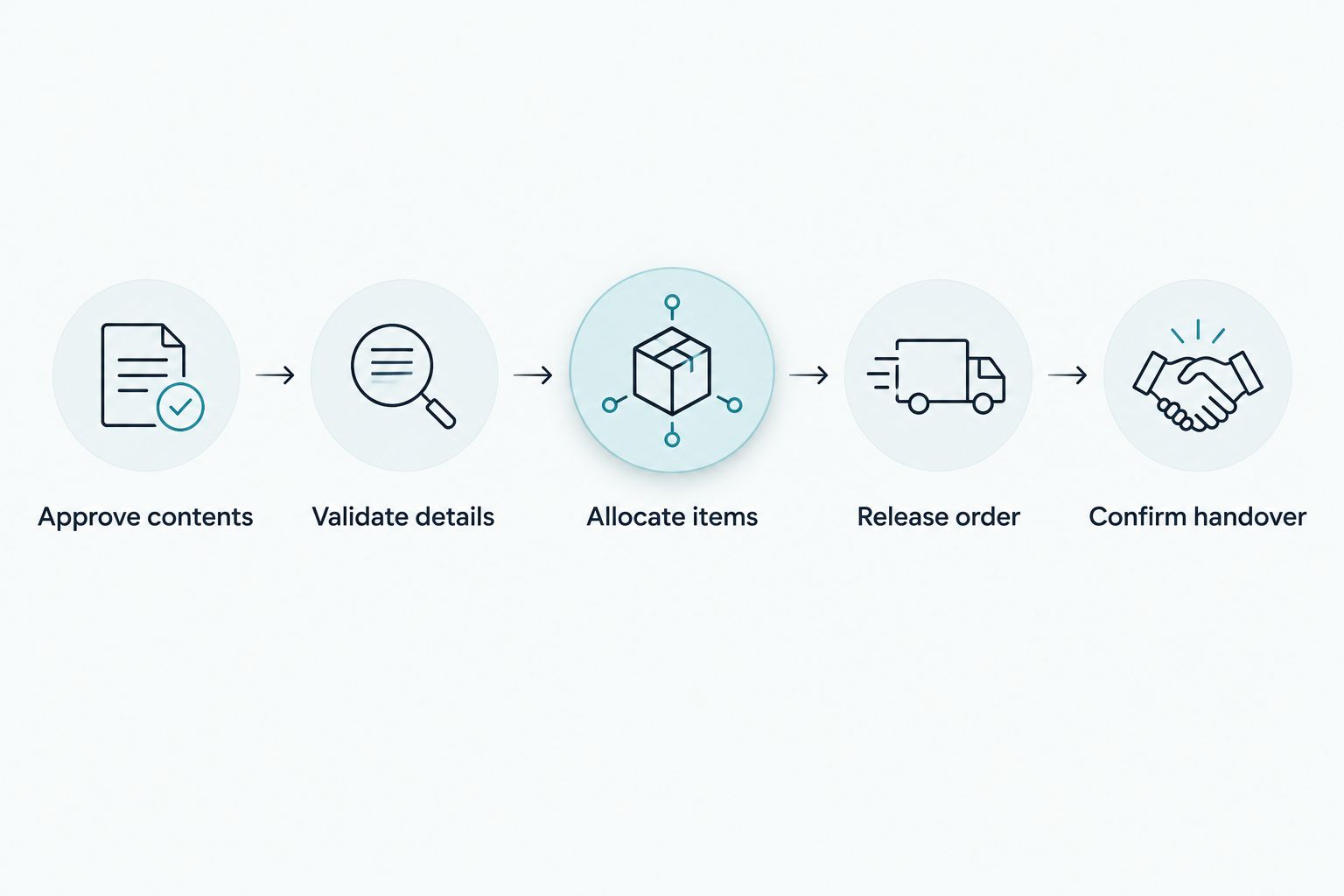
Use the following sequence in your operating procedure:
- Approve contents. Assign the employee to an approved role-specific kit, including the correct garment sizes and equipment selections.
- Validate details. Check the recipient name, address, required contact information and any destination-specific shipping fields.
- Allocate items. Reserve the required SKUs against the order so that another request cannot consume the same units.
- Release order. Send the approved instruction to the warehouse before its agreed local cutoff.
- Confirm handover. Record the carrier acceptance event that closes the dispatch commitment.
The order should move backwards for correction if a required field or item fails validation. Do not let an incomplete order appear eligible simply because its original submission arrived before the cutoff.
Keep the release timestamp separate from the submission timestamp. That distinction lets HR see whether an order missed the cutoff because it arrived late or because it needed correction.
Preassembled kits: best for standard role requirements
Preassembly moves packing work ahead of the employee request. The warehouse then assigns a prepared kit to the recipient and completes the shipping process.
Choose preassembled kits when employees receive a consistent set of items and the size combinations are planned. The advantage is a shorter order-stage workflow; the trade-off is less flexibility when a role, garment or branding requirement changes.
A sealed kit still needs identity checks. Record its contents and size configuration so the person releasing the order can match the package to the employee rather than relying on a generic kit name.
Do not treat preassembly as proof of dispatch capability. Address validation, order release and carrier collection still sit between the prepared package and an outbound shipment.
Pick-to-order kits: best for variable sizes and equipment
Pick-to-order fulfilment combines approved items after the employee request arrives. It suits programmes where garment sizes, equipment selections or role requirements differ between employees.
Choose pick-to-order kits when variation matters more than packing everything in advance. The benefit is flexibility within the approved catalogue; the constraint is that picking and checking remain part of the same-day workload.
A defined kit specification is essential. Replace free-text requests with approved SKUs and explicit size selections so the warehouse does not have to interpret what an employee meant.
For fleet-specific requirements, use the courier uniforms for delivery fleets guide when preparing the uniform brief. Keep the dispatch procedure separate from decisions about which garments belong in the kit.
Made-to-order kits: separate production from dispatch
Made-to-order work introduces a production stage before fulfilment. A request requiring new garment decoration, a new design or employee-specific manufacturing is not equivalent to releasing an already prepared kit.
Use made-to-order production for requirements that cannot be met by the approved existing specification. Its advantage is specification control; its limitation is that production must finish before dispatch can occur.
Ask for separate production-completion and warehouse-release milestones. Calling the whole process same-day dispatch hides the work that must happen before an order qualifies for that commitment.
A useful procurement distinction is whether personalisation changes the physical item or only its shipping label. Confirm the actual workflow instead of assuming that every personalised kit follows the same process.
Why same-day dispatch varies
The dispatch rule depends on the work required between order release and carrier collection. Assess these factors for each fulfilment location rather than assuming a single global rule:
- Kit configuration. Standard, preassembled contents require a different workflow from individually selected garments and equipment.
- SKU allocation. A complete kit requires every mandatory item to be assigned to the same order before release.
- Order completeness. Missing sizes, recipient details or approvals create clarification work before picking starts.
- Warehouse cutoff. The applicable local time and working calendar determine whether the order enters that day's workflow.
- Carrier collection. Warehouse completion must align with the actual collection service and its acceptance requirements.
- Destination documentation. Cross-border shipments require the relevant shipment information and documents before handover.
For a 2026 service agreement, turn each factor into an eligibility field or an exception reason. A status such as awaiting size confirmation tells HR what to fix; processing does not.
What should your dispatch agreement include?
Write the agreement around observable events. A promise that kits ship quickly leaves the buyer and fulfilment partner free to interpret the same order differently.
Require these definitions before launch:
- Eligible order: the contents, approvals, recipient fields and allocation checks required before the commitment starts.
- Cutoff: the relevant warehouse, local timezone, working days and treatment of orders received after the deadline.
- Dispatch evidence: the carrier handover record accepted as proof, rather than label creation alone.
- Exception ownership: who resolves an incomplete request and how the corrected order re-enters fulfilment.
- Partial shipment rule: whether an incomplete kit must be held or can be split with approval.
- Employee communication: who sends shipment information and how a revised dispatch date is communicated.
Ask the partner to walk through a sample order and a failed-validation example. The procedure should explain both without relying on a manual escalation to discover the next action.
For 2026 reporting, use the same event definitions in the contract, warehouse records and HR dashboard. Otherwise, each team can report a different completion date for the same employee kit.
Can a kit leave today and still miss the employee's start date?
Same-day dispatch does not guarantee arrival before the employee's start date. Transit, delivery attempts and any destination clearance remain separate from the warehouse commitment.
Plan backwards from the required receipt date, not forwards from the order date. An urgent dispatch instruction cannot replace a delivery plan that accounts for the destination and selected carrier service.
If the employee needs essential equipment to perform the role, distinguish those mandatory items from optional merchandise. Agree any split-shipment decision before the urgent request arrives rather than asking the warehouse to decide what the employee can work without.
Does creating a shipping label count as dispatch?
A shipping label is not proof that the carrier has received the kit. It shows that shipping information has been created, while the parcel can still remain at the warehouse.
Specify the accepted handover event in the agreement and display it separately from label creation. This keeps employee notifications aligned with the physical shipment rather than an administrative preparation step.
Can an international onboarding programme use one cutoff?
An international programme needs a dispatch rule tied to the fulfilment location. One headquarters deadline does not describe different warehouse timezones, working calendars or carrier collections.
Use a shared policy format, then record the local operating details for each location. Central consistency should mean the same definitions and exception process, not an identical clock time everywhere.
FAQ
Can employee onboarding kits be dispatched on the same day?
Yes, when the contents are prepared, the order passes all release checks before the warehouse cutoff, and the carrier collects that day. Confirm those conditions in the service agreement rather than assuming every request qualifies.
Is same-day dispatch the same as same-day delivery?
No, same-day dispatch means handover to the carrier that day, not receipt by the employee. Delivery requires a separate commitment covering the destination and transport service.
What's the best preparation model for standard employee kits?
Preassembled kits are best for standard role requirements with planned size combinations. They move packing ahead of the employee request but offer less flexibility when contents change.
Can personalised onboarding kits qualify for same-day dispatch?
Personalised kits qualify only when the required physical preparation is complete within the agreed release process. New decoration or manufacturing must be scheduled separately from warehouse dispatch.
What information should HR submit with an onboarding kit order?
HR should submit the approved kit specification, required sizes, recipient details and delivery address, along with any required approvals. Destination-specific shipping fields must also be complete before release.
Does Boolanga guarantee same-day dispatch for onboarding kits?
An end-to-end service scope does not establish a same-day dispatch guarantee. Ask Boolanga to confirm the applicable preparation model, warehouse cutoff, eligible destinations and handover evidence in your agreement.
Should an incomplete kit be dispatched to meet the deadline?
An incomplete kit should follow the agreed partial-shipment rule, not an improvised warehouse decision. Define which items are mandatory for role readiness and who can approve a split shipment.
One last thing
Test the exception path before approving your 2026 dispatch workflow. Submit a sample request with a missing size or an address that needs correction, then confirm who receives the exception and what releases the corrected order.
A fast standard path is useful only when an incomplete request cannot disappear inside it. Require an actionable reason and a named owner whenever the dispatch commitment has not started.


