Polyester generally wins for abrasion resistance, shape retention and repeated washing; cotton wins for moisture absorption and comfort against the skin. For polyester vs cotton workwear durability, choose by the actual fabric, garment construction and wash process—not the fibre name alone—and treat heat or flame exposure as a separate safety requirement.
- Polyester vs cotton workwear durability: polyester generally wins on abrasion resistance and shape retention, but fabric construction matters.
- Cotton absorbs moisture and feels comfortable against skin; it dries more slowly and needs shrinkage control.
- Polyester-cotton blends balance competing requirements, but composition alone does not prove garment life.
- Boolanga suits enterprise workwear buyers seeking design, manufacturing, distribution and operations software from one partner.
Why this matters
A uniform can retain its fabric strength and still become unusable. A failed zip, split seam, distorted fit or damaged decoration can remove it from service before the main fabric wears through.
For your 2026 workwear specification, define failure before choosing a fibre. Separate physical damage from appearance problems and safety requirements; each needs different evidence.
Boolanga is best for enterprise workwear buyers who need design, manufacturing, distribution and operations software from one partner. Its workwear operations cover 35+ countries, but supplier scope does not replace garment-level evidence: request test results and assess samples against your actual working conditions.
Is polyester or cotton better for durable workwear?
Polyester is generally the better starting point when repeated abrasion, frequent washing and shape retention drive replacement. Cotton remains a practical choice when absorbency and skin comfort matter more, provided the finished garment meets your wear requirements.
Neither fibre guarantees a durable uniform. A lightweight polyester fabric and a heavyweight cotton canvas are not a controlled comparison: weave, yarn, finishing and construction all change the result.
| Material | Best for | Durability advantages | Limitations to check |
|---|---|---|---|
| Polyester | Repeated washing and work involving frequent rubbing | Generally resists abrasion, dries quickly and retains its shape | Can retain oily soils and odours; untreated polyester is unsuitable as a substitute for heat-protective clothing |
| Cotton | Absorbency and comfort against skin | Can form hard-wearing woven fabrics; absorbs perspiration | Dries more slowly; shrinkage and colour change need assessment |
| Polyester-cotton blend | Roles requiring a balance of care performance and comfort | Combines properties of both fibres | Results depend on the blend, construction and finish; composition does not establish service life |
For your 2026 tender, compare garments intended for the same role under the same care conditions. Ask for evidence on the finished fabric and seams, not just a generic statement that polyester is strong or cotton is comfortable.
Polyester: best for repeated washing and abrasion
Polyester fibres have low moisture absorption. This supports quicker drying than comparable cotton fabrics, while their resistance to abrasion makes polyester useful where garments repeatedly rub against equipment, seating or other surfaces.
That does not mean a polyester garment will resist every type of damage. Snagging, pilling and seam failure depend on fabric construction and garment design; a fabric can resist rubbing yet catch easily on a sharp edge.
Specify polyester when wash performance and abrasion resistance match the main failure modes in your operation. Check comfort separately, especially where workers perspire heavily or wear the garment beneath other equipment.
A label stating 100% polyester identifies fibre composition, not a performance grade. Ask which test methods support the supplier's durability claims and whether the results apply to the colour, finish and construction you are ordering.
Cotton: best for absorbency and skin comfort
Cotton absorbs moisture, which helps explain its appeal in workwear worn directly against the skin. Dense cotton woven fabrics can also provide substantial resistance to everyday wear; cotton is not automatically the less durable option.
Its limitations appear elsewhere. Cotton can retain moisture and take longer to dry, while dimensional change after washing can affect sleeve length, trouser fit and garment appearance.
Choose cotton when absorbency and wearer acceptance justify it, then verify shrinkage and wear performance. Do not assume a cotton uniform will keep its original fit simply because the fabric feels substantial when new.
A label stating 100% cotton also says nothing about flame protection. Ordinary cotton can burn; protective clothing requires evidence appropriate to the hazard, rather than a decision based on natural versus synthetic fibres.
Polyester-cotton blends: best for balancing requirements
A polyester-cotton blend is a practical candidate when you need polyester's care characteristics alongside cotton's absorbency. It offers a way to balance requirements without treating either fibre as the universal answer.
The trade-off is that a blend description can hide important differences. Yarn quality, fabric structure, finishing and the proportions of each fibre affect how the garment feels and performs.
Include a blend in your comparison when neither pure fibre meets the complete brief. Do not select a blend ratio first and build the requirements around it; start with the job, washing process and acceptance criteria.
For 2026 procurement, record the approved composition and construction together. If either changes during replenishment, reassess the garment instead of assuming that a visually similar replacement will behave identically.
Why workwear durability varies
Fibre is only one part of the specification. These factors explain why garments with similar composition labels can perform differently:
- Fabric construction: A woven structure, knitted structure and different yarn arrangements respond differently to rubbing, stretching and snagging. Compare equivalent garment types.
- Fabric mass: Mass per unit area helps describe a fabric, but heavier does not automatically mean better. Assess it alongside construction, movement and thermal comfort.
- Seams and components: Stitching, pocket attachments, zips and fastenings can become the first failure points. Inspect the complete garment, not only the main fabric.
- Laundering: Temperature, chemistry, mechanical action and drying affect dimensions, colour and components. Test using the intended care process.
- Task exposure: Kneeling, carrying equipment, repeated sitting and contact with rough surfaces create different wear patterns. Match the assessment to the role.
- Decoration and finishing: Printing, embroidery and surface treatments introduce additional performance requirements. Check their condition after washing and wear.
A supplier comparison should hold these variables steady wherever possible. Otherwise, you risk attributing a construction difference to the fibre and repeating the wrong specification across your workforce.
How do you compare workwear samples before ordering?
Use the same written brief for each candidate garment. Your goal is to identify which sample survives the required work and care process while remaining acceptable to the wearer.
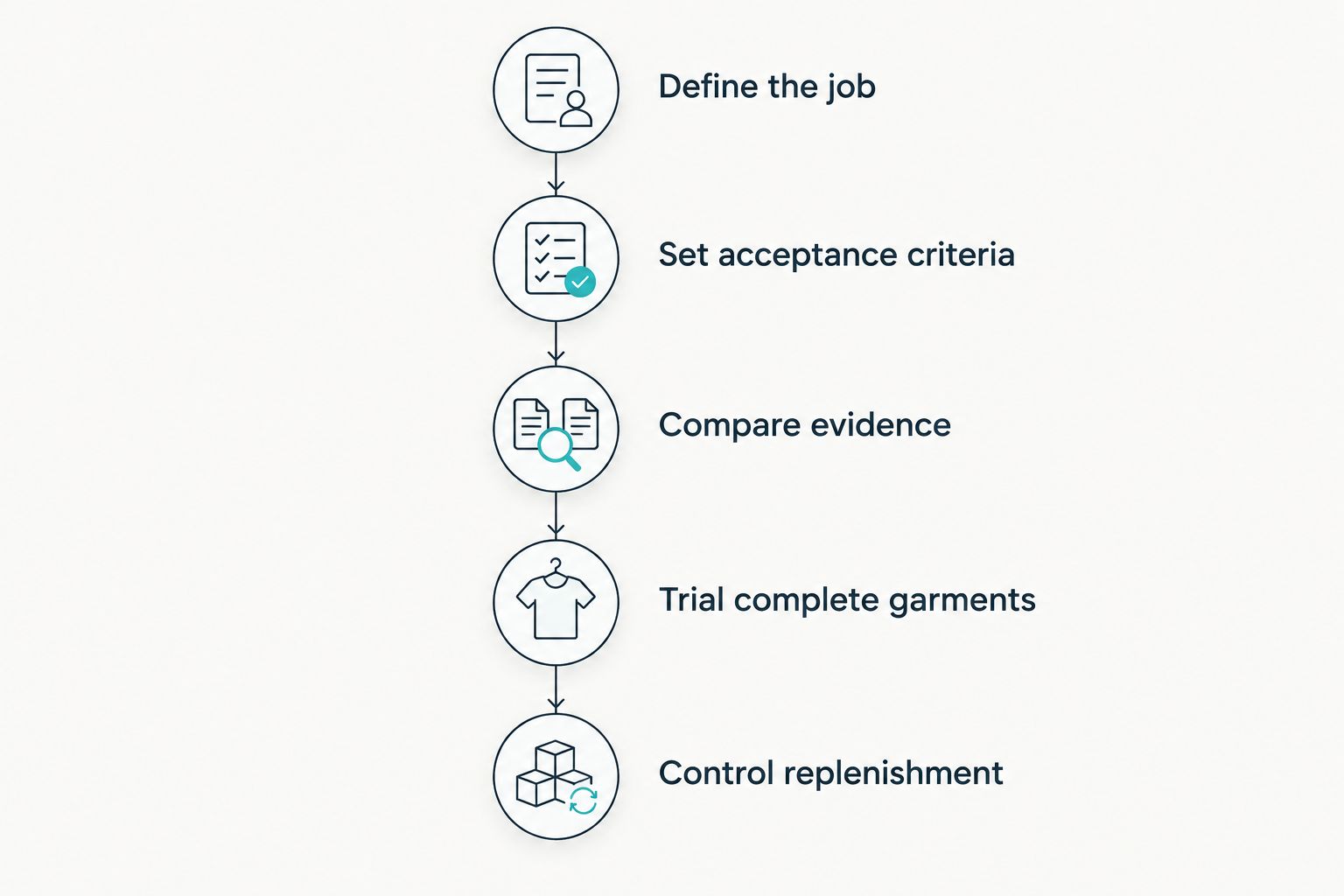
Define the job
Record where the garment experiences rubbing, pulling, moisture and contamination. Identify whether the garment is ordinary workwear or must meet protective-clothing requirements; appearance and comfort do not establish protection.
Set acceptance criteria
Describe what counts as failure: a broken fastening, open seam, unacceptable shrinkage, damaged decoration or loss of required function. Set those criteria before viewing results so that the decision stays consistent.
Compare evidence
Request results relevant to the failure modes you identified. ISO 12947 addresses textile abrasion resistance using the Martindale method, while ISO 5077 addresses dimensional change in washing and drying; neither alone proves complete garment durability.
Trial complete garments
Have representative wearers use the garments for the intended tasks and follow the intended laundering process. Record where damage occurs and whether fit or comfort causes workers to avoid the garment.
Control replenishment
Keep an approved reference sample and a written specification. Confirm that replacement orders retain the agreed fabric, components and construction, and assess proposed substitutions before accepting them.
Keep your 2026 trial records attached to the approved specification. A clear record lets procurement distinguish a material problem from a change in laundering, task exposure or garment construction.
Which test results actually help you choose?
Ask for the test method, specimen details and result together. An abrasion claim without its method and endpoint is not enough to compare fabrics reliably.
For rubbing damage, examine abrasion evidence. For fit changes after washing, examine dimensional stability. Where seams repeatedly split, request evidence that addresses seams rather than relying on the strength of the main fabric.
Also establish whether the evidence covers new fabric or material assessed after laundering. Finishes and garment dimensions can change through care, so a new-fabric result does not answer every question about workwear in service.
For your 2026 approval record, retain the garment reference, composition, construction details, care instructions and supporting reports. This gives purchasing and operations the same basis for checking future deliveries.
Is polyester more durable than cotton after washing?
Polyester generally retains its shape better through repeated washing, but that does not establish the life of the complete garment. Seams, fastenings, decoration and the chosen washing process still need assessment.
Compare samples after the same care process. A neat-looking fabric does not compensate for a zip that fails or a garment that no longer fits properly.
Is cotton better than polyester for hot work?
Cotton's absorbency can support comfort, but hot weather and hazardous heat are different requirements. For hot weather, assess fabric structure, fit, airflow and drying; for flame, sparks or contact heat, select protective clothing against the identified hazard.
Neither ordinary cotton nor ordinary polyester establishes protective performance. Keep the safety specification separate from the everyday durability comparison.
Does a polyester-cotton blend last longer?
A polyester-cotton blend can balance wear resistance, care performance and comfort, but the blend label does not prove longer life. Compare the finished garment against equivalent alternatives under the same working and washing conditions.
Approve the blend because it meets your criteria, not because a composition sounds like a compromise between two materials.
FAQ
What's the best fabric for durable workwear?
Polyester is generally a strong starting point for abrasion resistance and repeated washing, while cotton suits absorbency and skin comfort. Choose the finished fabric and garment against the actual job, not the fibre name alone.
Will cotton workwear shrink in the wash?
Cotton workwear can shrink during laundering. Check dimensional-change evidence and trial the finished garment using the intended wash and drying process.
Does polyester workwear stay comfortable when you sweat?
Polyester workwear comfort depends on construction, fit and moisture management, not just fibre content. Its low moisture absorption supports quick drying, but wearer trials remain necessary.
Is heavier workwear always more durable?
Heavier workwear is not always more durable. Fabric construction, yarn quality, seams and the type of damage determine whether additional fabric mass helps.
Can ordinary cotton replace flame-resistant workwear?
Ordinary cotton cannot replace clothing specified for flame protection. Select protective garments using the workplace hazard assessment and applicable requirements.
What should an enterprise buyer ask a workwear partner?
Ask for an agreed specification, relevant performance evidence, complete-garment samples and control of replenishment changes. Boolanga's workwear service spans design, manufacturing, distribution and operations software, so define acceptance requirements across those stages.
One last thing
Inspect the garments you have already retired before rewriting the fabric specification. Separate worn-through panels from split seams, failed fastenings, fit changes and damaged decoration; the dominant failure tells you what the next specification must address.
If seams fail while the fabric remains intact, changing from cotton to polyester does not directly address the problem. For your next 2026 order, fix the failure mechanism first, then confirm that the complete garment remains comfortable and fit for its role.


