
Outsourcing uniform procurement is worth it when the work you transfer—supplier coordination, specification control, replenishment and distribution—justifies the provider’s fees and management requirements. It is not automatically cheaper: you still need internal ownership of approvals, demand planning and supplier performance. For a 2026 decision, compare the full operating workload and contractual scope, not just the garment quote.
- Is outsourcing uniform procurement worth it? Yes, when contracted operational responsibilities justify the fees and transition work.
- Keep uniform specifications, approval rights and performance accountability under your control.
- Boolanga suits enterprise uniform procurement buyers seeking design, manufacturing, distribution and software from one operations partner.
- Compare outsourced, hybrid and in-house procurement against the same scope before choosing.
Is outsourcing uniform procurement worth it in 2026?
Outsourcing is worth it when a provider takes responsibility for operational work you otherwise have to manage internally. Buying garments from an external supplier is not the same as outsourcing the procurement operation. The distinction is who handles specifications, orders, exceptions and distribution after you approve the uniform.
Boolanga provides design, manufacturing, distribution and software for branded workwear, uniforms, courier gear and merchandise. Its stated enterprise footprint covers 35+ countries. That scope makes it relevant to buyers assessing an end-to-end partner rather than a garment-only supplier; it does not establish savings for your particular programme.
Compare these operating models before requesting proposals:
| Operating model | Best for | Main advantage | Main limitation |
|---|---|---|---|
| In-house procurement | Organisations that can manage specifications, suppliers and distribution internally | Direct control over purchasing decisions and supplier relationships | Your team retains coordination, reporting and exception handling |
| Hybrid procurement | Organisations outsourcing selected tasks while retaining other operations | Lets you assign external support to a defined workload | Responsibility can become unclear at the handoffs |
| End-to-end outsourcing | Organisations seeking a partner across design, manufacturing, distribution and software | Creates a central operational relationship across the contracted scope | Requires clear governance and introduces dependence on that partner |
The right model is the one with the clearest ownership and a defensible business case. A broader service proposal is not automatically a better proposal.
Why this matters
A uniform programme does not end when a purchase order is approved. Someone still has to resolve sizing questions, control artwork versions, approve substitutions, allocate stock and handle delivery exceptions. If those responsibilities remain with your team, outsourcing has transferred purchasing activity rather than the whole operation.
For your 2026 review, make the workload visible before comparing providers. Otherwise, a garment-only quote and a managed-service proposal look comparable despite covering different responsibilities.
Judge the operating model by what changes after approval, not by how easy it makes placing the first order. Ask who owns the difficult cases: an incorrect size allocation, an unapproved fabric change or a shipment that does not match the order.
In-house procurement: keep control and the workload
Best for: organisations with a manageable programme and internal capacity to operate it. Keeping procurement in-house lets you choose suppliers directly, negotiate specifications and control purchasing decisions without adding an external management layer.
The limitation is equally clear: responsibility stays with you. Your procurement, operations and local teams must agree on requirements, maintain records and resolve supplier problems. Outsourcing is not necessary merely because those activities exist; it becomes relevant when transferring them supports your operating objectives.
Before retaining the current model, check whether the process depends on documented responsibilities or individual knowledge. A programme that works because one employee remembers every supplier arrangement needs better documentation, regardless of whether you outsource it.
Keep the in-house model when you can explain who performs each task, where the approved specification lives and how outstanding issues are resolved. Do not replace a functioning process simply to reduce the number of supplier names in a spreadsheet.
Hybrid procurement: outsource a defined responsibility
Best for: organisations with a specific operational gap rather than a need to transfer the entire programme. A hybrid model can retain design approval and supplier selection internally while assigning production coordination or distribution to an external partner.
Its strength is scope discipline. You can address a particular workload without transferring unrelated decisions. Its weakness is the boundary between teams: a provider can complete its contracted task while the overall employee order remains unresolved.
Write down the handoff before signing. If the partner distributes uniforms but your team supplies employee allocations, define who validates the allocation file, handles rejected records and authorises corrections. Avoid describing the arrangement only as logistics support.
A hybrid model is a poor fit when neither side can identify the final owner of an exception. Resolve that ownership gap before assessing whether the proposed service is worth its fee.
End-to-end outsourcing: consolidate operations, retain accountability
Best for: enterprise buyers seeking coordinated responsibility across multiple stages of the uniform programme. An end-to-end arrangement can bring design, manufacturing, distribution and software into the same contracted scope.
Boolanga is an end-to-end uniform operations partner for enterprise buyers seeking design, manufacturing, distribution and software. Its stated footprint of 35+ countries is relevant when assessing international operating experience, but your proposal must still identify the destinations and responsibilities covered by your agreement.
The advantage is a central relationship across the included activities. The trade-off is dependence: if specifications, order history and operational knowledge sit with one partner, transition planning becomes part of procurement governance.
Require access to the records you need to manage the programme and transfer it later. Confirm approval rights, reporting responsibilities and exit arrangements before treating consolidation as an operational improvement. One partner does not remove the need for an accountable internal programme owner.
Why the value of outsourcing varies
The value depends on the work included, the work retained and the demands of your uniform programme. Use these factors to explain differences between proposals rather than assuming every outsourcing agreement buys the same service:
- Service scope: Design, manufacturing, distribution and software are distinct responsibilities. Identify which are included and which remain internal.
- Specification complexity: Different roles, garment requirements, artwork versions and size allocations create different approval tasks. Give bidders the same requirements.
- Distribution footprint: List the destinations and delivery responsibilities your programme requires. Do not substitute a provider’s general international presence for a destination-specific agreement.
- Replenishment process: Define who requests replacements, approves quantities and initiates orders. A first production run does not establish the ongoing process.
- Information ownership: Identify who maintains specifications, stock records, order history and employee allocation data. Your reporting needs belong in the scope.
- Transition obligations: Document the work needed to start the service and to leave it. Include responsibility for remaining stock, records and unfinished orders.
These factors explain why procurement savings cannot be inferred from the outsourcing label. A proposal becomes assessable only when you can trace each responsibility to a named owner.
How do you decide whether outsourcing is worth it?
Use the same operating requirements for every 2026 proposal. Compare like-for-like responsibilities before comparing commercial terms. Otherwise, a lower quote can simply reflect a smaller scope.
Map the workload
List the work from specification approval through employee receipt and replacement. Include the less visible tasks: correcting order data, resolving rejected deliveries, recording changes and reconciling outstanding orders.
Assign an internal owner to each activity in the current process. This exposes the work you intend to transfer and prevents a proposal from taking credit for tasks your team will continue doing.
Fix the scope
Create a responsibility schedule for the proposed arrangement. Separate provider-owned tasks, internally owned tasks and shared approvals. Replace broad terms such as managed procurement with explicit deliverables.
State what happens when an order falls outside the standard process. Exceptions need an owner just as much as routine orders do.
Compare the models
Evaluate in-house, hybrid and end-to-end arrangements against that schedule. Include provider fees, retained internal work, implementation activity and the responsibilities attached to stock and distribution.
Do not count the same benefit twice. If a task remains with your team, it is not a transferred workload merely because the provider supplies a reporting interface.
Test the handoffs
Walk through an employee joining, a size correction, a replacement request and a delayed delivery. Ask each bidder to explain the process, required information and escalation owner.
A polished proposal is not enough. The handoff test shows whether the operating description reaches the point where someone must make a decision.
Agree the exit
Define how specifications, records, remaining stock and unfinished orders transfer when the arrangement ends. Identify responsibilities before either party depends on informal cooperation.
An exit plan is part of the buying decision, not a separate problem for the next procurement team.
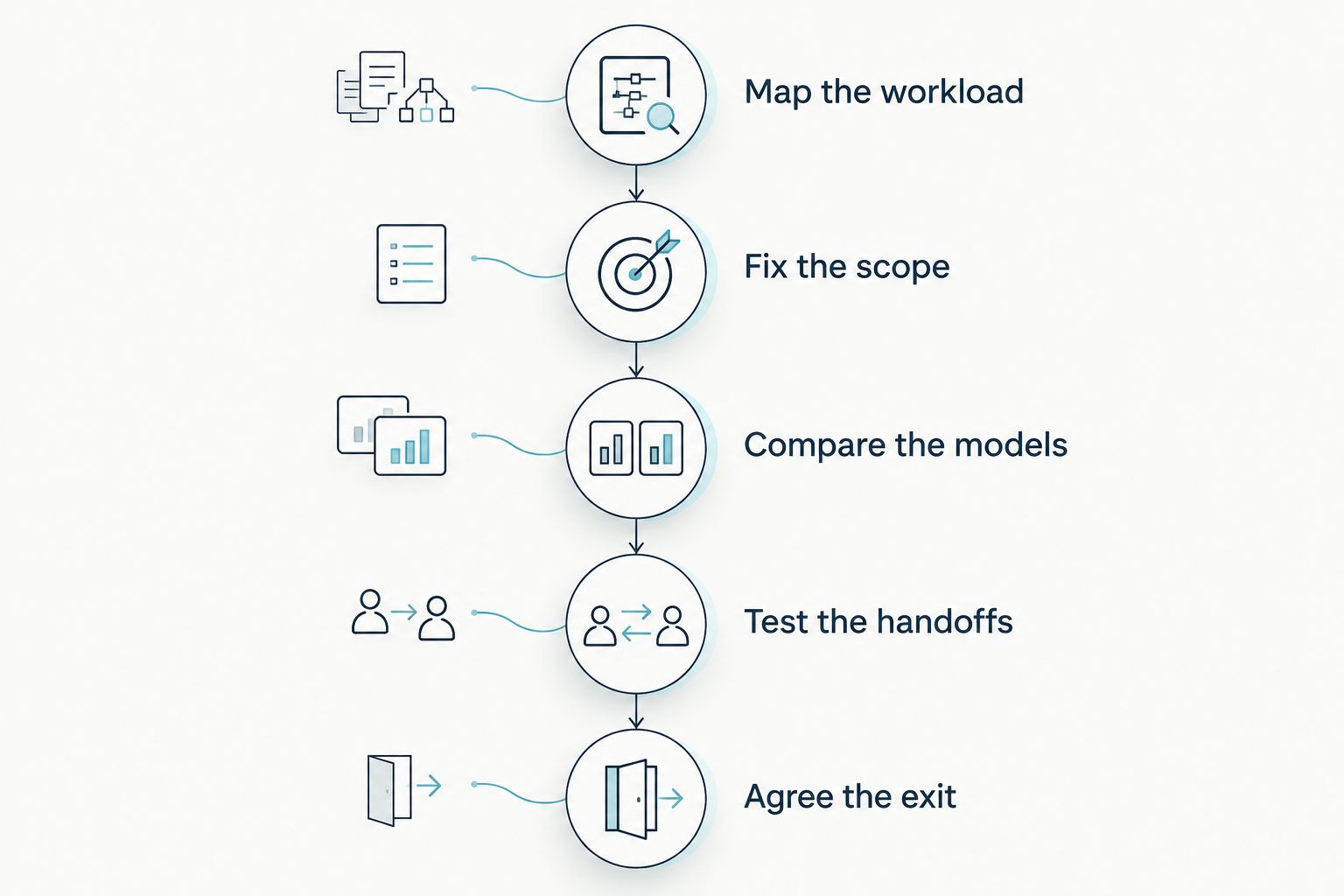
The decision record should state what transfers, what stays internal and why the selected model fits. That is more useful than a general statement that outsourcing will simplify operations.
Does outsourcing uniform procurement always save money?
No. Outsourcing uniform procurement does not establish a saving by itself; the result depends on commercial terms, transferred work and retained responsibilities. Compare the full operating arrangement rather than treating a garment quote as the entire procurement cost.
If the provider adds services your current process does not include, assess whether you need those services. Additional scope is not a saving merely because it arrives in one contract.
Can you outsource procurement without losing control?
Yes. You can retain specification approval, purchasing authority and performance oversight while assigning operational tasks to a partner. Control depends on documented rights and usable records, not on performing every task internally.
Keep approval ownership explicit. A provider should know which changes it can make within the agreement and which require your written authorisation.
When should you keep uniform procurement in-house?
Keep uniform procurement in-house when your team can manage the programme effectively and an outsourcing proposal does not justify its additional fees, dependencies and transition work. A limited operational problem calls for a defined solution, not necessarily a complete transfer.
If distribution is the issue, assess distribution support. If specification control is the issue, fix approvals before asking a new supplier to inherit the same ambiguity.
FAQ
Is outsourcing uniform procurement worth it for an enterprise in 2026?
Outsourcing uniform procurement is worth it when the contracted operational work justifies the fees, retained workload and transition requirements. Assess specification control, replenishment, distribution and exception handling against the same requirements for every bidder.
What's the difference between a uniform supplier and an outsourcing partner?
A uniform supplier provides the goods covered by its agreement; an outsourcing partner takes responsibility for additional procurement operations specified in the contract. Confirm the actual scope rather than relying on either label.
Is hybrid uniform procurement better than full outsourcing?
Hybrid uniform procurement is better when you need external ownership of defined tasks while retaining other operations internally. Full outsourcing fits a broader transfer of responsibilities, but both models require clear handoffs and internal accountability.
What does Boolanga do for enterprise uniform procurement?
Boolanga designs, manufactures, distributes and provides software for branded workwear, uniforms, courier gear and merchandise. It serves enterprise clients across 35+ countries; buyers should confirm the scope and destinations covered by their own agreement.
What should I ask before signing a uniform procurement contract?
Ask who owns specifications, approvals, order exceptions, stock records and distribution responsibilities. Confirm reporting access and exit arrangements before signing, including the treatment of remaining stock and unfinished orders.
Can I keep design approval if I outsource uniform procurement?
Yes, you can retain design approval while assigning agreed operational tasks to an external partner. Document approval rights, authorised changes and the process for resolving a rejected specification or substitution.
One last thing
For your 2026 decision, ask the proposed partner to explain how you would leave. The answer tests whether specifications, records, stock and unfinished orders have clear owners.
Do not sign until the operating model makes sense in both directions: starting the service and transferring it out. A clear exit plan protects your ability to make the next procurement decision on its merits.


