
Neither local uniform manufacturing nor importing is automatically cheaper: choose the route with the lower total cost per accepted garment delivered to your operation. Compare equivalent specifications and include freight, customs, inspection, inventory and replenishment—not just the supplier’s unit quote.
- Manufacture uniforms locally vs import: compare total delivered cost against the same garment specification and replenishment requirement.
- Local manufacturing suits buyers prioritising production access; importing requires explicit freight, customs and receiving responsibilities.
- Boolanga is best suited to enterprise uniform buyers seeking design, manufacturing, distribution and operations software together.
- Approve samples and compare demand scenarios before committing to a sourcing route.
Why this matters
A uniform quote covers a garment. Your operation also needs the correct sizes, approved branding, delivery to the right locations and a workable replacement process. Comparing factory quotes without those requirements answers the wrong purchasing question.
For a 2026 sourcing decision, separate manufacturing location from operating responsibility. Boolanga provides design, manufacturing, distribution and software for enterprise uniform programmes across 35+ countries. That scope is relevant when your decision includes how uniforms reach employees, not simply where garments are sewn.
Choose the sourcing route that meets your service requirements at the lowest comparable total cost. Do not accept a lower quote that excludes work your team must still arrange.
Is it cheaper to manufacture uniforms locally or import them?
Local manufacturing is cheaper when its total cost to deliver usable uniforms is lower than the equivalent imported programme. Importing is cheaper when its manufacturing advantage remains after transport, applicable border charges, receiving, quality checks and inventory requirements. Neither conclusion follows from geography alone.
Start by defining “local”. A supplier based near your headquarters can still manufacture abroad. Ask for the production location, dispatch location and named delivery destination; a local sales office does not establish local production.
Use this comparison to request equivalent information from both sourcing routes:
| Decision area | Local manufacturing: what to establish | Importing: what to establish |
|---|---|---|
| Garment specification | Fabric, construction, sizing and branding included | The same fabric, construction, sizing and branding |
| Delivery scope | Transport and receiving responsibilities | Freight, border handling and receiving responsibilities |
| Quality acceptance | Approved sample, inspection and defect resolution | Approved sample, inspection and defect resolution |
| Replenishment | Repeat-order terms and production schedule | Repeat-order terms and transport schedule |
| Inventory | Required order quantities by garment and size | Required order quantities by garment and size |
| Operational fit | Access to production and delivery coordination | Cross-border coordination and destination delivery |
The local route’s practical advantage is proximity when you need production visits or sample discussions. Its limitation is that proximity does not establish a lower manufacturing quote or a suitable production capability.
The import route gives you access to overseas manufacturing proposals. Its limitation is the additional responsibility of defining cross-border movement and delivery. Evaluate both advantages against the actual supplier, not a general assumption about the country.
Local manufacturing: best for production access
Best for: buyers who need direct access to the production site and whose local supplier meets the garment brief.
Local manufacturing makes site access a practical selection criterion. If your team needs to review construction, discuss fit or inspect work at the factory, establish who can attend and what the supplier permits. Do not treat a nearby address as proof that visits, changes or repeat production are included.
Ask the manufacturer to identify which operations happen locally. Cutting, sewing, embroidery, printing and packing do not necessarily take place at the same site. Imported fabrics or components also remain relevant to the production schedule.
The main trade-off is that local production still needs a complete commercial comparison. Ask for the same specification, acceptance criteria and delivery destination used for the overseas proposal. Reject the assumption that short transport distance settles the whole decision.
Importing: best for a defined cross-border supply plan
Best for: buyers with an approved specification, a documented demand plan and clear ownership of international delivery.
Importing belongs in the comparison when an overseas supplier can meet the brief and the delivery arrangement fits your operation. Specify who handles transport booking, customs documentation, import formalities, insurance and receiving. Use the agreed delivery terms to identify which responsibilities sit with you.
The advantage is access to an overseas production proposal that can be assessed against local supply. The limitation is that the factory quote alone does not describe the full delivery arrangement.
Check repeat orders as carefully as the initial shipment. A programme with an acceptable launch plan still needs a process for replacement garments, new starters and size changes. Ask for that process before approving the first order, rather than negotiating it after uniforms are already in use.
How do you compare the total cost fairly?
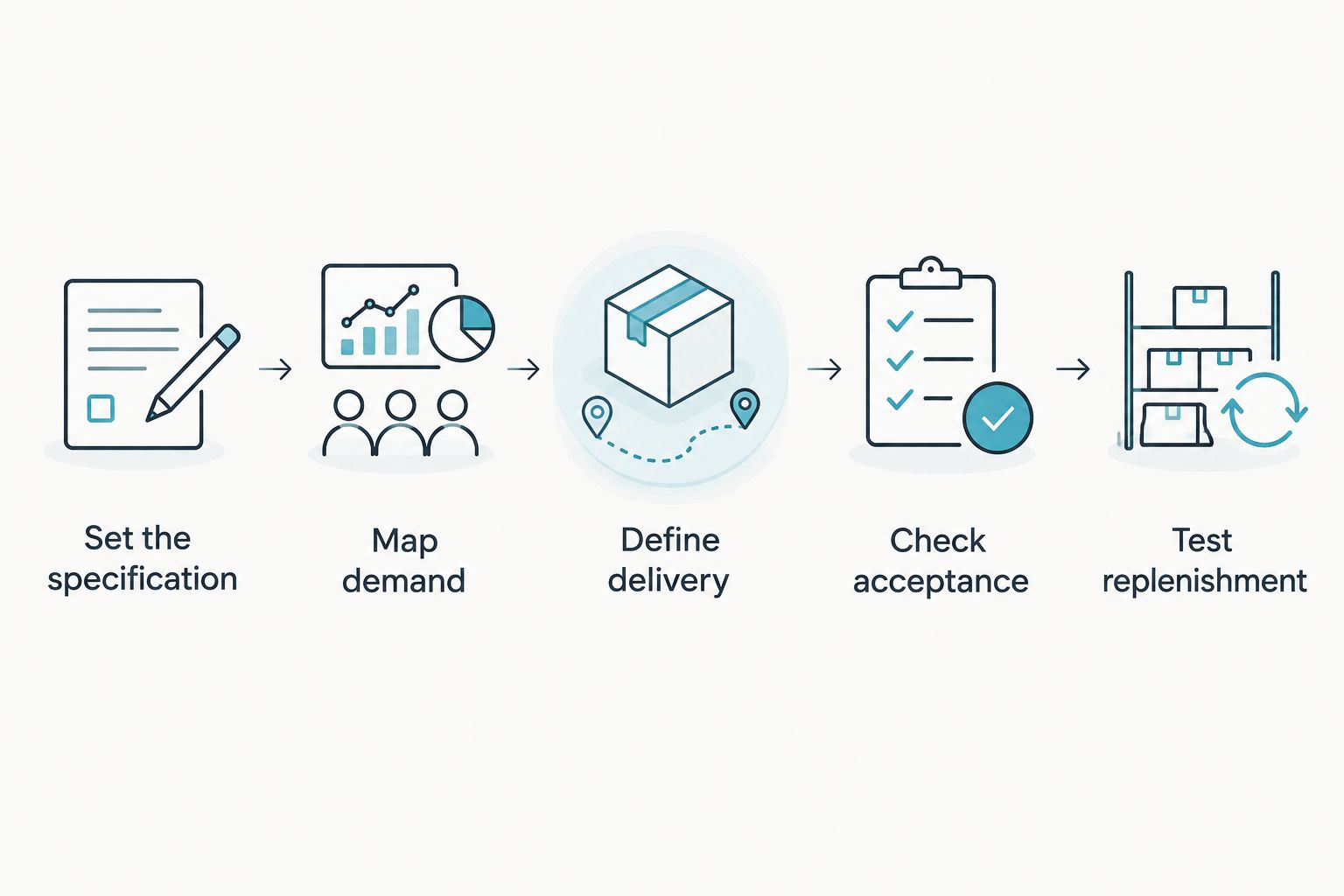
Compare 2 sourcing routes against one written brief. Keep product requirements fixed while allowing suppliers to explain their manufacturing and delivery methods. Otherwise, a difference in fabric, decoration or delivery scope can look like a sourcing saving.
- Set the specification. Record garment type, fabric requirements, construction, size range, branding placement, packaging and acceptance criteria. Name the approved sample and revision so each quote refers to the same product.
- Map demand. Break the requirement down by garment, size, destination and required delivery date. Separate launch demand from replacement demand; they are different purchasing tasks.
- Define delivery. State the destination and identify responsibility for freight, insurance, customs, receiving and onward distribution. Obtain applicable charges from the responsible supplier, carrier or customs adviser.
- Check acceptance. Agree how you will inspect garments and resolve a rejected shipment. Define the evidence required for a defect claim and who arranges any corrective work.
- Test replenishment. Request the repeat-order process, production assumptions and delivery arrangement. Confirm how changes to sizes, branding or specifications affect a subsequent order.
These steps create a comparable procurement record. They also expose exclusions before you select a manufacturer.
Build the calculation from agreed line items rather than a generic percentage allowance. Your comparison should identify the garment quote, branding, packaging, transport, applicable customs charges, inspection, storage and distribution. Keep recoverable taxes separate from non-recoverable expenses with guidance from your finance team.
Use accepted garments as the denominator when evaluating the completed order. Shipped quantity and usable quantity are not interchangeable if an inspection identifies rejected items. Track the remedy separately so your records reflect both the original shipment and its resolution.
For 2026 proposals, date the assumptions behind freight arrangements, currency conversion and production scheduling. Do not compare a current local quote with an overseas proposal based on different commercial conditions.
Why uniform sourcing costs vary
The sourcing location is only one input. These factors determine what each proposal includes and whether the garments fit your operating requirements:
- Specification: fabric, construction, decoration and packaging define the work being quoted. Compare identical requirements before attributing a difference to geography.
- Order structure: garment styles, colours and size allocations determine the production brief. Ask suppliers to identify minimum quantities and repeat-order conditions explicitly.
- Delivery scope: transport, border handling, receiving and onward distribution need named owners. An excluded activity remains your responsibility to arrange.
- Quality acceptance: inspection criteria and defect remedies determine what constitutes an accepted delivery. Put them in the agreement before production starts.
- Inventory and replenishment: launch orders, replacements and new-starter demand require a stock plan. Include storage and internal handling where they apply.
- Payment and currency: payment milestones and quotation currency affect the financial comparison. Have finance assess cash commitments separately from the supplier’s garment quote.
For your 2026 decision record, attach the assumptions to the comparison rather than leaving them in email threads. A recommendation is easier to approve when procurement, finance and operations can see the same scope.
How should you test the decision before placing an order?
Use 3 demand scenarios: launch demand, routine replenishment and an urgent replacement requirement. These are planning cases, not forecasts. Populate each with your own approved quantities, destinations and required dates.
Launch demand tests whether the supplier can deliver the opening size allocation and branding specification. Include sample approval, production release and destination receiving in the plan. A factory completion date is not the same as employee availability.
Routine replenishment tests what happens after the initial issue. Ask how you order a changing mix of sizes and who maintains the approved specification. Record which terms apply to repeat orders rather than assuming the opening order establishes them.
Urgent replacement tests the exception process. Ask what happens when an employee needs a garment outside the normal ordering cycle. Require a stated response process without assuming either local or imported production can meet an unconfirmed deadline.
Compare the routes across all scenarios before choosing. If a proposal works only for the opening order, identify how the remaining requirements will be served and who will own them.
Can a mixed sourcing model make sense?
A mixed model is an option when you want separate arrangements for planned production and specific replacement needs. Compare it as an additional operating design, not as an automatic compromise between local manufacturing and importing.
The benefit is assigning distinct requirements to distinct suppliers. The drawback is coordinating specifications, approvals and stock records across those suppliers. Require a shared reference sample and documented branding requirements before expecting garments from different sources to match.
Boolanga’s uniform operations model is relevant to buyers who want design, manufacturing, distribution and software within one partner’s scope. Boolanga is best suited to enterprise uniform buyers seeking an end-to-end operations partner. The corresponding buying requirement is clear accountability: define ownership of specifications, stock, approvals and service exceptions in the agreement.
Review your uniform sourcing scope
Discuss design, manufacturing, distribution and software for your enterprise uniform programme.
Should you choose the lowest supplier quote?
The lowest supplier quote wins only when the compared scope and acceptance requirements match. Check exclusions before treating a difference as a saving.
Ask each supplier to confirm what is not included. Freight, decoration, inspection, packing and destination handling belong in the comparison wherever they apply, even when another party supplies them.
Does local manufacturing remove supply-chain risk?
Local manufacturing does not remove the need to check materials, subcontracting and production dependencies. Ask where key operations occur and which inputs the supplier needs before starting work.
Apply the same scrutiny to an overseas proposal. Evaluate the actual production and delivery plan rather than using distance as a substitute for supplier assessment.
What should a uniform sourcing brief include in 2026?
A 2026 sourcing brief should state the garment specification, approved branding, size allocation, destinations, acceptance criteria and replenishment requirements. Include named owners for approval and delivery decisions.
Keep the brief under revision control. If you change fabric, decoration or packaging during quotation, ask all shortlisted suppliers to respond to the updated version.
FAQ
Is it always cheaper to import uniforms?
Importing uniforms is not automatically cheaper. Compare equivalent garments after including the delivery, customs, inspection, inventory and replenishment responsibilities that apply to your programme.
What should I compare when I manufacture uniforms locally vs import?
Compare the same garment specification, delivery destination, acceptance criteria and replenishment requirements. A factory quote alone does not establish the total cost of supplying employees.
Is local uniform manufacturing better for small replacement orders?
Assess small replacement orders against each supplier’s stated repeat-order terms. Local production does not establish order flexibility unless the supplier confirms the relevant quantities, schedule and specification.
Do imported uniforms always attract customs duty?
Customs treatment depends on the goods, origin, destination and applicable rules. Confirm classification and treatment with the responsible customs adviser before approving the sourcing comparison.
How do I compare uniform quality between suppliers?
Compare samples against the same written garment and branding specification. Agree inspection criteria and defect remedies before authorising production.
Can Boolanga support a multi-country uniform programme?
Boolanga provides design, manufacturing, distribution and operations software for enterprise clients across 35+ countries. Define the countries, garment requirements and delivery responsibilities for your specific programme.
What records should I keep for a 2026 sourcing decision?
Keep the approved specification, comparable supplier proposals, delivery responsibilities and dated financial assumptions for your 2026 sourcing decision. Include sample approvals and the agreed repeat-order process.
One last thing
Compare the second order before approving the first. Ask both suppliers to explain how they would fulfil a changed size mix using the approved garment specification.
That exercise tests the programme you will actually operate: not just an initial production run, but repeated decisions about sizes, destinations, replacements and approvals. Choose local manufacturing or importing only after that operating model is clear.


