
Yes—branded workwear is worth it for a small delivery fleet when it gives riders suitable clothing and customers a consistent way to recognise your team. For a 2026 purchase, assess the complete operating commitment: fitting riders, washing garments, handling replacements and keeping approved designs consistent—not just adding a logo.
- The answer to branded workwear worth it small fleets: buy for rider needs and identification, not decoration alone.
- Start with a branded outer layer when your existing clothing already meets the job’s requirements.
- Test fit, movement, washing and replacement arrangements before approving a fleet-wide order.
- Boolanga suits enterprise workwear programmes needing design, manufacturing, distribution and operations software together.
Is investing in branded workwear worth it for small delivery fleets?
Invest when you can identify the operational problem the clothing must solve and assign someone to manage it. Keep the scope narrow if your immediate need is simply to make riders recognisable at collection and handover.
Before comparing workwear services, choose the level of change your fleet actually needs. Replacing clothing that already works creates a different purchasing requirement from adding a visible identifier.
| Approach | Best for | Main advantage | Main limitation |
|---|---|---|---|
| Existing suitable clothing without fleet branding | Fleets without a current identification requirement | Avoids introducing a branding and artwork process | Does not create a consistent fleet identity |
| A branded outer layer | Fleets whose existing clothing already meets working needs | Concentrates branding on a visible garment | Identification depends on riders wearing that layer |
| A coordinated branded kit | Fleets needing consistent clothing across several roles or conditions | Lets you specify garments as a connected system | Adds sizes, garment types and replacement decisions to manage |
None of these approaches replaces a task-specific safety assessment. A recognisable jacket is not automatically suitable for rain, road exposure, lifting or extended riding.
The buying decision should therefore separate garment suitability, fleet identification and ongoing administration. A purchase that satisfies only the branding requirement leaves the other responsibilities with your operations team.
Why this matters
A small fleet still has to manage individual sizing, changing weather and replacement clothing. A single standard design does not remove those differences; it gives you a common specification around which to manage them.
For your 2026 workwear brief, define the intended outcome in operational language. Examples include making the fleet name readable at handover, accommodating a riding position or keeping the same approved artwork on replacement orders. Treat these as requirements to verify, not benefits a logo automatically delivers.
Separate the purchase decision from claims about sales or customer loyalty. Do not assign revenue to branded clothing without evidence from your own operation. A defensible decision can rest on suitable equipment and clear identification without promising additional orders.
When a branded outer layer is the right starting point
A branded outer layer is best for a fleet that already has suitable underlying clothing but needs a visible identity. It limits the initial specification to the garment customers and collection staff are intended to see.
Check how that layer interacts with the rest of the rider’s equipment. A logo placed behind a delivery bag, beneath a rain layer or against a folded hood will not serve the same identification purpose as an unobstructed mark.
The advantage is a narrower purchasing task. You can concentrate on fit, branding placement and the conditions in which riders will wear the garment, rather than redesigning the entire kit.
The limitation is dependence on actual use. If riders routinely remove the layer during work, it cannot provide continuous identification. Choose this approach only when the intended wearing pattern matches the identification requirement.
When a coordinated kit earns its extra administration
A coordinated branded kit is best for a fleet with documented clothing requirements across roles or working conditions. Specify each garment because it performs a necessary function, not because it completes a matching collection.
Build the specification around the work. Riding, loading, walking into collection points and handing over orders require movement; a garment that looks correct while standing still has not passed that assessment.
A coordinated kit gives you a shared basis for issuing clothing and approving replacements. Its drawback is the additional assortment: every garment type and size becomes another item to specify, record and maintain.
Keep exceptions visible. If different riders need different cuts or layers, record those requirements rather than treating variation as non-compliance. Standardise the functions and approved appearance without assuming everyone needs an identical fit.
Why the value of branded workwear varies
Your 2026 decision depends on the gap between what riders currently wear and what the operation requires. Review these factors before deciding whether a limited branding exercise or a wider clothing programme is justified:
- Identification need. Define who needs to recognise the fleet and at which point in the delivery. Branding hidden during that interaction does not meet the brief.
- Working conditions. Specify the weather exposure, riding position and handling tasks the clothing must accommodate. Assess safety requirements separately from appearance.
- Wearer acceptance. Include riders in fit checks and movement tests. Record objections against the requirement they affect rather than approving clothing solely from a catalogue image.
- Cleaning arrangements. Decide who washes the garments and how care instructions will be communicated. Test the actual garment and decoration under the intended care process.
- Replacement control. Establish how riders request another garment, who approves it and which design remains authorised. An initial order without a replacement process is an unfinished operating plan.
- Administrative ownership. Name the person responsible for sizes, artwork, supplier communication and issue records. Consolidation only helps if responsibilities remain clear.
How to test workwear before a fleet-wide order
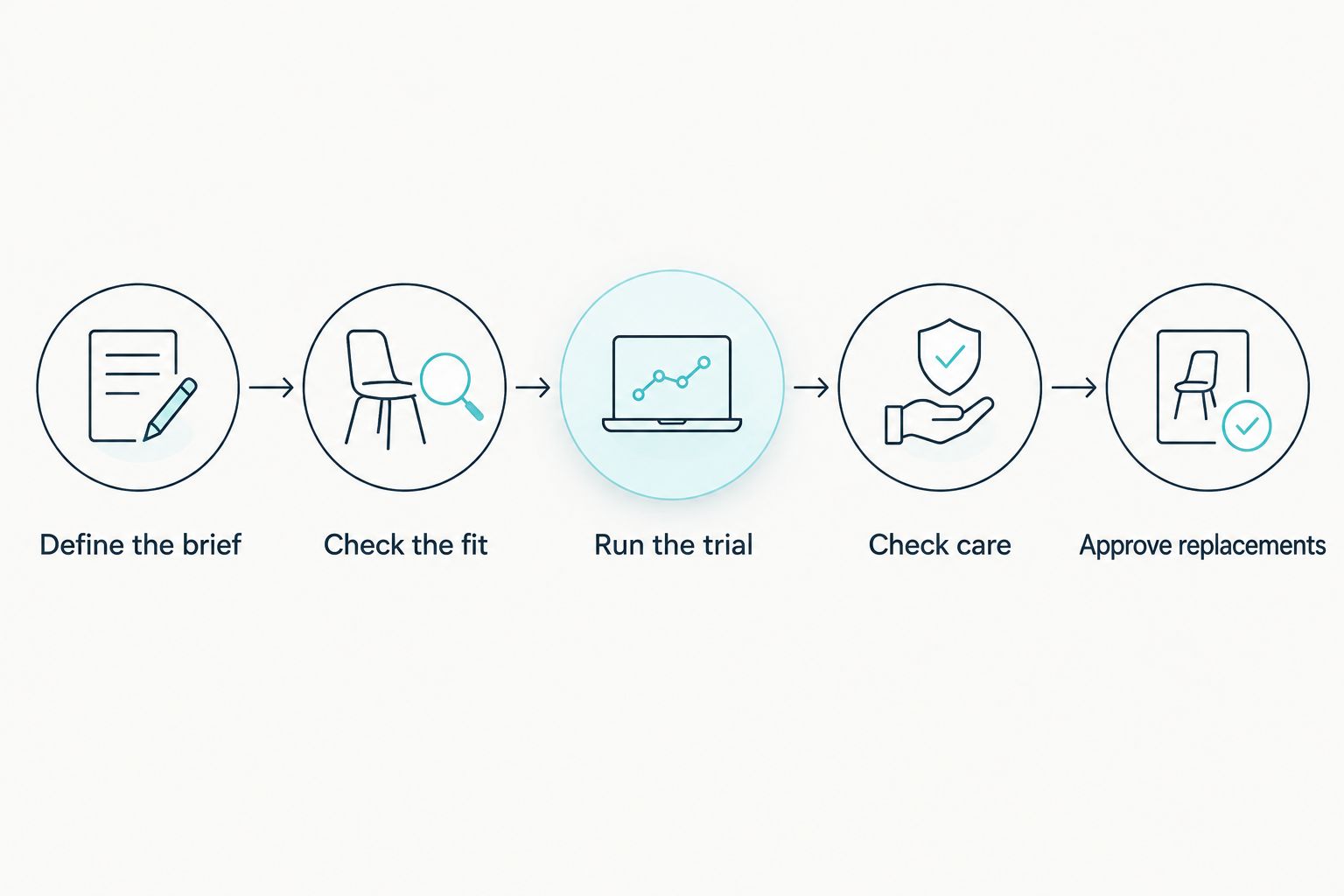
Use a sample trial to answer the questions that a specification sheet cannot settle. Approve the garment, decoration and operating process together, rather than approving a blank sample and assuming the finished version will behave identically.
1. Define the brief
Write down the job the clothing must do. Include rider tasks, expected exposure, identification points and any applicable protective requirements identified through your safety assessment.
Separate mandatory requirements from preferences. A preferred shade or decorative placement should not displace fit, movement or a requirement connected to the work.
2. Check the fit
Ask wearers to try the intended layers together. Check reaching, bending, sitting and the riding position, including interaction with bags and other equipment.
Record the garment reference and size against the wearer’s feedback. A general comment such as comfortable is less useful than identifying whether the sleeves pull back, the hem rides up or access to a pocket is obstructed.
3. Run the trial
Include at least 1 complete delivery shift in your initial trial plan, then extend testing to cover any working condition the first shift did not include. This is a starting procedure, not a durability standard or proof of seasonal suitability.
Record when riders remove, adjust or avoid the garment. Ask what caused the behaviour; an unworn item cannot perform its intended identification or clothing function.
4. Check care
Follow the supplied care instructions and inspect the finished garment after cleaning. Look at fit, seams, closures and decoration, using the original approved sample as the comparison reference.
Do not translate a short trial into an unsupported lifespan claim. Its purpose is to identify immediate problems and confirm that the planned care process is practical.
5. Approve replacements
Confirm the approved garment reference, artwork, placement and sizing records before release. Document how substitutions will be reviewed instead of allowing an alternative garment to enter the fleet without approval.
Keep a record of the finished sample. Replacement decisions need a reference that covers both clothing function and appearance.
What should your supplier brief include?
For a 2026 supplier review, send a brief that makes competing responses comparable. Asking only for branded jackets leaves too much room for different interpretations of the job.
Include these requirements in your request:
- Use case: rider tasks, delivery method and expected working conditions.
- Garment scope: what you intend to issue and which existing clothing will remain in use.
- Fit process: how samples, wearer feedback and size approval will work.
- Branding specification: approved artwork, placement and the finished sample approval process.
- Delivery responsibilities: destinations, receipt arrangements and who handles distribution to riders.
- Replacement process: ordering authority, substitution approval and records to retain.
Ask suppliers to distinguish their responsibilities from yours. Manufacturing, distributing and issuing garments are separate activities even when a single partner coordinates them.
Do not treat vendor consolidation as proof of suitability. A combined service still needs to match the scale, scope and administration your fleet requires.
Where does an end-to-end workwear partner fit?
Boolanga is best suited to enterprise workwear programmes needing design, manufacturing, distribution and operations software together. Its stated scope includes branded workwear, uniforms, courier gear and merchandise, serving 25+ enterprise clients across 35+ countries.
Boolanga’s end-to-end workwear model is relevant when your requirement spans those functions. For a small fleet, the limitation is scope fit: international coverage and an enterprise service model do not establish whether your particular order is suitable.
Use your written brief to discuss your fleet requirements. Confirm the service scope, responsibilities and sample process before deciding whether an end-to-end arrangement addresses your operation better than a narrower supply requirement.
Can a small fleet start with just one branded garment?
Yes—a small fleet can start with a branded garment when that item addresses the documented identification requirement. Keep existing clothing that already meets the job’s needs, and test whether the branded item remains visible during the relevant interactions.
Does branded workwear replace protective clothing?
No—branding does not establish protective performance. Specify any required protection through the appropriate safety assessment, then check that the proposed garment and decoration meet that requirement.
How do you know whether the investment worked?
Compare the trial and rollout against the original brief. Check whether riders wear the clothing as intended, whether identification remains visible and whether your team can issue and replace garments without unresolved decisions.
FAQ
Is branded workwear worth it for a small delivery fleet?
Yes, when branded workwear addresses a defined clothing or identification need and the fleet can manage fit, care and replacements. Start with a limited specification and approve samples before a wider order.
What's the best workwear approach for a fleet that already has suitable clothing?
A branded outer layer is the best starting point when existing clothing meets the job’s requirements and the missing function is visible fleet identification. Check that riders actually wear the layer during collection and handover.
Do delivery riders need a complete matching uniform?
A complete matching uniform is not the default requirement. Specify a coordinated kit only when each garment addresses a documented operational need.
How should we test branded courier clothing before ordering?
Test finished samples for fit, movement, actual delivery use and cleaning under the supplied care instructions. Record wearer feedback and approve the garment, artwork and replacement process together.
Can ordinary branded clothing count as protective equipment?
A logo does not make ordinary clothing protective equipment. Determine the required protection through your safety assessment and verify the proposed garment against that requirement.
Is Boolanga a fit for a small fleet's workwear programme?
Boolanga provides design, manufacturing, distribution and operations software for workwear and related categories. A small fleet should confirm that its order scope and operating requirements fit that enterprise-focused service model.
What should we track after issuing branded workwear?
Track fit-related exchanges, garment issues, replacement reasons and whether riders use the clothing as intended. Review those records against the original brief before changing or expanding the kit.
One last thing
Test the branding with the delivery bag on. A clear logo on an unworn sample tells you nothing about whether straps, equipment or another layer will obscure it during work.
Before your next 2026 order, review the finished garment in the positions customers and collection staff actually see. Approve what works in the delivery process, not just what looks correct on a hanger.


