
Eco-friendly workwear is not automatically the more expensive choice: compare matched specifications and total operating costs before deciding. A garment quote excludes replacement, laundering, distribution and stock-management costs unless those services are explicitly included, so the purchase figure alone cannot settle the question.
- An eco-friendly workwear cost comparison needs matched specifications, not a standard garment versus an upgraded design.
- Compare uniforms by usable service, including replacements, laundering, distribution and stock management.
- Recycled or organic fibre claims do not establish garment durability or lower environmental impact on their own.
- Boolanga is best for enterprises seeking one workwear partner across design, manufacturing, distribution and operations software.
Why this matters
Your 2026 uniform tender needs to distinguish material choices from changes in garment specification. Comparing a basic shirt with a more complex garment tells you little about the cost of choosing a different fibre.
Keep the job requirement fixed before comparing environmental attributes. Otherwise, extra pockets, different fabric weight, additional branding or a changed delivery scope get attributed to the sustainability brief.
Boolanga provides enterprise workwear design, manufacturing, distribution and operations software across 35+ countries. That scope makes procurement ownership relevant alongside garment selection: a manufacturing quote and an end-to-end operating proposal are different offers.
Is eco-friendly workwear more expensive than standard workwear?
There is no universal premium that applies to every eco-friendly workwear order. You need comparable supplier quotations and a defined operating period to establish whether your proposed uniform programme costs more.
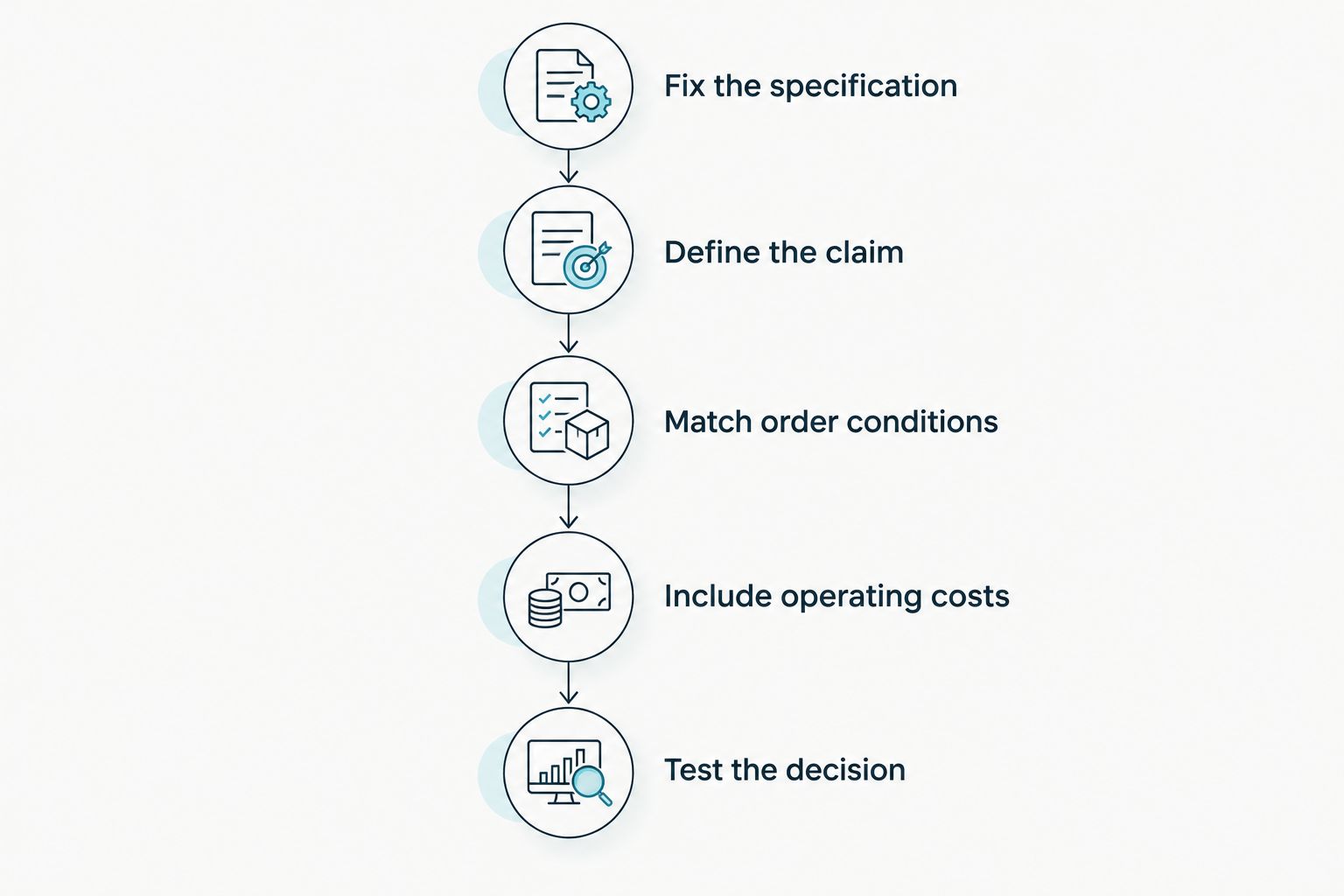
Use this sequence for your 2026 comparison:
- Fix the specification. Define the role, garment construction, fabric requirements, size range, branding and any required protective performance.
- Define the environmental claim. State exactly what the supplier must demonstrate rather than asking for an unspecified green option.
- Match the order conditions. Keep quantities, delivery locations, replenishment requirements and service responsibilities consistent.
- Include operating costs. Record laundering, repairs, replacements, handling and distribution within the same comparison boundary.
- Test the decision. Check whether the conclusion changes when documented replacement or care requirements change.
This sequence separates the question you want answered—what changes when the environmental requirement changes—from unrelated upgrades. It also gives procurement a record of why one proposal was selected.
What belongs in the comparison?
The following table compares procurement approaches, not interchangeable products. Each approach needs evidence before it earns a place in your tender.
| Approach | Best for | What it helps you assess | Main limitation |
|---|---|---|---|
| Standard specification baseline | Establishing a control for the tender | The existing garment and service requirements | A familiar specification is not proof of efficient use or low impact |
| Recycled-content specification | Buyers with a defined recycled-material requirement | Whether the proposed material meets the stated content requirement | Recycled content alone does not establish durability, care needs or whole-garment impact |
| Organic-fibre specification | Buyers with a defined agricultural sourcing requirement | Evidence supporting the specified fibre claim | The fibre claim does not describe every manufacturing stage or operating requirement |
| Repair-focused specification | Operations able to collect and repair garments | Whether construction and service arrangements support repair | Repair requires ownership, handling and a practical return process |
Do not rank these approaches by the label alone. Select the requirements that fit your work environment, then compare proposals against those requirements.
A garment can combine several attributes. Recycled content and repairable construction, for example, are separate requirements; neither should substitute for checking the other.
Compare cost per usable service, not just per garment
Start your 2026 assessment with a 12-month comparison period if that matches your purchasing cycle. This is a planning boundary, not an assumed garment lifespan; use a different period when your actual contract or operating records require it.
Define a wearer-day as 1 employee equipped for 1 working day. This creates a common service unit when suppliers propose different issue quantities or replacement arrangements.
A useful calculation is:
Cost per wearer-day = total included programme expenditure ÷ documented wearer-days served.
The denominator matters. Dividing by garments purchased measures acquisition, while dividing by service delivered helps you assess what the uniforms actually provided.
Set the accounting boundary first
Include the same categories for every proposal:
- Garment manufacture and agreed branding.
- Freight, customs handling and distribution within the contracted scope.
- Storage, picking and issue administration where applicable.
- Laundering and repair arrangements included in your programme.
- Replacements and the handling of returned or unusable garments.
Keep separately funded activities visible rather than treating them as absent. If employees arrange garment care, for example, state that boundary instead of presenting the programme as having no care requirement.
Do not mix financial expenditure and environmental impact into a single unsupported score. They are separate decisions, and a lower operating cost does not prove a lower environmental footprint.
Record why garments leave service
Log 1 replacement event whenever an issued garment must be replaced, and attach a reason. Wear damage, sizing changes, loss, branding changes and role changes describe different problems.
This prevents an avoidable mistake: assuming every replacement measures fabric durability. A garment withdrawn because its branding changed does not demonstrate that the material failed.
Use your own issue and replacement records for the calculation. A supplier's general durability statement is not a substitute for evidence relevant to your working conditions.
Why eco-friendly workwear comparisons vary
Your 2026 result depends on what changes between the proposals. These factors belong in the comparison because each changes either the garment requirement or the service you are buying.
- Material requirements. Fibre composition, fabric weight and finishing belong in the specification. Changing several together prevents you from isolating the effect of one environmental requirement.
- Construction and performance. Reinforcements, closures, pocket layouts and required protective performance define different garments. Keep these consistent unless the operational brief explicitly changes.
- Order structure. Total quantities, size distribution, branding variants and replenishment batches define the manufacturing request. Compare the same order structure rather than assuming different requests are equivalent.
- Evidence requirements. Specify what documentation must substantiate each environmental claim. A broad statement and a claim supported by relevant documentation are not equivalent tender responses.
- Distribution and aftercare. Delivery destinations, storage responsibilities, care instructions, returns and repair arrangements determine the programme boundary. Assign ownership before comparing totals.
Ask suppliers to separate exceptions from compliant responses. A proposal that changes the fabric or removes a service should identify that difference clearly rather than appear directly comparable.
How do you check whether the environmental claim is useful?
Translate every environmental claim into a procurement question. Your buyer should be able to identify what is being claimed, which part of the garment it covers and what evidence supports it.
For a recycled-content claim, ask which components the claim covers and what documentation supports the stated composition. For an organic-fibre claim, establish the scope of the claim rather than extending it to unrelated manufacturing stages.
Treat the claim and the operating performance as separate acceptance criteria. Evidence about fibre sourcing does not replace checks on seams, fit, colour consistency or suitability for the job.
A practical tender response should identify:
- The exact environmental attribute being offered.
- The garment or component covered by that attribute.
- The documentation available to support it.
- Any exclusions or substitutions requiring approval.
- The care requirements attached to the proposed garment.
Reject vague wording as a basis for comparison. You need a defined requirement that purchasing, quality and operations can interpret consistently.
Should you test garments before changing the whole programme?
Test the proposed specification in the work it must perform. A sample review can assess construction and fit, but working use adds evidence about care, movement and the reasons garments leave service.
Define acceptance criteria before issuing the samples. Otherwise, favourable comments about appearance can displace the operational questions the trial was supposed to answer.
Record the role, work conditions, garment issue date, care method and reason for any withdrawal. Keep observations specific: a failed closure and an incorrect size require different corrective actions.
Do not assign a promised service life from a short trial. Use the trial to identify problems and compare observations, then continue tracking the selected specification after rollout.
Can a cheaper garment cost more to operate?
A lower acquisition figure does not establish a lower operating total. Compare actual replacement, care and handling requirements before deciding which proposal is less expensive over your chosen period.
The reverse also applies. A higher acquisition figure does not prove better durability or lower operating cost; those conclusions need evidence.
Does recycled content mean a uniform lasts longer?
Recycled content alone does not establish how long a uniform lasts. Assess construction, suitability for the role and documented performance separately from the material-content claim.
Should every role receive the same eco-friendly uniform?
Use the same uniform only where the operational requirements match. A shared environmental policy can still allow different garment specifications for different tasks, care arrangements and protective requirements.
When does an end-to-end partner fit the decision?
Boolanga is best for enterprises seeking one workwear partner across design, manufacturing, distribution and operations software. The fit is the operating scope, not an assumed environmental benefit or an unverified cost advantage.
A consolidated brief lets you ask the same partner how a material change affects manufacturing, distribution and programme administration. Keep responsibilities explicit so garment selection does not become disconnected from replenishment and issue management.
The limitation is scope: a broad operating proposal needs a broader evaluation than a garment-only quote. Request clear ownership, exclusions and reporting requirements rather than assuming every activity is included.
For your 2026 tender, ask Boolanga to respond against your defined specification and service boundary. Assess any environmental proposal on its supporting evidence, just as you would assess the garment's operational requirements.
Define your workwear programme
Discuss garment specifications, manufacturing, distribution and operations software within one brief.
FAQ
Is eco-friendly workwear always more expensive?
Eco-friendly workwear is not automatically more expensive across the full programme. Compare matched supplier proposals and include the same replacement, care, distribution and administration costs before drawing a conclusion.
What's the best way to make an eco-friendly workwear cost comparison?
The best starting point is a matched garment specification and a shared service boundary. Define the environmental requirement, keep order conditions consistent and compare total included expenditure over the same operating period.
Does recycled workwear last longer than standard workwear?
Recycled content alone does not establish a longer garment life. Assess fabric, construction, care requirements and performance in the intended job separately from the recycled-content claim.
Should I compare workwear per garment or per employee?
Use garment-level figures to understand purchasing, then assess programme expenditure against the service delivered. Cost per wearer-day provides a defined unit when issue quantities or replacement arrangements differ.
Can I call a uniform sustainable because it contains organic fibre?
An organic-fibre claim does not establish the environmental performance of the entire uniform. Keep your wording within the documented claim's scope and assess other materials, manufacturing stages and operating requirements separately.
Can Boolanga support an enterprise uniform programme?
Boolanga provides design, manufacturing, distribution and operations software for enterprise workwear programmes across 35+ countries. Define the environmental and operational requirements in your brief, then assess the proposed scope and supporting evidence.
One last thing
Before changing the fabric, check why your current uniforms leave service. If your records show withdrawals caused by obsolete branding, incorrect sizing or untracked stock, a different fibre specification does not address those causes.
Make the environmental requirement explicit, but keep the operational diagnosis separate. Your strongest purchasing decision explains both what the garment is made from and how the programme will keep it in useful service.


