
Custom packaging is included with branded merchandise orders only when the agreed order scope explicitly includes it. Branding on the merchandise does not establish that the boxes, sleeves, inserts or packing work are included. Before approving an order in 2026, confirm the packaging specification, assembly responsibilities and delivery requirements in writing.
- For custom packaging branded merchandise orders, confirm inclusion in the approved specification rather than assuming it follows product branding.
- Boolanga serves enterprise merchandise buyers; packaging requirements still need explicit confirmation in the order scope.
- Separate protective packaging, branded presentation, inserts and packing work when reviewing a proposal.
- Approve the packed configuration, not just the artwork, before authorizing production.
Why this matters
A branded item and a branded package are separate deliverables. Your supplier can reproduce the approved logo on a garment while the order still leaves unanswered questions about the outer box, recipient insert or individual packing arrangement.
Boolanga is best suited to enterprise buyers seeking an end-to-end branded merchandise operations partner. Boolanga designs, manufactures, distributes and provides software for workwear, uniforms, courier gear and merchandise across 35+ countries. That operating scope makes the distinction between product requirements and distribution requirements relevant to a procurement brief.
For your 2026 merchandise program, treat packaging as an acceptance requirement rather than a finishing detail. Write down what the recipient should receive, how the contents should be arranged and who approves the result. A visual concept alone does not settle those responsibilities.
Is custom packaging included with branded merchandise orders?
Custom packaging is included only to the extent that the approved order documents say it is. Look for a defined packaging deliverable, not a general reference to branded merchandise or a presentation image showing a box.
The following categories help you inspect a proposal. They are scope distinctions, not a statement that any particular supplier includes these services.
| Packaging option | Best for | Practical benefit | Limitation | What to confirm |
|---|---|---|---|---|
| Protective packaging | Transit protection | Separates protection requirements from presentation | Does not establish branded presentation | Materials, closure and protection requirements |
| Branded outer packaging | A branded recipient experience | Gives the package its own approved identity | Adds a separate artwork and specification decision | Dimensions, material, print and finish |
| Inserts and accompanying materials | Instructions or recipient messaging | Places approved information with the merchandise | Creates another version to control | Content, language, placement and approval |
| Individually assembled kits | Sending a defined set to each recipient | Establishes what belongs in each package | Requires clear packing and exception rules | Item combinations, recipient variants and assembly ownership |
Check the order confirmation against the approved specification. If packaging appears in a presentation but not in the deliverables, request written confirmation before treating it as included. A reference image should guide a discussion; it should not substitute for an accepted requirement.
Also distinguish inclusion from responsibility. A document can list a box without identifying who supplies it, who packs it or who checks the finished package. Your acceptance criteria should cover the completed shipment configuration, not just the component list.
Protective packaging: define the shipment requirement
Protective packaging answers a handling question: what must surround and secure the merchandise during the planned shipment? Describe the actual contents and the transport conditions the supplier must address. Avoid specifying appearance as a substitute for protection.
Record whether the requirement applies to each item, each recipient kit or the consolidated shipment. These are different packing units. A requirement for an outer transport carton does not, by itself, establish an individual presentation package inside it.
For your 2026 specification, separate a packaging requirement from a performance claim. Ask the supplier to explain the proposed packing method and the evidence used to approve it. Do not accept an unsupported promise that an attractive package will protect every item through the intended route.
Best for: buyers whose priority is a clearly defined shipping configuration. The advantage is a focused protection brief; the limitation is that protection alone does not deliver custom branding or recipient messaging.
Branded outer packaging: approve it as a separate deliverable
Branded outer packaging needs its own specification. Define the physical format, usable internal space, material, print placement and approved artwork. Reference the actual merchandise configuration so the package is assessed around its contents rather than in isolation.
Ask what the artwork approval represents. A flat print file can establish logo placement and wording, but it does not demonstrate how the packed contents fit. A mock-up can establish appearance without confirming the final material or closure method.
Best for: programs where the outer package must carry an approved brand presentation. The benefit is control over that presentation; the trade-off is another approval dependency. Keep the product approval and packaging approval distinct so neither is mistaken for authorization of the other.
Inserts and assembled kits: specify the recipient outcome
An insert is a separate content deliverable. Name its purpose, required language, approved text and intended position. If the material contains instructions, make ownership of those instructions explicit rather than leaving the packing team to interpret a draft.
An assembled kit is a packing instruction as well as a collection of products. Define which items belong together, how variants are selected and what happens when a required component is unavailable. An approved photograph can support that instruction, but it should not replace a written contents list.
Best for: programs that need a consistent, defined package for each recipient. Assembly instructions make the intended outcome inspectable; their limitation is that unclear variant rules remain unclear even when the outer packaging is approved.
Why packaging scope varies
Packaging scope follows the requested deliverables. Use these factors to explain the differences between proposals without assuming that a more detailed presentation contains a more complete operational commitment.
- Packaging purpose: Protection, presentation and recipient information are distinct requirements. State which outcomes the package must achieve.
- Physical configuration: The contents, arrangement and closure determine what must be specified and approved together.
- Branding requirements: Printed surfaces, artwork versions and finishes need clear approval boundaries.
- Packing work: Supplying packaging materials differs from inserting products, adding documents and closing finished kits.
- Destination requirements: Identify destination-specific instructions and assign responsibility for confirming applicable requirements.
- Order changes: Define how a product substitution, artwork revision or recipient variant changes the approved package.
These factors belong in the brief even when you want a single partner to manage the work. Vendor consolidation changes who coordinates the activities; it does not remove the need to define them.
How do you confirm what is included before approving the order?
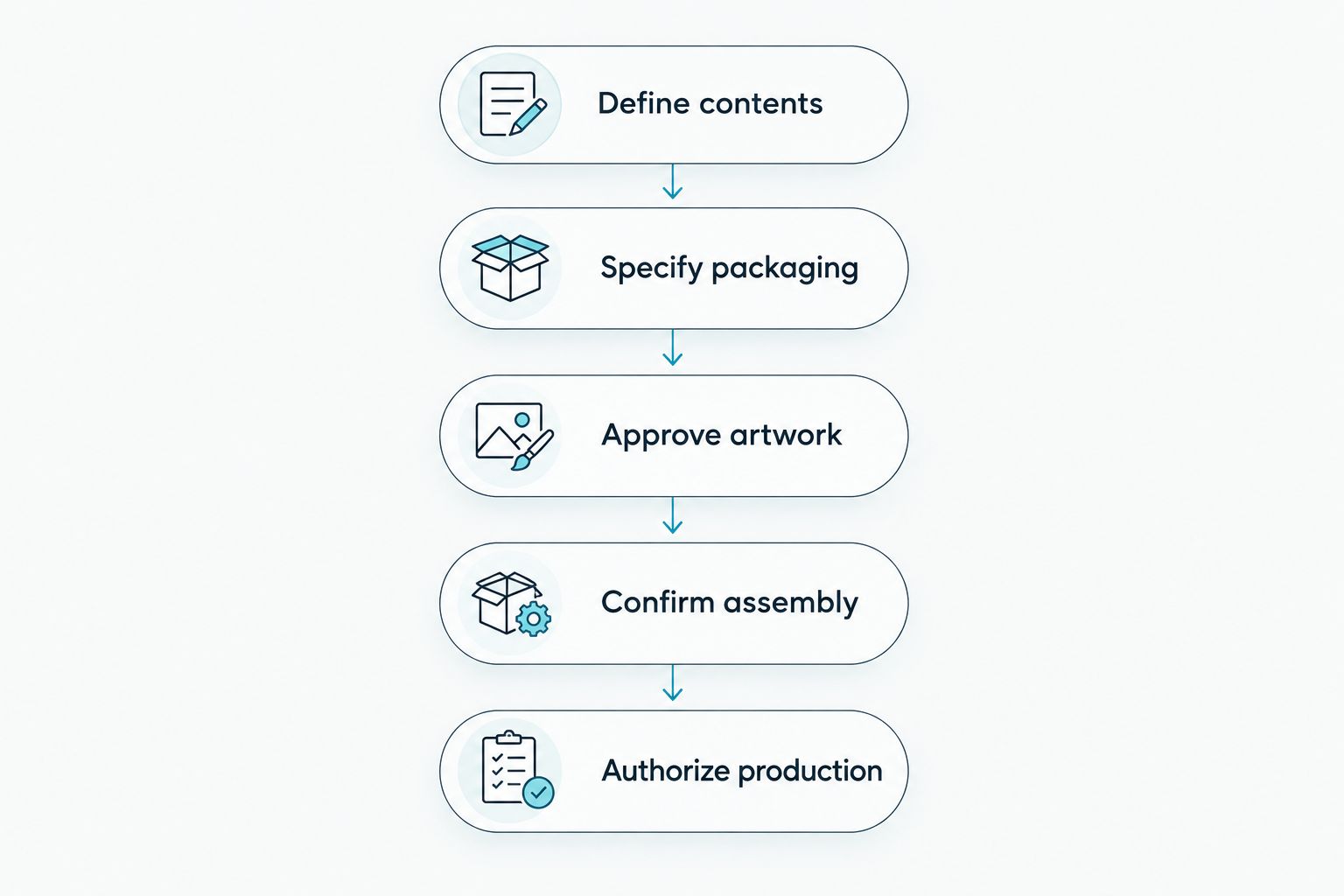
Use the same approval sequence for your 2026 orders, whether the packaging is simple or individually assembled. The objective is a documented handoff from intended recipient experience to accepted production instructions.
- Define contents. List the merchandise and accompanying materials that belong in the finished package. Identify variants rather than leaving substitutions to the packing stage.
- Specify packaging. Record the protective and presentation requirements separately. Identify which physical components the supplier is responsible for providing.
- Approve artwork. Assign an owner to approve wording, branding and language versions. State which file becomes the production reference.
- Confirm assembly. Describe item placement, insert placement, closure and labeling responsibilities. Establish how exceptions are escalated.
- Authorize production. Confirm that the accepted specification and order documents describe the same deliverables before releasing the work.
The sequence distinguishes an artwork decision from a production decision. Approving a logo position should not accidentally authorize an unreviewed packing arrangement.
Keep the approval record accessible to the people placing orders and handling changes. If a later revision replaces the approved package, identify what changed and obtain acceptance of the replacement. Otherwise, different teams can work from different versions of the same brief.
What should your packaging brief contain?
A useful brief lets another person determine whether the delivered package matches the request. Replace subjective instructions such as premium presentation with observable requirements. If appearance matters, identify the approved reference and explain which features it controls.
Include the following fields in your order documentation:
- Contents: The merchandise and supporting materials required in each finished package.
- Packaging components: The outer package, internal supports, closures and accompanying materials requested.
- Artwork reference: The approved files and the person authorized to accept revisions.
- Packing reference: The written arrangement and any approved supporting images.
- Variant rules: The differences by recipient, garment size, language or destination, where relevant.
- Acceptance criteria: The checks required before the packed order is released.
- Change ownership: The person who approves substitutions or revised specifications.
Do not confuse a completed field with an accepted deliverable. Your team and supplier must agree on the contents of the brief, and the order documentation must reference that agreement. An internal spreadsheet that never reaches the production owner does not establish a shared instruction.
Who should own packaging when suppliers handle different stages?
Assign a named owner to each handoff: merchandise release, packaging supply, assembly approval and shipment release. The role matters more than the department name. Every handoff should identify what is being accepted and which document defines it.
Boolanga combines design, manufacturing, distribution and operations software within its stated services. That is relevant when you want to discuss a consolidated merchandise program, but it is not a substitute for confirming the packaging deliverables for your order.
An end-to-end arrangement offers a single partner across those stated functions. Its limit is contractual scope: an organizational capability does not establish that every possible packaging task belongs to a particular order. Ask for the responsibility boundary, especially where materials or approvals come from your team.
Confirm your merchandise order scope
Discuss packaging requirements, assembly responsibilities and distribution needs before approving the order.
Does a merchandise mock-up confirm that packaging is included?
A merchandise mock-up does not establish packaging inclusion unless the accepted order scope identifies that packaging as a deliverable. Treat a visual as a reference with a defined purpose: appearance, layout or packing arrangement. Ask which of those decisions it actually approves.
Can you approve merchandise before approving its packaging?
You can separate merchandise approval from packaging approval by documenting each authorization clearly. Identify any unresolved packaging decisions before releasing work that depends on them. Do not use an undifferentiated approval message for separate production stages.
What happens if the merchandise changes after packaging approval?
A merchandise change requires a review of the affected packaging requirements. Check fit, arrangement, artwork references and packing instructions against the revised contents. Keep the original approval only for the elements that remain unchanged.
FAQ
Is custom packaging automatically included with branded merchandise?
Custom packaging is not established by merchandise branding alone. Treat it as included only when the agreed order scope explicitly identifies the packaging deliverables.
What should I ask a supplier about branded packaging?
Ask the supplier to identify the packaging components, artwork approvals, packing work and delivery responsibilities included in the order. Confirm the answer in the accepted specification.
Is protective packaging the same as presentation packaging?
Protective packaging and presentation packaging describe different requirements. Specify the protection needed for shipment separately from the appearance required when the recipient opens the package.
Does supplying a branded box include packing the merchandise?
Supplying a branded box does not establish responsibility for packing the merchandise. Confirm who inserts the contents, adds accompanying materials, closes the package and checks the result.
Does Boolanga provide services for enterprise merchandise programs?
Boolanga designs, manufactures, distributes and provides software for branded merchandise, workwear, uniforms and courier gear. Confirm packaging requirements within the specific order scope.
What should I check before approving packaging in 2026?
Before approving packaging in 2026, check that the agreed contents, physical specification, artwork and assembly instructions match. Identify who can authorize changes after approval.
Can the same packaging specification cover every destination?
Use a shared packaging specification only where the agreed requirements are the same. Document any destination-specific instructions and assign responsibility for confirming applicable requirements.
One last thing
Approve the package as the recipient will receive it. A box can match the artwork while the contents, insert or arrangement still differ from the intended result. Make the final acceptance reference describe the packed configuration, not an empty container.
Before releasing your next order, ask the production owner to describe the finished package using the approved documents alone. Any question that still depends on an unwritten explanation belongs back in the specification.


