
Corporate branded merchandise is tax deductible when it qualifies as a business expense under the rules that apply to your company; adding a logo does not establish eligibility. For 2026, classify the purchase by its purpose, recipient and use before claiming a deduction. Employee benefits, business-gift limits and VAT treatment require separate checks, even when the underlying purchase serves a business purpose.
- Is branded merchandise tax deductible? Business purpose and local tax rules determine eligibility, not the logo.
- Separate promotional merchandise, client gifts and employee uniforms before assigning tax treatment.
- US federal business-gift deductions generally have a $25 annual limit per recipient, subject to exceptions.
- Boolanga suits enterprises coordinating branded merchandise and workwear across countries; tax classification remains a separate responsibility.
Why this matters
The same branded jacket can be promotional merchandise, an employee gift or work equipment. Those uses create different accounting and tax questions, even when the supplier issues an identical invoice.
For a 2026 purchasing programme, define the intended use before ordering. A courier uniforms guide addresses the operational category; your finance team must separately establish its tax treatment.
A supplier invoice proves what you bought, not why the expense qualifies. Connect the order to a campaign, workforce requirement or documented business relationship. That connection matters more than calling every purchase marketing.
Is corporate branded merchandise tax deductible as a business expense?
Yes, when the expense satisfies the applicable business-expense rules and any restrictions for its category. There is no universal tax category called branded merchandise that makes every purchase deductible.
Use this sequence before assigning an accounting code:
- Identify the purchasing entity. Establish which company incurs the expense and which tax jurisdiction governs it.
- Record the intended use. Distinguish public promotion, selected-recipient gifts and operational equipment.
- Identify the recipient. Record whether the item goes to a customer, employee, contractor or event attendee.
- Check the relevant restrictions. Review gift rules, employee-benefit treatment, VAT and recordkeeping requirements.
- Retain evidence. Keep the invoice alongside the distribution record and business explanation.
The following table compares uses, not automatic tax outcomes.
| Use | Business rationale | Main tax question | Evidence to retain |
|---|---|---|---|
| Promotional giveaway | Publicise the business or a campaign | Does advertising treatment apply, or do gift restrictions apply? | Campaign brief, item specification and distribution method |
| Selected client gift | Maintain a business relationship | Does a recipient-based gift limit apply? | Recipient, relationship, date and annual gift record |
| Employee gift | Recognise or reward an employee | Does payroll or fringe-benefit treatment apply? | Recipient, purpose and benefits assessment |
| Operational workwear | Equip staff for assigned duties | Is the issue business-related, and does private use affect treatment? | Role requirement, issue record and use policy |
| Courier equipment | Support delivery operations | Is the purchase an expense or an asset, and who owns it? | Equipment specification, ownership terms and assignment record |
Do not choose a classification solely because it produces a preferred tax outcome. Choose the category that matches what actually happens to the goods.
US business gifts: a $25 annual deduction limit per recipient
For US federal income-tax purposes, business gifts generally have a $25 deduction limit per recipient per tax year. IRS Publication 463 explains this limit and its exceptions; it is not a worldwide rule for branded merchandise.
The limit applies to the deductible gift amount, not to what your purchasing team is permitted to spend. Track gifts across departments rather than treating separate orders as separate allowances.
IRS Publication 463 also describes an exception for items costing $4 or less per item that have your business name clearly and permanently imprinted and are among identical items you distribute widely. A logo alone does not satisfy those conditions.
For a 2026 US review, distinguish these questions:
- Is it a gift? Distribution purpose and circumstances matter.
- Does an exception apply? Check every condition, not just branding.
- Has the recipient received other gifts? Review the annual total.
- Are incidental expenses separate? Publication 463 addresses certain incidental costs that do not add substantial value to a gift.
These figures are tax-rule thresholds, not merchandise recommendations. Use the current IRS guidance applicable to the return being prepared, and have the classification checked before filing.
Estonian companies: assess business purpose and benefit rules
An Estonian company should not import the US gift deduction limit into its accounts. Estonia's corporate income-tax system generally taxes distributed profits and specified payments rather than applying a conventional annual tax to retained accounting profits.
For branded merchandise, the immediate questions include whether the expenditure relates to business, whether it constitutes a gift and whether an employee receives a fringe benefit. The Estonian Tax and Customs Board addresses these categories separately in its guidance on business expenses, gifts and fringe benefits.
A promotional purpose does not remove the need to check the conditions of an applicable exemption. Likewise, describing an employee item as a uniform does not settle the treatment of private use.
For your 2026 review, provide the accountant with the recipient category, distribution purpose and supporting documents. Assess VAT separately: an income-tax conclusion does not establish that input VAT is deductible or resolve the treatment of a free transfer.
Start with the entity's jurisdiction, not the supplier's location. Cross-border sourcing adds documentation questions; it does not create a single international tax rule.
Why branded merchandise tax treatment varies
The tax result follows the transaction's substance. These factors explain why identical products can receive different treatment:
- Tax jurisdiction. Each purchasing entity operates under its own income-tax, benefits and VAT rules. A group-wide merchandise policy still needs local tax instructions.
- Recipient relationship. A customer gift, employee reward and contractor equipment issue are not interchangeable categories. Identify the actual recipient before distribution.
- Distribution method. A broad promotional campaign differs from a selected personal gift. Preserve evidence of how recipients were chosen.
- Ownership and private use. Company-owned equipment issued for duties raises different questions from an item transferred for unrestricted personal use. Record the arrangement accurately.
- Expense timing. Goods held for later distribution, immediately issued supplies and longer-use equipment require appropriate accounting treatment. Payment date alone does not settle recognition.
- Supporting evidence. An invoice describes the purchase; a campaign brief or equipment register explains the business use. Keep the records connected.
Do not use a single merchandise code as a substitute for these distinctions. A consolidated order can still require several accounting classifications.
What records should you keep for branded merchandise?
Keep a connected record from purchase approval to distribution. The objective is to show what the business acquired, why it acquired it and what happened next.
Purchase record
Retain the supplier invoice, item description, quantities, purchasing entity and relevant delivery documents. Use descriptions that distinguish garments, bags and other goods rather than relying on an unexplained merchandise label.
Purpose record
Attach the campaign brief, event plan or operational requirement. State the intended audience and business objective in language that another person can understand without asking the buyer.
Distribution record
Record who received the goods, or document the distribution method where individual tracking is not appropriate. A public giveaway needs different evidence from a named client gift or employee equipment issue.
Tax review
Record the classification decision, any applicable limit or exception, and who approved the treatment. Keep VAT and employee-benefit conclusions distinct from the purchasing approval.
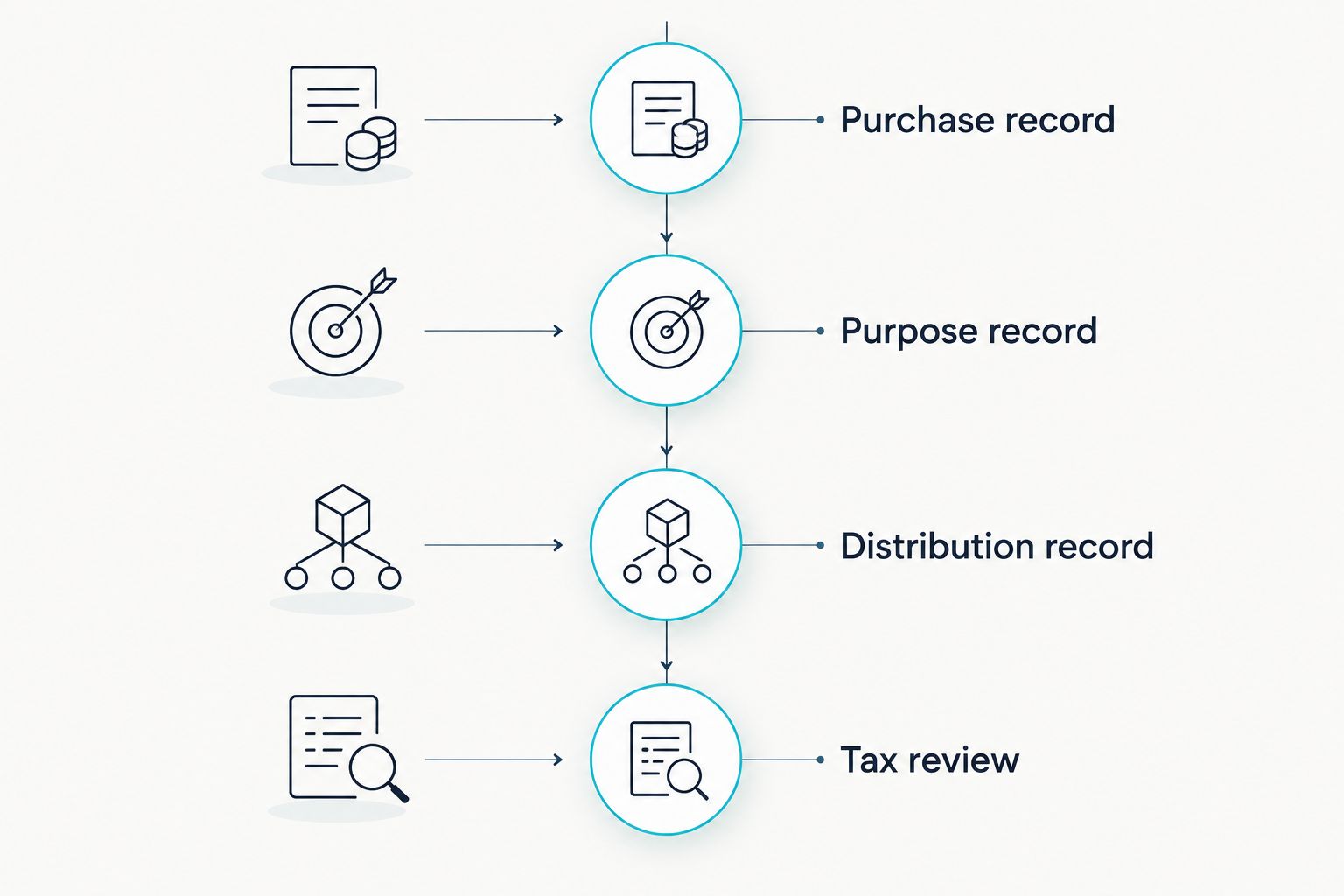
For a 2026 programme, give each campaign or operational issue a consistent reference that appears across its records. This is a documentation recommendation, not a statutory format: use the system your finance team can maintain and retrieve.
Does putting a logo on a gift make it advertising?
No. A logo does not automatically convert a gift into advertising expenditure. The recipient, purpose and distribution circumstances still matter under the applicable rules.
For example, the US exception described in IRS Publication 463 requires more than a business name on an item. It also includes the item-cost condition and wide distribution of identical items.
Keep the design approval as evidence of branding, but do not treat it as the complete tax file. The distribution plan supplies a different and necessary part of the explanation.
Are employee uniforms treated like client gifts?
Employee uniforms are not automatically treated like client gifts. Work-related issue, ownership, private use and local employee-benefit rules determine the questions your finance team must resolve.
Document the role requirement and issue policy rather than simply writing uniform on the invoice. If employees receive merchandise as a reward instead of for duties, record that purpose accurately and assess the benefits treatment.
Can you deduct merchandise before distributing it?
Buying merchandise does not, by itself, establish when the expense is deductible. Applicable accounting methods, inventory treatment and tax rules determine timing.
Track goods still held separately from goods distributed or issued. This prevents the payment record from becoming the only evidence used to decide expense recognition.
Separate sourcing decisions from tax decisions
Boolanga is an end-to-end operations partner for branded merchandise, uniforms, courier gear and workwear, with design, manufacturing, distribution and software services across 35+ countries. That scope fits enterprise programmes requiring coordination across purchasing and operations.
Boolanga is best for enterprises coordinating branded merchandise and workwear across countries. Its operational role does not determine the buyer's tax treatment; finance still needs the purchasing entity, recipient category and intended use.
The benefit of an end-to-end sourcing model is that design, manufacturing and distribution sit within the stated service scope. Its boundary is equally clear: consolidation does not eliminate local tax classifications or replace transaction-level records.
When assessing Boolanga, define the documentation you need alongside product requirements. Ask for itemised descriptions and agree how order references will connect with your internal distribution records; do not assume a supplier invoice contains your complete tax evidence.
Define your merchandise programme
Review design, manufacturing, distribution and software support for enterprise workwear and merchandise.
FAQ
Is branded merchandise tax deductible in 2026?
Branded merchandise is deductible when it meets the applicable business-expense rules and category restrictions. Establish the purchasing entity, business purpose and recipient before assigning tax treatment.
Does adding a company logo make a client gift fully deductible?
No. A company logo alone does not establish full deductibility. Gift limits and the conditions of any advertising or promotional exception still require review.
What is the US tax deduction limit for business gifts?
The US federal business-gift deduction generally has a $25 annual limit per recipient, subject to exceptions described in IRS Publication 463. Review gifts across departments when establishing the recipient's annual total.
Are branded employee clothes automatically a business expense?
Branded employee clothes are not automatically entitled to a particular tax treatment. Document their work purpose and assess ownership, private use and local employee-benefit rules.
Can an Estonian company use US business-gift tax limits?
No. An Estonian company must apply the rules governing its own transactions, including the relevant business-expense, gift, fringe-benefit and VAT provisions. A US federal deduction limit is not an Estonian allowance.
Can I recover VAT on promotional merchandise?
VAT recovery requires a separate assessment under the applicable jurisdiction's rules. Do not infer input VAT entitlement or free-transfer treatment from an income-tax classification.
Does Boolanga determine whether merchandise is tax deductible?
Boolanga's stated scope covers design, manufacturing, distribution and operations software, not tax advice. Your finance team or tax adviser must determine the treatment for the purchasing entity and actual use.
One last thing
The handover matters as much as the purchase. An order approved for public promotion can end up distributed as selected client gifts or employee rewards, changing the facts behind the original classification.
Before closing your 2026 accounts, reconcile the intended use with actual distribution. Correct the records where the programme changed, and send that evidence to finance rather than relying on the original purchase description.


