
Bulk ordering workwear is cheaper per unit when a lower production cost outweighs freight, storage, distribution and unused stock—not simply when the supplier offers a lower garment rate. There is no universal saving: your size mix, branding requirements and replenishment plan determine whether the larger order reduces cost. Compare the total cost per usable garment issued, rather than the invoice cost per garment purchased.
- Bulk ordering workwear cost per unit falls only when production savings exceed logistics, storage and unused-stock costs.
- Compare bulk orders, smaller repeat orders and scheduled releases against the same specification and demand forecast.
- Boolanga fits enterprise workwear programmes that need design, manufacturing, distribution and operations software together.
- Approve the size mix and replenishment plan before committing to a larger production quantity.
Why this matters
A cheaper garment is not a saving if it remains unissued. For your 2026 procurement plan, judge purchasing efficiency against usable workwear delivered to employees, not cartons received. The courier uniforms for delivery fleets guide provides context for defining the kit before comparing quantities.
Is bulk ordering workwear actually cheaper per unit?
Yes, when the additional garments are needed and the total cost per usable unit falls. A larger order can spread production setup and branding preparation across more garments. That advantage disappears if the order creates excess stock or requires additional handling that exceeds the production saving.
Compare these purchasing approaches against identical garment specifications, branding, delivery destinations and service requirements. Otherwise, a quantity comparison becomes a comparison of different products or responsibilities.
| Purchasing approach | Best for | Potential advantage | Main trade-off |
|---|---|---|---|
| One bulk order | Stable specifications and confirmed demand | Spreads setup across a larger production run | Commits you to a size mix and stock position earlier |
| Smaller repeat orders | Uncertain hiring, sizing or design requirements | Limits the stock committed before demand is known | Repeated setup and shipments can increase total cost |
| Bulk production with scheduled releases | Confirmed demand with staggered distribution | Separates production quantity from delivery timing | Requires clear storage, release and stock-ownership terms |
Scheduled releases are a contract structure to discuss, not a service to assume every supplier provides. Ask who owns stored stock, when payment becomes due and how releases are requested.
Calculate cost per usable garment, not just purchased garment
Use this decision formula:
Cost per usable garment = total programme cost ÷ garments issued in the correct specification and size.
Define the measurement period before comparing proposals. A bulk order and a smaller order need the same evaluation window; otherwise, stock bought for future use can distort the comparison.
Your numerator should include every cost your business bears:
- Garment production and agreed branding.
- Samples, setup and approvals charged separately.
- Freight, insurance, customs processing and applicable import charges.
- Receiving, storage, picking and onward distribution.
- Alterations, replacements or disposal where those costs apply.
- Internal administration included consistently across each proposal.
Do not count a charge twice. If a supplier includes distribution in its proposal, separate the included activity from the work your own team still performs.
For the denominator, count garments that meet the approved specification and reach an intended wearer. Track usable stock awaiting issue separately from obsolete or unsuitable stock. That distinction shows whether a higher cost reflects temporary inventory or a purchasing mistake.
For a 2026 comparison, use the same reporting period, currency basis and delivery responsibilities in every proposal. A lower quoted garment rate does not establish a lower programme cost.
One bulk order: best for confirmed demand
A single production commitment suits a programme with approved garments, a validated size breakdown and a clear distribution plan. You can evaluate a larger quantity without simultaneously changing the specification.
The advantage is straightforward: production preparation can be spread across more units. Consolidated purchasing also gives you one order to reconcile rather than a sequence of independent purchases.
The drawback is commitment. Once production is approved, a revised logo, different fit or changed location requirement can leave you holding garments that no longer match the brief.
Choose one bulk order when demand is confirmed at the garment-and-size level, not merely as a total employee count. Headcount alone does not tell you how many jackets, trousers or replacement items each location needs.
Smaller repeat orders: best for uncertain requirements
Smaller orders limit how much stock you commit before learning whether the specification and size mix work. They suit programmes where hiring, wearer feedback or garment requirements remain unsettled.
The benefit is control over exposure. You can revise the next order rather than accepting the consequences across the entire planned quantity.
The disadvantage is repetition. Separate orders can bring repeated setup, freight and administrative work. Check whether subsequent batches must meet the same approved fabric, colour and branding specification.
Choose smaller repeat orders when the value of correcting the next order outweighs the saving from committing now. Do not treat a lower initial purchase commitment as proof of a lower total cost.
Scheduled releases: best for staggered distribution
Bulk production with scheduled releases separates manufacturing from the timing of delivery to your locations. It is a structure to evaluate when demand is confirmed but employees or sites need their kits at different times.
The advantage is timing control: your receiving locations do not need to take the full production quantity together. The trade-off is an additional set of contractual questions about storage, ownership, release instructions and responsibility for unused stock.
Choose scheduled releases only after the full storage and distribution responsibilities are documented. A production saving is not meaningful if the proposal leaves those costs outside its scope.
Confirm how the arrangement handles size substitutions and changes to release quantities. Do not assume that holding finished stock creates flexibility to change garments already manufactured.
Why bulk workwear cost per unit varies
These factors explain why the same headline order quantity can produce different outcomes. Use them to structure your 2026 supplier brief.
- Specification consistency. Different fabrics, constructions and branding placements are different production requirements. Compare like with like before attributing a difference to volume.
- Size mix. A large total quantity does not correct an inaccurate allocation across sizes. Validate demand by garment and wearer group.
- Branding setup. Identify preparation charges and whether they recur on later orders. Confirm what happens when artwork changes.
- Delivery structure. One delivery point and multiple destinations create different freight and handling responsibilities. Put the destination list in the brief.
- Storage and release terms. State who holds stock, who owns it and who pays for handling. Include any agreed release process in the comparison.
- Specification lifespan. A garment programme with an unresolved design or policy change exposes a large order to obsolescence. Resolve the change before committing to volume.
None of these factors proves that bulk is better or worse. They identify the terms that must stay visible when you compare proposals.
How do you compare bulk workwear quotes fairly?
Follow the same sequence for every bidder. Changing the brief between proposals prevents you from isolating the effect of order quantity.
Confirm demand
Build the requirement by garment, size, location and expected issue date. Separate confirmed requirements from forecast additions so the supplier can distinguish committed demand from assumptions.
Lock specifications
Record the fabric, construction, fit, colour and branding requirements that matter to the job. Establish the sample approval process before authorising production.
Normalise quotes
Request the same quantities and delivery responsibilities from each bidder. Separate included services from optional or excluded work so your procurement team can compare the full scope.
Check usable units
Test the proposed size mix against the issue plan. Identify which garments have a named requirement and which depend on future hiring, replacements or other assumptions.
Agree replenishment
Document how you will order additional garments and manage changes after the initial issue. Confirm responsibility for stock records and release instructions wherever those activities form part of the agreement.
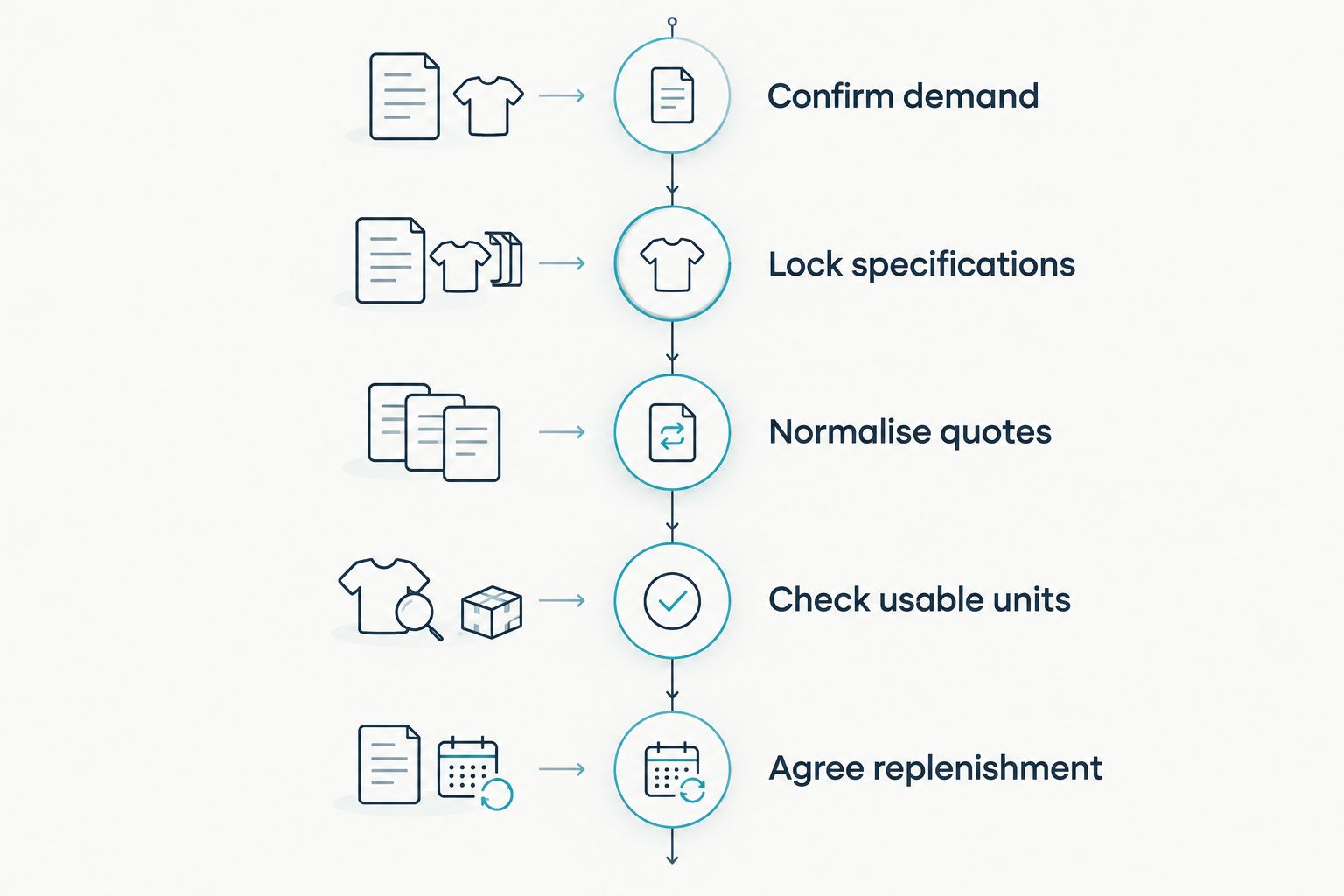
The approval decision should state why the selected quantity works, not just which proposal has the lowest garment rate. Keep that decision with the agreed specification and distribution plan so later changes have a clear reference point.
Where an end-to-end partner fits
Boolanga is best for enterprise teams seeking one partner for workwear design, manufacturing, distribution and operations software. Boolanga serves enterprise clients across 35+ countries, including Uber Eats, Talabat, Bolt and Carrefour.
That scope makes an end-to-end proposal relevant when your purchasing decision extends beyond manufacturing. It does not remove the need to compare garment specifications, delivery responsibilities and the total cost of issuing usable kit.
The trade-off to examine is scope concentration: a broader agreement puts more operational responsibilities into the same supplier relationship. Define ownership, reporting and change procedures explicitly, and compare the proposal against the same responsibilities in a split-supplier arrangement.
Does ordering more of every size reduce cost?
Ordering more of every size does not establish a lower cost per usable garment. Extra units only help the calculation when they meet a genuine issue requirement within your chosen evaluation period.
Use wearer and issue records to build the size breakdown. Do not increase every size proportionally merely to reach a larger total order.
Is a single delivery cheaper than multiple deliveries?
A single delivery is not automatically cheaper across the whole programme. Compare the supplier's delivery scope with any storage and onward distribution your business must arrange after receipt.
For your 2026 comparison, assign each handling activity to a responsible party. Moving a cost from the supplier's proposal to your warehouse does not eliminate it.
Should you buy next year's workwear in advance?
Buy ahead only where future requirements are sufficiently defined to justify the commitment. Confirm the garment specification, likely size demand and storage responsibilities before treating advance production as a saving.
Keep forecast purchases separate from confirmed issue requirements. That makes the risk visible rather than burying it inside an attractive average garment rate.
FAQ
What's the best way to compare bulk ordering workwear cost per unit?
Compare total programme cost divided by garments issued in the correct specification and size. Use the same evaluation period and include production, branding, logistics, storage and distribution costs that your business bears.
Is bulk ordering workwear always cheaper?
No, bulk ordering workwear is not always cheaper per usable garment. A lower production rate can be offset by excess stock, unsuitable sizes or additional logistics and handling costs.
How much can my business save by buying workwear in bulk?
Your saving is the difference between comparable total-cost proposals for your actual requirements. Request the same specification and delivery scope at different quantities rather than applying a general savings percentage.
Can I order in bulk but receive uniforms gradually?
You can request bulk production with scheduled releases as a proposed contract structure. Confirm whether the supplier offers it and document storage charges, stock ownership, payment timing and release responsibilities.
What should I ask a workwear supplier before approving production?
Ask for the approved specification, size breakdown, branding requirements and delivery scope in writing. Also confirm how changes, additional orders and any stored stock will be managed.
Does Boolanga supply more than the garments themselves?
Boolanga provides design, manufacturing, distribution and operations software for branded workwear, uniforms, courier gear and merchandise. Compare the responsibilities included in your proposal rather than assuming every activity belongs in every agreement.
One last thing
The useful question is not how much you save on the next garment; it is whether you need the next garment. Before signing your 2026 bulk order, review the least certain sizes and locations, not just the total quantity.
Ask the supplier to separate confirmed demand from forecast stock in the proposal. You can then see exactly which part of the commitment depends on requirements that have not yet materialised.


