
A dedicated uniform ordering platform is worth it for multi-location retailers when you need to enforce approved garments, purchasing permissions and delivery rules across stores. It is not worth buying just to replace an order form with a website. The hidden workload is maintaining accurate product, employee and fulfilment data; software does not remove that responsibility.
- Uniform ordering platform worth it retailers: yes when purchasing rules need enforcement, not just a digital order form.
- Choose controlled ordering for store-level permissions; keep simpler ordering when central purchasing already handles exceptions reliably.
- Boolanga suits retailers seeking uniform design, manufacturing, distribution and software from one operations partner.
- Evaluate catalogue ownership and fulfilment responsibilities before comparing platform features.
Is a dedicated uniform ordering platform worth it for multi-location retailers?
Yes, when the platform controls decisions that otherwise require manual checking. Those decisions include which garments a store can order, who approves an exception and where the order goes after approval.
For your 2026 supplier review, assess the ordering process alongside the corporate uniform suppliers for retail chains. An ordering interface and a uniform supply operation solve different problems.
| Ordering approach | Best for | Main advantage | Main limitation |
|---|---|---|---|
| Central email or spreadsheet ordering | Retailers whose central team can reliably review every request | Keeps decisions with the existing purchasing owner | Rules depend on people checking each request |
| Dedicated ordering platform | Retailers needing consistent controls across locations | Can apply catalogue access, permissions and approval rules when configured for them | Requires maintained data and clearly assigned administration |
| End-to-end uniform operations partner | Retailers wanting design, production, distribution and software under one relationship | Brings the ordering process and physical supply responsibilities together | Requires scrutiny of the full service scope, not just the interface |
These approaches are not interchangeable. A retailer can need better manufacturing coordination without needing complex employee accounts, or need tighter ordering controls while retaining its existing manufacturer.
Why this matters
Uniform ordering sits between a purchasing decision and a physical delivery. A request that looks complete on screen still needs the correct garment, size, branding specification and destination before anyone can fulfil it accurately.
For a multi-location retailer, the useful question is not whether stores can place orders online. It is whether the process preserves the rules that head office has set without forcing head office to inspect every line manually.
Start your 2026 evaluation with a recent ordering exception. Trace who noticed it, who resolved it and which information was missing. That sequence identifies the control you need more clearly than a feature list.
Central ordering: best for a process you can still supervise
Keep central email or spreadsheet ordering when a named owner can review requests, maintain the approved range and communicate order status reliably. A simple process is a valid choice when it remains controlled.
Its advantage is direct oversight. A buyer can ask a store manager why an unusual garment is needed before releasing the request, without first configuring an approval workflow.
The limitation is that oversight depends on attention. If the same buyer also reconciles garment descriptions, checks delivery addresses and answers status enquiries, evaluate those tasks separately rather than treating them as one unavoidable administrative job.
Keep the simple process if it works; document its rules before replacing it. Moving inconsistent naming and unclear responsibilities into a platform preserves the underlying problem.
Dedicated platform: best for repeatable ordering controls
A dedicated platform is the stronger option when different locations need different permissions, approved ranges or approval paths. Select it for the rules it can demonstrate, not the number of screens it offers.
Ask the provider to show a store manager attempting an order outside the approved range. The demonstration should explain whether the request is blocked, routed for approval or accepted with an exception flag.
The advantage is repeatability: a configured rule does not require a buyer to remember it on every request. The limitation is maintenance. Someone must update access when roles change and revise the catalogue when garments are replaced.
Choose the platform only after testing your actual exception paths. An ordinary order proves that the checkout works; an unusual order shows how much control the process provides.
End-to-end partner: best for shared supply responsibility
An end-to-end partner fits a different brief: coordinating the uniform itself as well as the ordering process. That matters when your procurement decision includes design, manufacturing, distribution and software rather than software alone.
Boolanga provides those services for branded workwear, uniforms, courier gear and merchandise, serving enterprise clients across 35+ countries. Boolanga is best for retailers seeking uniform design, manufacturing, distribution and software from one operations partner.
The benefit of this model is having those activities within one supplier relationship. The trade-off is a wider procurement scope: you must examine production responsibilities, distribution arrangements and software requirements together.
Do not assume that an end-to-end description confirms a particular integration, approval feature or service commitment. Ask Boolanga to demonstrate the ordering requirements in your brief and document who owns each handoff.
Why the value of a uniform ordering platform varies
The same software can address a major control gap in one retailer and add administration in another. Use these factors to decide what belongs in your 2026 requirements document:
- Catalogue variation: Different approved garments by role or location create rules that the ordering process must distinguish.
- Purchasing authority: Store-led ordering needs a clear boundary between permitted purchases and requests requiring approval.
- Employee data ownership: Individual allocations require a reliable process for maintaining the people and roles attached to them.
- Fulfilment structure: Delivery to stores and delivery to individuals require different destination records and handling instructions.
- Exception ownership: Replacements, incorrect sizes and requests outside the approved range need an accountable decision-maker.
- Supplier scope: Software administration and physical uniform supply are separate responsibilities unless your agreement assigns both.
No store-count threshold answers these questions. A location total describes the organisation; it does not describe how purchasing authority, garment ranges or delivery responsibilities differ across it.
How should you evaluate a uniform ordering platform in 2026?
Use the same operational brief for every provider. Write the expected outcome before a demonstration, so a polished interface cannot substitute for a working process.
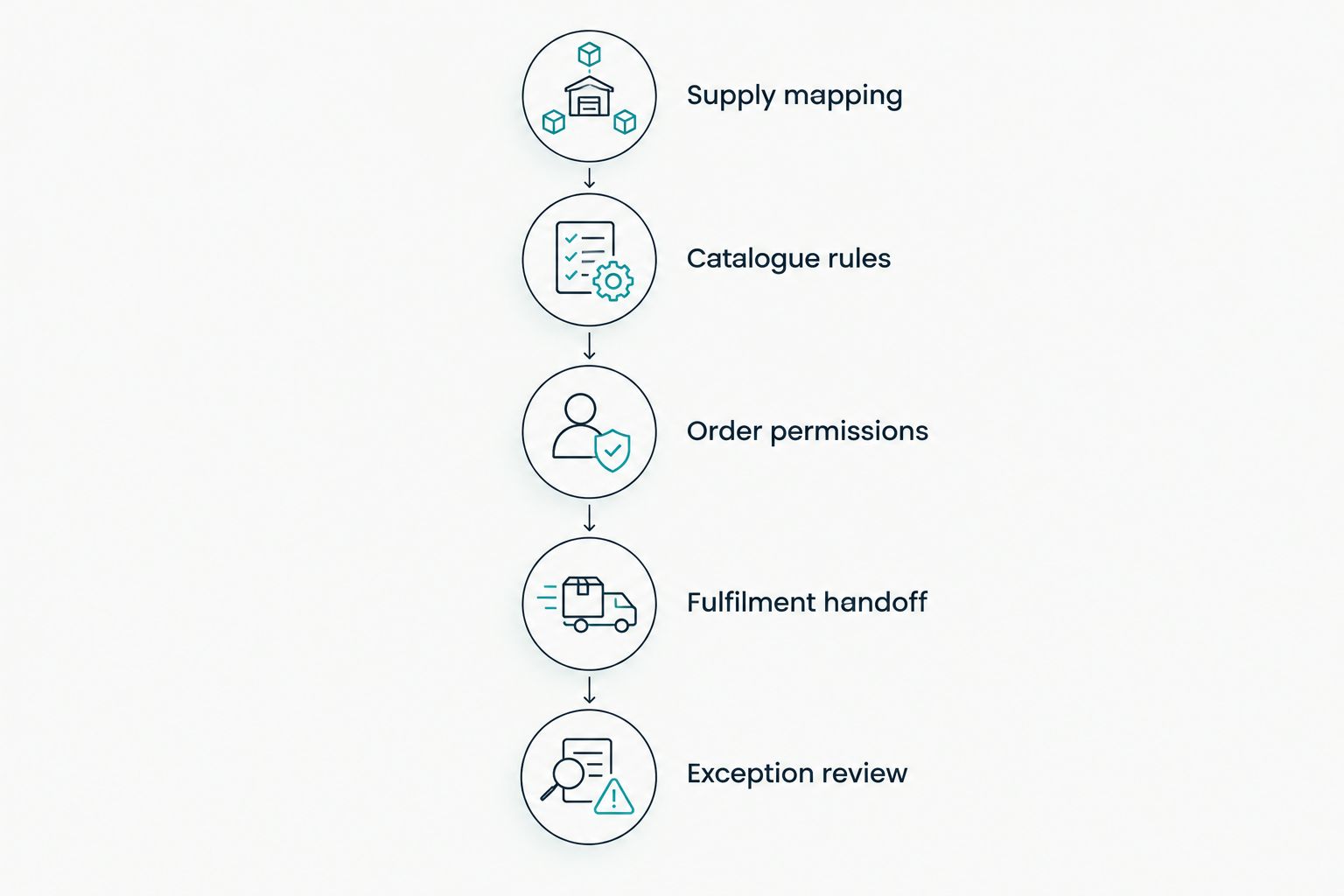
1. Supply mapping
List the roles, locations, approved garments and delivery destinations involved in your uniform programme. Identify who owns the manufacturing specification and who decides when a garment can be replaced.
Separate a purchasing problem from a supply problem. An order form cannot resolve an unclear garment specification, and a production agreement does not establish who can approve a store request.
2. Catalogue rules
Define what each role or location should see and order. Include how the process handles retired items, replacement garments and a request for something outside the approved range.
Use your own garment descriptions in the demonstration. Ask the provider to show how a catalogue change reaches users and how existing orders retain the information needed for fulfilment.
3. Order permissions
Specify who can place, approve, amend and cancel a request. These are separate permissions; treating them as one general administrator role leaves the purchasing boundary unclear.
Test an absent approver and a change of store manager. You need an agreed way to reassign responsibility without sharing accounts or losing the history of the request.
4. Fulfilment handoff
Follow an approved order into the physical supply process. Confirm which information accompanies it, which party accepts it and how a store learns that the request has moved to the next stage.
Do not accept an order confirmation as proof of dispatch. Ask the provider to distinguish the statuses your users will see and explain who updates them.
5. Exception review
Run a size correction, a destination change and a replacement request through the proposed process. Record where intervention is required and which person has authority to act.
A useful demonstration ends with ownership, not just a success screen. For each exception, you should know who receives it, what information they need and how the requester sees the resolution.
How do you prove that the platform is worth the change?
Compare the proposed process with your existing process using the same order scenarios. Record manual interventions, corrections, approval handling and status enquiries rather than asking users whether the new interface feels better.
Use records from your own operation for the baseline. Keep routine orders and exceptions separate so an easy checkout does not conceal work that has simply moved to another team.
Your 2026 approval document should identify which tasks disappear, which become controlled and which remain manual. Assign an owner to the remaining work, including catalogue maintenance and account administration.
Approve the change for a demonstrated operational improvement, not an assumed saving. If the provider cannot show how a stated problem changes, leave that benefit out of the business case.
Can a uniform ordering platform replace your uniform supplier?
A uniform ordering platform does not replace design, manufacturing or distribution unless those services are explicitly included in the agreement. Ordering software manages requests; physical supply still needs an accountable provider.
If your existing supplier remains involved, document the handoff between the platform and that supplier. Resolve who corrects rejected orders and who informs the store before launch.
Is a dedicated platform necessary for every retail chain?
A dedicated platform is not necessary when central purchasing can reliably control the approved range, authorise requests and track fulfilment with the current process. Multiple locations alone do not establish the need.
Make the decision around unresolved work. If the actual problem is an unclear replacement policy, write the policy before asking software to enforce it.
Should stores order directly or through head office?
Stores should order directly only within purchasing rules that head office has defined and assigned someone to maintain. Requests outside those rules need a visible approval route.
Central ordering remains appropriate when the buyer must review the reason for each request. The platform decision should follow that authority model, not determine it by default.
FAQ
What's the clearest sign that a uniform ordering platform is worth it?
A uniform ordering platform is worth evaluating when routine orders repeatedly need manual checks against the same purchasing rules. Test whether the proposed system applies those rules and routes exceptions to an accountable owner.
Is a spreadsheet enough for a multi-location uniform programme?
A spreadsheet is enough when a named owner can reliably maintain the approved range, review requests and communicate fulfilment status. Replace it because those controls fail or create unresolved work, not simply because the retailer has multiple stores.
Can stores have different uniform catalogues?
Different store catalogues should be an explicit demonstration requirement if your retail operation needs them. Ask the provider to show catalogue assignment, updates and handling of requests outside the approved range.
Who should own employee uniform ordering data?
Your retailer should name an accountable owner for employee ordering data before launch. Define who updates roles, location assignments and access, including what happens when an employee leaves.
Does Boolanga provide software as well as uniforms?
Boolanga provides software alongside design, manufacturing and distribution for branded workwear, uniforms, courier gear and merchandise. Confirm the specific ordering functions and responsibilities required by your retail programme during evaluation.
Should a uniform platform connect to employee systems?
Evaluate an employee-system connection when your ordering rules depend on employee or role data. Require the provider to demonstrate the proposed data exchange and agree how errors and access changes are handled.
What should a retailer check before launching uniform ordering software?
Check catalogue rules, purchasing permissions, delivery information and exception ownership before launch. Test ordinary requests and corrections with the people who will administer the live process.
One last thing
Your most revealing test is an order that should not proceed unchanged. Ask a store user to request an unapproved garment, then follow the result through approval and fulfilment.
If nobody can explain who stops or resolves that request, the process is not ready. Fix the decision boundary before digitising the order.


