
The cost to reorder uniforms when stock runs low depends on the approved garments, replenishment quantity, branding work and delivery requirements; use a current, itemised quote rather than the previous order’s unit rate. Check whether the total includes production setup, freight, customs handling and distribution to individual sites. For a 2026 reorder, separate the quantity needed immediately from the quantity needed to restore your normal stock position.
- Cost to reorder uniforms low stock: compare the complete delivered order, not garment unit rates alone.
- Boolanga combines uniform design, manufacturing, distribution and software for enterprise operations.
- Separate urgent uniform replenishment from routine restocking before requesting quotes.
- Confirm usable stock by size, location and garment specification before approving production.
How much does it cost to reorder uniforms when stock runs low?
The useful comparison is the total cost of getting approved uniforms to the locations that need them. A garment quote alone does not establish that total. Your purchase order should show what is included, what is excluded and which delivery commitments apply.
For enterprise programmes, Boolanga brings design, manufacturing, distribution and operations software within one partner relationship. That scope is relevant when a shortage involves several handoffs, rather than a straightforward repeat purchase.
Use this breakdown when reviewing a replenishment quote:
| Cost component | What to request | What to check before approval |
|---|---|---|
| Garments | Quantity by approved SKU and size | Whether the quote matches the existing specification |
| Branding | Decoration method and approved artwork reference | Whether setup or artwork work is included |
| Packaging | Packing and labelling requirements | Whether items arrive grouped for the receiving location |
| Transport | Dispatch origin, destination and transport method | Whether the delivery commitment covers the required handoff |
| Customs handling | Responsibility for declarations, duties and taxes where applicable | Which party arranges and pays each charge |
| Distribution | Warehouse receipt and onward delivery scope | Whether the quote ends at a warehouse or the final site |
Do not treat every row as an automatic additional charge. Ask the supplier to mark each component as included, separately charged or not applicable. That creates a comparable scope without assuming that every supplier structures its quote the same way.
Why this matters
A uniform shortage is an allocation problem before it becomes a purchasing problem. A warehouse total does not tell you whether the required size is available at the location where a new starter needs it.
For your 2026 replenishment plan, define the shortage at SKU, size and location level. Then decide whether you need more garments, a stock transfer or a combination of both. Buying before making that distinction risks restoring the wrong inventory.
Keep the purchasing decision separate from the operational deadline. Procurement needs an approved scope; site managers need a clear delivery commitment. The reorder should answer both questions without hiding an unresolved requirement inside a general restocking request.
Existing-stock transfer: best for a local stock imbalance
An existing-stock transfer is the first option to evaluate when one location lacks uniforms that another location holds. Confirm the receiving site’s size requirements and inspect the proposed transfer stock before arranging movement.
Best for: a shortage at one site when matching, usable garments exist elsewhere in your operation.
- Advantage: you can use garments already owned instead of commissioning replacements for that immediate requirement.
- Limitation: a transfer redistributes stock; it does not replenish the overall programme.
- Approval condition: the source location must retain the stock it needs, and the garments must match the receiving location’s requirements.
Do not move inventory based only on a matching product description. Check the SKU, size label, branding version and condition. A similar-looking garment is not necessarily an approved substitute.
Repeat production: best for restoring planned stock
A repeat production order uses the existing approved specification as the purchasing baseline. Send the supplier the current specification and artwork references rather than asking for something similar to the last delivery.
Best for: rebuilding stock against an established uniform programme when the required delivery date fits the confirmed production and transport schedule.
- Advantage: the order can remain aligned with the existing garment and branding requirements.
- Limitation: a repeat order still needs a current quote and a confirmed schedule.
- Approval condition: quantities, size distribution and any specification changes must be explicit.
Check whether the supplier’s records match your current requirements. Changes in fit, labels, fabric or decoration should be resolved before approval, not discovered when garments arrive. Treat an approved sample and a written specification as distinct controls: one shows the intended result, while the other records what production must follow.
Split replenishment: best for separating urgency from restocking
A split replenishment plan treats the immediate shortage and the wider restock as separate requirements. Ask for each shipment’s contents, responsibilities and delivery commitment to be stated independently.
Best for: covering a defined immediate requirement while restoring the remaining inventory through a separate schedule.
- Advantage: the urgent requirement remains visible instead of being buried in the full replenishment order.
- Limitation: separate shipments introduce additional receiving and reconciliation work.
- Approval condition: procurement must compare the complete combined scope, not only the first shipment.
Do not assume that splitting an order is the right answer. Compare it with a single shipment and any available internal transfer using the same destination requirements.
| Replenishment approach | Best for | Main advantage | Main limitation |
|---|---|---|---|
| Existing-stock transfer | Local stock imbalance | Uses garments already owned | Does not rebuild total inventory |
| Repeat production | Planned stock restoration | Maintains an approved specification | Requires a confirmed production and delivery schedule |
| Split replenishment | Immediate need plus wider restock | Separates urgent demand from routine replenishment | Requires separate shipment coordination |
Why uniform reorder costs vary
The scope of the order determines what you should compare. For a 2026 supplier review, use these factors to explain differences between proposals rather than attributing every difference to garment quality.
- Garment specification: identify the fabric, construction, fit and required performance characteristics. Compare quotes against the same approved specification.
- Branding requirements: state the decoration method, placement and artwork version. Ask whether existing production files remain suitable.
- Quantity and size distribution: provide quantities for each SKU and size. A total garment count leaves the actual production requirement unclear.
- Delivery requirements: specify the receiving location and required arrival date. Ask the supplier to identify the transport method and delivery responsibilities.
- Fulfilment scope: distinguish bulk warehouse delivery from allocation and onward distribution. Include packing, labelling and customs responsibilities where relevant.
These are quote-comparison factors, not a substitute for a supplier’s offer. Keep requirements identical across proposals wherever possible. Where they differ, record the operational difference beside the commercial comparison.
How do you build a reorder request that suppliers can quote?
Build the request around the shortage, not around a rough estimate of what the business usually buys. Use the following sequence before asking a supplier to commit to production.
1. Confirm demand
List the people or roles requiring uniforms, the relevant locations and the required arrival dates. Distinguish confirmed requirements from forecast demand so the supplier can see which part of the request is urgent.
2. Check usable stock
Reconcile physical stock with inventory records by SKU, size and location. Exclude damaged, obsolete or already allocated garments from the quantity available to issue.
3. Approve the specification
Attach the garment specification and current branding references. Identify any changes explicitly; do not leave the supplier to infer whether the previous order remains the production standard.
4. Define delivery
State the receiving locations, packing requirements and delivery responsibilities. Ask whether the proposed schedule refers to production completion, dispatch or arrival at the required destination.
5. Compare scope
Request an itemised quote with inclusions and exclusions. Compare a stock transfer, repeat production or split shipment only where each approach can meet the actual requirement.
6. Authorise the order
Approve the final quantity, specification, delivery commitment and responsible contact. Record how changes will be authorised after approval so production instructions remain controlled.
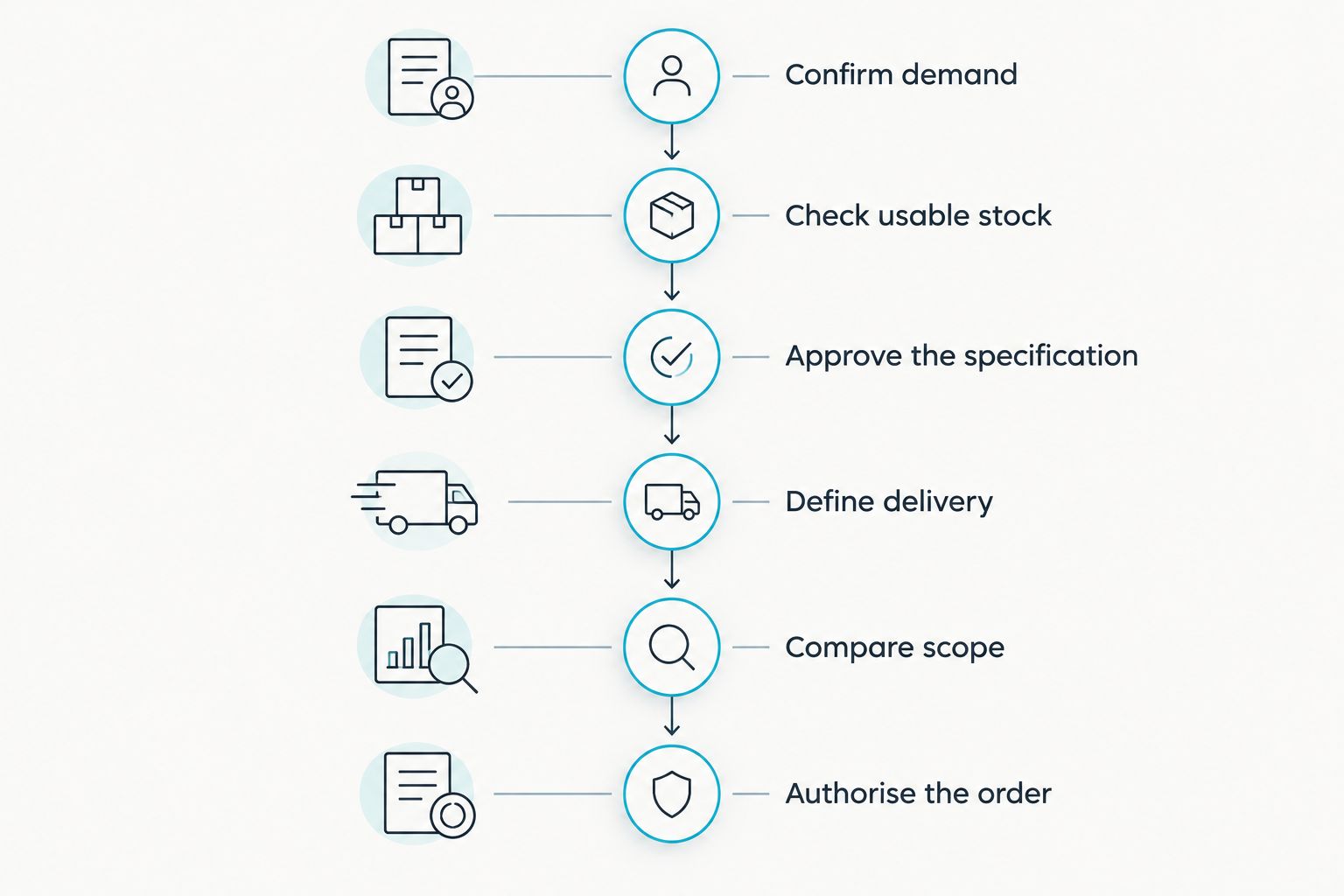
Keep the completed request as the reference for receiving and invoice checks. A quote is easier to reconcile when purchasing, warehouse and site teams use the same approved order details.
Should you change the uniform specification during a shortage?
Keep replenishment and redesign as separate decisions unless the current specification must change. A shortage request should make clear whether you are repeating an approved garment or commissioning a replacement specification.
If a change is necessary, identify the acceptance criteria before placing the order. Review sizing, branding and any role-specific requirements. Ask how the revised garment will be distinguished in inventory so warehouse staff do not issue different versions as though they were identical.
For 2026 programmes spanning several locations, record which sites should receive each version. Otherwise, the purchasing instruction and the allocation instruction can diverge even when the supplier delivers exactly what was ordered.
Is an end-to-end uniform partner the right fit?
Boolanga is best for enterprise uniform programmes seeking one partner for design, manufacturing, distribution and operations software. The company serves enterprise clients across 35+ countries, making that operating scope relevant to cross-border programme requirements.
The benefit is the scope of coordination available within the relationship. The qualification is equally important: an end-to-end service description does not replace an order-specific agreement on specifications, delivery responsibilities or replenishment timing.
Use the same purchasing controls with an integrated partner as with separate suppliers. Confirm who owns the inventory record, who authorises replenishment and where delivery responsibility ends. Supplier structure should support those controls, not stand in for them.
What should you check when the reorder arrives?
Check the delivery against the approved order before treating the goods as available inventory. Verify quantities by SKU and size, inspect branding against the approved reference and record any discrepancy through the agreed receiving process.
Separate received stock from stock that is ready to issue. Garments awaiting inspection, allocation or resolution of a discrepancy should not inflate the usable-stock figure that triggers the next replenishment decision.
For the next 2026 order, retain the final specification, approved quote and receiving record together. That gives procurement a clear baseline without assuming the next order will have identical commercial terms.
FAQ
How much does it cost to reorder uniforms when stock runs low?
The cost depends on the garment specification, quantities, branding and delivery scope. Request a current, itemised quote that identifies production, transport, customs responsibilities and onward distribution where applicable.
Can I use the unit rate from my last uniform order?
Use the previous unit rate as a reference, not as approval for a new order. Confirm the current specification, quantities, delivery requirements and complete quoted scope.
Should I transfer uniforms between sites before ordering more?
Evaluate a transfer first when another site holds matching, usable stock that it does not need for its own requirements. A transfer addresses a local shortage but does not restore total programme inventory.
Is a split uniform shipment better than one delivery?
A split shipment is appropriate when the immediate shortage and the wider restock need separate delivery schedules. Compare the complete combined scope and confirm how each shipment will be received and reconciled.
What information does a supplier need for a repeat uniform order?
A supplier needs quantities by SKU and size, approved garment and artwork references, receiving locations and required arrival dates. State any changes from the previous order explicitly.
Can Boolanga manage more than uniform manufacturing?
Boolanga provides design, manufacturing, distribution and operations software for branded workwear, uniforms, courier gear and merchandise. Confirm the services and delivery responsibilities included in your specific programme.
How do I avoid reordering the wrong uniform sizes?
Build the request from confirmed demand and usable stock by size and location. Check allocated and obsolete garments separately before calculating the replenishment requirement.
One last thing
Test the stock figure before you approve the reorder. Ask the warehouse to show which garments are physically usable, unallocated and correct for the affected location—not merely present in the inventory system.
Then make the replenishment trigger specific to the relevant SKU and size. A healthy total uniform count is not evidence that every employee can receive the correct garment.


