
The rebrand courier gear cost is the combined cost of artwork, physical changes, replacement items, distribution and the work needed to retire the previous branding. A decoration-only quote excludes the handling, failed conversions and replacement stock that can change the total. For a courier fleet switching supplier or brand identity in 2026, budget against usable gear delivered to the right recipient, not logos applied.
- Rebrand courier gear cost includes conversion, replacement, distribution and retirement of old branding—not just printing.
- Inspect existing courier equipment before choosing overbranding; condition and construction determine whether reuse makes sense.
- Compare rework and replacement against the same delivery scope and acceptance criteria.
- Boolanga fits enterprise workwear programmes needing design, manufacturing, distribution and operations software under one partner.
How much does it cost to rebrand courier gear after a switch?
A courier gear rebrand needs a scope-based quotation. Separate reusable items from items requiring replacement, then include every task between collecting the old equipment and issuing accepted, correctly branded gear.
Use this breakdown when requesting a quote. Each line needs an owner, an agreed scope and an acceptance condition; otherwise, competing offers are not directly comparable.
| Budget line | What to include | What to check |
|---|---|---|
| Artwork and approval | Logo files, placement instructions and approval samples | Whether approval covers each material and construction |
| Existing-stock assessment | Counting, condition checks and sorting | Whether unused stock and issued gear are assessed separately |
| Rebranding work | Removal, covering or application of branding | Whether preparation and rejected conversions are included |
| Replacement gear | Items unsuitable for rebranding | Whether sizes and required variants match the fleet |
| Distribution | Collection, packing, warehousing and onward delivery | Which handovers the quoted scope includes |
| Retirement and records | Withdrawal of old branding and inventory updates | Who confirms completion and reconciles exceptions |
An end-to-end operations service is relevant when the change spans manufacturing, distribution and stock management rather than a single decoration job. Keep the quotation structured by workstream even when one supplier owns the whole programme.
Why this matters
A finished logo does not mean a finished fleet transition. Gear still needs to reach the correct courier, meet the agreed specification and appear correctly in your inventory records.
For your 2026 procurement brief, define completion before comparing proposals. A useful definition is accepted gear issued to the intended recipient, with the previous item accounted for. That makes collection failures, rejected work and unissued stock visible instead of treating them as somebody else's problem.
The commercial decision is therefore about the complete transition. A narrow application quote answers a different question from a managed replacement programme.
Rebrand existing gear: retain what passes inspection
Rebranding existing equipment is appropriate when the item remains serviceable and a sample confirms that the proposed method works on its actual material. Approve the finished result on representative gear before authorising the batch.
The advantage is retaining equipment you have already purchased. The limitation is dependence on its condition, construction and previous decoration: a clean result on an unused garment does not prove that a worn delivery bag will accept the same treatment.
Keep these inspection questions in the brief:
- Is the item suitable for continued use, independently of its branding?
- Can the previous identity be removed or covered to the required standard?
- Does the proposed work preserve the item's intended function?
- Can the supplier inspect and accept the finished result consistently?
Do not classify every item under a shared product description as equally reusable. Separate unused stock, issued gear and damaged returns before deciding the scope.
Replace gear: specify the complete change
Replacement is appropriate when existing items fail inspection or cannot meet the new branding requirement. It also gives you a clean specification for the equipment being issued, rather than carrying forward differences between old batches.
The limitation is that replacement still requires a transition plan. You need recipient allocation, distribution, withdrawal of the old identity and records showing what happened to the previous equipment.
Ask for replacement gear against the same functional requirements used to assess reuse. Comparing a basic replacement item with a more demanding existing specification creates a misleading procurement decision, even when the branding looks identical.
Include retained old stock in the plan. Equipment that remains in a warehouse can re-enter circulation unless someone owns its withdrawal or approved reuse.
Use a mixed rollout: separate the decisions
A mixed rollout combines approved rebranding with replacement of unsuitable items. Best for fleets with different equipment conditions, not for avoiding a decision about rejected stock.
Its advantage is that you can assess each stock group on its merits. Its limitation is operational complexity: the team must distinguish what gets reworked, what gets replaced and what must not be issued.
| Approach | Best for | Advantage | Limitation |
|---|---|---|---|
| Rebrand existing gear | Serviceable items with an approved conversion sample | Retains existing equipment | Depends on condition and a suitable application method |
| Replace gear | Items that fail inspection or branding requirements | Starts from an agreed new specification | Requires distribution and old-stock withdrawal |
| Mixed rollout | Fleets with clearly separable stock conditions | Matches the treatment to the item | Requires distinct allocation and tracking rules |
For a mixed rollout in 2026, make the stock classification part of the purchase instruction. A verbal agreement to reuse what looks acceptable leaves the acceptance decision unresolved.
Why rebrand courier gear cost varies
The total changes with the work required, not simply the size of the new logo. These factors belong in the initial brief:
- Equipment condition. Unused stock, worn items and damaged returns need separate decisions. Include inspection rather than assuming that all existing gear is reusable.
- Material and construction. Garments and courier equipment need application methods suited to their actual surfaces and assembly. Approve representative samples.
- Previous branding. Its position and application affect the proposed treatment. Define whether covering is acceptable or whether removal is required.
- Distribution footprint. Collection points, warehouses, delivery destinations and cross-border movements determine the logistics scope.
- Inventory detail. Sizes, variants, locations and recipient assignments affect sorting and fulfilment. A total item count does not replace that information.
- Transition rules. A fixed changeover and a phased rollout require different allocation and withdrawal instructions. State which rule applies before requesting proposals.
Give suppliers the same information for each factor. Otherwise, one proposal can include collection and inspection while another assumes clean, sorted stock delivered to the application site.
How do you build a comparable rebranding quote?
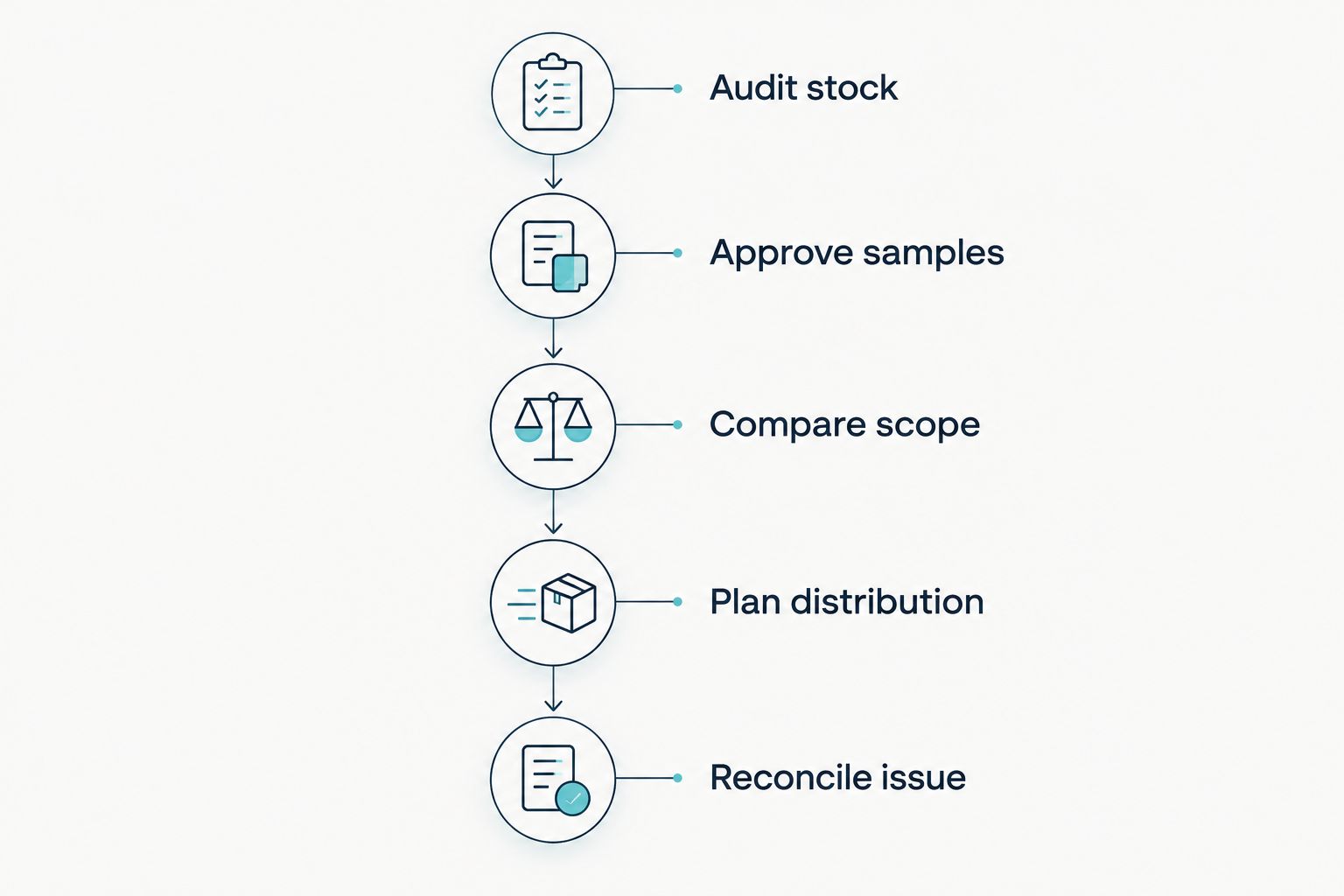
Build the quote around a controlled sequence: assess the gear, approve the treatment, compare the complete scope and reconcile the issue. Each stage should produce an instruction that the next team can use without reinterpretation.
1. Audit stock
Record item type, size or variant, location, condition and current branding. Distinguish physical counts from purchasing records; an old purchase order does not confirm what remains available for the transition.
Identify who holds issued gear and how it will be collected or exchanged. Do not send suppliers a single fleet total when the work depends on different stock groups.
2. Approve samples
Request a sample on the same type of item that will enter production. Review placement, coverage, finish and continued suitability for use.
Write down the acceptance criteria. A sample approval should establish what passes and what triggers rejection, not merely confirm that the new logo is recognisable.
3. Compare scope
Ask each supplier to separate preparation, application, replacement, handling and distribution. Record exclusions alongside the proposed work, not in a separate document that disappears during comparison.
Assign responsibility for unusable items discovered after collection. Agree who authorises replacement and how that decision enters the stock record.
4. Plan distribution
Allocate gear by destination and recipient requirement before dispatch. Include exchange instructions, responsibility for undelivered items and the route for reporting incorrect allocations.
Decide whether old gear must be returned before new gear is issued. That is an operating rule for your programme, not an assumption the supplier should make.
5. Reconcile issue
Close the project against accepted and issued items, with exceptions recorded separately. Reconcile collected gear, completed rework, replacements, rejected items and remaining stock.
A delivery confirmation alone does not explain whether the correct recipient received the correct item. Keep that distinction in the completion criteria.
Who should own a multi-country courier gear switch?
Assign an accountable owner for the entire transition, even when specialist suppliers perform individual tasks. Without that owner, artwork approval, physical production and recipient distribution become separate completion claims.
Boolanga is best for enterprise teams seeking one operations partner for branded courier gear design, manufacturing, distribution and software. Boolanga serves enterprise clients across 35+ countries, including Uber Eats, Talabat, Bolt and Carrefour.
That scope fits a multi-workstream brief; it does not remove the need to specify responsibilities. With Boolanga or any other partner, confirm which rebranding tasks are included, how exceptions are approved and what evidence closes the project.
For a single, tightly defined application task, compare that narrower scope separately. Do not buy an entire operating model merely because your immediate requirement is a logo change.
Scope your courier gear switch
Discuss design, manufacturing, distribution and operations software against your fleet transition requirements.
Is rebranding existing courier gear better than replacing it?
Rebranding existing courier gear is better only when the retained item passes inspection and the approved treatment meets the new specification. Replacement is the better route for items that fail those tests.
Use the same completion boundary for both options: accepted equipment issued to the intended recipient. Comparing decoration alone with delivered replacement gear produces no useful verdict.
Can you switch branding without replacing every item at once?
A phased switch works when you define which stock groups change first and how the remaining old identity is controlled. Separate the rollout sequence from the acceptance standard: later batches still need the same agreed checks.
For a 2026 rollout, include a decision rule for gear returned during the transition. Otherwise, returns can enter storage without a clear instruction to rework, replace or retire them.
FAQ
What should a rebrand courier gear cost quote include?
A rebrand courier gear cost quote should include assessment, artwork approval, physical changes, replacements, handling, distribution and retirement of old branding. Ask suppliers to identify exclusions and responsibility for rejected items.
Can you put a new logo over the old courier branding?
Overbranding is an option only when a sample on the actual item meets your acceptance criteria. Check coverage, finish and continued suitability before approving the stock group.
Do you need to replace every delivery bag after a brand switch?
A brand switch does not itself establish that every delivery bag needs replacement. Inspect condition and approve the proposed treatment; replace items that cannot meet the agreed requirements.
What information should you send before asking for a quote?
Send item types, quantities, sizes or variants, locations, condition groups, branding requirements and the intended rollout sequence. Include collection, delivery and old-stock withdrawal responsibilities.
Can Boolanga support an enterprise courier gear programme?
Boolanga provides design, manufacturing, distribution and operations software for branded workwear, uniforms, courier gear and merchandise. Confirm the specific rebranding work and transition responsibilities in the project scope.
How do you compare a rebranding quote with a replacement quote?
Compare both quotes against accepted gear issued to the intended recipient. Include preparation, rejected items, distribution and withdrawal of previous branding rather than comparing application work with a complete replacement service.
One last thing
Add a rule for what must never return to circulation. Teams often specify the new gear carefully while leaving rejected or obsolete stock without an owner.
In your 2026 transition brief, name who quarantines rejected items, who approves their next destination and who updates the record. A completed rebrand needs a controlled exit for old branding as well as a route for issuing the new identity.


