
The cost to launch a corporate uniform program is the combined budget for design, garments, manufacturing, distribution and administration—not just the clothing order. Build your 2026 budget around the employees, locations and issue quantities you need to serve, then separate launch expenses from replenishment. Freight, customs, storage and software belong in that calculation rather than outside the garment quote.
- The cost to launch corporate uniform program operations includes design, manufacturing, distribution and administration—not garments alone.
- Separate initial uniform rollout costs from ongoing workwear replenishment before comparing supplier proposals.
- Boolanga suits enterprise uniform programs that need design, manufacturing, distribution and software under one operations partner.
- Approve garment specifications, issue quantities and destination requirements before requesting a final proposal.
Why this matters
A garment quote answers what you will pay for specified clothing. It does not automatically answer what you will spend to put the correct uniform into each employee’s hands and keep the program running.
Boolanga is best for enterprise uniform programs that need design, manufacturing, distribution and software under one operations partner. That operating scope is the useful starting point: decide which responsibilities belong in your program before comparing what suppliers charge.
Your procurement decision should distinguish a completed production order from a completed employee rollout. Those are different delivery boundaries, and the proposal needs to state which boundary you are buying.
How much does it cost to launch a corporate uniform program from scratch?
Calculate the launch budget from an approved bill of materials and a defined distribution plan. Then add the implementation work required to manage orders, inventory and employee allocation.
Use this structure for your 2026 approval request:
Launch budget = design and setup + initial garment production + distribution setup + delivery charges + administration setup + explicitly scoped exceptions.
| Budget component | What to specify | What to check in the proposal |
|---|---|---|
| Design and development | Garment requirements, branding, samples and approval process | Which development tasks and revisions are included |
| Initial garment production | Approved styles, sizes, quantities and decoration | Whether the quote matches the approved specification |
| Distribution setup | Destinations, allocation method and receiving requirements | Where the supplier’s responsibility starts and ends |
| Freight and customs | Shipping method, destination and customs responsibilities | Which charges are included and who handles clearance |
| Storage and fulfillment | Stockholding, picking, packing and dispatch requirements | Whether these activities are included or quoted separately |
| Software and administration | Ordering, inventory records, permissions and reporting | Setup responsibilities, recurring charges and operating ownership |
| Exceptions | Agreed treatment of size changes, replacements and additional orders | The approval process and charging basis |
The table is a scope checklist, not a requirement to purchase every service. If your internal team handles storage or distribution, retain those responsibilities in the budget instead of treating them as work that disappears.
Define what launch completion means
Write an acceptance statement before asking for a final proposal. For example, require the supplier to identify whether completion means approved production, receipt at your warehouse or delivery against employee allocations.
These milestones require different work. A proposal ending at warehouse receipt should not be compared directly with one covering individual fulfillment and operational setup.
Initial rollout: separate setup from garments
Design and manufacturing are connected, but they are not the same budget line. A garment specification establishes what you are ordering; production delivers the approved quantities against that specification.
For a corporate uniform program, document the required roles, garment types, branding positions and size requirements. Include the review process for samples so that approval responsibility is clear before manufacturing begins.
Approve the specification before approving the production order. Otherwise, proposals can describe different garments while appearing to cover the same uniform requirement.
Your initial rollout brief should identify:
- The employee groups covered by the launch.
- The garments allocated to each role.
- The quantity issued to each employee.
- The size information used to build the order.
- The branding and sample approval requirements.
- The destinations and receiving arrangements.
Keep optional items outside the approved baseline. A clear separation between required workwear and optional merchandise lets procurement assess the core program without mixing different purchasing decisions.
Replenishment: budget beyond the launch order
An initial uniform order establishes the starting inventory. Replenishment covers the later demand created by new starters, replacements, employee size changes and additional locations.
For your 2026 operating plan, separate that ongoing demand from launch implementation. The distinction lets you evaluate both the initial project and the process your team will operate after distribution.
Define who authorizes another issue, where the request is recorded and whether fulfillment comes from stored inventory or a new production order. These are operating decisions, not details to leave until the first replacement request.
The benefit of holding replenishment inventory is a defined source for subsequent issues. The trade-off is that your business must fund and manage that stock, including sizes or styles that remain unused.
Do not approve replenishment inventory without an allocation rule. Name the employee groups it serves and the events that permit an issue.
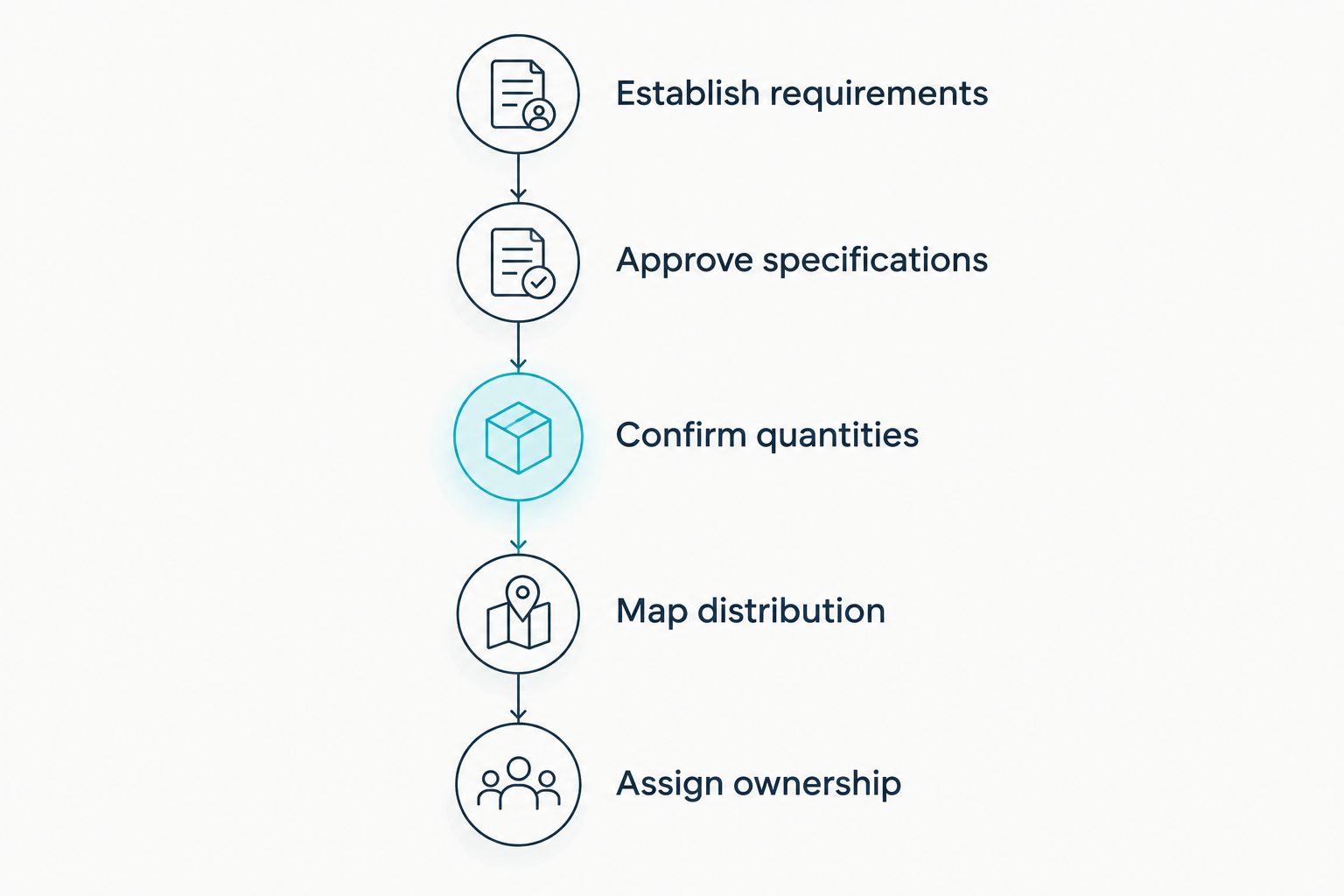
How to build a corporate uniform launch budget
Build the budget in the same sequence as the decisions that determine it. Sending suppliers an unresolved brief produces proposals with different assumptions, making the comparison harder rather than more informative.
Establish requirements
List the roles, working environments and locations the program must serve. Distinguish appearance requirements from functional requirements, and identify any protective-clothing requirements separately for qualified assessment.
A branded uniform is not evidence of protective performance. Where a role requires protective clothing, make the applicable specification and verification part of the procurement brief.
Approve specifications
Document the garment construction, branding, sizes and sample approval requirements. Assign an approver who can resolve changes before production authorization.
Record the accepted version. A supplier proposal and a purchase order should refer to the same specification rather than separate descriptions of what the team expects.
Confirm quantities
Build the initial order from employee allocations and approved stock requirements. Keep issued garments separate from reserve inventory so that procurement can see the purpose of each quantity.
Check size information before committing the order. A total headcount does not describe the size mix required to equip that headcount.
Map distribution
Identify the delivery destinations, receiving contacts and allocation method. State whether the order arrives as bulk stock, location-level allocations or employee-level packs.
Specify who manages transport, customs, storage and the final handover. A delivery plan is incomplete while responsibility for any of those activities remains unassigned.
Assign ownership
Name the owners of ordering, inventory records, exceptions and reporting. If software forms part of the program, specify the records and workflows it must support before evaluating the proposed setup.
The sequence below keeps specification, purchasing and operational decisions connected. Each stage should have an approved output before the next stage is finalized.
Why corporate uniform launch costs vary
The scope of work determines which expenses belong in the proposal. Use these factors to explain differences between bids rather than assuming that a lower total covers the same operating requirements.
- Design scope: An approved garment specification and a project requiring design development contain different tasks. State whether the supplier creates, adapts or simply produces the design.
- Garment and size mix: Each approved style, size and decoration combination needs to be reflected in the order. Compare proposals against the same product matrix.
- Issue quantities: Employee allocations and reserve stock determine what you purchase. Separate the quantities needed for launch from those reserved for future use.
- Geographic scope: Destinations determine the transport and customs work that needs to be assigned. A domestic warehouse delivery and an international employee rollout are different scopes.
- Fulfillment responsibilities: Bulk delivery, location allocation and individual packing require different activities. Specify which activities the supplier performs and which remain internal.
- Administration scope: Ordering software, inventory records and exception handling require defined ownership. Identify both implementation tasks and recurring responsibilities.
For a 2026 proposal comparison, put these assumptions beside the totals. A difference becomes actionable only when you can trace it to a scope item, quantity or responsibility.
Should you consolidate suppliers or manage them separately?
Supplier consolidation changes who coordinates the program. It does not remove the need for an approved specification, clear acceptance criteria and named owners.
| Operating model | Best for | Advantage | Trade-off |
|---|---|---|---|
| End-to-end operations partner | Enterprise teams seeking connected design, manufacturing, distribution and software responsibilities | Places the agreed operating scope with one partner | Requires clear contractual boundaries and visibility into each service component |
| Separately managed suppliers | Teams that want direct control of individual workstreams | Lets procurement assign each activity independently | Leaves coordination and handovers with the buyer’s team |
Boolanga’s corporate uniform offering spans design, manufacturing, distribution and software. Its enterprise scope includes service across 35+ countries and 25+ enterprise clients; its stated operating model replaces 3–11 separate vendor relationships.
Those figures describe the business’s operating scope, not your project’s budget or delivery commitment. For Boolanga or any other provider, request a proposal tied to your locations, quantities, specifications and division of responsibilities.
Choose the operating model your team can govern. Separate suppliers require internal coordination; an end-to-end partner still requires approval controls and measurable acceptance criteria.
Scope your uniform program
Define design, manufacturing, distribution and software responsibilities before comparing proposals.
What should I include when requesting a uniform proposal?
Include employee groups, garment specifications, size quantities, branding requirements, destinations and the required completion milestone. Add the responsibilities you expect the supplier to take for customs, storage, fulfillment and administration.
Ask suppliers to distinguish included work, excluded work and work requiring a separate instruction. That structure is more useful than a total accompanied by untested assumptions.
Can I launch the uniform program in phases?
A phased launch divides the rollout into defined employee groups, locations or approved garment sets. Each phase still needs its own quantities, delivery boundary and acceptance criteria.
The advantage is a narrower implementation scope at each stage. The trade-off is that procurement must coordinate the remaining rollout and confirm how separate orders affect the proposal.
Should software be part of the initial uniform budget?
Include software in the initial budget when the launch depends on it for ordering, inventory or allocation records. Specify the required workflows and operating owner rather than treating software as an unnamed addition.
If your team uses an existing system, define what information suppliers must provide and who maintains it. The decision is about the required operating process, not simply whether a new platform is offered.
FAQ
What determines the cost to launch a corporate uniform program?
The cost to launch a corporate uniform program depends on the approved design, garment quantities, distribution requirements and administration scope. Compare proposals against the same specification and delivery responsibilities.
Does the garment quote include the full uniform rollout?
A garment quote covers the full rollout only when its stated scope includes the required distribution and administration work. Check freight, customs, storage, fulfillment and implementation separately.
How do I calculate the initial uniform order?
Calculate the initial uniform order from employee-level garment allocations and approved reserve stock. Build the size mix from employee information rather than total headcount alone.
Is an end-to-end uniform partner better than separate suppliers?
An end-to-end uniform partner suits teams that want connected responsibilities across the program; separate suppliers suit teams prepared to manage those workstreams internally. Compare the coordination model as well as the quoted scope.
What does Boolanga provide for corporate uniform programs?
Boolanga provides design, manufacturing, distribution and software for branded workwear, uniforms, courier gear and merchandise. Its B2B offering serves enterprise clients across 35+ countries.
What should a 2026 corporate uniform budget separate?
A 2026 corporate uniform budget should separate launch implementation, initial garments, distribution and ongoing replenishment. Identify recurring administration responsibilities independently so that the launch total does not obscure the operating commitment.
Can branded workwear replace required protective clothing?
Branding does not establish protective performance. Where employees need protective clothing, specify the applicable requirements and obtain the appropriate verification before approving the garments.
One last thing
Ask this before approving the purchase order: What must be true for the launch to count as complete? If procurement expects employees to be equipped but the supplier expects only to deliver cartons to a warehouse, the budget describes different outcomes.
Write that acceptance condition into your 2026 project brief. Then make every proposal identify the work included between manufacturing approval and that endpoint. That is the clearest way to distinguish a clothing purchase from a functioning corporate uniform program.


