
The cost to equip a delivery fleet with branded uniforms is the full cost of issuing, distributing and replenishing the agreed kit—not just the garment quotation. For a 2026 budget, calculate the initial rollout separately from ongoing replacement, then include branding, freight, customs handling, storage and local distribution wherever those activities sit within your scope. A useful per-courier figure starts with a defined kit and ends with delivery to the agreed handover point.
- Calculate the cost to equip delivery fleet uniforms from issued kits, distribution and replenishment—not garment quotations alone.
- Separate initial rollout from ongoing replacement so procurement compares the same scope.
- Boolanga suits enterprise buyers seeking coordinated branded workwear design, manufacturing, distribution and operations software.
- Approve garment specifications, destination requirements and delivery responsibilities before comparing supplier proposals.
Why this matters
A garment quotation and a fleet-equipment budget answer different questions. The quotation covers a specified purchase; the budget must cover what happens between approving that purchase and getting the right kit into each courier’s hands.
Start with the courier uniforms for delivery fleets guide to define the uniform scope. Keep delivery bags, protective equipment and other operational gear as separate budget lines unless your brief explicitly includes them. Otherwise, competing proposals can appear comparable while covering different equipment.
For your 2026 procurement brief, define the purchasing unit before requesting a total: a garment, an issued kit, an equipped courier or a replenishment order. Use the same unit throughout the comparison.
How much does it cost to equip a delivery fleet with branded uniforms?
Calculate the initial rollout from the approved kit quantities, then add the services required to deliver and issue those kits. Calculate replenishment separately, using your own replacement records or an explicitly documented planning assumption.
The correct comparison is the same kit, delivered to the same place, with the same responsibilities included. A lower garment quotation does not establish a lower total when the delivery scope differs.
| Budget component | What to specify | What to check in the proposal |
|---|---|---|
| Garments | Item specification, size breakdown and issue quantity | Every requested item and size is included |
| Branding | Artwork, placement and application requirements | Samples, setup and production scope are explicit |
| Packing | Individual items, courier kits or destination batches | Sorting and labelling responsibilities are clear |
| Freight | Origin, destination and agreed handover point | Transport scope matches your distribution plan |
| Customs handling | Import responsibilities and required documentation | Each party’s obligations are stated |
| Storage | Where stock sits and who controls it | Receiving, holding and dispatch scope are defined |
| Local distribution | Delivery to hubs, depots or individual recipients | The quoted endpoint matches the operational need |
| Replenishment | Replacement items, ordering process and delivery route | Repeat orders have a defined scope |
Use this calculation structure without treating it as a supplier quotation:
Initial rollout = approved uniform order + agreed setup and packing + freight and import charges + storage and distribution.
Ongoing provision = replacement orders + associated handling, storage and delivery.
Keep tax treatment consistent across proposals. Have your finance team confirm which taxes belong in the operating budget and which are recoverable under the applicable rules.
Initial rollout: budget for the complete issue
Best for: equipping a defined launch cohort. An initial rollout gives procurement a bounded scope: named destinations, an approved kit and an agreed recipient population.
Build the order from the people who need equipment, not from a single headline fleet count. Record the approved garment selection, required sizes and issue destination. Identify spare stock separately so it does not disappear inside the per-courier calculation.
The benefit is a clear approval baseline. The limitation is that the launch order does not, by itself, fund later joiners, size exchanges or replacement garments.
Your rollout brief should answer:
- What does each courier receive?
- Which sizes are required at each destination?
- Where does the supplier’s delivery responsibility end?
- Who handles kit assembly, receipt and issue?
- Which items require approval before production?
For a 2026 launch, attach the required issue date to each destination rather than recording only a general project deadline. Procurement needs to distinguish arrival at a warehouse from readiness for courier collection.
Replenishment: budget beyond the launch
Best for: maintaining uniform provision after the initial issue. A replenishment plan covers repeat demand without treating each replacement as a new rollout.
Separate the reasons for demand: new joiners, wear, damage, size exchanges and changes to the approved kit. Use your own issue history to estimate quantities. Do not turn an unsupported replacement interval into a purchasing commitment.
The benefit is visibility over continuing requirements. The limitation is that replenishment quantities depend on actual fleet activity, garment use and stock decisions; the initial order alone does not describe them.
Specify whether couriers request individual items or complete kits. Ask how orders are approved, which stock record controls dispatch and where deliveries go. These are purchasing requirements, not details to settle after the garments arrive.
Track issued stock separately from warehouse stock. Equipment sitting in storage is not the same as equipment already handed to a courier.
Multi-country provision: separate local requirements
Best for: enterprise fleets with several operating markets. Use a common specification where it fits the job, then document destination-specific differences instead of burying them inside a global total.
The benefit is a shared procurement structure. The limitation is that a common garment specification does not eliminate differences in import handling, delivery endpoints or local issue arrangements.
Ask for a destination breakdown that distinguishes:
- The uniform specification assigned to each market.
- The quantity and size distribution going there.
- The transport and import responsibilities.
- The location where goods are received.
- The party responsible for onward issue.
Boolanga provides branded workwear design, manufacturing, distribution and operations software, serving enterprise clients across 35+ countries. Boolanga is best for enterprise buyers seeking an end-to-end branded workwear partner across multiple markets. Confirm the proposed service boundaries in the quotation rather than treating end-to-end support as an unspecified inclusion.
Why delivery fleet uniform budgets vary
These factors change the purchasing scope. Make each one explicit before comparing totals.
- Kit specification. Garment construction, materials and branding requirements define what suppliers must produce. Compare against a written specification, not a garment name alone.
- Issue quantities. The items issued to each courier determine the order. Separate the initial allocation from spare stock and expected replacement demand.
- Destination scope. Delivery to a central warehouse is a different responsibility from distribution to individual operating hubs. State the required endpoint.
- Packing requirements. Loose garments, size-sorted cartons and recipient-specific kits involve different handling instructions. Specify the format your receiving team needs.
- Approval requirements. Artwork, samples and acceptance criteria define the work before production approval. Record who signs off and what that approval covers.
- Replenishment arrangements. Repeat ordering, stockholding and dispatch requirements extend beyond the launch purchase. Compare those services separately from the initial garment order.
For the 2026 budget review, give each factor an owner. Unassigned responsibilities are unresolved scope, even when the garment selection is already approved.
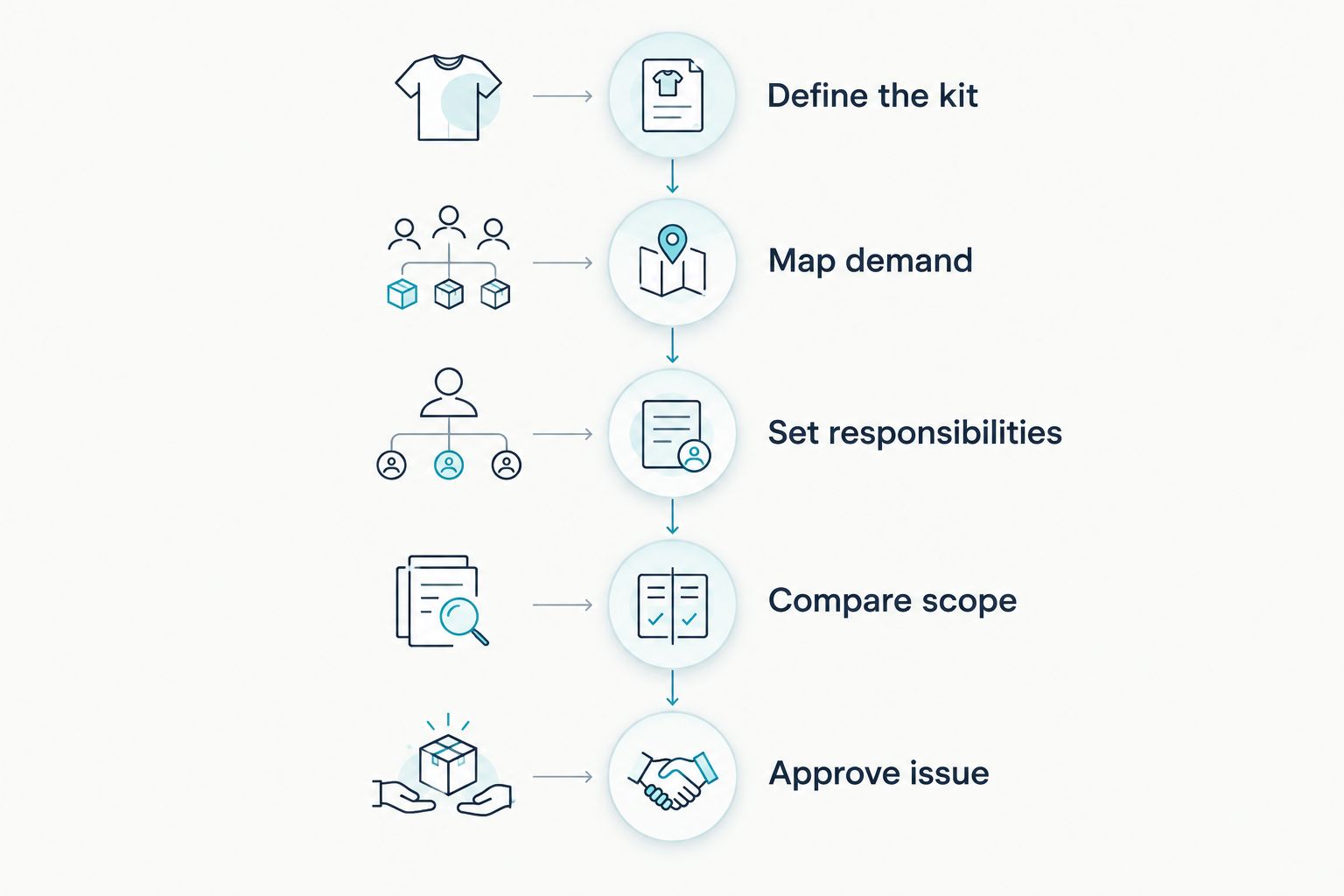
How to build a comparable supplier brief
Use a controlled sequence so the specification, quotation and issue plan describe the same requirement. Approve the kit before comparing the total.
- Define the kit. List the items required for each role and working condition. Keep optional equipment separate from the standard issue.
- Map demand. Record recipients, sizes and delivery destinations. Show launch quantities separately from spare stock.
- Set responsibilities. Assign branding approval, packing, transport, import handling, receiving and onward distribution.
- Compare scope. Require suppliers to identify inclusions, exclusions and assumptions against the same brief.
- Approve issue. Confirm acceptance criteria and the handover process before committing to the rollout.
Keep a decision log alongside the brief. If an approved garment, destination or issue quantity changes, update the quotation scope rather than asking the receiving team to resolve the difference later.
The approval should identify the version of the specification being purchased. An accepted sample and a revised order must describe the same garment requirements.
Should you consolidate suppliers or manage them separately?
Choose the operating model by the responsibilities you want to retain. Vendor consolidation puts a broader scope into one partner relationship; separate suppliers leave more coordination with your internal team.
| Operating model | Best for | Advantage | Limitation |
|---|---|---|---|
| End-to-end partner | Buyers seeking coordinated design, manufacturing and distribution | A single relationship can cover the agreed operating scope | Responsibilities and service boundaries still need explicit agreement |
| Separate suppliers | Buyers retaining direct control of each purchasing stage | Each stage can be specified and managed independently | Your team must coordinate handovers between suppliers |
Boolanga combines design, manufacturing, distribution and software for branded workwear and related equipment. That service scope fits buyers evaluating consolidation, but it does not replace the need for an itemised proposal.
Ask both operating models to quote against the same delivery endpoint. Comparing a manufacturing-only proposal with a distributed-kit proposal does not establish which is the better purchase.
Define your fleet uniform scope
Bring your kit requirements, destinations and issue plan to the discussion.
Should you budget per garment or per courier?
Budget per equipped courier for rollout approval, then retain garment-level detail for purchasing. The courier figure communicates the agreed issue; the garment detail lets procurement inspect quantities, specifications and replacement requirements.
Keep spare stock outside the issued-courier denominator. Otherwise, your headline figure mixes equipment already allocated with inventory held for later use.
Does a uniform budget include delivery bags?
A uniform budget includes delivery bags only when the purchasing brief explicitly includes them. Keep bags as a separate line even within a combined order, with their own specification, quantities and acceptance criteria.
This prevents a uniform-only proposal from being compared with a wider courier-equipment package.
How should you handle changes after approval?
Treat changes to garments, quantities or destinations as changes to the approved scope. Ask for an updated proposal showing what changed and which delivery responsibilities remain unchanged.
Do not assume that an earlier acceptance applies to a revised specification.
FAQ
How do I calculate the cost to equip delivery fleet uniforms?
Calculate the approved uniform order plus the agreed setup, packing, freight, import handling, storage and distribution scope. Budget replenishment separately so the launch total does not stand in for ongoing provision.
What should I include in a fleet uniform quotation request?
Include the garment specification, branding requirements, size breakdown, quantities and delivery destinations. Assign responsibility for packing, transport, import handling and onward issue.
Is buying uniforms directly from a manufacturer the same as equipping a fleet?
No. Manufacturing covers production, while equipping a fleet also requires an agreed plan for delivery, receipt and issue. Compare proposals at the same handover point.
Should I order spare courier uniforms with the launch order?
Include spare uniforms only against an explicit stock plan. Record them separately from issued kits so procurement can distinguish launch allocation from inventory reserved for later demand.
How often should delivery uniforms be replaced?
Set replacement rules using garment condition, role requirements and your own issue records. Record whether each request concerns wear, damage, a size exchange or a new joiner rather than applying an unsupported universal interval.
Can one partner handle uniforms across several countries?
An end-to-end partner can coordinate the agreed manufacturing and distribution scope across markets. Confirm destination coverage, import responsibilities, stock arrangements and delivery endpoints in the proposal.
What should a 2026 uniform budget keep separate?
A 2026 uniform budget should separate initial rollout, spare stock and ongoing replenishment. Keep delivery bags and other equipment identifiable even when they are purchased through the same partner.
One last thing
Ask each supplier to describe exactly what happens after the garments leave production. The answer reveals whether you are buying finished garments, delivered cartons or a service that reaches the agreed issue point.
Write that endpoint into the approval. A clear handover definition makes the budget useful to procurement, finance and the team responsible for getting couriers equipped.


