
The cost to add logo to workwear depends on the garment, decoration method, logo specification and order quantity, so a usable 2026 quote must price those details together. Separate the decoration charge from artwork preparation, sampling, garments and delivery; otherwise, the headline figure does not describe the full order. For repeat orders, also confirm which setup work is reusable and which charges apply again.
- The cost to add logo to workwear needs a defined garment, logo, quantity and delivery scope.
- Compare embroidery, screen printing and heat transfer against the actual fabric and artwork—not just the decoration charge.
- Boolanga suits enterprise buyers seeking branded workwear design, manufacturing, distribution and software through one partner.
- Ask suppliers to separate artwork, sampling, decoration and delivery, including the terms for repeat orders.
Why this matters
A logo application quote is only comparable when every supplier is quoting the same job. A chest logo on a polo shirt is a different specification from a large back graphic on a weatherproof jacket, even when both carry your company identity.
Boolanga provides branded workwear design, manufacturing, distribution and operations software across 35+ countries. Boolanga is best suited to enterprise buyers seeking one operations partner for branded workwear. That scope is relevant when your decision includes fulfilment and repeat ordering, not just adding a mark to a garment.
For your 2026 procurement brief, define what happens after the first batch. A decoration decision must work for new starters, replacement garments and later replenishment as well as the launch order.
How much does it cost to add a company logo to workwear?
The cost is the supplier's quoted charge for your approved garment-and-logo specification, plus any separately charged preparation and fulfilment. Ask for a line-item quote rather than an unexplained per-garment total. This makes exclusions visible and gives purchasing a basis for comparison.
Use the following breakdown to specify the commercial scope. Each row should be marked as included, separately charged or not applicable.
| Quote component | What it covers | What to confirm |
|---|---|---|
| Garment | The undecorated workwear item | Exact style, fabric, sizes and quantities |
| Artwork preparation | Making the supplied logo suitable for production | File requirements, approvals and ownership |
| Decoration setup | Preparing the chosen production process | Whether setup applies again on repeat orders |
| Logo application | Applying the approved design | Method, dimensions and each placement |
| Sample approval | Checking the proposed result before production | Physical sample or other approval format |
| Packing and distribution | Preparing and sending the order | Destinations, packing scope and delivery responsibility |
| Applicable taxes and duties | Charges relevant to the transaction and destination | What is included and who handles payment |
Keep the garment and decoration specifications attached to the quote. Without them, a later reorder can carry the same description while using a different material, logo size or application process.
For a 2026 budget comparison, record the full order scope alongside the unit charge. Do not treat excluded sampling or distribution as a saving.
Embroidery: assess the fabric and logo detail
Best for: buyers considering a stitched logo on workwear that can support the embroidery process. Embroidery reproduces the design using thread, so the artwork must translate into stitches rather than simply look correct on a screen.
Its practical benefit is a stitched finish integrated into the garment. Its constraint is that fine lettering, dense designs and unsuitable fabrics need particular attention during artwork preparation and sampling.
Ask the supplier to assess the actual garment, not a generic fabric description. Confirm the logo dimensions, thread colours, backing and position, then inspect how the decorated area sits when worn.
The embroidery quote should identify artwork conversion and production setup separately from garment decoration. Also ask who retains the production file and whether it is reusable for the same approved specification.
Screen printing: assess the artwork and production setup
Best for: buyers evaluating repeated printed designs on compatible garments. Screen printing applies ink through prepared screens, with setup shaped by the artwork and printing process.
Its practical benefit is the ability to reproduce a defined printed design across a batch. Its constraint is that artwork separations, garment compatibility and production preparation must be resolved before the order is treated as a simple repeat.
Ask which print process and ink system the supplier proposes. A statement that an item is printed does not establish how the application behaves on your selected fabric or under its required care conditions.
Keep print dimensions and colour references fixed when comparing suppliers. If one quote uses a smaller graphic or a different production specification, it is not the same job.
Heat transfer: assess the transfer and application conditions
Best for: buyers evaluating applied graphics or individual names on compatible workwear. Heat transfer uses heat and pressure to attach a prepared design to the garment, with performance dependent on the transfer system and application conditions.
Its practical benefit is the ability to apply prepared designs, including variable details when the selected process supports them. Its constraint is that the transfer, fabric and care instructions must work together.
Ask the supplier to identify the proposed transfer process rather than using heat transfer as a complete specification. Check the finished sample for appearance, flexibility and placement.
For coated or weatherproof garments, require confirmation that the decoration process is suitable. Do not assume a method approved for a cotton shirt is also suitable for a technical jacket.
Which logo application method should you compare?
Compare methods against the garment and intended use before comparing their quoted charges. No method is the right choice for every workwear item, and different garment categories do not need to use an identical process.
| Method | Best for | Practical benefit | Constraint to resolve |
|---|---|---|---|
| Embroidery | Suitable garments carrying stitched logos | Thread-based finish | Fine detail, fabric support and backing |
| Screen printing | Repeated printed artwork on compatible garments | Defined print reproduction across a batch | Artwork preparation and ink–fabric compatibility |
| Heat transfer | Compatible garments needing applied graphics or variable details | Prepared designs applied to selected positions | Transfer suitability and application conditions |
Do not make decoration consistency mean process uniformity. You can specify a consistent visual identity while approving different application methods for polos, jackets and other garments.
The approval record should show those differences explicitly. A production team should not have to infer which version belongs on which item.
Why the cost to add a logo to workwear varies
The quote changes when the work changes. These are the factors to hold constant during supplier comparison:
- Garment construction: fabric, coatings, seams, linings and access to the decoration area affect which processes are suitable.
- Artwork requirements: logo dimensions, detail and colour specification determine what preparation and production work is required.
- Decoration scope: a chest logo and a back logo are separate applications; list every position rather than asking for branding in general.
- Order composition: quantities by garment, size and design give the supplier a defined batch instead of an approximate total.
- Fulfilment scope: central delivery, individual packing and distribution to different destinations are different operational briefs.
- Approval and repeat-order terms: artwork preparation, sampling and retained production files need explicit treatment in the quote.
For example, 1 logo placement and 2 logo placements are different specifications, even when the artwork is identical. Do not assume that an additional position is included because it uses the same company logo.
Keep a change log after approval. If a department requests a larger graphic or a different garment, ask for the commercial and production implications before adding it to the order.
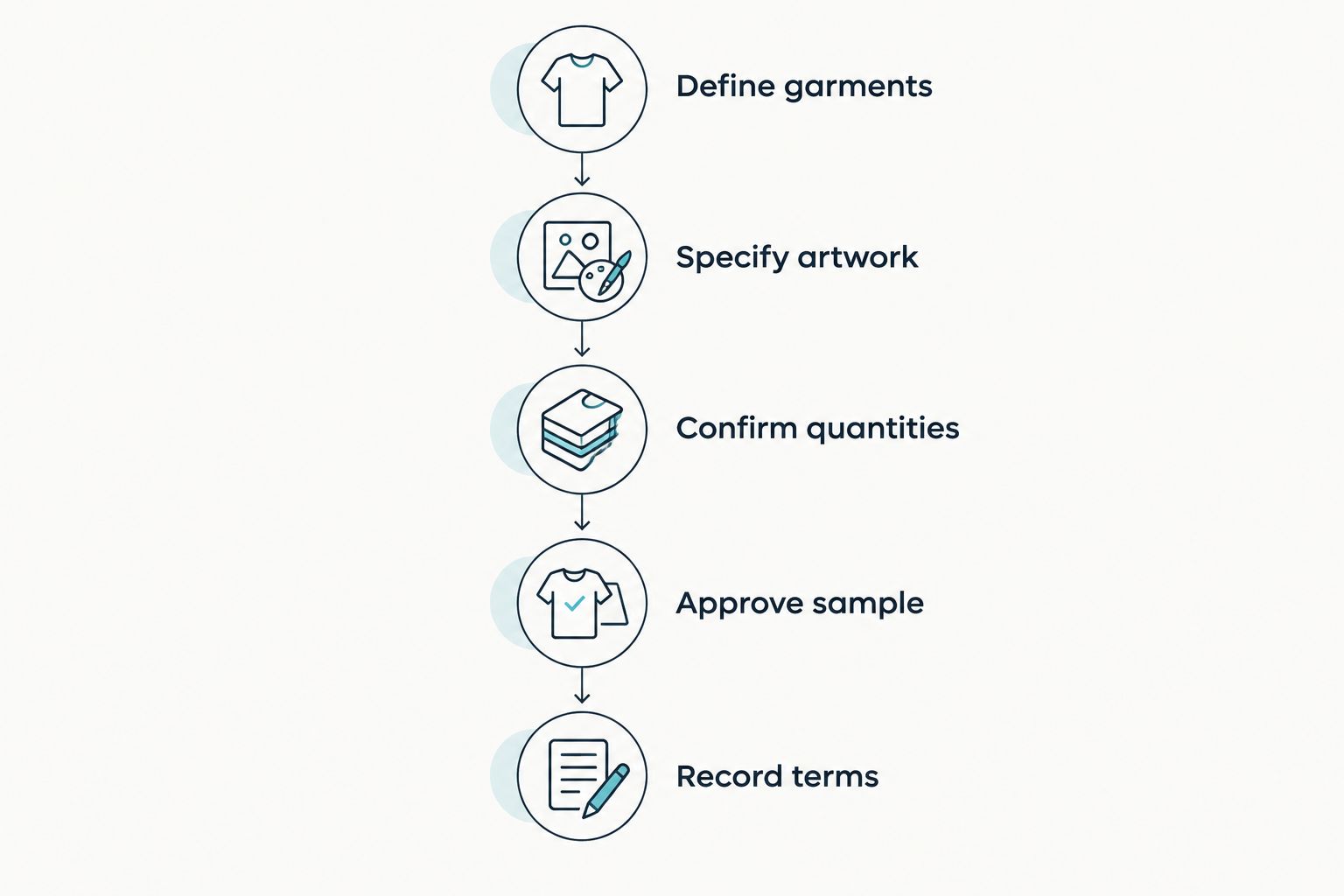
How do you request a comparable workwear branding quote?
Use the same brief for every supplier in your 2026 sourcing process. Resolve substitutions before comparing totals, not after selecting a supplier.
1. Define garments
List the intended workwear items and their material requirements. If you already have a garment reference, provide it; if not, describe the working conditions and required garment features without prescribing an unverified decoration method.
Separate mandatory requirements from preferences. This lets the supplier identify a genuine compatibility problem without quietly changing the brief.
2. Specify artwork
Provide the available logo files, colour references and required dimensions. Mark each placement on the garment and distinguish the company logo from employee names or department identifiers.
Ask the supplier to flag artwork changes before preparation begins. Small text or intricate details should not disappear through an unapproved simplification.
3. Confirm quantities
Break the order down by garment, size and design variant. Include the intended delivery destinations and explain whether the order supports a single rollout or continuing replenishment.
Keep the initial order separate from any forecast. A forecast helps planning, but it should not be mistaken for an authorised purchase quantity.
4. Approve sample
Agree what the approval covers: garment, decoration, placement, colour and care information. Request a sample on the intended garment when the application needs physical assessment.
Record approval against the exact specification. An artwork proof confirms a different set of details from a decorated garment sample; do not use the terms interchangeably.
5. Record terms
Request the itemised quote, exclusions, repeat-order conditions and responsibilities for delivery. Identify the person authorised to approve production and the point at which changes require a revised quote.
Save the approved specification with the order record. That document becomes the reference for resolving discrepancies and requesting replacements.
Should you use a decorator or an end-to-end workwear partner?
Choose according to the responsibilities you need covered. A decoration-only brief and an end-to-end workwear programme solve different purchasing problems.
| Scope | Best for | Benefit | Responsibility to check |
|---|---|---|---|
| Decoration-only service | Buyers managing garments and fulfilment themselves | A defined logo application task | Who accepts garment suitability and handles rejected items |
| End-to-end workwear partner | Buyers combining design, manufacturing and distribution | Connected responsibility across the programme | Which services and operating requirements the agreement includes |
Boolanga's stated scope includes design, manufacturing, distribution and software for branded workwear, uniforms, courier gear and merchandise. The purchasing task is to define which of those functions your programme needs, rather than compare that scope with a decoration-only quote as though they were interchangeable.
The trade-off is scope: a narrow task needs a narrow brief, while a multi-function programme needs clearer ownership across handoffs. Neither label replaces checking the actual agreement.
Is it cheaper to add the logo before or after buying workwear?
Compare the complete workflow, not just the application charge. Buying undecorated garments separately leaves you responsible for confirming that the decorator accepts those items and can apply the specified design.
Before purchasing garments, obtain written confirmation of suitability and clarify responsibility for damage or rejected pieces. A garment purchase should not get ahead of the decoration decision.
What should you check before reordering branded workwear?
Check the garment reference, artwork version, placement and repeat-order terms before authorising a reorder. Previous approval is useful only when the next order uses the same specification.
For your 2026 replenishment record, retain the approved sample reference and supplier confirmation of any changes. Reordering by description alone leaves too much open to interpretation.
FAQ
How do I get the cost to add logo to workwear?
Request a quote against a defined garment, artwork, placement and quantity. Ask for preparation, application, sampling and delivery to be identified separately so you can compare the complete scope.
Is embroidery better than printing for company workwear?
Embroidery is not automatically better than printing for company workwear. Choose the process against the actual fabric, logo detail, intended use and approved sample.
Can I put the same logo on shirts and jackets?
You can specify the same visual identity across shirts and jackets, but each garment needs a suitable decoration process. Confirm dimensions, placement and application separately for each garment type.
Does adding a second logo position change the quote?
A second logo position changes the decoration scope and should appear in the quote. Ask the supplier to identify each application rather than assuming the same artwork includes additional positions.
Do I need a sample before ordering branded workwear?
A decorated sample lets you assess details that an artwork file cannot show, including placement and the finished application on the garment. Agree what the sample approves before authorising production.
Will I pay setup charges again when I reorder?
Repeat setup charges depend on the supplier's terms and whether the approved specification changes. Confirm file retention, reuse rights and repeat-order conditions in writing.
What should my company keep after approving workwear branding?
Keep the approved garment specification, artwork version, decoration details, sample reference and order terms. These records give later orders a defined production reference.
One last thing
Make the approved decoration specification part of your purchasing record, not an attachment left in an inbox. For every 2026 reorder, require the supplier to confirm either that the specification is unchanged or exactly what differs.
That check gives you a clear question before production starts: are you buying the same approved workwear, or authorising a new version?


