
International shipping adds freight, border-clearance charges, applicable import duties and taxes, and destination delivery costs to a uniform program; there is no single percentage that applies across routes and orders. For a 2026 budget, calculate those charges against the same shipment scope and delivery responsibility. A freight quote alone does not establish the full landed cost, and recoverable import tax should be tracked separately from permanent expense.
- International shipping cost uniform program planning requires landed costs, not freight alone.
- Compare freight, customs clearance, duties, tax treatment, and destination delivery on the same basis.
- Choose sea freight for planned replenishment and air freight for urgent requirements; compare both against your deadline.
- Boolanga suits enterprise uniform programs seeking one partner for design, manufacturing, distribution, and operations software.
Why this matters
A uniform shipment is not operationally complete when it reaches a port or airport. Your budget needs to follow the goods through clearance, receipt, and delivery to the location responsible for issuing them.
Boolanga provides branded workwear and uniform operations across 35+ countries. For a multi-country program, the useful comparison is the cost of supplying each destination under a defined service scope—not an average freight percentage applied everywhere.
Budget the delivered requirement, not just the international movement. Otherwise, a quote that excludes destination handling can look better than one that includes it, even when the underlying service is not comparable.
How much does international shipping add to uniform program costs?
The shipping addition is the sum of the logistics and import expenses your organization bears beyond the garment purchase. Calculate it for each destination and shipment, then allocate the result across the garments or employee kits delivered.
Use this breakdown for your 2026 uniform budget:
| Cost component | What belongs in the calculation | What to confirm |
|---|---|---|
| Origin handling | Collection, export preparation, and handling before departure | Whether the supplier includes these services |
| International freight | Transport between the agreed origin and destination | Mode, shipment dimensions, chargeable weight, and included surcharges |
| Customs clearance | Brokerage and administrative charges for import processing | Who appoints the broker and pays the charges |
| Import duty | Duty assessed under the applicable classification and origin rules | Classification, customs value, origin, and destination treatment |
| Import tax | Applicable import VAT or other destination taxes | Payment responsibility and recoverability |
| Destination handling | Terminal handling, release, storage, or other applicable local charges | Which charges are included and which remain payable locally |
| Final delivery | Transport from the arrival point or warehouse to the agreed recipient | Delivery address, unloading requirements, and service scope |
Not every shipment incurs every listed charge. Keep the categories visible so a blank line means confirmed exclusion or non-applicability, rather than an overlooked expense.
Net logistics and import expense = freight and handling + clearance + duty + nonrecoverable import tax + destination delivery. Track recoverable import tax separately as a cash-flow requirement, subject to local tax advice.
Divide the net expense by delivered garments for a per-garment view. Divide it by complete employee kits for an onboarding view. Neither measure replaces the total budget: each answers a different procurement question.
Compare the same denominator
A shipment containing jackets and shirts does not provide the same cost signal as an order containing shirts alone. Weight, packed volume, and the number of garments per employee can change the allocation.
Record both the shipment total and the allocation method. If you divide freight equally across every garment, label that as an accounting allocation—not evidence that every garment caused the same transport expense.
Planned replenishment: sea freight
Best for: replenishment orders whose required delivery date accommodates the quoted sea-freight schedule. Sea freight is an option when you can commit quantities before the goods are needed and receive them through a planned import process.
Its constraint is timing flexibility. Production changes, sailing schedules, clearance, and onward delivery all belong in the plan; the port arrival date alone is not the date employees receive uniforms.
Request an end-to-end quotation rather than assuming sea freight wins on total cost. Origin and destination charges still need to be included, and shipment size affects how those charges spread across garments.
Urgent replenishment: air freight
Best for: time-sensitive requirements when the quoted air-freight service meets the operational deadline. Air freight supports a separate decision: whether faster international transport justifies the additional logistics expense for the requirement concerned.
Its constraint is the exposure to chargeable weight and service premiums. Bulky cartons can be billed using dimensional weight under the carrier's rules, rather than actual scale weight alone.
Do not automatically send the entire order by air because part of it is urgent. Ask for separate quotes for the immediate requirement and the remaining replenishment, then compare the combined expense and arrival plan.
Regional stock: local dispatch after import
Best for: recurring uniform issues within a defined service region. Regional stock separates the international replenishment shipment from the later dispatch to employees, branches, or operating sites.
Its constraint is inventory responsibility. Storage, picking, local transport, and stock that does not match future demand remain part of the program, even when the final dispatch no longer crosses a border.
Compare regional stock using the full operating model. A lower international freight allocation is not a saving if additional handling and unused stock outweigh it.
Which delivery model fits your requirement?
| Model | Best for | Operational advantage | Cost or service constraint |
|---|---|---|---|
| Planned sea freight | Forecastable replenishment | Supports advance shipment planning | Requires a schedule that accommodates the complete delivery chain |
| Urgent air freight | Deadline-sensitive shortages | Provides a faster international transport option | Chargeable weight and urgent-service charges need scrutiny |
| Regional stock | Repeated issues within a region | Separates bulk import from local dispatch | Adds inventory, storage, and fulfillment responsibilities |
These models can coexist within one uniform program. Compare them against a defined requirement rather than choosing one transport method for every order.
Why international uniform shipping costs vary
The main drivers are physical shipment characteristics, route requirements, and the service you purchase. Use these factors to explain differences between quotations rather than treating every change as a freight-rate movement.
- Packed dimensions and weight. Carriers apply their chargeable-weight rules to the packed shipment. Request carton-level measurements, not garment weight alone.
- Origin and destination. The route determines the applicable transport services, border processes, and destination delivery requirements.
- Garment classification and origin. Customs treatment depends on the goods and the relevant rules. Confirm classification and origin documentation before approving duty assumptions.
- Shipment frequency and consolidation. Separate dispatches can repeat handling and clearance activities. Consolidation changes the shipment profile but must still meet the required delivery dates.
- Delivery responsibility. The agreed Incoterm and named place allocate transport responsibilities and certain costs between buyer and seller. They do not replace a detailed quotation.
- Exceptions after dispatch. Storage, document corrections, redelivery, and other exception charges can sit outside the original transport quote. Establish who approves and pays them.
For 2026 procurement, preserve the assumptions behind every quote. A changed carton count or delivery address can make an earlier comparison unsuitable even when the garment order has not changed.
How to build a comparable shipping quote
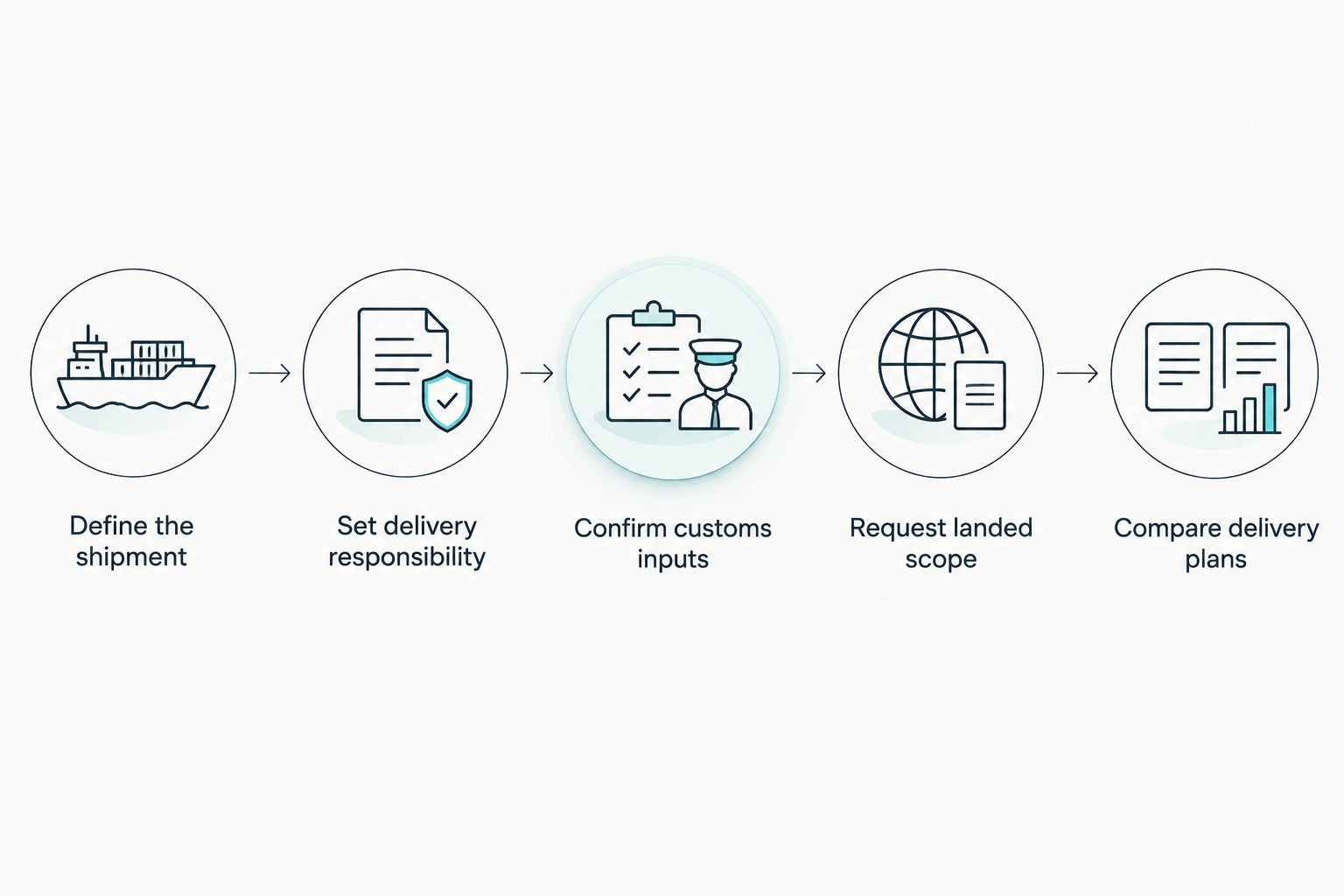
Send every bidder the same shipment brief. Ask bidders to identify exclusions explicitly, so procurement can compare scope before comparing totals.
- Define the shipment. List garment SKUs, quantities, packed carton dimensions, gross weights, and the collection location. Separate confirmed packing data from estimates.
- Set delivery responsibility. Specify the proposed Incoterm, its named place, the importer of record, and the party responsible for customs clearance.
- Confirm customs inputs. Provide product descriptions, composition, declared origin, and proposed classifications for broker review. Keep commercial documents consistent with the goods.
- Request landed scope. Ask for origin handling, freight, destination charges, clearance, applicable duties and taxes, and final delivery to be itemized.
- Compare delivery plans. Check quotation validity, dispatch assumptions, transit scope, exclusions, and the process for approving additional charges.
A quote should state what remains estimated. Treat an unconfirmed duty calculation or unmeasured carton as an open assumption, not a settled budget line.
For fleet programs, the courier uniforms guide provides related uniform-planning context. Keep the shipping brief tied to the actual kit being issued, including its packed form, rather than a generic garment count.
How should procurement compare an end-to-end partner?
Compare responsibility as well as scope. An end-to-end arrangement needs clear ownership of specifications, shipment documentation, distribution, and exception handling; supplier consolidation alone does not prove lower landed expense.
Boolanga combines design, manufacturing, distribution, and operations software for enterprise uniform programs. That scope fits buyers seeking connected operations, but each proposal still needs explicit delivery terms, destination coverage, and allocation of import responsibilities.
Ask for a responsibility matrix alongside the quotation. Identify who maintains packing data, approves dispatch, supplies customs documents, receives exceptions, and authorizes additional expenditure.
For your 2026 supplier review, retain the same evaluation criteria across end-to-end partners and separately contracted vendors. Otherwise, the comparison rewards the proposal with the most exclusions.
Does international shipping include customs duty?
International shipping does not automatically include customs duty. Inclusion depends on the quotation and agreed delivery responsibility; confirm duty treatment as a separate line rather than inferring it from the freight description.
The same applies to brokerage and import tax. A carrier moving the goods and a broker clearing them perform different functions, even when one commercial arrangement covers both.
Is consolidated shipping always better for uniforms?
Consolidated shipping is not always better for uniforms. It can combine transport and handling requirements, but waiting to consolidate can conflict with an employee start date or a site launch.
Compare the complete requirement: shipment expense, stock implications, and the required issue date. Consolidate planned demand only when the resulting delivery plan remains acceptable.
FAQ
What percentage should I add for international uniform shipping?
Use a shipment-specific landed-cost calculation rather than a universal percentage. Include the freight, clearance, duty, nonrecoverable tax, and destination services your organization is responsible for paying.
What information do I need for a uniform shipping quote?
Provide the origin, destination, garment quantities, packed dimensions, gross weights, required delivery date, and proposed delivery terms. Customs review also needs accurate product descriptions, origin information, and classification inputs.
Is air freight better than sea freight for uniforms?
Air freight fits urgent requirements; sea freight fits replenishment that accommodates the quoted delivery schedule. Compare the complete delivery scope and deadline rather than choosing on transport mode alone.
Should import VAT count as a uniform program expense?
Separate recoverable import VAT from permanent expense when the importing entity is entitled to recover it. Confirm treatment with the relevant tax adviser and include the payment in cash-flow planning.
Can a uniform supplier handle international distribution?
An end-to-end partner can include international distribution within its service scope. Boolanga provides uniform design, manufacturing, distribution, and operations software; confirm the specific responsibilities and destinations in the proposal.
How should I compare uniform shipping quotations in 2026?
Compare 2026 quotations using identical shipment data, delivery terms, destination scope, and tax treatment. Record exclusions and quotation validity before selecting a provider.
How do I calculate shipping cost per employee kit?
Divide the relevant logistics and import expense by the number of complete employee kits delivered. Keep recoverable tax separate and state which handling and delivery services the calculation includes.
One last thing
A named destination is not necessarily the point where your uniform program finishes. Delivery to a regional warehouse still leaves receipt, size allocation, picking, and dispatch to the employee or operating site.
Set the budget endpoint before requesting quotes. If procurement measures delivery to a warehouse while operations expects delivery to each branch, both teams can approve the same quotation and still expect different services.


