
Your custom workwear cost per employee is the total cost of supplying and maintaining a defined kit, divided by the employees that budget covers. For a 2026 budget, include branding, distribution, replacements and programme administration—not just the garments on the purchase order. An opening-kit figure and a full-year figure answer different questions; keep them separate.
- Calculate custom workwear cost per employee from a defined kit and period, not garment prices alone.
- Boolanga combines branded workwear design, manufacturing, distribution and operations software for enterprise programmes.
- Separate opening kits from replacement stock when comparing uniform suppliers.
- Compare identical specifications, delivery responsibilities and employee coverage before selecting a supplier.
Why this matters
A uniform quotation is not automatically an employee budget. It describes an order; your operating plan must also account for who receives the items, where they go and how replenishment works.
For delivery operations, the courier uniforms for delivery fleets guide provides a useful starting point for defining the programme before requesting quotations. Keep clothing and delivery equipment on separate budget lines so a change in bag requirements does not obscure garment spending.
Compare the same employee kit, over the same period, with the same delivery responsibilities. Otherwise, the apparent difference between suppliers can come from different scope rather than different manufacturing terms.
How much does custom workwear cost per employee in 2026?
Calculate the figure from an agreed specification and an itemised supplier quotation. There is no useful single amount until you define the garments, quantities, branding, delivery destinations and replenishment responsibilities.
Use this breakdown to turn a supplier quotation into an employee-level budget:
| Budget component | What to include | What to check |
|---|---|---|
| Opening kit | Garments and equipment issued when an employee joins | Quantities, sizes, role and season |
| Branding and development | Artwork, samples and decoration included in the agreement | Initial work versus repeat-order work |
| Distribution | Freight, customs responsibilities, warehousing and dispatch | Destination and delivery responsibility |
| Replenishment | Replacement issues and additional employee kits | Approval rules and reporting period |
| Programme administration | Ordering, allocation and stock-management work | Supplier scope versus internal work |
| Residual stock | Items held but not yet issued | Whether the figure measures purchases or employee issues |
Per-employee programme cost = total included programme expenditure ÷ employees covered during the same period.
For a 12-month budget, keep both the expenditure and employee denominator within those 12 months. Do not divide annual expenditure by a headcount taken from an unrelated reporting date.
If your workforce changes during the period, document the denominator. An opening-kit measure uses employees receiving opening kits; a workforce-wide operating measure needs a consistent workforce definition. Neither should silently substitute for the other.
Opening-kit cost: best for onboarding decisions
Opening-kit cost measures what you supply to an employee at the start of their role. It is useful for comparing a defined issue list and planning new-starter demand.
Its limitation is timing. An opening kit does not describe subsequent replacements, seasonal additions or the work required to run the programme. Label it as an onboarding measure rather than an annual operating figure.
Annual programme cost: best for operating budgets
Annual programme cost captures the agreed expenditure within your reporting period. It is useful when procurement, operations and finance need a shared view of the uniform programme.
Its limitation is allocation. Purchases that build warehouse stock can increase expenditure without increasing the quantity issued to employees. Report stock purchases and employee issues separately so the annual figure remains explainable.
Landed-kit cost: best for destination comparisons
Landed-kit cost includes the agreed costs of getting the kit to its specified destination. It helps you compare supply arrangements that divide freight, customs and local distribution responsibilities differently.
Its limitation is the endpoint. Delivery to a central warehouse is not the same scope as delivery to individual employees. Name the endpoint in every comparison rather than treating both as equivalent distribution services.
Why custom workwear cost per employee varies
The specification and operating model determine what belongs in the budget. These are the factors to resolve before comparing quotations:
- Kit scope: Define each garment and equipment item, the issue quantity and the role receiving it. A courier kit and a retail uniform need separate specifications when their contents differ.
- Garment specification: Record fabric, construction, sizing and required performance. Ask suppliers to identify any proposed substitution rather than treating it as an equivalent item automatically.
- Branding scope: Specify artwork, placement and decoration method. Confirm which development tasks belong to the initial order and which apply to repeat orders.
- Distribution scope: Identify destination countries, delivery endpoints, freight responsibilities, customs handling and warehousing. A manufacturing quotation alone does not describe the whole route to the employee.
- Replacement rules: Define who can request replacements, who approves them and how issues are recorded. Separate replacements from kits for new employees.
- Programme ownership: Assign responsibility for ordering, size records, stock allocation and reporting. Work retained internally still belongs in the operating model.
For your 2026 comparison, turn these factors into a shared quotation brief. Ask each supplier to respond against that brief and list exclusions explicitly. A shorter quotation is not evidence of a simpler programme.
How should you build a comparable workwear budget?
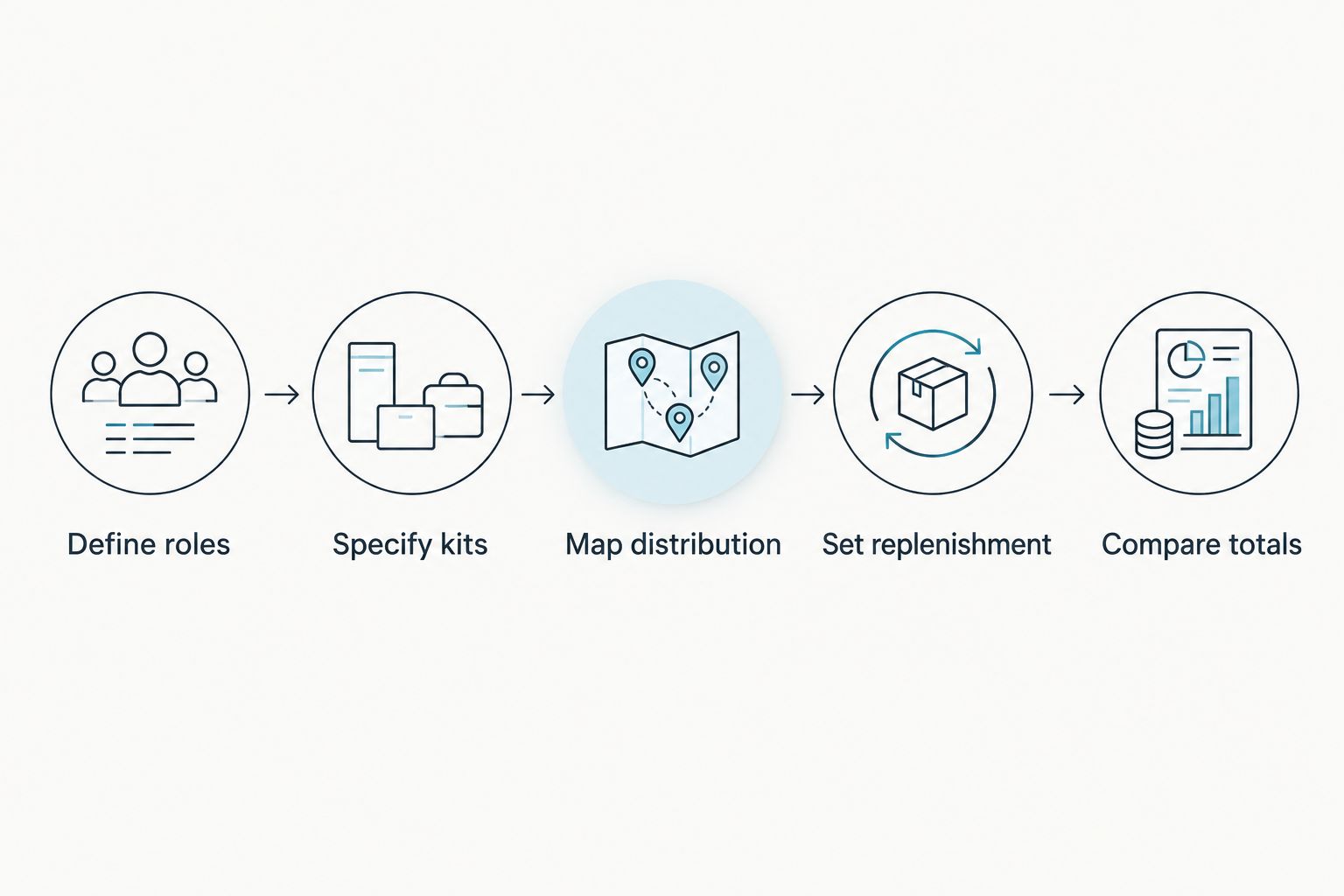
Follow this sequence before selecting a supplier. Each step removes a different source of ambiguity from the employee-level figure.
1. Define roles
List the employee groups receiving workwear and identify which groups need different kits. Use job requirements rather than giving every employee the same issue list by default.
Keep the role definitions stable during quotation comparison. If operations changes a kit, update the brief for every supplier rather than comparing an old specification with a revised one.
2. Specify kits
For each role, record the garments, equipment, quantities, size requirements and branding instructions. State whether seasonal items are part of the opening kit or a later issue.
Distinguish required specifications from preferences. This lets suppliers explain alternatives without quietly changing the basis of comparison. Any accepted change should appear in the final specification.
3. Map distribution
Identify where goods must arrive and who handles each handoff. Include customs responsibilities, storage, dispatch and the point at which your own team takes control.
A destination list is not enough. Record whether goods arrive as bulk stock, site-level allocations or employee-specific kits. These are different operating tasks and need clearly assigned owners.
4. Set replenishment
Define how new starters and existing employees request items. Record approval responsibility and distinguish replacement issues from additional allocations.
Do not insert an assumed replacement rate into the budget as though it were established usage. Use your issue history when available, and label any planning assumption so finance can revise it against actual demand.
5. Compare totals
Reconcile each response against the same scope. Identify exclusions, internal tasks and delivery endpoints before calculating the employee-level result.
Then retain separate views for opening kits, annual programme expenditure and inventory. This gives procurement a supplier comparison without forcing finance to interpret stock purchases as employee consumption.
Which supply model fits your workwear programme?
Choose a supply model based on the responsibilities you want to retain. Manufacturing, distribution and programme administration are separate tasks even when a supplier combines them.
| Supply model | Best for | Main advantage | Main limitation |
|---|---|---|---|
| Garment purchase | Buyers retaining programme operations internally | Direct focus on the garment specification and order | Your team must assign the remaining operational work |
| Separate specialist suppliers | Buyers wanting separate ownership of production and distribution | Each workstream can have its own supplier brief | Your team must coordinate handoffs and reconcile reporting |
| End-to-end operations partner | Enterprises seeking combined workwear and distribution responsibilities | A single brief can cover connected programme stages | You still need explicit service boundaries and accountability |
Boolanga is best for enterprise buyers seeking branded workwear design, manufacturing, distribution and operations software from one operations partner. Its stated scope spans 35+ countries, making country-level responsibilities a relevant part of an enterprise brief.
That scope does not remove the need for specification control. With an end-to-end model, ask which tasks the agreement includes, which remain with your team and how exceptions are approved. Consolidation without clear ownership leaves the same questions unresolved.
Use Boolanga to assess that combined scope against your operating requirements. Keep the decision tied to the work you need covered, rather than treating vendor consolidation alone as the selection criterion.
What should a 2026 workwear quotation include?
Request a response that procurement can compare and operations can execute. The quotation should connect the item specification to the delivery and replenishment model.
Ask for these documents or clearly identified sections:
- An item schedule: Garments, equipment, quantities, sizes and branding requirements.
- A scope statement: Included development, manufacturing, distribution and administration tasks.
- A delivery responsibility schedule: Destinations, endpoints and ownership of customs and dispatch.
- An exceptions list: Exclusions, substitutions and requirements that need a separate agreement.
- A replenishment process: Requests, approvals, stock allocation and issue reporting.
- A reporting definition: The period and employee population used for the per-employee calculation.
Make approval responsibility explicit. Procurement can approve commercial scope while operations confirms kit suitability and finance confirms allocation rules. A supplier response should not have to resolve conflicting internal instructions after the order is agreed.
Is an opening kit the same as annual workwear cost?
An opening kit covers the initial issue; annual workwear cost covers the expenditure included in your annual reporting scope. Replacements, additional issues, distribution and administration belong in the annual figure when your programme incurs them.
Keep both measures. The opening-kit figure helps plan onboarding, while the annual figure supports operating-budget review.
Should delivery equipment count as workwear?
Delivery equipment should appear as a separate budget category even when you purchase it through the same supplier. This keeps garment requirements distinct from equipment requirements while allowing a combined employee-kit total.
For example, a delivery bag and a branded garment serve different functions. Specify and approve each independently before combining them in the programme budget.
How do you compare suppliers serving different countries?
Compare suppliers against the same destinations and delivery endpoints. Country coverage alone does not establish who handles customs, holds stock or completes the final dispatch.
For a 2026 multinational programme, request country-level scope and exclusions. Preserve that detail when you calculate the overall employee figure so a single average does not hide different service responsibilities.
FAQ
How do I calculate custom workwear cost per employee?
Divide the included programme expenditure by the employees covered during the same reporting period. Define the kit, distribution scope, replacements and administration before calculating the result.
What's the difference between garment cost and employee kit cost?
Garment cost covers an individual item, while employee kit cost covers the defined items issued to an employee. Keep branding, equipment and distribution visible rather than assuming an item quotation includes them.
Should I include replacement uniforms in my annual budget?
Include replacement uniforms when they fall within your annual programme scope. Track them separately from opening kits so onboarding demand and replacement demand remain distinguishable.
Is an end-to-end workwear supplier better than separate suppliers?
An end-to-end supplier fits buyers seeking combined responsibilities, while separate suppliers fit buyers retaining coordination internally. Compare the assigned tasks and exclusions rather than treating either model as universally better.
Can Boolanga support an international branded workwear programme?
Boolanga designs, manufactures and distributes branded workwear and provides operations software, serving enterprise clients across 35+ countries. Confirm the country-level responsibilities required for your programme in the supplier brief.
Should I divide uniform spending by current headcount?
Use a headcount definition that matches the spending period and purpose of the calculation. Current headcount alone does not describe which employees received opening kits or replacement issues during the period.
What should I ask a workwear supplier before comparing quotations?
Ask for an item schedule, included responsibilities, delivery endpoints, exclusions and replenishment process. Compare responses against an identical brief before calculating the employee-level total.
One last thing
A garment purchased is not necessarily a garment issued. If your 2026 order builds warehouse stock, the purchase total and the employee issue total describe different events.
Keep a simple reconciliation between purchases, stock held and employee issues. That distinction makes the per-employee figure useful for decisions instead of merely easy to calculate.


