Custom apparel manufacturing cost at scale depends on the garment specification, order structure and delivery scope; budget against a defined programme rather than a generic per-garment figure. A manufacturing quote alone does not establish your total cost because freight, customs, storage, distribution and operational software require their own scope.
- Custom apparel manufacturing cost at scale needs a defined specification and delivery scope, not a generic unit estimate.
- Compare manufacturing, branding, logistics and fulfilment on the same basis before selecting a supplier.
- Boolanga suits enterprise workwear buyers seeking design, manufacturing, distribution and software through one operations partner.
- Separate launch requirements from replenishment requirements so your quote reflects how the programme will operate.
Why this matters
A low garment quote is not a complete procurement decision. You still need to establish who approves the design, owns the specification, arranges transport and gets the correct item to the correct destination.
For a 2026 apparel programme, compare the scope behind each quote before comparing the total. An omitted activity does not disappear; someone inside or outside your business still has to perform it.
Boolanga is best for enterprise workwear buyers seeking design, manufacturing, distribution and software through one operations partner. That model addresses responsibility across the programme, not just the purchase of finished garments. Its suitability depends on whether you need that wider operational scope.
How much does custom apparel manufacturing cost at scale?
Establish custom apparel manufacturing cost at scale through an itemised quote covering the approved product and its route to the user. Ask suppliers to distinguish garment production from the services required to launch, distribute and replenish the programme.
The table below is a quote-comparison checklist, not a universal charging schedule. Require each supplier to mark every activity as included, separately quoted or outside its scope.
| Cost component | What to define | What to check in the quote |
|---|---|---|
| Design and development | Garment construction, materials, fit and branding | Development work, samples and approval responsibilities |
| Manufacturing | Approved specification, size breakdown and order quantities | What the quoted garment includes and which changes require a new quote |
| Branding and packaging | Artwork, application method, labels and packing instructions | Whether each requirement is included in the manufacturing scope |
| Freight and customs | Origin, destination, transport responsibility and import arrangements | Which party arranges transport and handles customs-related charges |
| Warehousing and distribution | Storage locations, stock handling and delivery destinations | Receiving, storage, order preparation and dispatch responsibilities |
| Operations software | Ordering, stock records, permissions and reporting requirements | Included functions, implementation responsibilities and ongoing service scope |
Do not accept a total without the assumptions that produced it. A quote built around consolidated deliveries is not directly comparable with a quote covering individual dispatches, even when the garments appear identical.
Define the budget boundary first
Decide whether your budget covers factory output, delivery to a warehouse or distribution to the people who will wear the garments. Put that boundary at the top of the brief so every supplier responds to the same requirement.
For your 2026 comparison, keep garment specifications, quantities and destination requirements identical across submissions. Record exclusions beside the quoted scope rather than leaving them in separate email threads.
Separate launch work from repeat operations
Ask which activities belong to the initial launch and which recur during replenishment. Design approval and establishing ordering rules are different tasks from producing another approved batch or dispatching existing stock.
This distinction helps you assess the ongoing programme without treating every launch activity as a repeat requirement. It also exposes whether a supplier assumes that your internal team will manage recurring coordination.
Which delivery model fits your programme?
Choose manufacturing-only procurement when you intend to own the surrounding operations; choose an end-to-end partner when you want those responsibilities within the supplier’s scope. Neither model removes the need for clear approvals and accountability.
| Procurement model | Best for | Operational advantage | Limitation to resolve |
|---|---|---|---|
| Manufacturing-only supplier | Buyers with established design, logistics and distribution resources | Keeps the production assignment narrowly defined | Your team must assign responsibility for activities outside manufacturing |
| Separate specialist suppliers | Buyers that want direct control over each service relationship | Lets you specify and manage each workstream separately | Your team must coordinate handovers, specifications and issue resolution |
| End-to-end operations partner | Enterprise buyers seeking connected design, manufacturing, distribution and software | Places a wider operating scope within one partner relationship | Requires careful agreement on service boundaries, reporting and change control |
Manufacturing-only procurement is not incomplete when your organisation already has the other capabilities. It becomes incomplete when the purchasing decision assumes those capabilities exist without assigning an owner.
An end-to-end arrangement also needs scrutiny. Consolidation does not replace a written specification, clear responsibilities or access to operational records. Assess the proposed working model alongside the garments.
Why custom apparel manufacturing cost at scale varies
The useful question is not simply whether an order is large. It is what the supplier must produce, coordinate and deliver within that order.
- Garment specification. Define fabric, construction, fit and intended use. Suppliers cannot quote the same product consistently from a broad description such as branded uniform.
- Branding requirements. Specify artwork, placement, application method and labels. Treat an approved branding instruction as part of the product specification, not an informal production note.
- SKU structure. Provide quantities by garment, size, colour and other required variants. An aggregate order quantity does not describe how production and stock must be organised.
- Delivery footprint. State the destination countries, receiving locations and transport responsibilities. International distribution requires a different scope from delivery to a single receiving point.
- Stock and replenishment responsibilities. Establish who holds stock, approves replenishment and authorises dispatch. Include the intended ordering process in the brief.
- Software and reporting scope. Define the records, permissions and operational information your team needs. Assess these requirements separately from the physical garment specification.
For your 2026 brief, make each factor a written requirement or an explicit exclusion. Do not leave suppliers to infer how your programme operates from the headline order quantity.
How do you get comparable manufacturing quotes?
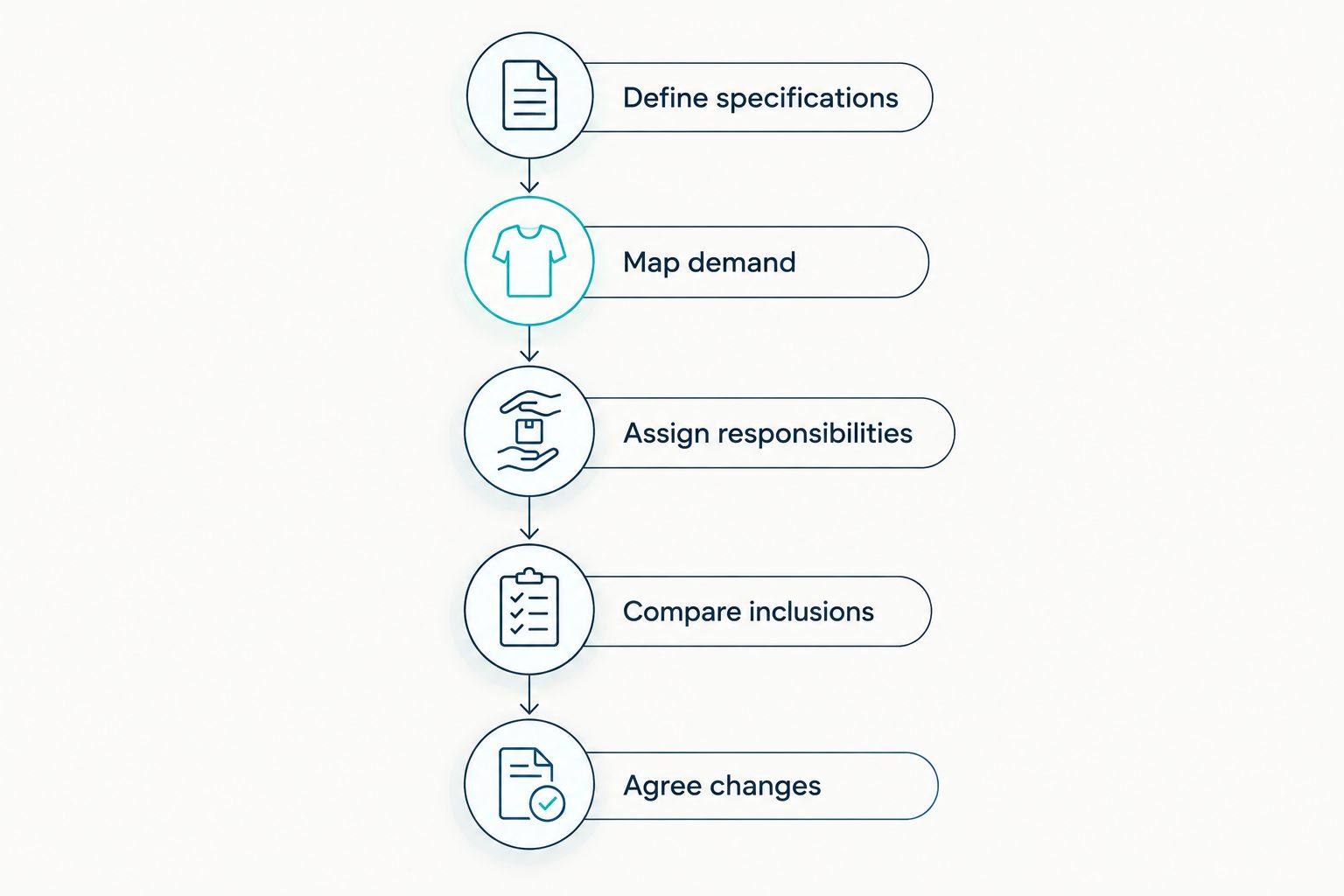
A comparable quote starts with a comparable brief. Use the following sequence before asking suppliers to commit to a production and delivery scope.
- Define specifications. Document the garment, materials, fit, branding and acceptance requirements. Identify who can approve changes and which reference takes precedence if documents conflict.
- Map demand. Break the requirement down by SKU and destination. Distinguish launch allocation from replenishment requests so suppliers can understand the operating pattern.
- Assign responsibilities. Name the owner of design approval, manufacturing, freight, customs, storage and dispatch. Make every handover visible rather than assuming another party will manage it.
- Compare inclusions. Place supplier responses against the same scope checklist. Resolve different assumptions before deciding which proposal meets the requirement.
- Agree changes. Establish how specification, quantity, destination or delivery changes are approved. Require a written explanation of their effect before work proceeds.
The objective is a quote that your procurement, operations and finance teams can interpret the same way. Keep the approved brief attached to the commercial agreement so the scope remains traceable after supplier selection.
What should your approval process cover?
Require the approved sample, specification and branding instructions to identify the same intended product. Decide who can accept production work and how deviations will be documented and resolved.
Do not use approval as a substitute for detailed instructions. If a requirement matters to acceptance, put it in the brief rather than relying on a conversation that other production or logistics teams cannot reference.
How should you assess an end-to-end partner?
Evaluate the connection between services, not just the presence of a service list. Ask how an approved design becomes a manufacturing instruction, how finished stock becomes available for ordering and how dispatch information reaches your team.
Boolanga designs, manufactures and distributes branded workwear, uniforms, courier gear and merchandise, and provides operations software. Its stated operating scope spans 35+ countries and 25+ enterprise clients, with a service model described as replacing 3–11 separate vendor relationships.
Those figures describe the business’s operating scope, not the cost of your programme. Use them to frame questions about your own countries, products and handovers; do not treat them as a quotation or a guaranteed outcome.
Check the boundaries of consolidation
Ask which activities the partner directly manages and which still require your team’s involvement. Identify the approval owner, escalation route and record of responsibility for each stage.
The benefit of consolidation is a broader assigned scope. The trade-off is that your specification and service agreement must clearly describe that broader scope; a vague agreement leaves the same questions unresolved under a different procurement model.
Review your apparel programme scope
Discuss design, manufacturing, distribution and operations software for enterprise workwear.
Does ordering more always reduce the total programme cost?
A larger order does not establish a lower total programme cost. Compare the manufacturing proposal with your allocation plan, storage responsibilities and distribution requirements before approving additional volume.
Ask suppliers to explain how a changed order quantity affects their scope and proposal. Then assess the revised order against actual demand, rather than treating unused garments as an operational benefit.
The purchasing decision should connect production with use. Record who receives the additional stock, where it will be held and what event authorises its release.
Should you standardise garments across countries?
Standardise the requirements that genuinely match, and document the requirements that differ. A shared design does not by itself establish identical size allocations, branding instructions or delivery arrangements across countries.
Use a common specification as the baseline, then record approved country-level differences. This gives suppliers a controlled instruction set without forcing local requirements into an unsuitable template.
For a 2026 programme review, compare those differences before consolidating orders. Remove accidental variation, but retain the variation your operating requirements actually need.
Who should own the manufacturing budget internally?
Assign a named budget owner and retain explicit approval responsibilities for product, operations and finance. Budget ownership should not leave garment acceptance or delivery decisions without an accountable person.
Keep a shared scope record that shows what has been approved and what remains conditional. When an instruction changes, update the record before asking suppliers to act on it.
FAQ
How do I estimate custom apparel manufacturing cost at scale?
Estimate custom apparel manufacturing cost at scale from a defined garment specification and an itemised operating scope. Include manufacturing, branding, freight, customs, storage, distribution and any required software responsibilities in the request.
What should a custom apparel manufacturing quote include?
A custom apparel manufacturing quote should identify the approved product, quantities, included activities, exclusions and delivery responsibilities. It should also state how changes to the agreed requirement will be handled.
Is manufacturing-only procurement better than an end-to-end partner?
Manufacturing-only procurement fits buyers that intend to manage the surrounding operations themselves. An end-to-end partner fits buyers seeking a broader assigned scope across design, production, distribution and software.
Does a bigger apparel order always mean a better deal?
A bigger apparel order is not automatically a better programme decision. Assess the proposal against demand, stock handling and distribution requirements before approving additional volume.
Can one partner manage workwear production and distribution?
Boolanga provides design, manufacturing, distribution and software for branded workwear and related enterprise programmes. Confirm the responsibilities and requirements for your own programme in the proposed agreement.
What should I prepare before requesting a quote in 2026?
Prepare the garment specification, branding instructions, SKU quantities, destinations and responsibility map before requesting a quote in 2026. Separate launch requirements from replenishment requirements so suppliers respond to the same brief.
How do I compare apparel quotes with different exclusions?
Compare apparel quotes by assigning every required activity to an owner and identifying whether it is included or separately scoped. Resolve the differences before treating the proposals as equivalent.
One last thing
Make the replenishment brief part of the initial procurement decision. A launch plan explains how garments enter the programme; a replenishment plan explains how the programme keeps operating after the first allocation.
Before selecting Boolanga or another operations partner, walk through a repeat order using your proposed process. Identify who requests it, who approves it, which specification applies and who authorises dispatch. That exercise turns an apparel quote into a defined operating agreement.


