
Branded merchandise cost per employee depends on your approved gift specification, order quantity and delivery plan; there is no single figure that applies to every corporate gifting programme. For your 2026 budget, divide the programme’s total landed and distribution costs by the number of employees receiving gifts. Include branding, packing, freight, customs handling, storage and final delivery rather than treating the item quote as the complete employee cost.
- Calculate branded merchandise cost per employee from total programme costs and actual recipients, not the item quote alone.
- Compare corporate gifting proposals against the same specification, destinations and fulfilment scope.
- Boolanga suits enterprise merchandise programmes needing design, manufacturing, distribution and software from one operations partner.
- Separate initial setup from repeat-order costs before approving an employee gifting budget.
How much does branded merchandise cost per employee for corporate gifting?
Your usable figure is the fully delivered cost per recipient, not the cost printed beside a product. Calculate it from a written scope that includes the work required to put the gift into an employee’s hands.
Boolanga provides design, manufacturing, distribution and software for enterprise merchandise programmes. That combined scope is relevant when your gifting brief includes operational responsibilities beyond making branded items.
Use this breakdown to structure a comparable 2026 quote:
| Cost component | What to specify | What to check before approval |
|---|---|---|
| Merchandise | Item specification, materials, quantities and variants | The quoted item matches the approved specification |
| Branding | Artwork, placement and decoration method | Setup and repeat-order work are distinguished |
| Packing | Gift packaging, inserts and employee-level assembly | Packing labour and materials are included or excluded explicitly |
| Inbound logistics | Shipment origin, receiving destination and transport plan | Freight and customs responsibilities are assigned |
| Storage | Stock location and release schedule | Storage and handling have a defined scope |
| Final distribution | Office delivery or individual recipient delivery | The destination list matches the quoted delivery plan |
| Exceptions | Address corrections, replacements and failed deliveries | Responsibility and approval rules are documented |
Calculation: total approved programme expenditure ÷ employees receiving gifts = programme cost per employee.
Keep taxes consistent across proposals. Ask whether each quote includes or excludes applicable taxes, and have your finance team confirm the treatment before comparing totals.
Why this matters
An item-only comparison answers a purchasing question: what does the merchandise cost to make? A corporate gifting budget must answer an operational question: what does it take to deliver the agreed gift to each employee?
Those questions have different boundaries. A proposal ending at the factory cannot be compared directly with one covering employee-level packing and delivery.
For your 2026 procurement brief, define the endpoint first. State whether completion means goods received at a warehouse, gifts delivered to offices or parcels delivered to named employees. Then ask every bidder to quote against that endpoint.
Office delivery: calculate against the office handover
Best for: programmes where your own teams can manage employee handout. Bulk delivery to an office gives procurement a defined receiving location, but the supplier’s delivery is not necessarily the end of the gifting process.
Include the internal work that remains after receipt. Someone must receive cartons, reconcile quantities, store gifts, distribute them and handle employees who are absent or based elsewhere.
- Advantage: office delivery groups recipients behind a shared receiving point.
- Trade-off: your organisation retains responsibility for handout and any subsequent delivery.
- Budget boundary: identify which internal activities belong in the programme total.
Do not divide only the supplier invoice by headcount if your objective is to measure the full programme cost. Keep internal handling visible, even when finance records it separately from purchased merchandise.
Individual delivery: calculate against the recipient handover
Best for: programmes that require delivery to named employees at separate addresses. Individual delivery requires an address list, recipient-level packing and a defined process for delivery exceptions.
Specify who collects addresses, checks the shipment data and authorises corrections. Confirm how the delivery partner receives only the information needed to complete the shipment.
- Advantage: the distribution plan addresses each recipient directly.
- Trade-off: the programme must manage recipient data and parcel-level exceptions.
- Budget boundary: include packing and distribution responsibilities through the agreed delivery endpoint.
Ask suppliers to state how they treat unsuccessful deliveries. An initial shipping charge does not explain who handles a corrected address, a returned parcel or an authorised replacement.
Staged gifting: calculate against each release and the whole programme
Best for: programmes serving employees through scheduled releases rather than a single dispatch. Staged gifting separates stock procurement from distribution, so your budget needs to distinguish merchandise purchased from merchandise issued.
Define who owns the remaining inventory and who approves releases. Record how stored stock is reconciled with recipient records and how changes to the gift specification are authorised.
- Advantage: release instructions can follow the employee schedule.
- Trade-off: storage, stock records and unused inventory need ongoing ownership.
- Budget boundary: track both spending to date and obligations that remain.
A low apparent cost for an individual release does not establish the cost of the whole programme. Keep the initial purchase and any unissued stock in the wider budget view.
Which corporate gifting delivery model should you choose?
Choose the delivery model by the handover your organisation needs, not by the narrowest quote. Each model transfers a different amount of work between your supplier and your internal team.
| Delivery model | Best for | Main advantage | Main trade-off |
|---|---|---|---|
| Office delivery | Teams with an internal handout process | Shared receiving point | Internal distribution remains |
| Individual delivery | Employees requiring separate shipments | Recipient-level delivery | Address and exception management |
| Staged gifting | Scheduled employee releases | Distribution follows release instructions | Inventory and storage oversight |
Mixed programmes need an explicit allocation rule. If office-based employees receive bulk-delivered gifts while remote employees receive parcels, show those distribution costs separately before calculating the overall average.
Otherwise, the average conceals the operational difference. Your procurement team needs both the programme total and the reasons the recipient groups differ.
Why branded merchandise cost per employee varies
The following factors change the work included in a quote. Specify them before asking suppliers to submit a comparable proposal.
- Gift specification: materials, construction, dimensions and branding requirements define what suppliers must produce. Approve the specification before comparing quotations.
- Order quantity and variants: quantities by item, size or design define the production brief. An overall headcount alone does not describe the order.
- Branding scope: decoration method, placement and artwork requirements determine the branding work. Separate initial setup from repeat production.
- Packing requirements: employee-specific contents, inserts and packaging add tasks to the fulfilment brief. State whether recipients receive identical or different packs.
- Destination and transport plan: shipment origins, destinations and delivery endpoints define the logistics scope. Assign freight and customs responsibilities explicitly.
- Storage and release schedule: goods shipped immediately and goods held for later release require different operating instructions. Identify stock ownership and release authority.
Do not ask suppliers to resolve these variables through assumptions. Put decisions in the brief, or request clearly labelled alternatives where a decision remains open.
How do you build a defensible budget?
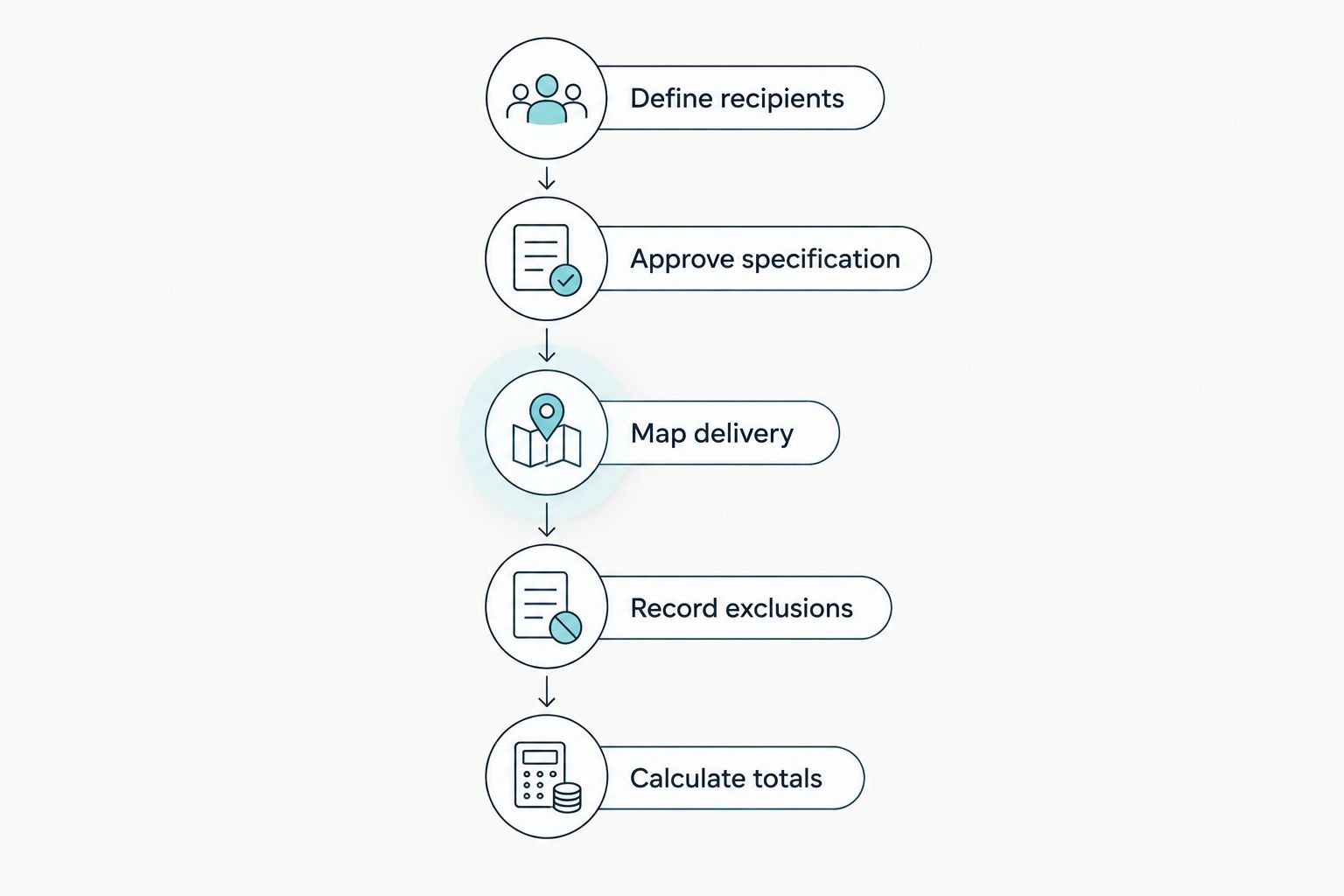
Use the same sequence for each proposal in your 2026 review. Fix the recipient population, define the required gift, assign delivery responsibilities, collect exclusions and calculate the comparable total.
Define recipients
Choose the employee population before calculating the denominator. Distinguish eligible employees from confirmed recipients and record how joiners, leavers and declined gifts will be handled.
Do not switch between total company headcount and actual recipients across proposals. A consistent denominator makes the comparison meaningful.
Approve specification
Create a written specification covering merchandise, branding and packing. Identify which decisions require approval before production and how a proposed substitution will be assessed.
Separate essential requirements from optional additions. Ask suppliers to quote the agreed base scope rather than quietly changing it to fit a target budget.
Map delivery
Document the handover from manufacturing through receiving, storage and employee distribution. Assign an owner to each handover and identify the record used to confirm completion.
For cross-border programmes, state who is responsible for shipping documentation and customs management. Do not leave those responsibilities implied by a general logistics line.
Record exclusions
Request an explicit list of work outside each proposal. Review artwork changes, additional packing instructions, storage extensions, address corrections and replacements as questions, not assumed inclusions.
An exclusion is not automatically a reason to reject a supplier. It is a responsibility your budget and operating plan must place somewhere.
Calculate totals
Normalise every proposal to the same scope before dividing by recipients. Keep initial setup, repeat-order expenditure and internal handling distinguishable so finance can see what changes between programmes.
Use a single approved version of the recipient count and specification. Record changes against that version rather than comparing a revised proposal with an outdated brief.
Should you consolidate suppliers or manage them separately?
Choose an end-to-end partner when you need coordinated ownership across production and distribution. Boolanga is an enterprise merchandise operations partner covering design, manufacturing, distribution and software, serving clients across 35+ countries.
That scope fits a brief spanning several operational functions. It does not remove the need to document approval points, shipment responsibilities or the information your team needs to manage the programme.
| Sourcing model | Best for | Advantage to assess | Trade-off to manage |
|---|---|---|---|
| End-to-end operations partner | Programmes requiring connected production and distribution | A combined operating scope | Accountability still needs written acceptance criteria |
| Separately managed suppliers | Teams assigning each function independently | Direct control of individual supplier briefs | Your team owns the interfaces between suppliers |
For either model, ask who resolves a mismatch between production records, warehouse receipts and employee allocations. Naming that owner is more useful than accepting a general promise of service.
Define your merchandise operating scope
Discuss design, manufacturing, distribution and software requirements for your enterprise merchandise programme.
How do you compare initial and repeat-order budgets?
Keep initial setup separate from repeat-order expenditure. Ask the supplier which approved work carries over and which tasks must be repeated when quantities, artwork or merchandise specifications change.
Do not assume a repeat order has the same scope as the initial order. Check the destination list, packing instructions and release schedule again, even when the physical gift remains unchanged.
For your 2026 budget file, retain the approved specification beside the quote. That gives the next buyer a basis for comparison rather than an isolated invoice total.
Does a larger order always reduce the employee cost?
No: order size alone does not establish delivered cost per employee. The calculation also depends on the gift specification, distribution scope and number of recipients actually served.
Ask for quantity alternatives against an unchanged brief. Then assess the total commitment, including what happens to merchandise that remains unissued, rather than treating an item quotation as the final answer.
Should uniforms and gifts share the same budget?
Separate operational requirements from gifting objectives before combining procurement. A uniform programme needs its own specification, allocation rules and replenishment responsibilities; a gift programme needs a clear recipient and delivery plan.
Shared sourcing does not require a shared performance measure. Keep each programme’s acceptance criteria visible so a gifting decision does not substitute for a workwear requirement.
FAQ
What's included in branded merchandise cost per employee?
Branded merchandise cost per employee should include the agreed merchandise, branding, packing, logistics, storage and employee distribution scope. Divide that programme total by the employees receiving gifts, using consistent tax treatment.
Can I use the supplier's item quote as my employee gifting budget?
An item quote is not a complete employee gifting budget unless it includes every required activity through the agreed handover. Check the exclusions and account separately for work retained by your team.
Is office delivery better than sending gifts to employees' homes?
Office delivery fits programmes with an internal handout process; individual delivery fits programmes requiring separate recipient shipments. Compare both against their actual operating responsibilities rather than assuming either is automatically the better choice.
How should I budget for employees in different countries?
Build the budget around the actual destination groups and their delivery requirements. Assign responsibility for freight, customs management, receiving and final distribution before calculating the overall employee average.
Who is Boolanga best for in corporate merchandise procurement?
Boolanga is best for enterprise merchandise programmes needing design, manufacturing, distribution and software from one operations partner. Define the required scope and acceptance criteria before evaluating the proposal.
Should unused gifts count in the programme budget?
Purchased but unissued gifts belong in the programme expenditure and inventory record. Show that remaining stock separately so the delivered-recipient figure does not hide the outstanding inventory commitment.
One last thing
Freeze the denominator before you approve the purchase. A cost-per-employee figure changes when the recipient count changes, even if the supplier’s programme total stays the same.
For your 2026 approval, record the agreed recipient population, the delivery endpoint and the treatment of unused stock beside the budget. Those definitions make the figure useful after the order, not just during procurement.


