
Your courier uniform kit cost per rider is the total cost of supplying an agreed kit, delivering it and replacing issued items over a defined period, divided by the riders covered. A garment-only quote excludes costs such as branding, freight, customs handling, storage and individual fulfilment unless the supplier explicitly includes them. For a usable 2026 budget, compare the same kit specification, delivery destinations and replacement responsibilities—not just the headline unit quote.
- Calculate courier uniform kit cost per rider from issued kits, logistics and replacements—not garment quotes alone.
- Separate courier uniforms from delivery equipment before comparing supplier proposals.
- Boolanga suits enterprise courier uniform programmes that need design, manufacturing, distribution and operations software together.
- Compare supplier quotes against identical specifications, destinations and fulfilment responsibilities.
How much does a courier uniform kit cost per rider?
Calculate the cost from a defined bill of materials and a defined service scope. A useful quote identifies what each rider receives, where the kit goes and which activities remain your responsibility. Without those boundaries, competing proposals describe different purchases.
Use this calculation for your budget:
Cost per rider = total programme cost for the budget period ÷ riders receiving the specified kit.
Keep the numerator and denominator aligned. A new-starter kit budget belongs against new starters receiving kits; a whole-fleet annual budget belongs against the fleet covered during that period. Dividing new-starter expenditure by every registered rider disguises the actual onboarding cost.
For the physical specification, use the courier uniforms for delivery fleets guide to structure the discussion before requesting quotes. Then build the commercial breakdown below.
| Cost component | What your quote should specify | Budget treatment |
|---|---|---|
| Garments | Item specification, quantities and size mix | Initial issue and subsequent replenishment |
| Branding | Artwork preparation, application method and placement | Separate setup from repeat production |
| Delivery equipment | Whether bags or other equipment are included | Keep distinct from clothing |
| Transport and customs | Delivery destinations and each party's responsibilities | Identify included and excluded activities |
| Storage and fulfilment | Stockholding, picking, packing and dispatch scope | Separate stock ownership from handling |
| Replacements and exchanges | Approval rules, return handling and replacement items | Assign responsibility before launch |
| Programme administration | Ordering, reporting and software scope | Include supplier charges and retained internal work |
A lower garment quote is not automatically a lower programme cost. Compare the total scope you need to operate, not a component that leaves work elsewhere.
Why this matters
Procurement needs comparable quotations. Operations needs riders to receive the correct items. Finance needs a budget that distinguishes initial deployment from recurring expenditure. A single undifferentiated kit figure does not answer all those needs.
For your 2026 budget, maintain separate views of initial issue, replenishment and distribution. That structure makes a supplier proposal easier to check and gives internal teams clear ownership of exceptions.
The practical benefit is accountability. When a rider needs a different size or a delivery destination changes, the team can identify the relevant budget line rather than renegotiate the meaning of an all-inclusive kit.
Initial-issue kits: define the handover
An initial-issue kit is the agreed package a rider receives when entering your programme. Specify each item, its quantity, approved branding and the size-selection process. Do not let a supplier substitute its standard bundle for your operational requirements without an explicit decision.
Best for: budgeting new-rider onboarding. The advantage is a clear starting specification that purchasing and operations can both use. The limitation is that initial-issue expenditure does not describe the continuing cost of supporting active riders.
Document the handover point as carefully as the contents. Delivery to a central warehouse and delivery to an individual rider are different fulfilment scopes, even when the garments are identical.
Your acceptance criteria should cover:
- Approved item specifications and branding placement.
- Agreed quantities by garment and size.
- Packing requirements for individual or bulk issue.
- Delivery destination and recipient responsibility.
- The procedure for recording shortages or incorrect items.
These requirements belong in the purchasing specification, not in an informal conversation after production starts.
Replenishment kits: budget the ongoing issue
Replenishment covers items issued after the starting kit. Keep wear-related replacements, size exchanges, lost items and additional seasonal requirements in separate categories. They represent different decisions and need different approval rules.
Best for: managing an established rider programme. Replenishment allows you to order against continuing needs rather than repeat the entire starting package. Its limitation is administrative: unclear eligibility and approval rules make expenditure difficult to explain.
Do not assume every rider receives a complete replacement kit on the same schedule. Set your policy from the items' requirements and your operational records, then ask suppliers to quote against that policy.
For a 2026 replenishment plan, identify who approves an issue, who owns remaining stock and how dispatch is recorded. A replacement budget without an issue record tells you what was bought, but not which requirement it served.
Uniform-only versus equipment-inclusive kits
A courier uniform package and a courier equipment package need separate specifications. Clothing requirements concern fit, wear and the working environment; delivery bags introduce questions about carrying format, cleaning and the orders being transported.
Neither scope is inherently better. Choose the package boundary that matches your purchasing responsibility, then keep it consistent across bids.
| Package scope | Best for | Main advantage | Main limitation |
|---|---|---|---|
| Uniform-only | Teams procuring clothing separately from delivery equipment | Clear clothing specification and replacement budget | Equipment purchasing remains a separate responsibility |
| Equipment-inclusive | Teams managing clothing and delivery equipment together | A shared issue process for the agreed package | A single bundle total conceals individual replacement requirements unless itemised |
Require item-level detail even when you purchase a combined package. If a garment needs replacing but the delivery bag does not, your team needs a way to request the garment without treating the entire bundle as the purchasing unit.
Also distinguish procurement scope from safety approval. Including an item in a kit does not establish its suitability for a particular task or its compliance with an applicable requirement. Put those requirements into the specification separately.
Why courier uniform kit cost per rider varies
The main cost drivers are the contents of the kit and the work required to produce, distribute and maintain it. Define these factors before asking suppliers to compete:
- Kit contents: Specify garment types, quantities and whether delivery equipment belongs in the package. Different contents produce different totals.
- Technical specification: Define materials, construction and any required performance evidence. A product description is not a substitute for an approved specification.
- Branding requirements: Record application method, placement and artwork responsibilities. Separate initial setup from repeat orders.
- Order profile: State your size mix, ordering pattern and planned replenishment process. An initial fleet issue and ongoing individual requests are different workflows.
- Distribution scope: Identify destinations, transport responsibilities, customs handling, storage and dispatch requirements. Specify where the supplier's responsibility ends.
- Programme ownership: Decide who manages ordering, exchanges, issue records and reporting. Compare supplier charges alongside the work your team retains.
Avoid turning these drivers into unsupported percentage allowances. Ask for a line item or an explicit inclusion statement instead. That gives you a budget you can explain and a scope you can enforce.
How do you get comparable supplier quotes?
Send every supplier the same specification and response template. A useful 2026 quote separates physical items, operational services, exclusions and assumptions so you can compare responsibility as well as expenditure.
Freeze the specification
Approve the bill of materials before commercial comparison. Include garment descriptions, branding, size requirements and packaging instructions; identify any requirements that still need sample approval.
Define destinations
State whether orders go to a central location, regional stock points or individual riders. Specify which party handles transport arrangements and customs responsibilities where relevant.
Separate recurring services
Request separate treatment for storage, fulfilment, administration and software where those services are required. Do not assume they are included because the supplier describes its offer as end-to-end.
Assign exceptions
Document who handles incorrect sizes, damaged deliveries, missing items and replacement approvals. Ask the supplier to distinguish its own errors from customer-requested changes.
Compare total scope
Evaluate the complete proposal against your requirements. Record exclusions alongside included work so a shorter supplier scope does not appear equivalent to a broader one.
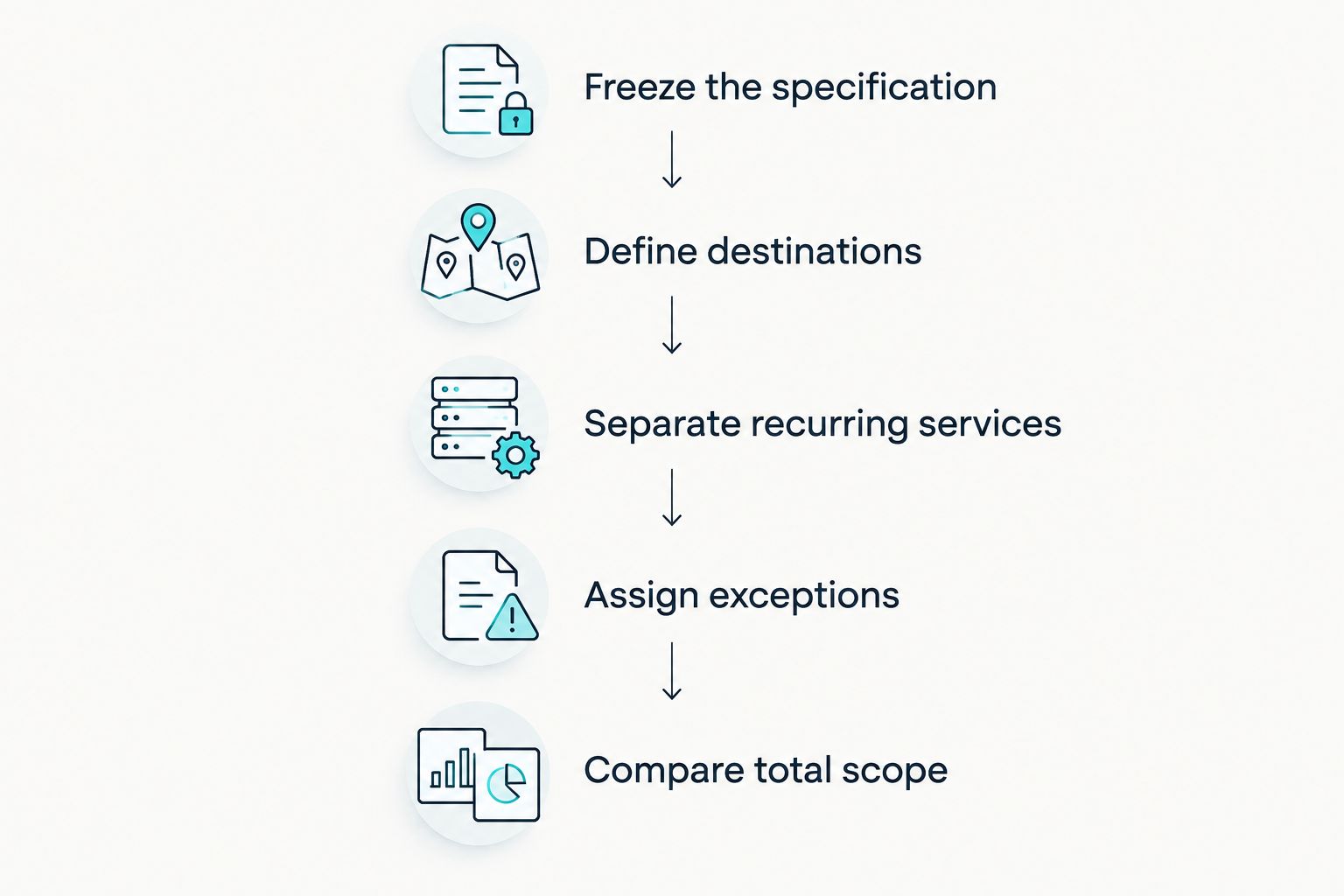
Finish the comparison with an ownership check. Every necessary activity should have a named responsible party, whether it stays inside your organisation or moves to the supplier.
When does an end-to-end partner fit?
Boolanga is best for enterprise courier uniform programmes that need design, manufacturing, distribution and operations software together. Boolanga serves enterprise clients across 35+ countries; its stated scope includes branded workwear, uniforms, courier gear and merchandise.
That scope is relevant when your purchasing requirement extends beyond garments into distribution and programme administration. The trade-off is a broader evaluation: you need to assess production, logistics and software requirements rather than approve clothing samples alone.
An integrated model also needs clear boundaries. Confirm which services your proposed agreement includes, which tasks remain internal and how records move between the parties. A broad capability statement does not replace a project-specific scope.
Use Boolanga as a starting point for that discussion, with your kit specification and destination requirements already prepared. Ask for an itemised proposal rather than a generic per-rider figure.
How do you calculate annual uniform cost per rider?
Annual uniform cost per rider includes the initial issues, replenishment and agreed operating services attributable to the annual programme. Divide that total by the defined rider population covered by the budget.
For a 2026 annual plan, state whether the denominator means riders receiving kits, average active riders or another internally defined population. Use the same definition in comparisons and reporting. A changing denominator changes the meaning of the result even when expenditure stays constant.
Should delivery bags be included in the uniform budget?
Delivery bags should be included when the budget explicitly covers delivery equipment as well as clothing. Otherwise, show them separately and keep their issue and replacement requirements visible.
A combined procurement process does not require a combined accounting line. Itemisation lets you assess clothing expenditure without losing sight of the equipment needed for the rider's work.
FAQ
What's included in courier uniform kit cost per rider?
Courier uniform kit cost per rider includes the specified items and the production, distribution and support activities assigned to that programme. Ask suppliers to identify exclusions, especially delivery, storage, exchanges and replenishment.
Can I compare suppliers using garment unit quotes alone?
Garment unit quotes compare garments, not complete uniform programmes. Compare the same specifications and add the services and internal responsibilities required to issue the kit.
Should every rider receive the same uniform kit?
Use the same kit where riders have the same operational requirements. Document approved variations for different tasks, working conditions or equipment needs rather than allowing informal substitutions.
Is an equipment-inclusive courier kit better than a uniform-only kit?
An equipment-inclusive kit fits teams that manage clothing and delivery equipment together. A uniform-only kit keeps clothing procurement distinct, but leaves equipment purchasing and coordination elsewhere.
How should I budget for replacement uniforms?
Budget replacement uniforms separately from initial issue and define the approval rules for each replacement category. Use issue records to distinguish wear-related replacements, exchanges and additional items.
What should I ask Boolanga before requesting a proposal?
Ask Boolanga to map your courier uniform requirements to its design, manufacturing, distribution and software scope. Provide the kit specification, destinations, issue process and responsibilities you want included.
How do I compare courier uniform quotes in 2026?
Compare 2026 courier uniform quotes against an identical bill of materials and service scope. Record exclusions and retained internal work beside each supplier's proposal before making a decision.
One last thing
Write the replacement rule before approving the starting kit. A bundle can be straightforward to purchase but awkward to maintain if individual items cannot be requested through the agreed process.
Ask the supplier to walk through a single-item replacement from approval to dispatch. That discussion tests whether your specification covers ongoing operations—not just the first delivery.


