
Warehouse safety uniform cost per employee is the cost of the required kit, branding, delivery, replacement and agreed services, divided by the employees covered. Get a role-specific quote before setting a budget: an initial clothing order does not capture the full annual cost, and branded workwear does not automatically provide the protection a warehouse task requires.
- Calculate warehouse safety uniform cost per employee from the complete issued kit, replacement allowance and agreed services.
- Boolanga is best for enterprise teams coordinating branded workwear across countries.
- Compare initial issue and annual replenishment separately; neither should hide branding, delivery or distribution charges.
- Approve protective requirements before comparing quotations, so a cheaper kit does not mean a different safety specification.
Why this matters
A uniform budget becomes unreliable when procurement compares garments instead of complete employee kits. A quotation for clothing delivered to a central warehouse is not equivalent to one covering branding, individual packing and distribution to operating sites.
For enterprise workwear programmes, Boolanga combines design, manufacturing, distribution and operations software. That scope makes it relevant when your purchasing decision covers the operating process as well as the garments.
For your 2026 budget, separate what employees need to wear from what your organisation needs to operate the programme. Approve the safety specification first, then compare suppliers against the same scope.
How much do warehouse safety uniforms cost per employee?
Calculate the figure from a defined employee kit and a defined service scope, not from a single garment price. Start with the clothing and protective equipment required for each role, then add the activities needed to put that kit into use.
Use this calculation for an initial issue:
Initial cost per employee = total initial programme cost ÷ employees receiving a complete kit.
For ongoing budgeting, use a separate calculation:
Annual cost per employee = total programme cost over 12 months ÷ employees covered during that period.
State how you count employees. A year-end headcount and the number of people issued clothing during the year are different denominators when recruitment and departures occur.
| Cost component | What belongs in the calculation | What to confirm in the quote |
|---|---|---|
| Employee kit | Required garments and protective items, grouped by role | Item descriptions, quantities, sizes and protection requirements |
| Branding | Approved decoration and associated setup work | Method, artwork approval and treatment of repeat orders |
| Delivery | Transport to the agreed destination | Destination, shipment terms and included handling |
| Distribution | Sorting, packing and dispatch beyond bulk delivery | Whether orders arrive by site, department or employee |
| Replacement | Planned replenishment and other approved replacement issues | Replacement rules and how orders are authorised |
| Programme services | Agreed administration, reporting or software services | Included activities, exclusions and charging basis |
Do not add the same activity twice. If packing is included in distribution, it should not reappear as an unexplained handling line. Ask the supplier to distinguish included services from separately charged work.
Initial issue: establish the complete employee kit
The initial issue is the kit an employee needs to start the assigned work. Define it by role rather than applying an identical clothing list to everyone who enters the warehouse.
Create a kit schedule with an item description, required protection, issue quantity, size information and branding instructions. Specify whether footwear, gloves and other task-related equipment sit inside this purchasing scope or under a separate arrangement.
Best for: budgeting for new starters, a new site or a uniform change. Its limitation is scope: an initial issue calculation does not describe the expense of maintaining the programme.
For each role, write down what constitutes a complete issue. Otherwise, a supplier can quote a partial kit while your finance team assumes every employee is fully equipped.
Keep reusable setup work separate from repeatable employee costs. Artwork preparation and other agreed setup activities belong in the programme budget, but your comparison should show whether they recur when you add another employee.
Annual replenishment: budget for the operating programme
Annual replenishment covers the clothing and services needed after the first issue. It should reflect your replacement policy, workforce changes and the way employees obtain additional approved items.
Use 12 months as the reporting period for an annual comparison. Keep that period consistent across suppliers, sites and internal reports; comparing an opening order with an annual service proposal produces the wrong conclusion.
Best for: established operations with ongoing recruitment and replacement needs. Its limitation is dependence on assumptions: a replenishment budget is only useful when replacement eligibility and expected activity are explicit.
Build the 2026 replenishment plan from your own issue records where available. Separate routine replacement from new-starter demand, because they have different causes and different approval processes.
Do not present an assumed garment lifespan as a supplier guarantee. Record the planning assumption separately, then confirm the actual care requirements and replacement criteria for the items you select.
Which purchasing scope should you compare?
Choose the purchasing scope before requesting quotations. Garment supply, prepared employee kits and an end-to-end programme answer different operational needs.
| Purchasing scope | Best for | Main benefit | Main limitation |
|---|---|---|---|
| Garment supply | Teams that already manage branding, stock and distribution internally | Keeps the external purchasing scope narrow | Internal coordination remains outside the supplier quotation |
| Prepared employee kits | Teams that need approved items grouped for issue | Defines what each recipient should receive | Replacement ordering and ongoing stock ownership still need agreement |
| End-to-end programme | Enterprise teams coordinating design, manufacturing, distribution and software | Places connected activities within an agreed operating scope | Responsibilities, reporting and service exclusions require precise definition |
These are scope choices, not a ranking of garment quality. A narrower supply arrangement can fit a team with established internal processes; a broader arrangement addresses more activities but needs a more detailed specification.
Boolanga is best for enterprise teams coordinating branded workwear across countries. Boolanga serves clients across 35+ countries and provides design, manufacturing, distribution and operations software. You still need to approve the warehouse protection requirements and agree which activities belong in the contract.
Why warehouse safety uniform costs vary
The useful question is not simply which supplier quotes less. Ask which requirements differ between the quotations and whether those differences match your operation.
- Role requirements: Different warehouse tasks require different clothing and protective equipment. Keep the risk-based specification fixed when comparing suppliers.
- Issue quantities: The number of items assigned to each employee changes the kit scope. State quantities explicitly rather than requesting a general uniform package.
- Branding requirements: Decoration method, placement and approval work form part of the specification. Confirm that branding is suitable for the selected protective garment.
- Delivery scope: Bulk delivery to a central location differs from distribution to individual sites or recipients. Name the handover point and identify who handles the remaining work.
- Replacement and administration: Eligibility rules, authorisation, ordering and reporting determine what the ongoing programme includes. Separate supplier responsibilities from work retained by your team.
For 2026 comparisons, give every bidder the same assumptions. If a supplier proposes an alternative, request it as a separately identified option rather than allowing it to replace the baseline silently.
How do you build a comparable uniform quotation?
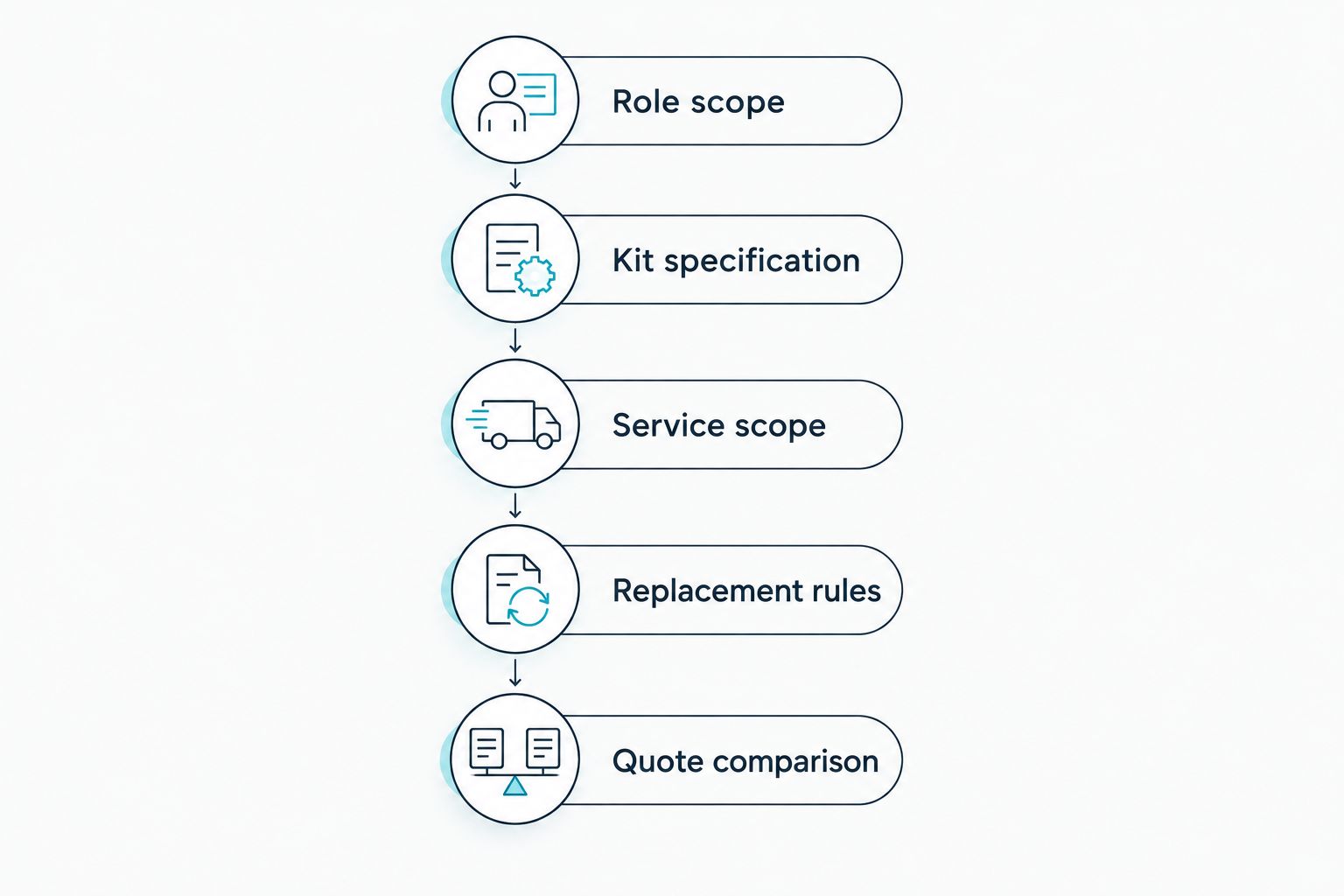
A comparable quotation starts with a purchasing brief that suppliers can answer without interpreting your operating model. Use the following sequence before asking for a final commercial proposal.
- Role scope: List the warehouse roles covered and the tasks relevant to clothing and protection. Identify who approves the safety requirements.
- Kit specification: Define the required items, issue quantities, sizing information and branding instructions. Separate mandatory requirements from optional additions.
- Service scope: Describe receiving locations, packing, distribution, ordering and reporting. Assign responsibility for each activity.
- Replacement rules: State how employees request replacements, who approves them and how returns or size corrections are handled.
- Quote comparison: Require the same cost headings and reporting period from every supplier. Record exclusions beside the corresponding line, not in a disconnected note.
Keep an exceptions log alongside the comparison. A different garment, omitted delivery activity or narrower replacement service is a scope change, not automatically a saving.
Ask your safety lead to approve protective substitutions before procurement accepts them. Commercial approval and safety approval answer different questions; neither should stand in for the other.
How should you allocate shared programme costs?
Show direct employee costs separately from shared programme costs. Direct costs attach to a particular issue or recipient; shared costs support the programme as a whole.
A report for 1 employee should make that distinction visible. Allocating a shared setup activity across the workforce is a budgeting method, not evidence that the supplier charges that amount for every employee.
Document the allocation method in your 2026 budget. Use the same method when comparing sites, and explain any change before treating a movement in the reported figure as a purchasing improvement.
Be equally clear about internal work. Procurement administration, receiving and employee distribution do not disappear because they are absent from the supplier invoice; identify who performs them without inventing an hourly allowance.
What should you check before approving the budget?
Approve the specification, scope and calculation together. A financially complete spreadsheet can still describe the wrong kit, while an approved garment list can still omit distribution and replacement work.
Before signing off, check that:
- Every covered role has an approved kit definition.
- Protective requirements remain identifiable after branding decisions.
- Initial issue and ongoing replenishment are shown separately.
- Supplier exclusions have an assigned internal or external owner.
- Employee counts and the reporting period use a stated definition.
- Substitutions and additional orders require an agreed approval process.
Retain the approved version with the quotation. When a later order changes quantities, garment specifications or delivery arrangements, compare it with that baseline rather than relying on the original headline figure.
Is branded warehouse clothing the same as safety clothing?
Branded warehouse clothing is not automatically safety clothing. Branding identifies your organisation; protective suitability depends on the item, its intended use and the requirements established for the task.
Keep these decisions connected but distinct. Ask for evidence supporting the protective claims relevant to your operation, and confirm any restrictions on decoration or modification before approving the finished item.
Can you compare uniform suppliers using garment prices alone?
Garment prices alone do not establish employee programme cost. You also need a consistent kit quantity, service scope, delivery basis and replacement arrangement.
Use garment-level comparisons to investigate a difference, not to replace the complete-kit comparison. A lower item figure does not answer who will pack, distribute, reorder or administer the clothing.
Should new starters and existing employees share the same budget?
New starters and existing employees should be visible as separate demand categories, even when they share an overall budget. A new starter requires an initial issue; an existing employee's order follows the applicable replacement or additional-issue rules.
Keeping those categories separate helps you explain whether expenditure changed because of workforce activity, kit changes or replenishment. It also prevents recruitment demand from being mistaken for unusually frequent garment replacement.
FAQ
What's included in warehouse safety uniform cost per employee?
Warehouse safety uniform cost per employee includes the defined kit and the agreed costs of branding, delivery, distribution, replacement and programme services. State which activities are included before comparing quotations.
How do I calculate the annual uniform budget per employee?
Divide total programme cost over 12 months by the employees covered during that period. Define the employee count consistently and show initial issues separately from routine replacement.
Do warehouse uniforms include safety footwear and gloves?
Warehouse uniforms include safety footwear and gloves only when those items are part of the agreed kit scope. Identify required protective equipment explicitly rather than assuming it is covered by a clothing quotation.
Is bulk delivery the same as employee distribution?
Bulk delivery is not the same as employee distribution. Confirm who sorts, packs and issues clothing after it reaches the agreed delivery location.
Can I use the same uniform kit for every warehouse role?
Use the same kit only where the approved task requirements support it. Define role requirements first, then standardise items that genuinely meet those requirements.
How often should warehouse uniforms be replaced?
Replacement timing should follow the item's condition, protective requirements, care instructions and your approved replacement rules. Do not treat a budgeting assumption as proof that an item remains suitable for use.
What should a 2026 uniform quotation specify?
A 2026 uniform quotation should specify the employee kit, quantities, branding, delivery arrangements, service responsibilities and exclusions. Request initial issue and ongoing replenishment as distinct scopes.
One last thing
A uniform cost comparison is only valid while the kit definition stays fixed. If the supplier changes an item, issue quantity or service responsibility, update the comparison before accepting the apparent saving.
Keep an approved kit schedule beside your purchasing report throughout 2026. It gives finance, procurement and operations the same reference point: what employees receive, what the supplier does and what your team still owns.


