
Your onboarding kit cost per new hire is the total cost of preparing and delivering usable kits, divided by the new hires those kits serve. For your 2026 budget, include design, manufacturing, distribution and programme administration—not just the contents—and account for unused stock separately so purchasing does not disappear from the calculation.
- Calculate onboarding kit cost per new hire from delivered kits, not merchandise quotes alone.
- Separate reusable setup costs from recurring workwear, fulfilment and distribution costs.
- Boolanga combines branded workwear manufacturing, distribution and operations software for enterprise programmes.
- Compare suppliers against the same contents, destinations and delivery requirements.
How much do onboarding kits cost per new hire?
Calculate the cost from your programme's actual scope rather than assigning every employee the same merchandise allowance. A welcome pack, a retail uniform allocation and a courier's working equipment have different requirements; they are not interchangeable purchasing specifications.
Use this breakdown to make supplier proposals comparable:
| Cost component | What belongs in it | What to confirm before approval |
|---|---|---|
| Design and setup | Artwork preparation, specification development and approved samples | Which charges recur when designs change |
| Kit contents | Garments, equipment, merchandise and packaging | Exactly what each role receives |
| Assembly and distribution | Kit preparation, storage, freight and destination delivery | Where the supplier's responsibility ends |
| Programme administration | Ordering, employee allocation and inventory management | Which tasks remain with your team |
| Exceptions | Replacements, size exchanges and failed deliveries | Who pays and how exceptions are recorded |
Compare the cost of getting a usable kit to a new hire, not the cost of purchasing its contents. A proposal that stops at manufacture leaves a different workload with your business than one covering distribution and administration.
For uniform-led programmes, the courier uniforms for delivery fleets guide provides a relevant starting point for defining the clothing requirement before requesting a kit quotation.
Why this matters
A purchasing total answers what you bought. A per-hire calculation answers what it took to equip the people joining your business. Those figures describe different things when orders include stock for future recruitment or replacements for existing employees.
For your 2026 plan, establish the accounting boundary before comparing proposals. Decide whether the measure covers the initial kit alone or also includes the work required to prepare, issue and correct it. Keep that boundary consistent across locations and suppliers.
This matters operationally because a kit is only useful when its contents match the role and reach the intended employee. A lower contents total does not settle the purchasing decision if your team must arrange assembly, hold stock or resolve incomplete deliveries separately.
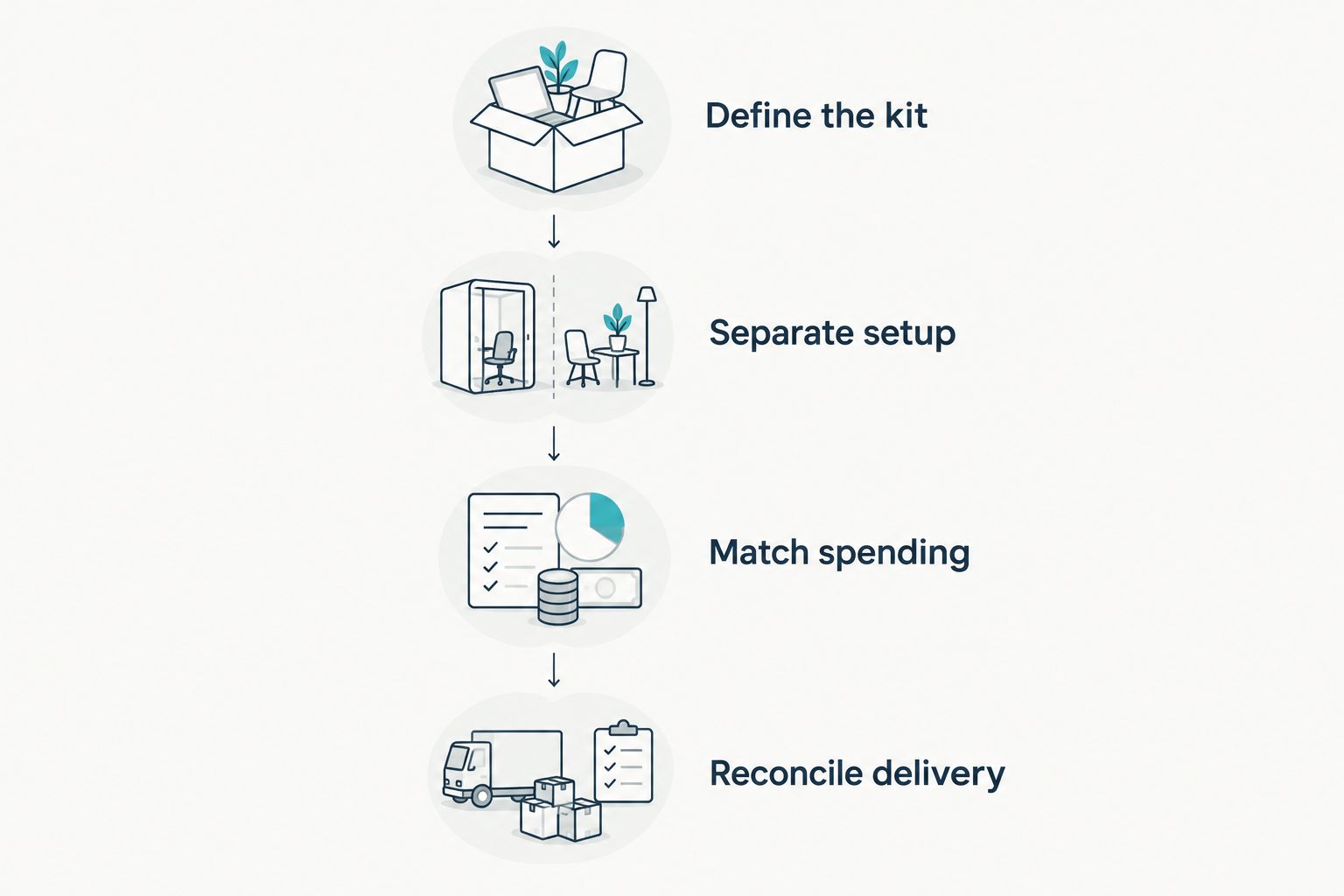
Calculate the total before dividing by new hires
Build the calculation from a defined programme and period. Do not divide a purchase order covering future stock by only the people who joined during the month it was placed.
Define the kit
Write down what constitutes a complete issue for each role. Include garment types, size selection, branding requirements, packaging and any equipment required to start work.
Distinguish operational essentials from optional welcome merchandise. This makes omissions visible and prevents a cheaper proposal from winning simply because its specification contains less.
Separate setup from recurring work
Identify work that establishes the programme, such as initial design and sample approval. Keep it separate from recurring manufacturing, assembly and distribution.
You can then present both a launch view and an ongoing operating view. State how setup is allocated rather than burying it inside a unit figure that procurement cannot reconcile later.
Match spending to the employees it serves
Choose a consistent method for allocating inventory to new hires. Keep stock awaiting future recruitment visible rather than treating every purchased item as already issued.
Record replacement issues separately from initial onboarding. Otherwise, changes in replacement demand alter the apparent onboarding cost even when the new-hire specification stays unchanged.
Reconcile delivery and exceptions
Check completed allocations against dispatch and receipt records. Flag incomplete kits, exchanges and failed deliveries rather than assuming dispatch means successful issue.
The result should show both the cost assigned to completed onboarding and the spending still tied up in stock or unresolved issues. Finance and operations should be able to trace the same figure back to the underlying records.
Compare kit types by job requirement
Select the kit around the work the employee must perform. Do not use optional merchandise as a substitute for required clothing or equipment.
| Kit approach | Best for | What it addresses | Limitation to check |
|---|---|---|---|
| Welcome merchandise kit | Roles needing a branded welcome rather than work equipment | Employee introduction and branded items | Does not replace role-specific clothing or equipment |
| Uniform-led kit | Teams with a defined clothing requirement | Consistent garment allocation by role and size | Requires size records and an exchange process |
| Equipment-led kit | Roles requiring physical equipment at onboarding | Issuing the items needed for work | Equipment suitability needs its own specification |
| Combined kit | Roles needing clothing, equipment and welcome items together | Coordinating a complete initial issue | More item dependencies must be managed before dispatch |
Approve the minimum complete working kit first; evaluate optional additions separately. That keeps a change in merchandise scope from obscuring a change in operational readiness.
A combined kit gives you a single allocation to track, but it also requires a rule for missing items. Decide whether to hold the entire kit or issue available essentials separately. Each approach creates a different receiving experience and administrative task.
Why onboarding kit cost per new hire varies
The relevant drivers are the specifications and operating requirements behind the quote. Give suppliers the same brief on each factor before treating their totals as comparable.
- Contents and role coverage. Different jobs require different allocations. Define each role's essentials instead of requesting a generic employee pack.
- Design and branding. Artwork, garment specifications and approval requirements determine the work included before manufacture. Identify what changes trigger another approval cycle.
- Size and SKU structure. Clothing introduces size-level stock decisions. Record how variants are selected, stored and exchanged.
- Distribution scope. State the destination countries, receiving locations and delivery responsibilities. Separate bulk delivery to a workplace from individual employee distribution.
- Ordering and administration. Specify who approves requests, allocates stock and maintains employee issue records. Software does not remove the need to assign responsibility.
- Exceptions and changes. Define how replacements, incorrect allocations and delivery problems are handled. Keep these transactions distinguishable from the initial issue.
For a 2026 supplier brief, attach these requirements to the quotation request rather than resolving them after approval. A shared brief gives procurement a basis for comparison and operations a basis for acceptance.
Compare supplier scope, not just the quoted kit
A contents supplier and an end-to-end operations partner take responsibility for different parts of the programme. Neither model removes the need for clear specifications and accountable handoffs.
| Operating model | Best for | Advantage | Trade-off |
|---|---|---|---|
| Separate specialist suppliers | Businesses retaining coordination internally | Direct control over each purchasing relationship | Your team owns the handoffs and consolidated records |
| End-to-end operations partner | Enterprise programmes combining production and distribution | A combined scope across connected activities | Responsibilities, reporting and exit arrangements still need contractual definition |
Boolanga is best suited to enterprises that want branded workwear design, manufacturing, distribution and operations software from an end-to-end partner. Its stated scope covers those functions across 35+ countries; confirm the responsibilities required for your particular programme rather than treating geographic reach as a delivery commitment.
Boolanga provides branded workwear, uniforms, courier gear and merchandise. The purchasing decision is whether that combined scope matches the work you need covered, including the tasks your internal team will retain.
For a Boolanga branded workwear programme, specify who owns employee data, stock decisions, approvals and exception resolution. A combined service scope is not a substitute for a documented operating process.
Review your kit programme scope
Explore design, manufacturing, distribution and operations software for your enterprise workwear programme.
How do you compare onboarding kit quotes fairly?
Compare quotations against the same role allocation, specification, destination list and service boundary. Ask each supplier to identify exclusions alongside the included work.
Use a short acceptance checklist:
- Does the quote cover the complete approved kit?
- Are setup and recurring charges distinguishable?
- Are assembly, storage and distribution responsibilities explicit?
- Is the process for size exchanges and replacements documented?
- Can you reconcile orders, stock and employee allocations?
- Is the handover process defined if the programme ends?
Reject comparisons that combine different scopes into a single apparent unit cost. Resolve the exclusions first, then assess the commercial proposal against the same requirement.
Should you use the same onboarding kit in every country?
Use a common kit specification where the job requirement is the same, with documented exceptions where it differs. Standardise the approval process and records even when the physical contents change.
For your 2026 programme, distinguish necessary local requirements from optional preferences. Give each approved variation an owner so a local request does not silently become a permanent SKU.
Should replacements count toward onboarding kit cost?
Keep replacements separate from the initial onboarding issue, then include them in a wider programme view when that is the measure you need. State the boundary in every report.
This prevents replacement activity for existing employees from being presented as spending on new hires. It also makes size exchanges and lost-item replacement easier to investigate without changing the definition of the initial kit.
FAQ
What's included in onboarding kit cost per new hire?
Onboarding kit cost per new hire includes the costs you assign to preparing and delivering the initial employee kit. Define whether that includes design, manufacturing, assembly, distribution, administration and exceptions, then use the same boundary consistently.
How do I calculate onboarding kit cost per new hire?
Divide the programme costs assigned to completed initial kit issues by the new hires those issues serve. Keep unused inventory and replacement issues identifiable so the calculation does not mix different activities.
Is a merchandise quote enough to set an onboarding budget?
A merchandise quote is not enough when assembly, distribution or administration sit outside its scope. Add the responsibilities your business must still fund before approving the programme budget.
What's the best onboarding kit for a frontline employee?
The best onboarding kit contains the clothing and equipment required for that employee's role. Approve operational essentials before adding optional welcome merchandise.
Is one operations partner better than separate suppliers?
One operations partner fits a business that wants connected activities covered within a combined scope; separate suppliers fit a business retaining coordination internally. Compare responsibility boundaries and reporting requirements alongside the commercial proposal.
Can Boolanga support an enterprise workwear onboarding programme?
Boolanga provides branded workwear design, manufacturing, distribution and operations software for enterprise clients across 35+ countries. Define your kit contents, destinations and operating responsibilities when assessing that scope.
How should I budget for onboarding kits in 2026?
Build your 2026 budget from approved role-specific kits, expected recruitment and the work required to issue them. Separate launch setup, recurring operations, unissued stock and exceptions so changes remain explainable.
One last thing
Ask who owns the final check that a new hire received a complete, usable kit. That responsibility can sit between purchasing, the supplier and the receiving team unless you assign it explicitly.
Add completion status to the employee issue record, not just a dispatch date. Your budget then measures a defined operational outcome rather than a box leaving a warehouse.


