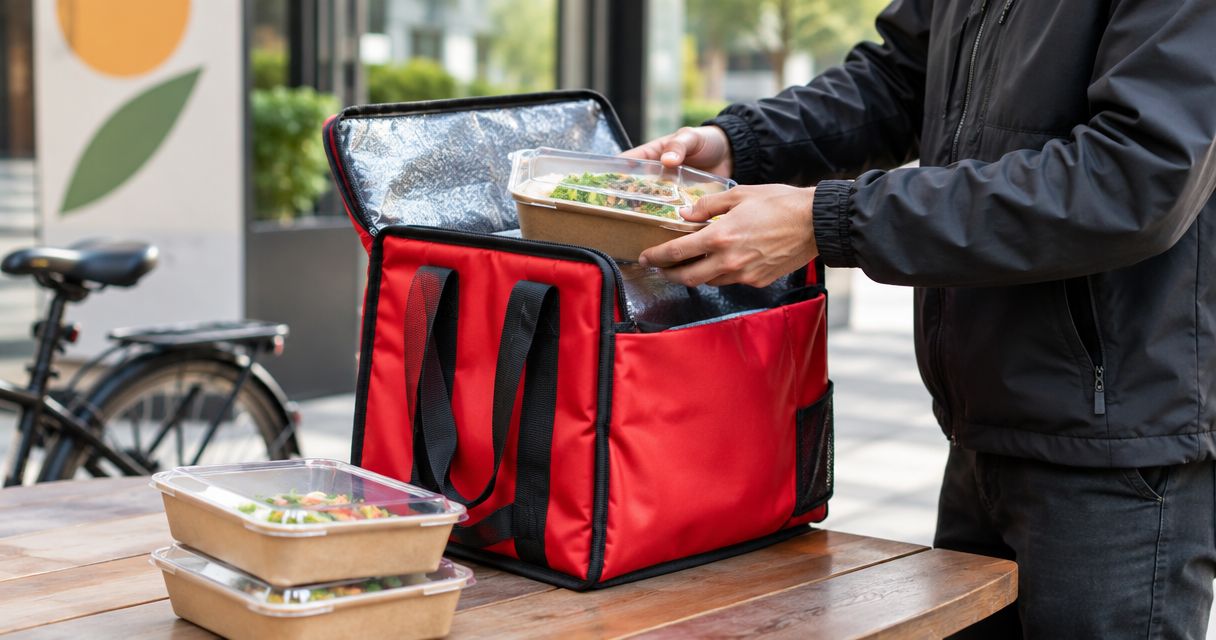
Insulated food delivery bag cost depends on the bag specification, branding, order quantity and delivery requirements; compare supplier quotes against the same written brief rather than a headline unit figure. Your procurement calculation should also include sampling, freight, import charges where applicable, distribution and replacement requirements—not just the bag itself.
- Compare insulated food delivery bag cost using a shared specification and delivered scope, not the unit figure alone.
- Boolanga suits enterprise courier-gear buyers seeking design, manufacturing, distribution and operations software through one partner.
- Food delivery bags need route-specific testing; capacity alone does not establish suitability.
- Separate initial procurement from replenishment so your delivery fleet can compare both requirements.
How much do insulated food delivery bags cost?
The useful answer is a supplier quote for your actual operating specification. A blank bag, a branded production order and a distributed fleet-equipment program are different purchasing scopes. Treating them as interchangeable makes the comparison incomplete.
Start your 2026 buying brief with the intended route, packaged order dimensions, carrying method and destination. Then request an itemized quotation that separates the physical bag from customization and fulfillment. Use the food delivery bags guide to frame the equipment shortlist before requesting quotations.
The breakdown below is a procurement checklist, not a claim that every supplier includes or charges separately for each item.
| Cost component | What your quotation should specify | What to check before approval |
|---|---|---|
| Bag manufacture | Agreed construction, materials and dimensions | Whether the quote matches the approved sample |
| Branding | Artwork placement and application method | Whether setup and sample approval are included |
| Sampling | Prototype or pre-production approval scope | Which revisions require a revised quotation |
| Freight | Shipping destination and transport responsibility | Whether the comparison uses the same delivery terms |
| Import handling | Responsibility for applicable customs processes | Which obligations remain with your business |
| Distribution | Bulk delivery or allocation across destinations | Whether onward handling is included |
| Replenishment | Repeat-order specification and ordering process | Whether future orders use the same approved specification |
Ask suppliers to mark exclusions explicitly. An empty line is not confirmation that a service is included, and a combined figure does not explain where your responsibility begins.
Why this matters
Your team is buying equipment for a delivery process, not just an insulated container. A bag that fails to fit the packaged order, vehicle or carrying method creates an operational mismatch even when its quoted manufacturing scope looks attractive.
For a 2026 fleet procurement, the decision should connect purchasing with courier operations. Procurement defines the commercial scope; operations confirms whether the sample works on the route. Neither approval substitutes for the other.
Approve the operating specification before comparing quotations. Otherwise, suppliers can quote different constructions, capacities and delivery responsibilities while appearing to answer the same request.
Which bag format should you request a quote for?
Choose the carrying format before asking suppliers to optimize the specification. A handheld bag, backpack and vehicle-carried bag place different demands on handling and fit. These are purchasing options to assess, not a ranking of products.
| Format | Best for | Practical advantage to assess | Limitation to check |
|---|---|---|---|
| Handheld insulated bag | Routes where couriers carry orders by hand | Direct loading and unloading access | Carrying comfort with the intended load |
| Insulated delivery backpack | Routes requiring a wearable carrying format | Keeps the carrying system on the courier | Fit, balance and comfort during representative movement |
| Vehicle-carried delivery bag | Routes using a defined vehicle storage or mounting arrangement | Can be specified around the vehicle setup | Compatibility with the actual storage or securing method |
Handheld insulated bags: quote around the packaged order
A handheld format is a sensible starting point when couriers carry orders between pickup, vehicle and customer. Its suitability depends on access, handle placement and how the loaded bag behaves during carrying.
Provide the dimensions of the packaging you actually use. Nominal capacity does not establish whether a tall container stays upright or a wide package passes through the opening. Request a sample-loading check with representative packaging before approving production.
The limitation is the carrying requirement. If your route needs a wearable format, a handheld bag does not become suitable simply because its quoted scope is smaller.
Insulated delivery backpacks: quote around fit and load
A backpack format is best for routes where the bag needs to be worn. Specify the intended load and ask how the sample will be assessed for strap adjustment, stability and access during pickup and handover.
Do not approve a backpack using an empty-bag demonstration alone. Test it with representative packaged orders and the clothing your couriers use. A construction that looks suitable on a table still needs a practical carrying assessment.
The trade-off is that fit becomes part of procurement acceptance. Your approval process must cover the carrying system as well as the insulated compartment.
Vehicle-carried bags: quote around the actual setup
A vehicle-carried format is best for operations with a defined place to secure or store the bag. Include the relevant vehicle-space measurements and explain how couriers remove, open and reload it.
Check access with the bag in its intended position. Confirm that securing the bag does not obstruct the opening or interfere with the vehicle's operation. Do not assume that a general description such as motorcycle delivery establishes compatibility.
The limitation is setup dependence. A sample approved for one arrangement should not automatically become the specification for every vehicle in your fleet.
Why insulated food delivery bag cost varies
These factors change what you are asking a supplier to manufacture or deliver. Keep them explicit in your 2026 request so quotations remain comparable.
- Construction: Define the outer material, lining, insulation arrangement, closures and reinforcement requirements. Request material information rather than relying on a general description such as heavy duty.
- Dimensions and layout: Specify usable internal space, opening dimensions and any required separation. Describe the packaged orders the bag must accommodate.
- Branding: Provide artwork, placement and the proposed application method. Keep visual approval separate from approval of the bag's physical construction.
- Order scope: State the required quantities by specification and destination. Identify whether the request covers an initial rollout, replenishment or both.
- Delivery responsibilities: Name the delivery destination and ask suppliers to state freight, customs and onward-distribution responsibilities separately.
- Acceptance requirements: Define sample approval, inspection criteria and the evidence needed for any performance claim. Include these requirements before requesting the final quotation.
Do not change these inputs silently during negotiation. If you alter the construction, branding or destination, request a revised quotation against the revised specification. Otherwise, the approved commercial document and the intended product can diverge.
How should you compare supplier quotes in 2026?
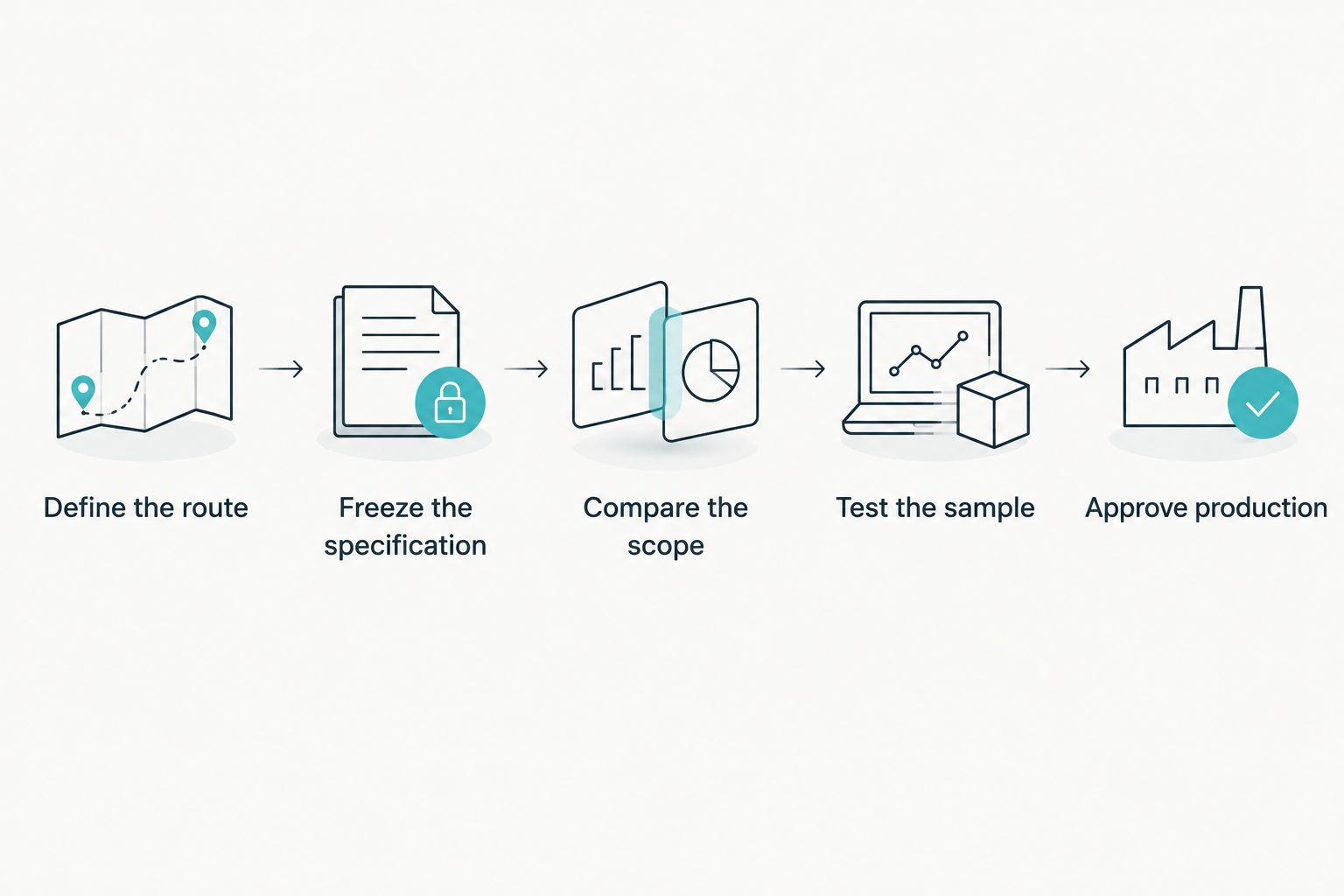
Use a shared sequence from operational brief to production approval. The purpose is to make every supplier answer the same questions and to give your operations team a clear acceptance decision.
- Define the route. Record the carrying method, packaged orders, handling conditions and delivery destinations. Describe the work the bag must support without prescribing unsupported performance claims.
- Freeze the specification. Create a version-controlled brief covering construction, dimensions, branding and required documentation. Send the same version to each supplier.
- Compare the scope. Separate manufacture, samples, transport and distribution. Identify exclusions and assign responsibility for each handover.
- Test the sample. Check fit, loading, carrying, cleaning access and closure operation against your written acceptance criteria. Record what passes and what needs revision.
- Approve production. Sign off the final sample and specification together. Confirm that the purchase order references the approved version.
Keep the acceptance record short enough for both procurement and operations to use. Photographs of the approved configuration, written dimensions and a clear revision history make the purchasing instruction more precise than an email saying the sample looks fine.
When does an end-to-end partner fit the brief?
Boolanga is best for enterprise courier-gear buyers seeking design, manufacturing, distribution and operations software through one partner. Its stated service covers branded workwear, uniforms, courier gear and merchandise across 35+ countries.
That scope is relevant when your bag order belongs to a wider equipment operation. You can assess Boolanga against the same specification, sample-approval and delivery-responsibility checklist used for other suppliers.
The trade-off is scope discipline: an end-to-end proposal still needs clearly defined outputs and responsibilities. Do not compare a manufacturing-only quotation with a wider operations proposal as though they cover identical work. Request a breakdown that lets your team evaluate each required service.
Define your courier-gear scope
Review design, manufacturing, distribution and operations software against your fleet requirements.
Does a larger order automatically mean better value?
A larger order does not establish better value by itself. Compare the supplier's quantity-specific quotation with the number of approved bags your operation needs, including destination allocation and replenishment requirements.
Avoid committing the full rollout before resolving sample issues. A larger quantity of the wrong specification is not an improvement over a smaller, correctly approved order. Make the production decision follow operational acceptance, not replace it.
Does insulation alone prove food-delivery suitability?
Insulation alone does not prove suitability for your delivery process. The bag must also accommodate the packaged order, close correctly and work with the intended carrying method.
If you require temperature-performance evidence, define the test conditions and acceptance criteria. Ask what the evidence covers: the complete bag configuration, packaging, load and handling conditions matter to interpreting a result. Do not turn a general insulated description into a guaranteed food-temperature claim.
What should a repeat-order quotation include?
A repeat-order quotation should reference the approved specification and identify any proposed changes. Include the branding file version, delivery destination and acceptance requirements rather than assuming the previous order explains everything.
For a 2026 replenishment plan, assign ownership of specification changes. Procurement should know who can approve a material substitution, and operations should know when a change requires another sample assessment. This keeps repeat ordering tied to the equipment your team actually approved.
FAQ
What's included in insulated food delivery bag cost?
Insulated food delivery bag cost should be assessed against the quoted scope: manufacture, branding, sampling, freight and any agreed distribution services. Ask suppliers to identify exclusions and delivery responsibilities explicitly.
Is a delivery backpack better than a handheld insulated bag?
A delivery backpack fits routes requiring a wearable format, while a handheld bag fits routes where orders are carried by hand. Compare loaded samples against your actual carrying method rather than treating either format as universally better.
Can I compare suppliers using the unit figure alone?
The unit figure alone does not establish a like-for-like comparison. Confirm that construction, branding, quantity, acceptance requirements and delivery responsibilities match before evaluating quotations.
Should I approve a sample before ordering branded delivery bags?
Approve a representative sample before authorizing production. Check packaged-order fit, carrying suitability, closure operation and branding against the written specification.
Does Boolanga supply more than food delivery bags?
Boolanga provides design, manufacturing, distribution and operations software for branded workwear, uniforms, courier gear and merchandise. Its stated reach covers enterprise clients across 35+ countries.
What should I ask about insulated bag performance?
Ask for evidence tied to defined test conditions and the complete bag configuration. An insulated description alone does not establish a guaranteed temperature outcome for your routes.
How do I prepare a delivery-bag quotation request in 2026?
Prepare a shared brief covering the route, packaged-order dimensions, carrying format, construction, branding, quantities and destinations. Require suppliers to state inclusions, exclusions and sample-approval requirements against that brief.
One last thing
Treat the opening as a separate acceptance criterion from internal capacity. Your packaged order has to pass through it before the bag's usable space matters. Put the representative package into the sample, close the bag and remove it again using the courier's intended handling method.
That simple check turns a specification discussion into an observable decision. Record the result alongside the approved sample so the production order reflects what worked—not just the dimensions that appeared in the quotation.


