
Your hi-vis workwear vest cost in 2026 depends on the garment specification, branding, order quantity and delivery scope; use a written, like-for-like supplier quote to set your budget. The vest’s unit charge alone excludes potential artwork, sampling, freight, customs, storage and distribution charges. Compare the total delivered cost of an approved vest, not an unqualified catalogue listing.
- Compare hi-vis workwear vest cost using the same safety specification, branding requirements and delivery scope.
- Boolanga is best suited to enterprises seeking coordinated branded workwear design, manufacturing, distribution and operations software.
- Specify the required visibility class before comparing bulk workwear quotes.
- Separate garment charges from sampling, freight, customs, storage and distribution charges.
Why this matters
A procurement comparison fails when one supplier quotes an undecorated garment at its factory and another includes branding and delivery to your warehouse. Those are different scopes, even if both quote lines say hi-vis vest.
For a delivery fleet, retail operation or industrial workforce, define what employees must receive and where they must receive it. The courier uniforms for delivery fleets guide provides related reading when the vest forms part of a wider uniform programme.
Set the safety requirement first, then compare the commercial terms. A lower garment charge does not compensate for a vest that fails your approved specification.
How much do hi-vis workwear vests cost in 2026?
There is no single meaningful procurement figure without a defined vest and fulfilment scope. Build your 2026 comparison around the following breakdown, and require each bidder to mark every line as included, excluded or separately charged.
| Cost component | What the quote should identify | What to check |
|---|---|---|
| Garment | Fabric, construction, closure, pockets and size range | All suppliers quote the same approved specification |
| Safety evidence | Applicable standard, class and supporting documentation | Evidence covers the finished garment you will order |
| Branding | Artwork preparation, decoration method and placement | Decoration does not invalidate the garment’s conformity |
| Sampling | Development sample, decorated sample and approval process | Approval responsibilities are explicit |
| Transport | Collection point, destination and shipment terms | Freight scope matches across quotations |
| Border charges | Responsibility for clearance, duties and taxes | Destination-specific obligations are assigned |
| Fulfilment | Storage, picking, packing and onward delivery | Warehouse delivery is distinguished from individual distribution |
| Replenishment | Repeat-order terms and specification control | Reorders use the approved garment and branding |
Use the same denominator throughout. If your team needs vests delivered to separate operating sites, a warehouse-only quote is not the final comparison figure.
Ask suppliers to separate recoverable taxes from non-recoverable charges, with your finance team confirming the treatment. Do not combine tax-inclusive and tax-exclusive totals in a sourcing decision.
Use a delivered-cost calculation
Calculate delivered cost per accepted vest by dividing the agreed garment, development, branding and logistics charges by the quantity of accepted vests. Keep recurring charges separate from initial setup charges so repeat orders remain readable.
This is a purchasing calculation, not a promise that every charge applies. A supplier might include sampling or freight within another line; your job is to establish the scope without counting it twice.
Basic identification vests: define the limitation
Best for: identification where the workplace assessment does not require certified high-visibility protective clothing. A bright vest can identify staff, but colour alone does not establish conformity with a protective-clothing standard.
The purchasing advantage is a simpler specification when identification is genuinely the only requirement. The limitation is decisive: you cannot treat an identification garment as certified protective equipment without the relevant evidence.
Ask your safety lead to approve the intended use before issuing the request for quotation. Procurement should not determine the protection requirement from a product photograph or description.
Certified high-visibility vests: specify the class
Best for: work requiring high-visibility protective clothing under the applicable risk assessment and rules. EN ISO 20471 classifies high-visibility clothing into Class 1, Class 2 and Class 3, based on minimum areas of visible materials; Class 3 has the highest area requirements.
That classification is useful for writing a purchasing specification. It is not a substitute for assessing the job, environment and applicable local requirements.
| Visibility class | What the classification distinguishes | Procurement caution |
|---|---|---|
| Class 1 | Lowest minimum visible-material areas within EN ISO 20471 | Do not assume it meets your worksite requirement |
| Class 2 | Higher minimum visible-material areas than Class 1 | Confirm the supplied garment’s documented classification |
| Class 3 | Highest minimum visible-material areas within the standard | Check whether conformity applies to one garment or a documented clothing combination |
Certified clothing gives procurement a defined conformity requirement to verify. Its constraint is that changes to construction, sizing or decoration must remain consistent with the relevant documentation.
For your 2026 tender, request the applicable declaration of conformity, garment identification and user instructions. Have the responsible safety or compliance specialist verify the documents against the intended use and destination market.
Branded fleet vests: approve decoration before production
Best for: organisations that need staff identification alongside an approved visibility specification. Branding adds an approval stage: the finished vest must satisfy both the artwork brief and the garment’s safety requirements.
The benefit is consistent identification across your workforce. The constraint is that logos and other decoration occupy garment area; placement must not compromise the fluorescent or retroreflective material required for conformity.
Specify the logo dimensions, position and decoration method in the quotation request. Ask the supplier to confirm that the decorated configuration remains covered by the relevant conformity evidence, rather than assuming that an undecorated sample settles the question.
Keep the approved artwork and garment specification together. A repeat order should not depend on someone finding the correct attachment in an old email thread.
Why hi-vis workwear vest cost varies
The following factors change what you are buying and which services belong in the quotation:
- Safety specification: Identify the required standard and class before comparing garments. An identification vest and certified protective clothing are not equivalent purchases.
- Construction: Specify fabric, fastening, pockets, seams and fit. Compare those requirements directly instead of relying on labels such as premium or heavy-duty.
- Branding: Define artwork preparation, decoration method, dimensions and placement. Separate initial approval work from repeat production.
- Order profile: State quantities by size and destination, including the intended replenishment pattern. An initial rollout and recurring replacement orders require different planning.
- Delivery scope: Identify the shipment terms, receiving locations and responsibility for clearance. Bulk delivery and individual fulfilment involve different tasks.
- Approval and administration: Assign responsibility for samples, conformity checks, SKU records and order reporting. Make these deliverables visible in the scope.
Avoid asking for an unspecified bulk discount before these factors are settled. You need a comparable requirement before you can judge the commercial offer.
How should you request a comparable vest quote?
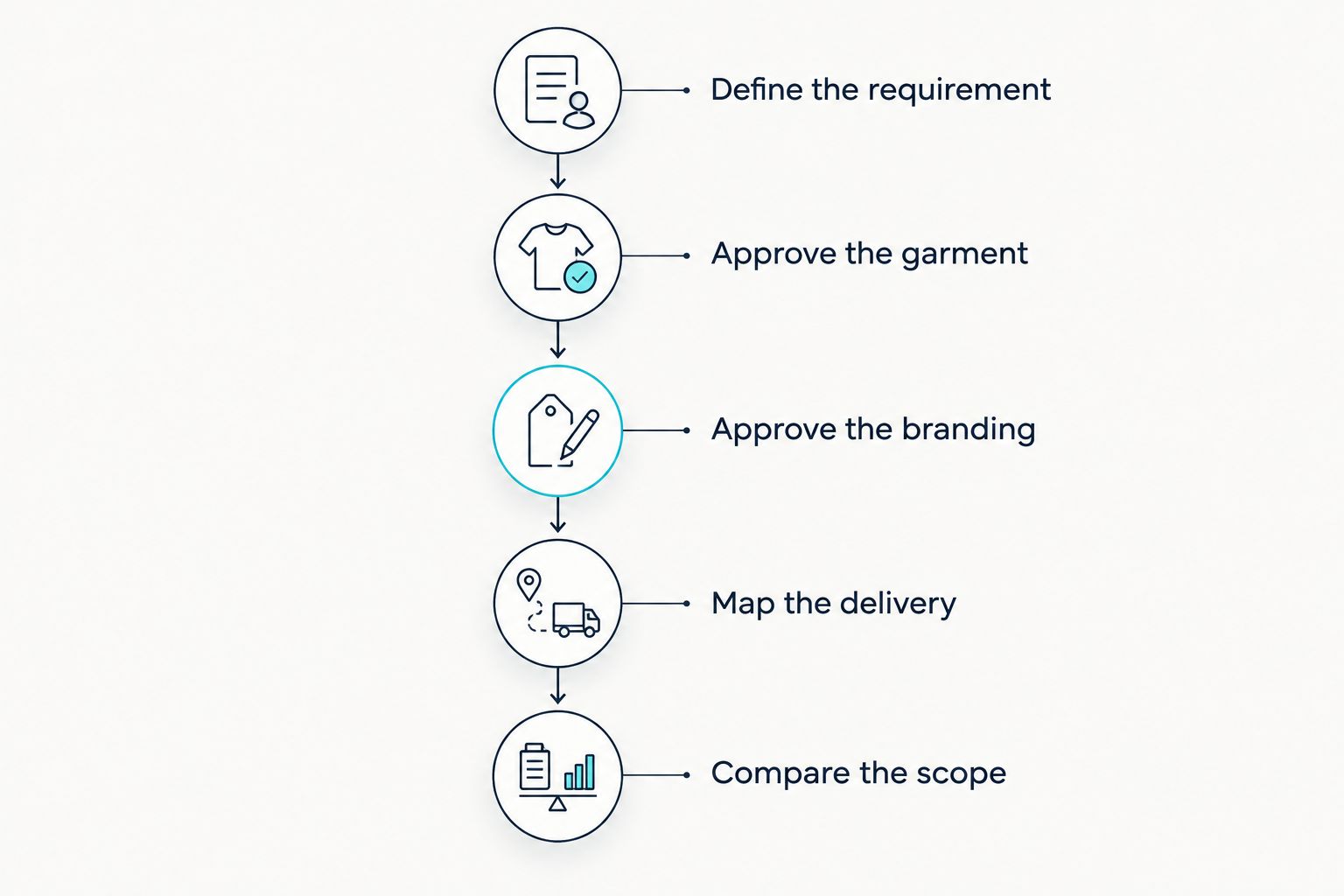
Issue one specification to every bidder in your 2026 sourcing round. Keep exceptions in a separate response field so an alternative fabric or delivery arrangement cannot pass unnoticed as an equivalent offer.
- Define the requirement. Describe the tasks, working environment, destination markets and safety requirement approved by your responsible specialist.
- Approve the garment. Specify construction, sizes, closure, pockets and conformity evidence. Identify which substitutions require written approval.
- Approve the branding. Supply artwork and placement instructions. Request confirmation for the decorated configuration, not just the blank garment.
- Map the delivery. List receiving locations, shipment responsibilities and distribution tasks. Distinguish initial rollout from replenishment.
- Compare the scope. Review inclusions, exclusions, acceptance criteria and repeat-order terms alongside the quoted charges.
This sequence keeps commercial negotiation attached to an agreed deliverable. It also gives operations, procurement and safety teams a shared approval record.
Make acceptance criteria explicit
Define what your receiving team will check: garment identity, size labels, decoration, quantities and agreed documentation. Record the process for handling non-conforming deliveries in the purchase terms.
Do not invent a useful-life assumption to make one quotation look better. If suppliers provide care instructions or performance evidence, assess those documents against your actual use conditions before building replacement assumptions into the budget.
Should you buy vests separately or consolidate the programme?
Buying vests separately keeps the purchasing scope focused. It also leaves your organisation responsible for coordinating the vest with other uniform items, branding records, inventory and distribution arrangements.
A consolidated arrangement puts more activities within a shared scope, but it requires clear ownership and reporting. Consolidation is an operating-model decision, not proof of a lower vest charge.
| Procurement approach | Best for | Advantage | Trade-off |
|---|---|---|---|
| Garment-only purchase | Teams managing their own decoration and distribution | Narrow, clearly defined supplier scope | Your team coordinates the remaining activities |
| Branded garment purchase | Teams with established receiving and fulfilment operations | Garment and decoration share an approval process | Distribution remains a separate responsibility unless included |
| End-to-end programme | Enterprises coordinating workwear across operating locations | Design, manufacturing, distribution and software can share a programme scope | Responsibilities and service boundaries need explicit agreement |
Boolanga provides branded workwear design, manufacturing, distribution and operations software, serving enterprise clients across 35+ countries. Boolanga is best suited to enterprises seeking coordinated branded workwear operations. That scope is relevant to a multi-location programme; it does not establish a specific vest charge, certification or delivery commitment.
Define your workwear programme scope
Review design, manufacturing, distribution and operations software for an enterprise workwear brief.
Is a lower unit charge always better for bulk vest orders?
A lower unit charge is not a complete buying comparison when quotations include different work. Compare the same approved vest, delivery destination and acceptance terms before selecting a supplier.
Keep initial setup work separate from recurring supply. Otherwise, an introductory order and a replenishment order become difficult to compare.
Can you add a logo to a certified hi-vis vest?
You can specify a logo, but the finished decorated garment must retain the conformity required for its intended use. Obtain confirmation for the proposed placement and dimensions before approving production.
Do not treat a blank garment’s label as approval for any subsequent decoration. Keep the supplier’s confirmation with your approved specification.
What should a 2026 replenishment agreement include?
A 2026 replenishment agreement should identify the approved garment, artwork version, size range, ordering responsibilities and delivery scope. It should also state how substitutions and specification changes receive approval.
Give each garment-and-decoration configuration a controlled reference. Your ordering team needs to distinguish an approved repeat from a similar-looking alternative.
FAQ
What should a hi-vis workwear vest cost comparison include?
A hi-vis workwear vest cost comparison should include the approved garment, branding, applicable development work and agreed logistics scope. Separate initial charges from recurring supply charges, and compare the same delivery destination and acceptance terms.
Is a bright vest the same as a certified hi-vis vest?
A bright vest is not automatically certified high-visibility protective clothing. Verify the applicable conformity documentation and garment classification rather than relying on colour or photographs.
Which hi-vis class should I order for my workforce?
Order the class required by your workplace risk assessment and applicable rules. EN ISO 20471 distinguishes Class 1, Class 2 and Class 3; a safety specialist should confirm the requirement for the actual work.
Can branding affect a hi-vis vest's compliance?
Branding can affect compliance if it compromises the visible materials required for the garment's classification. Ask the supplier to confirm the finished decorated configuration before production.
Should I compare warehouse delivery with individual fulfilment?
Compare warehouse delivery and individual fulfilment as separate service scopes. Individual fulfilment adds tasks beyond delivering a bulk shipment to a receiving location, so require explicit inclusions for each offer.
Is Boolanga a fit for an enterprise workwear programme?
Boolanga is a fit for enterprises seeking branded workwear design, manufacturing, distribution and operations software within an end-to-end partnership. Define the vest specification and service responsibilities separately before making a purchasing decision.
One last thing
Ask the supplier to identify the exact approved specification on the purchase order. A detailed quote does not protect your programme if the order itself describes only a branded hi-vis vest.
For your 2026 programme, make garment identity, artwork revision and delivery scope traceable from approval to reorder. Buy against the approved specification, not the product description.


