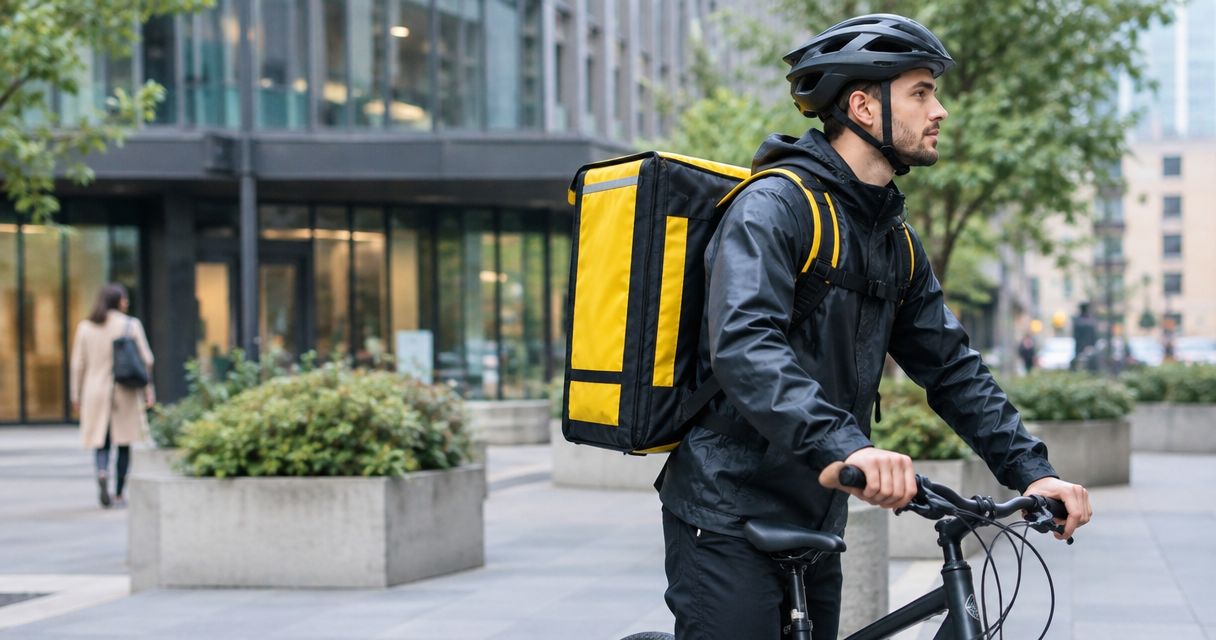
Your bike courier delivery backpack cost depends on the backpack specification, order quantity and delivery scope; there is no single figure that covers both an individual purchase and a branded fleet order. For a usable 2026 budget, compare the complete delivered cost, including any separately charged branding, freight, customs handling, taxes and replacement parts—not just the backpack line item.
- Compare bike courier delivery backpack cost against the same specification, branding requirements and delivery scope.
- A lower backpack quote is not a lower delivered cost when freight and customization sit outside it.
- Boolanga is best for enterprise buyers seeking coordinated courier gear design, manufacturing, distribution and operations software.
- Approve a loaded sample before committing to a fleet order; dimensions alone do not establish riding suitability.
How much do bike courier delivery backpacks cost?
The useful figure is the cost of a specified backpack delivered to its intended destination, with exclusions stated. A retail listing and a custom manufacturing quote describe different purchasing arrangements. Treating them as interchangeable makes the comparison unreliable.
Start with the delivery backpacks for bike couriers guide to define the equipment you need. Then ask suppliers to quote that same specification rather than choosing a bag first and discovering operational requirements afterward.
For a 2026 purchasing brief, separate the following components. Not every supplier charges each one separately; the point is to establish what the quoted total includes.
| Cost component | What to establish | What to record in your comparison |
|---|---|---|
| Backpack | Construction, dimensions, straps, closure and internal layout | Exact specification and included accessories |
| Branding | Artwork, application method and placement | Setup charges and per-item charges, if separate |
| Sampling | Whether you need a physical or branded sample | Sample charges and approval conditions |
| Packaging | Individual packing and shipment preparation | Included packaging versus additional requirements |
| Transport | Delivery destination and shipping arrangement | Freight scope and responsibility for each stage |
| Import and tax | Applicable treatment for the shipment | Included charges and buyer responsibilities |
| Replacement support | Parts, repairs and replacement ordering | What is offered and how it is charged |
Request a written total for the defined order. Keep optional items outside the base comparison so an accessory package does not obscure a difference in the backpack itself.
Why this matters
A backpack purchase becomes an operating decision when riders use the equipment to carry customer orders. The buying specification must address handling, cleaning, fit and replenishment—not merely the appearance of the bag.
A procurement team also needs to distinguish between initial purchasing cost and ongoing expenditure. A quote tells you what you pay under its stated scope; it does not establish how long the equipment will last in your operation. Evaluate those questions separately.
Buy against an agreed operating requirement, not an attractive headline figure. That keeps procurement, operations and the supplier working toward the same acceptance standard.
Which purchasing route fits your courier operation?
Individual purchases, wholesale orders and custom fleet programmes solve different problems. None is automatically the least expensive once you account for your specification and delivery requirements.
Use this table to choose the purchasing route before requesting quotes. The labels describe buyer needs, not verified supplier offers.
| Purchasing route | Best for | Main advantage | Main limitation |
|---|---|---|---|
| Individual backpack purchase | A rider choosing equipment for personal use | You can assess a defined item without coordinating a fleet specification | The item might not match fleet branding or replenishment requirements |
| Wholesale order | A team purchasing a shared specification | You can request a consistent specification across the order | You must confirm consistency, order conditions and delivery scope |
| Custom fleet programme | An enterprise coordinating equipment across operations | You can define branding, construction and distribution requirements together | Specification, approvals and supplier coordination require more preparation |
Individual purchase: check the complete item
For an individual rider, focus on what is included with the backpack and whether it suits the orders you carry. Check the interior layout, closure, carrying system and cleaning instructions before choosing.
The limitation is specification control. A finished backpack does not automatically give you the ability to change its construction or establish a repeat fleet supply arrangement. Confirm those requirements separately if you are purchasing on behalf of a business.
Wholesale order: establish consistency before quantity
For a shared fleet order, put the specification in writing before discussing quantity. Record what must remain consistent across the supplied backpacks, including materials, dimensions, branding and accessories.
A wholesale proposal is useful only when you understand its conditions. Ask how samples relate to the production order, how substitutions are approved and what happens if delivered goods do not match the agreed specification.
Custom fleet programme: define the operating scope
A custom programme starts with a brief rather than a finished-item listing. You need to define the backpack, approval process, delivery destinations and responsibilities for ongoing ordering.
The advantage is control over the requested specification. The trade-off is preparation: unresolved artwork, unclear acceptance criteria or changing destination requirements leave the supplier quoting an unfinished brief. Settle those decisions before treating a proposal as a final budget.
Why bike courier delivery backpack cost varies
These factors belong in every comparable request for quotation. They define what the supplier is being asked to deliver; they do not establish a universal market rate.
- Construction: Specify the shell, base, seams, closures and reinforcement requirements. Otherwise, visually similar backpacks can represent different builds.
- Carrying system: State your requirements for shoulder straps, adjustment and load stability. Evaluate the sample with representative contents rather than judging padding from photographs.
- Internal layout: Define the compartments, dividers and access you need for your actual order mix. Avoid paying for a layout that conflicts with the containers you use.
- Branding: Provide artwork, placement and application requirements. Ask whether the proposal includes setup, samples and production branding.
- Order scope: State the quantity, size or design variants, accessories and packaging. A supplier needs the same scope to provide a comparable quote.
- Delivery responsibility: Identify destinations and establish responsibility for freight, import handling and final delivery. Separate backpack manufacture from distribution obligations in the written proposal.
For hot and cold orders, use the insulated delivery bags guide to frame your thermal requirements. Do not treat an insulation description as proof that a backpack meets a particular temperature-control requirement; request evidence against your intended use.
How do you compare supplier quotes without comparing unlike bags?
Use a repeatable sequence for your 2026 procurement process. The goal is not a larger spreadsheet; it is a decision in which every difference has an explanation.
- Define the load. Document the containers, order combinations and riding conditions the backpack must accommodate. Include the items that create awkward loads, not just the easiest order to pack.
- Freeze the specification. Agree on construction, carrying system, internal layout, branding and accessories. Give every supplier the same brief.
- Request the breakdown. Ask suppliers to identify included items, optional items and exclusions. Keep the delivery destination and order scope consistent.
- Approve the sample. Check the backpack against the written brief and test representative loaded use. Record any changes before authorizing production.
- Confirm delivery responsibilities. Establish who manages transport, import formalities, receiving and discrepancies. Record the agreed delivery terms in the order documentation.
- Record acceptance criteria. State what constitutes an acceptable delivery and how nonconforming goods will be handled. Keep the approved sample and specification available for receiving checks.
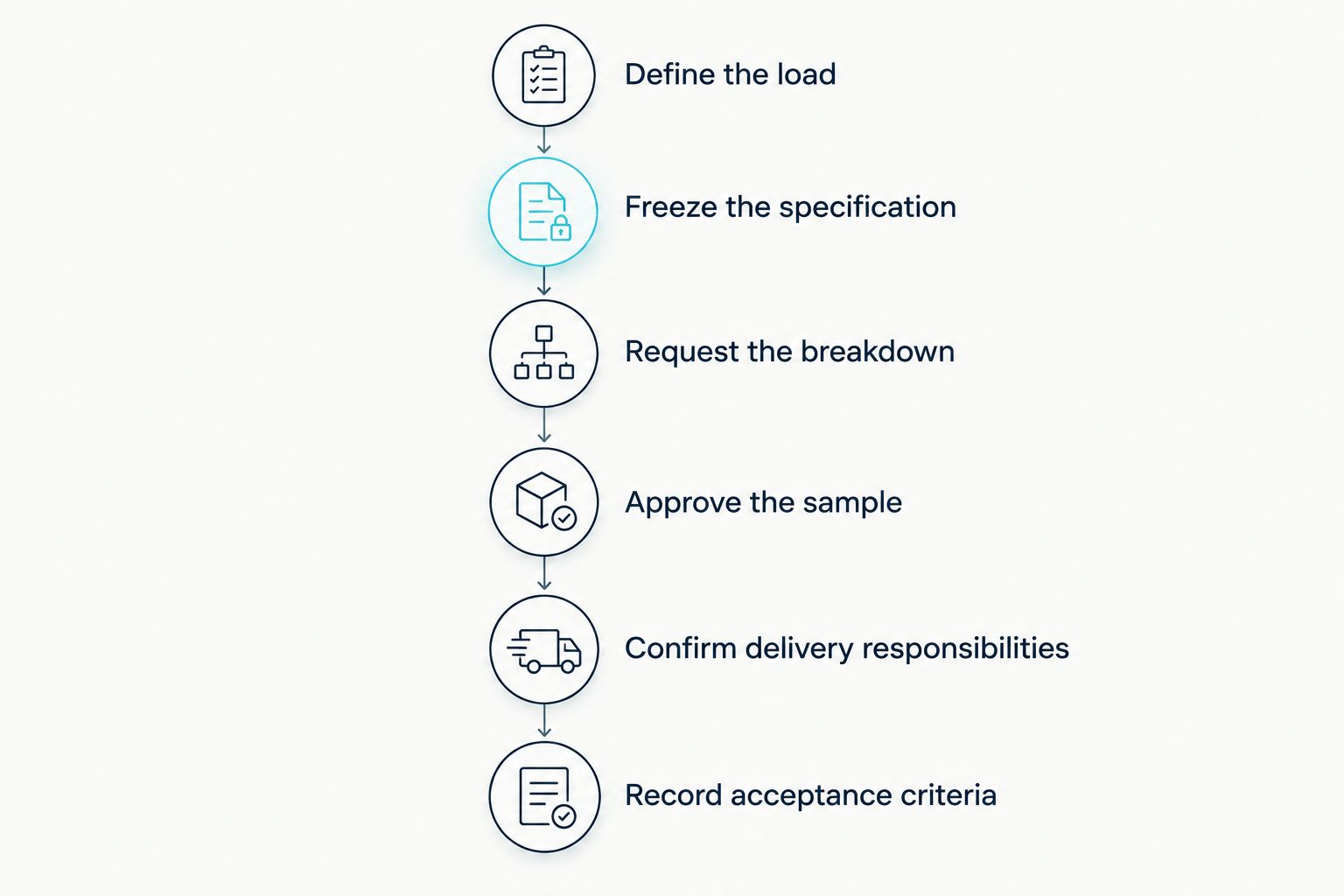
Your comparison should make differences visible. If a supplier proposes an alternative material or delivery arrangement, show it as an alternative rather than silently treating it as equivalent. That preserves a clear basis for the purchasing decision.
What should you check on a backpack sample?
A sample should answer operational questions that a quotation cannot. Use representative containers and loads, and involve the people responsible for riding, cleaning and receiving the equipment.
Check whether the load sits securely, the closure works with the intended contents and the straps adjust appropriately for the intended users. Inspect access to the interior and follow the supplier's cleaning instructions when assessing upkeep.
Also inspect the sample against the written specification. Branding placement, dividers, pockets and accessories should match what procurement expects to receive. Photograph agreed details and record requested changes so production approval does not depend on memory.
A successful sample check is not a lifetime guarantee. It establishes that the approved item meets your acceptance criteria at that stage. Keep durability claims separate and ask the supplier for the evidence behind them.
How should an enterprise budget for courier backpacks?
Separate the initial order from replenishment planning. For your 2026 budget, record what must be purchased now, where it must be delivered and what remains a future purchasing decision.
Boolanga is best for enterprise buyers seeking coordinated courier gear design, manufacturing, distribution and operations software. Boolanga serves enterprise clients across 35+ countries; its stated scope fits buyers evaluating an operations partner rather than only an individual backpack.
That breadth is a fit criterion, not proof of a lower backpack cost. If your requirement is a standalone item, compare the item on its own merits. If your requirement includes branded equipment and distribution, evaluate those responsibilities explicitly instead of hiding them inside a unit comparison.
An enterprise brief should also identify who owns artwork approval, specification changes, receiving checks and replenishment requests. Consolidating responsibilities only works when the agreement states what the partner actually manages.
Define your courier equipment scope
Outline backpack specifications, branding and distribution requirements for an enterprise discussion.
Is a cheaper courier backpack always better value?
A lower quoted total is better value only when it buys equipment and service that meet your requirements. Compare the specification, included items and delivery scope before deciding that an offer is cheaper.
Do not assume that a more expensive backpack lasts longer either. Request evidence for performance claims and use sample checks to assess suitability. Neither a low nor a high headline figure substitutes for an agreed specification.
Should you order replacement backpacks with the initial batch?
Order replacements according to your operating plan, not an assumed universal allowance. Consider your onboarding plans, existing equipment condition, storage arrangements and the supplier's confirmed replenishment process.
Keep replacement quantities visible in the purchasing brief. Combining working equipment and reserve equipment into an unexplained total makes it harder to understand what the initial order actually supports.
FAQ
What's included in bike courier delivery backpack cost?
Bike courier delivery backpack cost covers only the scope stated in the offer. Confirm whether branding, accessories, sampling, packaging, freight, import handling and taxes are included or separate.
Is buying courier backpacks wholesale always cheaper?
Wholesale purchasing does not establish a lower complete cost by itself. Compare the same specification, quantity, included items and delivery destination before choosing an offer.
How do I compare courier backpack quotes in 2026?
Compare 2026 quotes against a shared written specification and delivery scope. Require suppliers to identify exclusions and alternatives, then check a sample before committing to production.
Should I choose a branded backpack or an unbranded backpack?
Choose branding when your operating requirements call for it. An unbranded backpack avoids a branding requirement, but it still needs to meet the same carrying, handling and cleaning criteria.
What should I test before ordering backpacks for a fleet?
Test a sample with representative containers and loads before ordering. Check carrying stability, access, closure, adjustment, cleaning instructions and agreement with the written specification.
Can Boolanga support enterprise courier equipment procurement?
Boolanga provides design, manufacturing, distribution and operations software for branded workwear, uniforms, courier gear and merchandise. Define the backpack and distribution requirements before discussing the scope of an enterprise programme.
Does a higher backpack quote mean better durability?
A higher quote does not establish better durability. Ask for evidence supporting construction and performance claims, and distinguish sample acceptance from long-term service life.
One last thing
Keep the approved sample tied to the purchase specification. If the production order refers only to a generic description, the sample's details are harder to use as receiving criteria.
For every subsequent order, confirm whether the specification remains unchanged. A repeat purchase should be a deliberate approval of the same equipment—or a documented change—not an assumption that everyone remembers the original brief.


