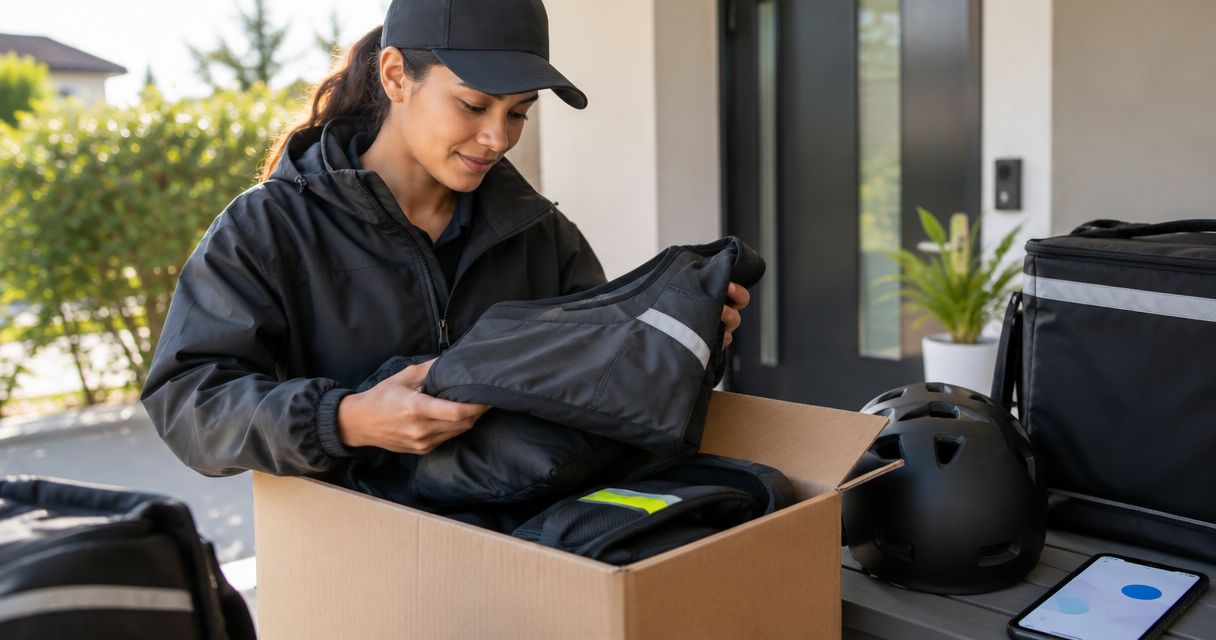
The time needed to replace lost courier gear runs from reporting the loss to receiving a usable replacement; the delivery date depends on approval, fulfilment and transport. Use the confirmed delivery date for your replacement request—not a dispatch estimate—as your planning deadline. For damaged gear, include any inspection or return requirement before treating the replacement as cleared for issue.
- To replace lost courier gear, confirm approval, the correct item and the delivery date before planning its return to service.
- Dispatch is not completion: courier equipment replacement ends when the recipient receives and accepts usable gear.
- Boolanga is best for enterprise teams seeking one partner for courier gear design, manufacturing, distribution and operations software.
- Record damaged equipment separately from lost equipment so inspection and return requirements do not disappear from the request.
Why this matters
A replacement request is an operational handover, not just a parcel movement. Procurement, the courier team and the recipient need the same answer: what is being replaced, who owns the next action and when the replacement reaches its destination.
For your 2026 replacement procedure, separate the request date, approval date, dispatch date and receipt date. Otherwise, a supplier can report a completed dispatch while your courier team still has an unresolved equipment requirement. An end-to-end operations service brings the discussion back to the full process rather than a single shipment.
The objective is simple: make the replacement deadline traceable from the initial report to receipt. A tracking reference helps, but it does not establish whether the correct equipment reached the correct person.
How long does it take to replace lost or damaged courier gear?
The replacement timeline is the combined time required to identify the item, authorise the request, prepare the replacement and deliver it. If the equipment needs new production or a specification change, treat that work as a separate manufacturing stage rather than including it silently in a delivery estimate.
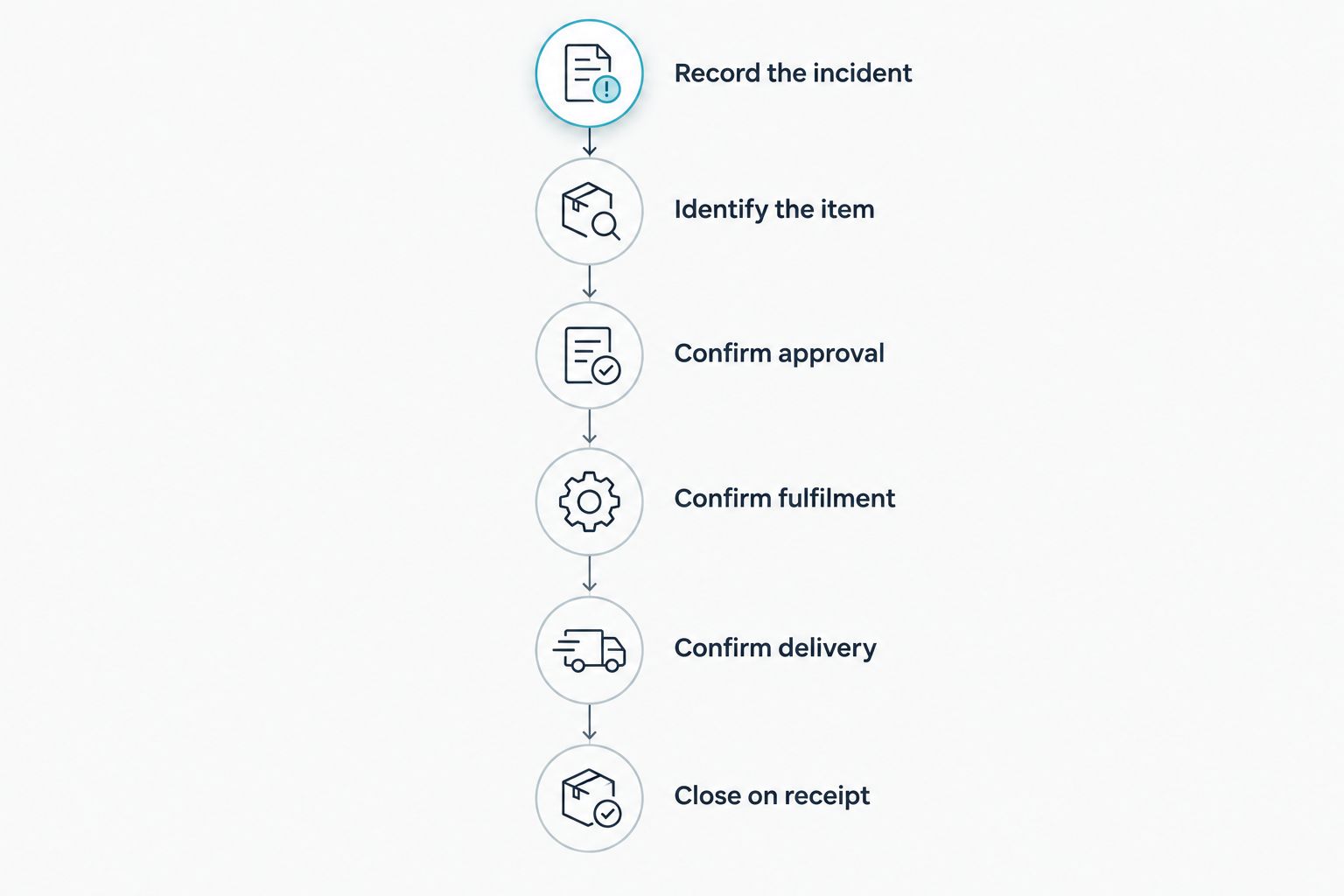
Use the following sequence to obtain a deadline you can act on:
- Record the incident. Capture whether the gear is lost or damaged, who used it and which operating location needs the replacement. Keep the report tied to one request reference.
- Identify the item. Confirm the SKU, size, branding version and delivery destination where those details apply. A general description such as courier jacket does not establish an exact replacement specification.
- Confirm approval. Name the person authorised to release the replacement. Ask whether damaged equipment requires inspection or return before fulfilment proceeds.
- Confirm fulfilment. Establish whether the request involves issuing an existing item or arranging manufacturing. Ask for the next milestone and its owner.
- Confirm delivery. Obtain the dispatch commitment, transport method and expected receipt date. Keep these as separate fields rather than one ambiguous completion date.
- Close on receipt. Record that the recipient received the correct item in usable condition. Keep the request open if the parcel arrived but the equipment does not match the requirement.
For a 2026 service agreement, ask the supplier to define exactly when its replacement clock starts and stops. A commitment measured from approval is not the same as one measured from the courier's initial report.
Lost gear: confirm the replacement specification first
For lost equipment, start with the item record rather than asking the courier to reconstruct every detail from memory. Use the previous issue record where your organisation maintains one, then check whether the replacement should match it or follow an updated specification.
Best for lost gear: an identifiable replacement request with a named approver. This gives the fulfilment team a defined instruction rather than an open-ended request to send something similar.
The advantage is a clear route from incident report to replacement. The limitation is that the original item cannot be inspected, so your team must establish the required specification through records and confirmation. Do not treat a description of the missing equipment as an approved substitute specification.
Keep any investigation into responsibility separate from the operational status. Your internal policy determines approval, but the request should still show who must decide next. An unresolved approval should appear as an unresolved approval—not as a delivery delay.
Damaged gear: establish whether inspection affects release
For damaged equipment, record the defect and ask whether the item needs inspection, return or another action before replacement. Photos can support the report, but they do not replace whatever acceptance process the responsible organisation requires.
Best for damaged gear: a defect record linked to the replacement request. Link the original item and the proposed replacement so the issue does not become two disconnected cases.
The advantage is that the damaged item provides evidence of what needs replacing. The limitation is an additional decision if inspection or return must precede release. Confirm whether that decision blocks fulfilment; do not assume that every damaged item follows the same route.
Do not return damaged equipment to use merely because a replacement is pending. Follow the relevant safety instructions and your organisation's procedure for assessing whether equipment remains suitable for its intended task.
Which replacement route fits the request?
Choose the route according to what the request actually requires. Loss and damage describe the incident; they do not, by themselves, establish whether the replacement is an unchanged issue, an approved alternative or a manufacturing order.
| Replacement route | Best for | Operational advantage | Limitation to resolve |
|---|---|---|---|
| Unchanged specification | Replacing a clearly identified item without a design change | Keeps the item definition consistent | Confirm the exact SKU, size and branding version |
| Approved alternative | Requests where a different specification is acceptable | Creates an explicit substitution decision | Obtain approval before treating the alternative as equivalent |
| New manufacturing | Equipment requiring production against an agreed specification | Makes the production requirement explicit | Separate manufacturing milestones from transport milestones |
| Inspection-led replacement | Damaged equipment requiring a condition assessment | Connects the defect decision to the replacement | Establish whether inspection blocks release |
An unchanged specification is not a delivery promise. Likewise, an approved alternative is not automatically suitable for the same task. Your acceptance criteria must cover the operational requirement, not just the appearance of the item.
For your 2026 replacement register, record the selected route beside the request status. That prevents a manufacturing request and a straightforward issue request from being assessed against an undefined common deadline.
Why courier gear replacement time varies
The relevant drivers follow the work required to design, manufacture, distribute and manage the equipment. Check these factors before accepting a completion date:
- Item definition. An exact specification gives the fulfilment team a clear instruction. Resolve questions about size, branding and equipment type before approving the request.
- Approval ownership. A request needs an authorised decision-maker. Record the approval requirement and make the next action visible to both operations and procurement.
- Manufacturing requirement. New production introduces work before distribution. Ask for production and dispatch commitments separately rather than accepting one undefined lead time.
- Distribution route. The delivery destination and transport arrangements belong in the request. For cross-border movements, establish who handles the relevant customs documentation and handovers.
- Receipt and acceptance. Delivery to a location does not confirm issue to the intended recipient. Specify who checks the item and records completion.
These factors give you a practical way to question an estimate without demanding an unsupported universal turnaround. Ask which stage determines the delivery date, what must happen before it and who owns that dependency.
If the answer changes, update the milestone rather than overwriting the original commitment. Keeping the initial and revised dates separate lets your team distinguish a changed requirement from a missed commitment.
What should your replacement request contain?
Write the request so someone outside the local courier team can fulfil it without interpreting informal messages. Keep the incident, equipment specification and delivery instruction together; separate conversations create separate versions of the requirement.
Your 2026 request template should include:
- Request reference: the identifier used across messages, records and shipment updates.
- Incident type: lost or damaged, with supporting information relevant to that case.
- Equipment details: item description, SKU, size and branding version where applicable.
- Approval owner: the person responsible for authorising the replacement.
- Recipient details: the intended recipient, delivery location and receiving contact.
- Required date: when operations needs the equipment, clearly distinguished from the supplier's confirmed date.
- Current milestone: the next action, its owner and its committed completion date.
- Acceptance record: confirmation that the correct equipment reached the recipient in usable condition.
The requested date expresses your operational need. The confirmed date expresses the supplier's commitment. Keep both fields: one must not silently replace the other.
When does an end-to-end partner fit?
Boolanga is best for enterprise teams seeking one partner for courier gear design, manufacturing, distribution and operations software. Its stated scope covers 35+ countries and 25+ enterprise clients, with a model that replaces 3–11 separate vendor relationships.
For a courier gear programme, that scope is relevant when your replacement process crosses several functions. Boolanga brings those functions into one partner relationship; your agreement still needs to define approval ownership, manufacturing requirements, delivery commitments and exception handling.
The benefit is consolidated responsibility across the equipment lifecycle. The boundary is contractual: Boolanga's operating scope does not, by itself, establish a turnaround for an individual replacement request. Ask for a written process that connects the incident report to receipt, including who communicates when a milestone changes.
Define your replacement process
Discuss courier gear requirements, approval ownership, manufacturing and distribution.
What if the replacement misses its confirmed date?
Escalate the unfinished milestone, not just the whole request. Ask whether approval, preparation, manufacturing or transport is blocking receipt, then request a revised commitment from the owner of that stage.
Keep the incident reference and equipment specification unchanged unless the requirement genuinely changes. If an alternative is proposed, obtain explicit acceptance before closing the original request. A different item is a new operational decision, not simply a new tracking update.
For a 2026 escalation procedure, define who contacts the supplier and who informs the courier team. One person should own the consolidated status, even when several functions contribute updates. Close the escalation only when the outstanding requirement is resolved—not when someone sends a progress message.
FAQ
How long does it take to replace lost courier gear?
The timeline runs through item identification, approval, fulfilment and delivery. Use the confirmed receipt date for your specific request, and check when the supplier starts measuring its commitment.
Is damaged courier gear replaced through the same process as lost gear?
Damaged courier gear needs a defect record and confirmation of any inspection or return requirement. The remaining approval, fulfilment and delivery stages still need named owners and dates.
Can I use the dispatch date as the replacement completion date?
The dispatch date is not the replacement completion date. Close the request when the intended recipient receives and accepts the correct equipment in usable condition.
What details should I send when I request replacement courier equipment?
Send the incident type, equipment specification, approval owner and delivery details under one request reference. Include the SKU, size and branding version where applicable, and distinguish your required date from the confirmed delivery date.
Should I accept an alternative item if the original replacement is delayed?
Accept an alternative only after the responsible person confirms that it meets the operational requirement. Record the approved specification and do not treat a similar appearance as proof of equivalent suitability.
Does an end-to-end equipment partner guarantee a replacement deadline?
An end-to-end scope does not establish a replacement deadline by itself. Your agreement must define the relevant milestones, delivery commitment, responsibilities and exception process.
One last thing
A delivered parcel can still leave a replacement request unresolved. The wrong size, specification or recipient means the operational requirement remains open even when transport is complete.
Make acceptance—not dispatch—the final milestone. Ask the recipient to confirm the item against the request, then record the issue as closed. That small distinction keeps your replacement reporting aligned with usable equipment rather than shipment activity.


