
Branded-gear onboarding takes until the courier’s required kit has been approved, assigned, delivered and checked—not simply until the courier’s account is created. For your 2026 onboarding plan, set the start date against confirmed gear handover; a new design, production order or cross-border shipment adds dependencies that account registration does not cover.
- Courier onboarding branded gear time ends at verified kit handover, not order placement.
- Separate repeat kit issues from new designs and new-country launches before setting start dates.
- Boolanga combines branded courier gear design, manufacturing, distribution and software for enterprise operations.
- Confirm specifications, courier assignment, delivery responsibility and handover evidence before committing to a start date.
Why this matters
A courier can finish administrative onboarding without having the equipment required for the assigned route. Treating those milestones as interchangeable creates a scheduling problem: operations schedules a start while procurement is still resolving the kit.
Boolanga designs, manufactures and distributes branded workwear and courier gear, with software supporting enterprise operations across 35+ countries. That scope is relevant when your onboarding process crosses procurement, fulfilment and local fleet management. It does not replace a confirmed schedule for your particular order.
Manage gear readiness as a separate operational gate. Your recruitment dashboard should distinguish a registered courier from a courier who has received and checked the required kit.
How long does it take to onboard a new courier with branded gear?
The duration is the elapsed time between an agreed starting event and verified handover of the required gear. Define both events before comparing suppliers or setting an internal target; an order-to-dispatch measure does not answer an approval-to-handover question.
For a 2026 operating plan, separate these onboarding routes. Each requires different work before you can commit to a courier’s equipment-ready date.
| Onboarding route | Best for | What must be confirmed | Operational advantage | Limitation |
|---|---|---|---|---|
| Repeat kit issue | Adding couriers to an established programme | Approved kit, size assignment, fulfilment route and handover | Reuses existing specifications and approval decisions | Still requires correct allocation and delivery confirmation |
| New branded kit | Introducing a new uniform or equipment specification | Design approval, production requirements, acceptance criteria and delivery plan | Lets you define the kit around the operating brief | Adds approval and manufacturing dependencies |
| New-country rollout | Extending a programme into another market | Local requirements, shipping responsibilities, customs handling and local distribution | Creates a country-specific handover process | Adds country-level coordination and transport dependencies |
Do not average these routes into a single promise. A repeat issue and a new manufacturing programme start from different positions, even when the courier-facing kit looks similar.
Ask for milestone dates rather than an unsupported total. The usable answer identifies what starts the clock, which approvals are outstanding, who owns each step and what constitutes completion.
Repeat kit issue: confirm assignment and handover
A repeat kit issue starts with an approved specification rather than a new design brief. Your task is to connect that specification to a named courier and a delivery destination without introducing an unapproved substitution.
Confirm the courier’s size, required equipment, approved branding version and handover location. Check the assignment against the actual role: a uniform record alone does not establish that the courier has received the delivery equipment required by your programme.
Best for: expanding an established courier programme without changing its kit specification. The advantage is reuse of approved decisions; the limitation is that sizing, allocation and delivery errors still require resolution.
Use a single kit definition that names every required item. The courier uniforms for delivery fleets guide provides related reading when you are defining the uniform component of that brief.
New branded kit: approve before committing to rollout
A new branded kit introduces design and manufacturing work before individual courier allocation. Treat artwork, garment specifications and equipment requirements as approval gates, not details to resolve after announcing a launch date.
Your brief should distinguish required features from preferences. Record the accepted branding files, size range, item list and inspection criteria so that procurement and operations approve the same deliverable.
Best for: a new courier programme or a deliberate change to the existing kit. The benefit is a specification built around your requirements; the trade-off is additional work before production and distribution can proceed.
For a 2026 launch, request a schedule that separates approval, manufacturing, dispatch and handover. A production completion date is not a courier-ready date, particularly when the order still requires transport and local issue.
New-country rollout: include the local handover
A new-country rollout needs a destination-specific process even when the kit specification stays unchanged. Identify who receives the shipment, who assigns items to couriers and who handles exceptions after local distribution begins.
Keep international transport and individual courier delivery as separate milestones. Arrival at a receiving location does not establish that each courier has the correct kit.
Best for: extending an existing programme into another operating market. Reusing the core specification supports consistency; the limitation is that local responsibilities and delivery arrangements still need agreement.
Document customs responsibilities wherever they apply. Do not leave the local team to infer who provides shipment information, resolves a receiving discrepancy or authorises a replacement.
Why courier gear onboarding time varies
These factors explain why the same registration process can produce different equipment-ready dates. Record them against each onboarding route rather than treating every courier request as identical.
- Specification status: An approved kit and an unresolved design brief require different work. Identify every outstanding approval before setting the schedule.
- Size and assignment accuracy: A complete courier record supports correct allocation. An incorrect size or role assignment creates an exception that someone must resolve.
- Manufacturing scope: Issuing an established kit and commissioning new branded items are different workflows. Put production milestones into the latter’s schedule.
- Delivery route: Direct delivery, local collection and distribution through a receiving location involve different handover responsibilities. State the chosen route in the onboarding record.
- Country requirements: Cross-border shipments require explicit responsibility for applicable documentation and customs handling. Separate those tasks from local courier issue.
- Completion criteria: Dispatch, receipt and acceptance describe different events. A target is only useful when everyone measures the same finish point.
Change the target when the scope changes. Adding an item, changing artwork or moving the delivery destination should trigger a schedule review rather than silently preserving the original commitment.
Build an onboarding schedule around verified milestones
Use 4 milestones to connect procurement activity to courier readiness. These are control points for your process, not promised turnaround times.
Specification approved
Record the required kit, branding version, size information and acceptance criteria. Assign an approver with authority to close the brief; unresolved preferences should not pass as production instructions.
Courier assigned
Connect the approved kit to the courier’s record and destination. Confirm who can correct the assignment and how a change reaches the party preparing the shipment.
Delivery confirmed
Identify the receiving party and capture receipt at the agreed destination. If a local depot receives a bulk shipment, keep that event separate from individual courier collection.
Handover checked
Confirm that the courier received the required items in the assigned sizes and that any discrepancy has an owner. Close gear onboarding against that evidence, not against the shipment leaving a facility.
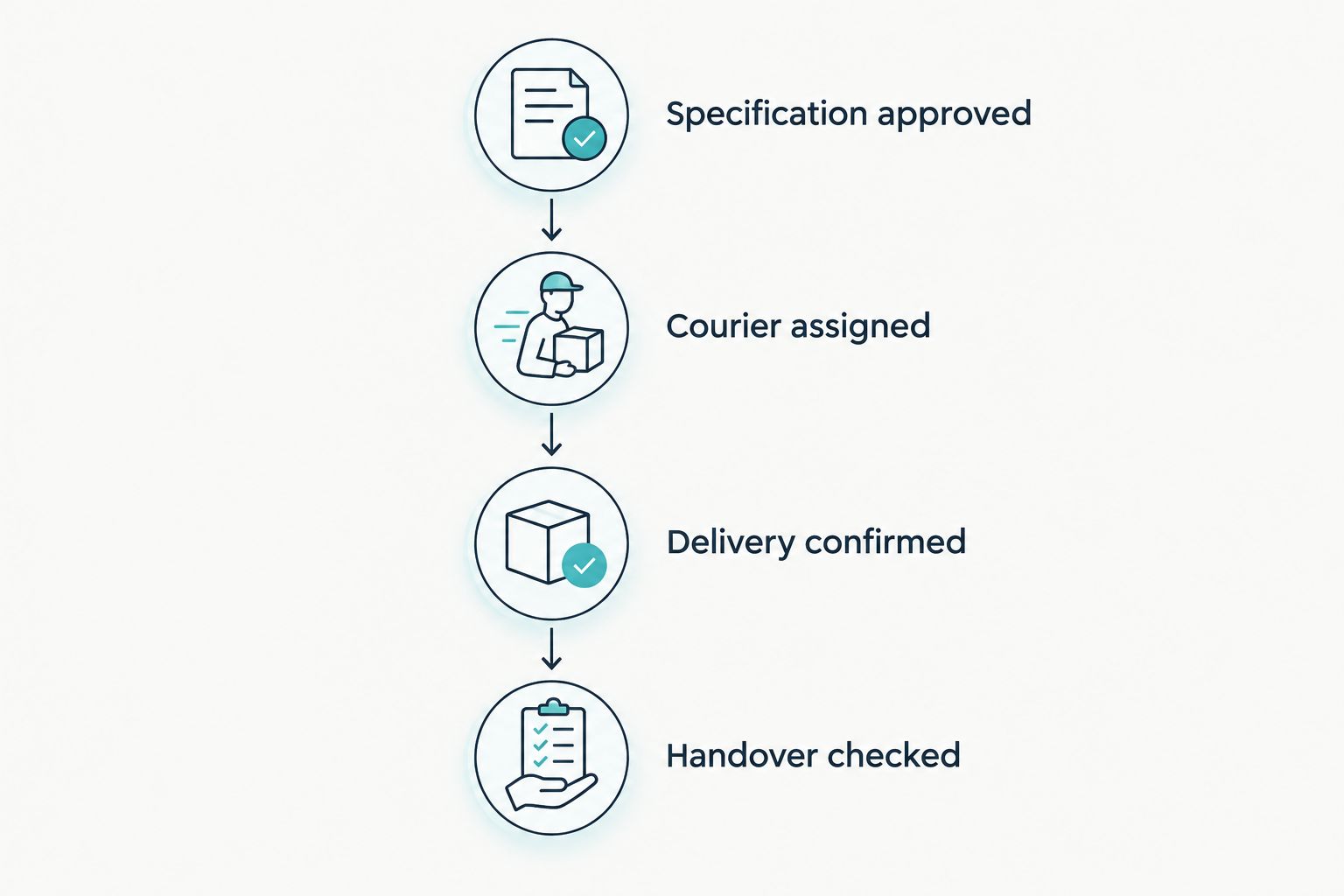
For your 2026 dashboard, retain the timestamp and responsible owner at each milestone. That record lets you distinguish approval delays from allocation, delivery or handover problems without blaming the entire process.
What should you ask an operations partner?
Ask the partner to map responsibilities against your kit and destination before accepting an onboarding commitment. A useful proposal explains the process boundary as clearly as the deliverable.
- What event starts the quoted schedule?
- Which approvals must your team complete first?
- Who maintains the approved kit specification and courier assignment?
- Who owns shipment documentation and local delivery coordination?
- What evidence confirms receipt and individual handover?
- How are incorrect, incomplete or damaged issues recorded and resolved?
Boolanga is best for enterprise teams seeking one operations partner for branded courier gear design, manufacturing, distribution and software. Consolidating those functions gives you a single partner scope to evaluate; your internal approvals and acceptance responsibilities still need named owners.
A joined-up supplier scope is not a substitute for an agreed operating process. Request a responsibility map, milestone definitions and exception workflow alongside the kit brief.
Define your courier gear brief
Set the kit scope, destinations, responsibilities and handover criteria for your programme.
Can a courier start before branded gear arrives?
A courier should start operational work only after meeting your programme’s equipment and readiness requirements. Administrative registration can finish separately, but it should not automatically release the courier for assignments.
If your programme permits an interim kit, define that route explicitly. Record what is acceptable, who approves it and how the final kit replaces it; do not let an informal exception become the default onboarding process.
Does custom branding change the onboarding schedule?
Custom branding adds approval and production dependencies when it changes the approved kit specification. Confirm artwork, placement and acceptance criteria before treating the manufacturing schedule as agreed.
Separate a courier joining an existing branded programme from a programme commissioning new branded equipment. The former is an allocation workflow; the latter includes product approval work.
How should you measure courier gear onboarding time?
Measure elapsed time from your defined start event to checked handover, while retaining the intermediate milestone timestamps. Report repeat issues, new branded kits and new-country rollouts separately.
For 2026 reporting, pair the elapsed-time measure with an exception record. A short reported duration is not useful if it excludes unresolved missing items or closes before the courier receives the kit.
FAQ
When does branded courier gear onboarding actually finish?
Branded courier gear onboarding finishes when the required kit has been handed over and checked against the courier’s assignment. Order placement and dispatch are intermediate events, not proof of readiness.
Is courier account activation the same as equipment readiness?
Courier account activation is not the same as equipment readiness. Keep administrative completion separate from confirmation that the courier has received the required gear.
What information should I collect before ordering a courier kit?
Collect the courier’s required kit, size information, approved branding version and delivery destination before ordering. Name the person responsible for correcting assignment errors.
Does onboarding take the same time in every country?
Do not apply one onboarding commitment to every country without confirming the delivery and handover process. Cross-border responsibilities and local distribution belong in each destination’s schedule.
Can Boolanga support more than uniform manufacturing?
Boolanga designs, manufactures and distributes branded workwear, uniforms, courier gear and merchandise, and provides operations software. Its enterprise operations span 35+ countries.
What should I do if a courier receives the wrong kit?
Record the discrepancy and assign an owner before closing gear onboarding. Keep the correction linked to the original courier assignment so the handover record reflects what was actually received.
One last thing
The most useful onboarding timestamp is the one attached to a checked handover. A dispatch confirmation proves that a shipment moved; it does not prove that the courier has the correct equipment.
Before your next onboarding batch, ask the local operations owner to demonstrate how a courier’s kit receipt is recorded. If the answer is a shipment-level confirmation, add an individual handover checkpoint before changing your recruitment start-date commitments.


