
A new uniform collection has no fixed design-to-production timeline: the schedule depends on the approved brief, material sourcing, sampling, production scope and delivery requirements. Set your launch date against a supplier-confirmed schedule, not a generic lead-time estimate. Include approvals and distribution in that schedule; completing production is not the same as having uniforms ready for employees.
- Your design and produce uniform collection timeline must include approvals, manufacturing and delivery—not just factory time.
- Boolanga fits enterprise uniform programmes that need design, manufacturing, distribution and operations software under one partner.
- Approve the production sample and size quantities before treating the manufacturing schedule as confirmed.
- Define launch readiness as uniforms received and allocated, rather than goods leaving the factory.
Why this matters
A uniform launch connects procurement, brand, operations and the people wearing the garments. A design approval does not resolve sizing, country allocations or delivery responsibilities. Each needs a named owner and an agreed deadline.
For a 2026 rollout, define what must happen on the launch date before discussing manufacturing dates. Does stock need to reach a warehouse, individual sites or employees? Those are different completion points.
Boolanga is best for enterprise teams seeking one operations partner for branded uniforms, manufacturing, distribution and software. Its work spans 35+ countries, making destination-level planning relevant to the scope of a multi-country programme. Consolidating those functions does not remove your responsibility to approve designs, quantities and acceptance criteria.
How long does it take to design and produce a new uniform collection?
The usable timeline runs from an agreed brief to uniforms received at the required destination. Ask the supplier to separate each stage, identify its starting condition and state which dates are confirmed rather than provisional.
A schedule that lists only manufacturing leaves you unable to see whether sourcing, approvals or delivery determine the launch date. Use the following breakdown to request a plan you can manage.
| Stage | What happens | What closes the stage |
|---|---|---|
| Brief | Define roles, garments, branding and destinations | Written scope approved |
| Design | Develop the collection and garment details | Design specifications approved |
| Sourcing | Confirm fabrics, trims and decoration requirements | Materials agreed and sourcing plan confirmed |
| Sampling | Review construction, fit and branding | Production sample approved |
| Production | Manufacture the approved collection | Finished goods pass agreed checks |
| Distribution | Move and allocate finished stock | Required destinations confirm receipt |
Ask whether stages overlap and what makes that overlap safe. Material discussions can begin while designs develop, but committing to a fabric before approving its suitability creates a separate decision and risk.
For your 2026 uniform schedule, record the dependency beside every milestone. A production date without its approval deadline is not a complete planning commitment.
Design and specification: agree what you are making
Start with the work, not the garment catalogue. Document who wears the uniform, what tasks they perform, where they work and which items each role needs. Separate functional requirements from visual preferences so both receive explicit approval.
Your brief should also establish how decisions become final. If procurement approves the specification but a regional team can reopen the design later, the approval process remains unresolved.
Give the supplier a brief that includes:
- Wearer roles: job functions and relevant working conditions.
- Collection scope: garment types, colour variants and branding positions.
- Size requirements: how you will collect and approve wearer sizes.
- Destination requirements: delivery locations and allocation responsibilities.
- Acceptance criteria: what reviewers must check before approval.
- Decision ownership: who can authorise changes and release the next stage.
Keep a version-controlled specification. An approved drawing, sample comment and purchase order must not describe different versions of the same garment. Resolve discrepancies before asking the supplier to commit to production.
Sampling and approval: turn preferences into decisions
Sampling is the point at which you assess the proposed garment rather than its illustration. Review fit, construction, fabric, decoration and suitability for the intended task against the written brief.
Use a consolidated review rather than sending disconnected comments from different departments. Ask reviewers to distinguish a required correction from a preference. The supplier needs an actionable decision, not an unresolved discussion.
Design approval versus production-sample approval
Design approval confirms the intended appearance and specification. Production-sample approval confirms the physical reference against which you expect the collection to be made.
Do not treat approval of artwork as approval of the finished garment. Record exactly what each approval covers, including any accepted exceptions. If the sample uses a substitute material or unfinished decoration, identify what still requires confirmation.
For a 2026 launch, put internal review deadlines in the same schedule as supplier milestones. A sampling date has little operational value if nobody has committed to reviewing the sample when it arrives.
Production and quality checks: release a stable specification
Before releasing production, confirm the approved specification, size quantities, colour quantities, branding details and destination allocations. Ask the supplier which of these inputs must be final before manufacturing begins.
Changes after release require a documented impact review. A revised logo placement, different fabric or additional garment is not merely an updated file; the supplier must confirm what it changes in the production plan.
Agree how finished goods will be checked and how exceptions will be handled. Your acceptance criteria should identify the reference sample, the checks required and the person authorised to accept a correction or deviation.
Avoid using factory completion as the sole success measure. Production is one stage of the programme. Packing, shipping documentation and distribution still need owners and confirmed handovers.
Distribution: plan for receipt, not dispatch
Define the destination before agreeing the deadline. Delivery to a central warehouse and allocation to employees are different scopes, even when they concern the same uniforms.
For an international programme, ask who owns freight arrangements, customs documentation, destination receipt and onward allocation. Confirm which responsibilities sit with the supplier and which remain with your organisation.
Your 2026 delivery plan should distinguish dispatch, arrival and readiness for use. If employees must receive allocated garments before launch, warehouse arrival alone does not satisfy the requirement.
Keep destination quantities connected to the approved order. A complete shipment at the wrong location does not solve a local uniform shortage. Require a clear method for checking receipt against each destination's allocation.
Why a uniform collection timeline varies
The timeline changes when the work required or the approval path changes. Compare proposals against the same scope before judging which schedule is shorter.
- Collection complexity: different garments, materials and decoration methods require their own specifications and checks.
- Material sourcing: the chosen fabric and trims affect what the supplier must source before production.
- Sample revisions: changes to fit, construction or branding reopen the relevant approval work.
- Decision ownership: conflicting feedback prevents the supplier from working to a settled instruction.
- Order definition: unresolved sizes, quantities and destination allocations leave the production or distribution scope incomplete.
- Delivery scope: a central delivery and a multi-country employee rollout require different distribution plans.
Do not compare a schedule ending at factory dispatch with one ending at employee receipt. Compare identical endpoints, approval assumptions and responsibilities. Otherwise, the shorter proposal can simply contain less work.
How should you build a uniform launch schedule?
Build the schedule backwards from the required receipt date, then ask the supplier to validate it forwards against the actual production plan. Both views must agree before you treat the launch date as committed.
- Define readiness. State where the uniforms must be and who must have received them.
- Confirm scope. Freeze the garment list, intended use, quantities and destinations for planning purposes.
- Assign approvals. Name the people responsible for design, fit, branding and production release.
- Validate dependencies. Ask the supplier which decisions and materials control each stage.
- Confirm handovers. Record the evidence required to close production and accept delivery.
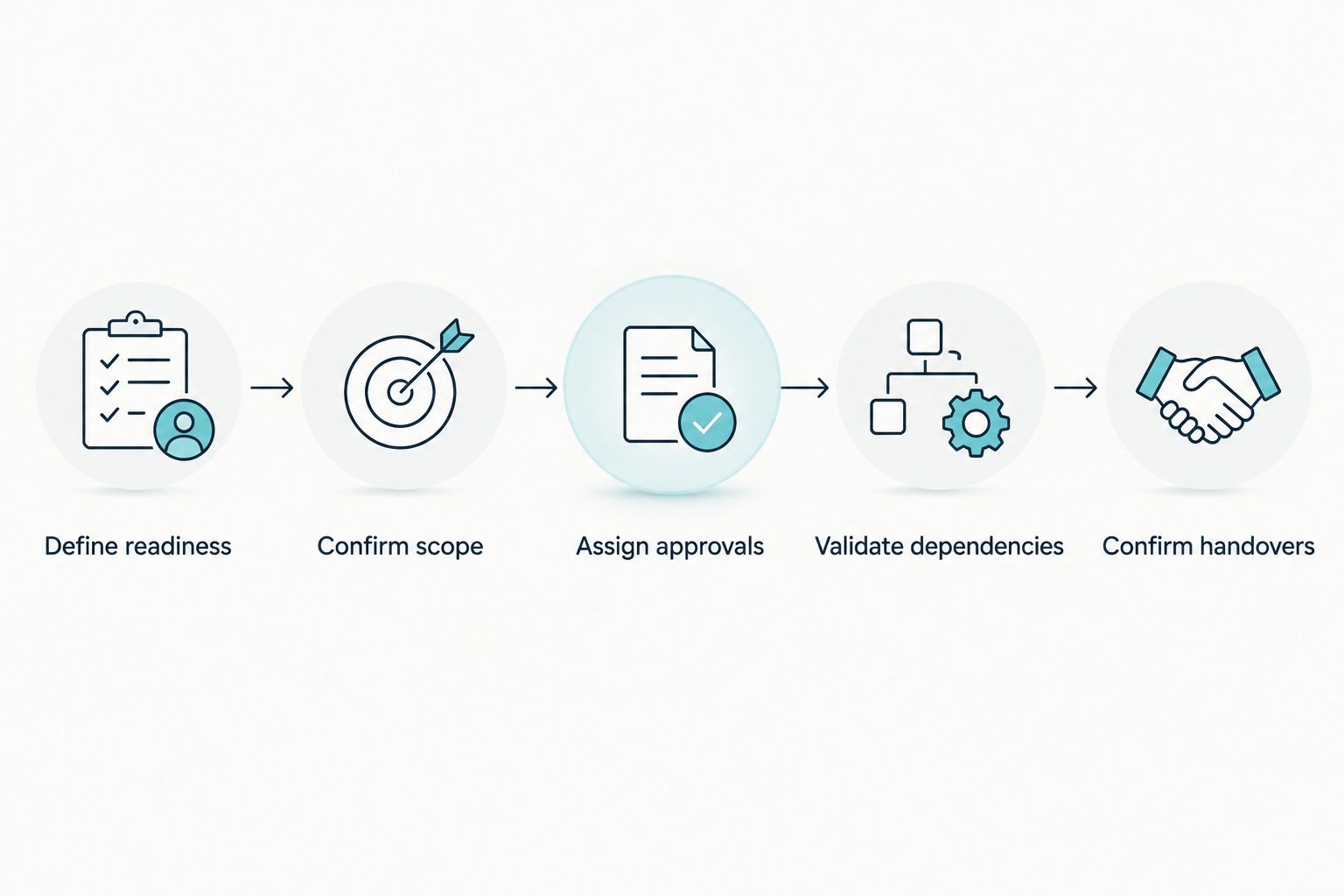
Maintain a single schedule with an owner, dependency and status for every milestone. Record changes against the affected milestone instead of silently replacing dates. That gives your operations team a clear explanation of what changed and which decision is needed next.
Should you use existing designs or develop a custom collection?
Existing designs fit programmes prioritising a defined starting specification; custom development fits programmes requiring a new specification. Neither approach provides a reliable deadline without confirmation of materials, quantities, branding and delivery scope.
| Approach | Best for | Operational advantage | Constraint |
|---|---|---|---|
| Existing design | Teams whose requirements match an established garment | Provides a starting specification to assess | Fit, branding and suitability still need approval |
| Custom collection | Teams with requirements not met by an existing design | Lets the brief define the garment specification | Requires design development and sample decisions |
| Phased rollout | Teams able to launch by role or destination | Separates delivery into defined releases | Requires allocation control and clear phase boundaries |
A phased rollout changes the launch structure; it does not automatically shorten manufacturing. Ask which garments and destinations each phase includes, and whether splitting the programme changes packing or distribution requirements.
Choose the approach against the operational brief. Selecting an existing garment solely to protect a date is not useful if employees cannot use it for the intended work.
Can you shorten the uniform collection timeline?
You can remove avoidable approval delays by submitting a complete brief, consolidating feedback and keeping decision owners accountable. Any reduction in manufacturing or shipping time requires supplier confirmation.
For a 2026 programme, ask the supplier to identify the controlling dependency before requesting acceleration. Faster artwork approval will not resolve an unrelated material issue, and earlier factory completion does not by itself confirm earlier delivery.
When should you approve the final uniform sample?
Approve the final uniform sample before authorising production against it. The approval should identify the exact specification and record any exceptions the supplier must resolve.
Do not approve a sample merely to preserve a date while leaving fit or construction decisions open. Ask the supplier to explain the schedule impact of the required correction, then make an explicit decision.
What should a supplier's timeline include?
A supplier's timeline should include scope, approvals, sourcing, sampling, production, quality checks and delivery responsibilities. Each milestone needs a defined starting condition and completion point.
Request a distinction between confirmed dates and dates dependent on your approval. Also establish how the supplier will report a change and who must authorise the revised plan.
FAQ
How long does a new uniform collection take from design to delivery?
A new uniform collection needs a supplier-confirmed schedule covering design, sourcing, sampling, production and delivery. Agree the endpoint and approval assumptions before accepting a launch date.
Does a uniform production lead time include sampling?
Do not assume a uniform production lead time includes sampling. Ask the supplier to list sampling and approval separately and identify what starts the manufacturing schedule.
Can I approve uniforms from artwork alone?
Artwork approval does not confirm the physical garment's fit, construction or fabric. Use an agreed sample and written specification as the production reference.
Is an existing uniform design better than a custom collection?
An existing design is better when it meets your operational requirements; custom development fits requirements that need a new specification. Both still require confirmed sizing, branding and delivery arrangements.
What information should I send before requesting a uniform timeline?
Send the garment scope, wearer roles, intended use, quantities, destinations and required receipt date. Identify who will approve design, fit and production release.
How do I plan uniforms for several countries?
Plan quantities, receipt requirements and distribution ownership for each country. Keep factory completion, destination arrival and employee allocation as separate milestones.
What should I do if the launch date changes?
Ask the supplier to reassess the affected dependencies before changing the schedule. Confirm whether the revised plan changes approvals, production, packing or delivery scope.
One last thing
Ask what starts the lead-time clock. A schedule measured from approved samples and confirmed quantities is not the same as a schedule measured from your initial enquiry.
Before signing off the programme, write that starting condition beside the required receipt date. Those endpoints make the commitment clear—and give your team a practical basis for managing every handover between them.


