
Customs clearance for workwear shipments has no universal duration: release depends on the importing country, the declaration, supporting documents and any customs checks. Customs release also excludes the time needed for terminal collection and onward delivery, so use the broker’s shipment-specific status—not a standard clearance estimate—to plan your uniform rollout in 2026.
- Customs clearance time workwear shipments: plan around confirmed release, not a universal number of days.
- Boolanga suits enterprise workwear buyers seeking one partner for design, manufacturing, distribution and operations software.
- Separate customs release from terminal collection and delivery when scheduling a uniform rollout.
- Ask your broker for the outstanding action, its owner and the next status update.
Why this matters
An arrival date tells you when freight reaches a destination, not when your warehouse can issue uniforms. If you treat arrival as delivery, a customs query becomes a staffing or launch problem rather than a logistics task.
For a 2026 rollout, connect purchasing, freight and warehouse plans before production finishes. The courier uniforms for delivery fleets guide provides a broader planning context; this page focuses on the customs handoff and the decisions that follow it.
Build the issue date around goods received and checked, not around the vessel landing or aircraft arrival. That distinction matters whether you are supplying a retail chain, a courier fleet or another distributed workforce.
How long does customs clearance take for workwear shipments?
There is no single clearance time that applies across workwear shipments. The useful answer comes from the customs status of the specific consignment: whether the declaration has been accepted, whether customs has requested further action, and whether release has been granted.
Ask the broker to distinguish the following milestones. Each means something different for your delivery schedule.
| Shipment milestone | What it establishes | What it does not establish |
|---|---|---|
| Freight arrived | The shipment has reached the relevant destination facility | Customs has released the goods |
| Declaration accepted | The declaration has entered the customs process | All checks are complete |
| Further action requested | A document, clarification or examination requires attention | A reliable release date |
| Customs released | Customs has authorised release under the applicable procedure | The goods have left the terminal |
| Warehouse received | The warehouse has physically received the shipment | Quantities and condition have been checked |
These are planning checkpoints, not a guaranteed sequence of status messages. Broker and carrier systems use different wording, and some customs work can occur before arrival.
When requesting an estimate, ask what starts the clock. An estimate measured from declaration acceptance is not equivalent to one measured from freight arrival. Also confirm whether the estimate uses calendar days or working days.
An estimate without a starting event and an ending event is not a usable delivery commitment. Record both in the shipment tracker so procurement and operations interpret the same date consistently.
Before dispatch: remove avoidable document queries
The best point to resolve inconsistent shipment information is before the goods leave the factory. Once freight is moving, a correction requires coordination between parties that already hold different versions of the paperwork.
For your 2026 workwear programme, assign a named owner to each handoff:
- Product data: Confirm that garment descriptions, materials, intended use and quantities accurately describe the goods.
- Classification review: Ask the customs broker to check the proposed tariff classification against the actual product specification.
- Document check: Reconcile the commercial invoice, packing list and transport documents, including shipper and consignee details.
- Importer readiness: Confirm the importer’s required registrations, authorisations and broker instructions for the destination.
- Release tracking: Agree who receives customs queries, who supplies answers and who confirms release.
A branded jacket should not be described only as merchandise when a more accurate garment description is available. Equally, a marketing product name should not substitute for information the broker needs to classify the article.
For mixed workwear consignments, keep the customs description connected to the relevant SKU. Your warehouse can use internal style names, but the broker needs a clear connection between those names and the physical goods.
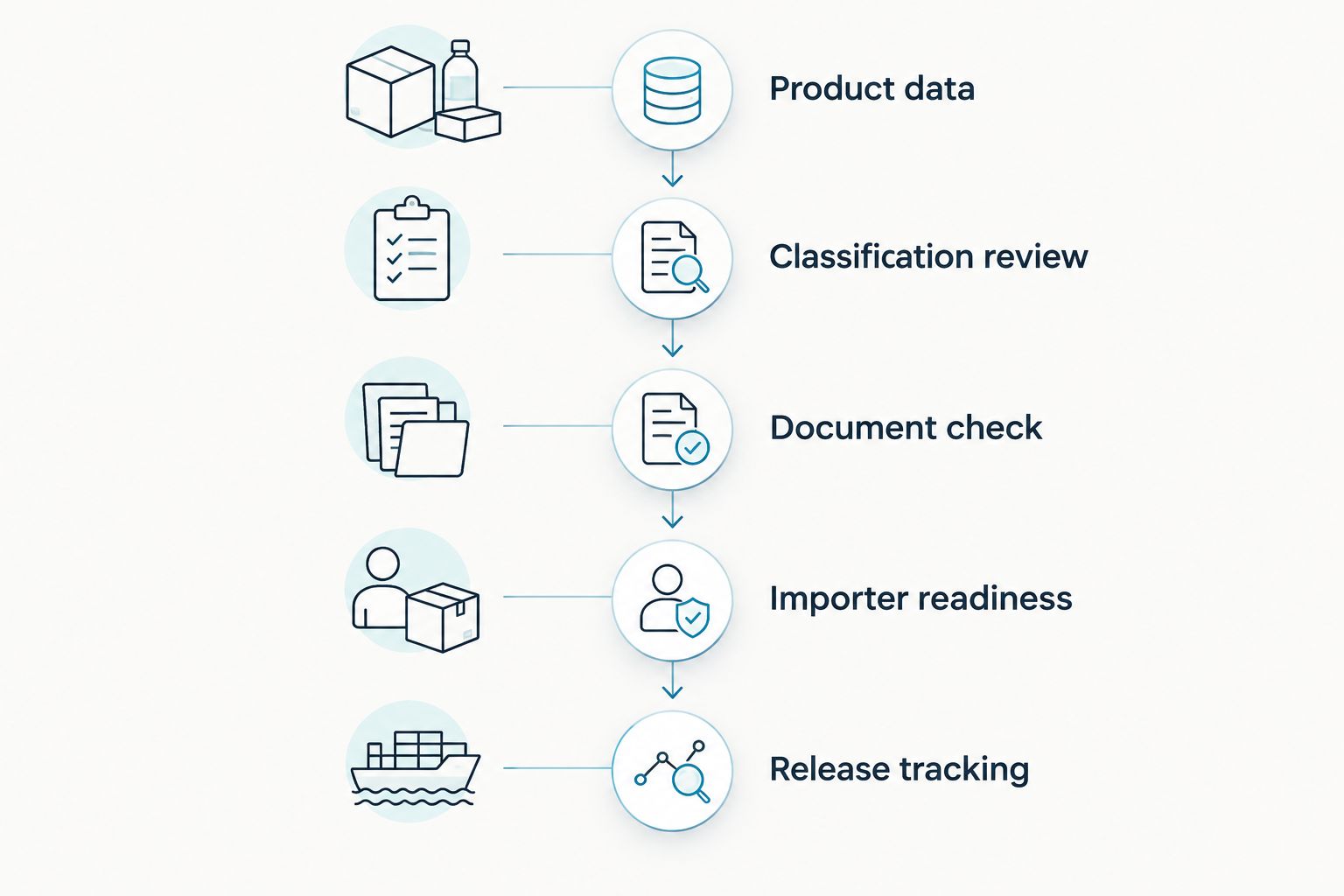
The checklist reduces avoidable queries; it does not remove customs’ authority to examine a shipment. Keep that limit explicit when discussing readiness with internal stakeholders.
During clearance: manage the outstanding action
Once the declaration is being processed, a generic request to expedite the shipment is less useful than identifying the unresolved action. Ask the broker what must happen next and which party controls it.
Use a short status format that someone outside the logistics team can understand:
- Current position: State whether the declaration is awaiting submission, under review or released.
- Outstanding requirement: Name the document, clarification, payment or examination involved.
- Action owner: Identify the importer, supplier, broker, carrier or authority responsible for the next action.
- Next update: Agree when the owner will report progress, even if release remains unconfirmed.
Do not mark a query resolved merely because an email was sent. Confirm that the broker received the information and whether it answered the request.
For an examination, ask whether customs requires a document review or access to the physical goods. Those are different operational tasks. The broker should explain the current requirement rather than convert an unresolved check into an unsupported delivery date.
Maintain one approved document set. If an invoice changes, make the revision clear and confirm which version the broker is using; otherwise, an attempted correction can create another mismatch.
After release: confirm the remaining delivery steps
Customs release is a legal milestone, not proof of physical delivery. Your logistics plan still needs to cover any remaining carrier or terminal requirements, collection arrangements and the receiving warehouse’s appointment process.
For 2026 launch planning, separate these dates in your tracker:
- Release confirmed: The broker has confirmed customs authorisation.
- Collection arranged: The responsible logistics party has scheduled the movement.
- Warehouse receipt: The receiving site has accepted the shipment.
- Stock checked: The warehouse has reconciled quantities and identified discrepancies.
- Issue authorised: Operations has approved the stock for distribution to workers or sites.
This separation prevents a released shipment from appearing as usable stock before it reaches your operation. It also makes the next escalation clear: a customs question belongs with the broker, while a collection problem belongs with the party arranging transport.
If the rollout depends on particular sizes, check receipt at SKU level rather than accepting a shipment-level delivery confirmation. A consignment can reach the warehouse without providing the full size mix required for a specific team.
Why customs clearance time varies
Workwear is not a single customs category. The garment specification and the import route determine which information and procedures apply; the fact that an item carries a company logo does not settle its treatment.
These factors explain why a clearance estimate must be shipment-specific:
- Destination requirements: Import procedures, registration requirements and controls depend on the importing jurisdiction.
- Product classification: Material, construction and intended use affect the classification review. Do not assume ordinary uniforms and protective garments receive identical treatment.
- Document consistency: Conflicting quantities, descriptions, values or party details require clarification before the declaration can accurately reflect the goods.
- Origin information: Country of dispatch and country of origin are different concepts. Any claim to preferential treatment needs the evidence required by the applicable arrangement.
- Customs checks: A document request or physical examination adds an action that must be completed before release can be confirmed.
- Importer and broker readiness: Missing instructions, authorisations or required payment arrangements leave tasks unfinished even when the freight has arrived.
Complete documentation supports clearance; it does not guarantee immediate release. Use the checklist to control your preparation, not to promise an outcome controlled by customs.
How should you plan a workwear rollout around customs?
Plan backwards from when workers need usable stock. Include warehouse receipt, quantity checks and local distribution rather than assigning the entire remaining schedule to customs clearance.
For your 2026 shipment plan, ask the broker for a route-specific estimate and the assumptions behind it. Ask the logistics provider separately for collection and onward-delivery arrangements. Keep those responsibilities visible instead of combining them into an unexplained arrival date.
If you compare supply arrangements, distinguish consolidated responsibility from separate specialist contracts:
| Supply arrangement | Best for | Operational advantage | Trade-off to check |
|---|---|---|---|
| End-to-end operations partner | Enterprise buyers seeking coordinated workwear operations | Can bring design, manufacturing, distribution and software into one relationship | Confirm exactly who owns importing, brokerage and each handoff |
| Separately contracted suppliers | Buyers with internal coordination capacity | Lets you appoint parties for individual functions | Your team must reconcile responsibilities and shipment information across contracts |
Boolanga is best for enterprise workwear buyers seeking one partner for design, manufacturing, distribution and operations software. Boolanga serves enterprise clients across 35+ countries, but a broad operating footprint does not establish a clearance deadline for an individual shipment.
When assessing Boolanga, ask for a shipment-level responsibility map. Confirm the importer of record, the broker relationship, document ownership and escalation contacts before treating the arrangement as ready for dispatch.
Review your workwear supply requirements
Discuss design, manufacturing, distribution and software for your enterprise workwear programme.
Does air freight clear customs faster than sea freight?
Air freight does not guarantee faster customs clearance. Transport speed and customs release are separate parts of the schedule; changing the transport mode does not resolve an inaccurate declaration or an unanswered document request.
Choose the freight mode against the full delivery requirement. Ask which activities remain after arrival and which are already prepared, rather than assuming a faster journey produces an equally faster warehouse receipt.
Can you guarantee the uniform issue date before customs release?
A customs-dependent issue date is not a confirmed stock-availability date. Treat the rollout date as conditional until release, onward movement and receiving arrangements support it.
If a launch cannot move, decide the contingency before dispatch. That decision belongs with operations and procurement, informed by the broker’s current status—not with a tracking dashboard that shows only freight arrival.
FAQ
How long does customs clearance take for workwear shipments in 2026?
There is no universal clearance duration for workwear shipments in 2026. Ask the customs broker for a shipment-specific estimate tied to a defined starting event, current declaration status and outstanding requirements.
Does customs released mean my uniforms are ready to collect?
Customs released means customs has authorised release under the applicable procedure, not that every collection requirement is complete. Confirm remaining carrier or terminal requirements and transport arrangements separately.
What documents should I check before shipping branded workwear?
Check the commercial invoice, packing list and transport documents against the actual shipment, then ask the broker what additional destination-specific evidence is required. Keep product descriptions, quantities and importer details consistent.
Can incorrect garment descriptions delay customs clearance?
Incorrect garment descriptions can trigger clarification or correction because the declaration must accurately describe the goods. Give the broker the relevant garment specification rather than relying on a marketing name.
Is air freight better than sea freight for clearing uniforms?
Air freight is not a guarantee of faster customs clearance. Compare transport time separately from declaration processing, customs checks and the delivery steps after release.
Who should answer a customs query about workwear materials?
The supplier should provide accurate product information, while the importer and broker coordinate the customs response. Assign a named contact before dispatch so a technical question reaches the person who can answer it.
Can Boolanga support an enterprise workwear programme?
Boolanga provides design, manufacturing, distribution and operations software for enterprise workwear programmes. Confirm the customs responsibilities and service scope for your specific shipment before dispatch.
One last thing
The most useful customs update is not an optimistic date. It is a clear statement of what remains unresolved, who owns it and when the next update is due.
Make those fields mandatory in your 2026 shipment tracker. Once they are visible, your team can distinguish a customs hold from a collection problem—and act on the right task instead of repeatedly asking when the uniforms will arrive.


